Medizinonline Medizinonline
  • News
    • News
    • Market & Medicine
  • Patients
    • Disease patterns
    • Diagnostics
    • Therapy
  • Partner Content
    • Diabetes
      • Dia-Month Club – Type 2 Diabetes
      • Diabetes in Motion
      • Diabetes Podcasts
    • Gastroenterology
      • IBD matters
    • Oncology
      • Swiss Oncology in motion
    • Orthopedics
      • Osteoporosis in motion
  • Departments
    • Allergology and clinical immunology
    • General Internal Medicine
    • Anesthesiology
    • Angiology
    • Surgery
    • Dermatology and venereology
    • Endocrinology and Diabetology
    • Nutrition
    • Gastroenterology and Hepatology
    • Genetics
    • Geriatrics
    • Gynecology
    • Hematology
    • Infectiology
    • Cardiology
    • Nephrology
    • Neurology
    • Emergency and intensive care medicine
    • Nuclear Medicine
    • Oncology
    • Ophthalmology
    • ORL
    • Orthopedics
    • Pediatrics
    • Pharmacology and toxicology
    • Pharmaceutical medicine
    • Phlebology
    • Physical medicine and rehabilitation
    • Pneumology
    • Prevention and health care
    • Psychiatry and psychotherapy
    • Radiology
    • Forensic Medicine
    • Rheumatology
    • Sports Medicine
    • Traumatology and trauma surgery
    • Tropical and travel medicine
    • Urology
    • Dentistry
  • CME & Congresses
    • CME continuing education
    • Congress Reports
    • Congress calendar
  • Practice
    • Noctimed
    • Practice Management
    • Jobs
    • Interviews
  • Log In
  • Register
  • My account
  • Contact
  • Publications
  • Contact
  • Deutsch
  • English
  • Français
  • Italiano
  • Português
  • Español
Subscribe
Medizinonline Medizinonline
  • News
    • News
    • Market & Medicine
  • Patienten
    • Krankheitsbilder
    • Diagnostik
    • Therapie
  • Partner Content
    • Diabetes
      • Dia-Month Club – Type 2 Diabetes
      • Diabetes in Motion
      • Diabetes Podcasts
    • Gastroenterology
      • IBD matters
    • Oncology
      • Swiss Oncology in motion
    • Orthopedics
      • Osteoporosis in motion
    • Phytotherapie
    • Rheumatology
  • Departments
    • Fachbereiche 1-13
      • Allergology and clinical immunology
      • General Internal Medicine
      • Anesthesiology
      • Angiology
      • Surgery
      • Dermatology and venereology
      • Endocrinology and Diabetology
      • Nutrition
      • Gastroenterology and Hepatology
      • Genetics
      • Geriatrics
      • Gynecology
      • Hematology
    • Fachbereiche 14-26
      • Infectiology
      • Cardiology
      • Nephrology
      • Neurology
      • Emergency and intensive care medicine
      • Nuclear Medicine
      • Oncology
      • Ophthalmology
      • ORL
      • Orthopedics
      • Pediatrics
      • Pharmacology and toxicology
      • Pharmaceutical medicine
    • Fachbereiche 26-38
      • Phlebology
      • Physical medicine and rehabilitation
      • Phytotherapy
      • Pneumology
      • Prevention and health care
      • Psychiatry and psychotherapy
      • Radiology
      • Forensic Medicine
      • Rheumatology
      • Sports Medicine
      • Traumatology and trauma surgery
      • Tropical and travel medicine
      • Urology
      • Dentistry
  • CME & Congresses
    • CME continuing education
    • Congress Reports
    • Congress calendar
  • Practice
    • Noctimed
    • Practice Management
    • Jobs
    • Interviews
Login

Sie haben noch keinen Account? Registrieren

  • Acute exacerbations of obstructive airway diseases: Asthma (Part 1)

Let’s not have any thunder!

    • Congress Reports
    • Pneumology
    • RX
  • 3 minute read

When asthma patients suffer from exacerbations, in at least two-thirds of cases they are triggered by either an allergy or an infection. In addition, however, there is also a not small number of cases that occur suddenly and for reasons that are incomprehensible to the physician.

Asthma exacerbations always increase progressively, under a wide variety of conditions. The classic asthma symptoms such as chest tightness, wheezing and shortness of breath are typical. Condition deterioration necessitates an increase in treatment intensity. “And importantly, even patients with very mild asthma can get very severe exacerbations,” warned Professor Roland Buhl, M.D., head of the pneumology focus at the III Medical Clinic and Polyclinic of the University Medical Center Mainz, at the congress of the German Society of Internal Medicine (DGIM) in Wiesbaden, Germany.

Unholy Alliance Leads to Thunderstorm Asthma

As an example, the expert cited the phenomenon of a so-called “Thunderstorm Asthma” in November 2016 in Australia. Within a few hours, nine people had died in Melbourne and several thousand (!) had to visit the emergency departments there within five hours. In thunderstorm asthma, the season and a severe thunderstorm unholy ally with each other, Prof. Buhl said. Pollen from plants that have just bloomed freshly and that often trigger allergies there are torn out of the plants in the thunderstorm. In the air, they break up under the high humidity, becoming even more allergenic, and eventually come back down to the ground with the rain and moist air. People breathe it in, and in the case in Australia, this has led to very severe exacerbations in a very short time in a very large number of people.

Prof. Buhl reminded the audience of various risk factors that increase the risk of an exacerbation and to which physicians should pay attention during their consultations. For example, the warning bells should ring if patients need their emergency sprays frequently, i.e., have high SABA use, or if they are unwilling to use regular therapy with ICS, the drug that is critical for asthma. Patients with poor lung function or mental health problems and smokers are also predisposed to seizures. And again and again we can observe allergies that are not addressed, like the famous cat, which has an important social function and is not abolished despite allergy. Very important, according to Prof. Buhl: “Do blood work on your asthma patients once in a while, because eosinophils indicate risk populations.”
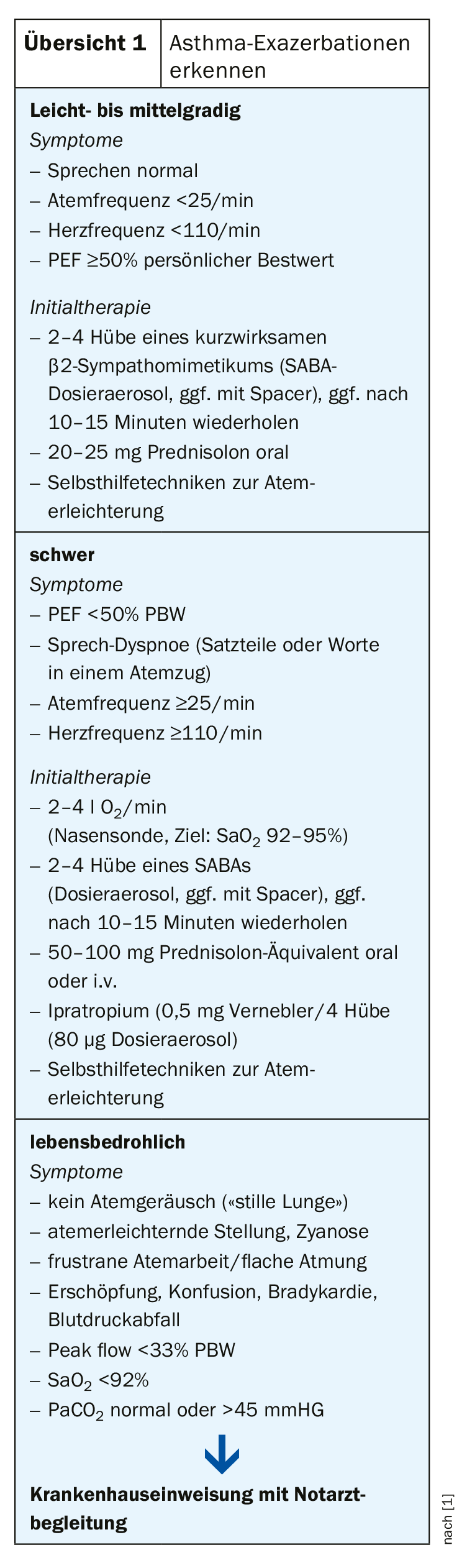


In prevention, it is important to communicate very clearly to the patient that regular use of inhaled cortisone during seizures is crucial. “And the best metered dose inhaler won’t help if it’s sprayed behind the ear, so please train your inhalation technique,” said the Mainz-based pulmonologist. The same is true for self-management, i.e., action plans and symptom monitoring. Individual risk factors should be identified and named in the consultation, as well as non-pharmacological interventions: Flu vaccination, smoking cessation, etc. If all these things are taken to heart, Prof. Buhl concludes, it is now possible to limit the frequency of at least higher-grade asthma exacerbations in patients to a very low level.

Source: DGIM 2019, Wiesbaden (D)


Literature:

  1. German Respiratory League, DGP & ÖGP. Pulmonology 2017; 71(12): 849-919


InFo PNEUMOLOGY & ALLERGOLOGY 2019; 1(2): 34 (published 9/26/19, ahead of print).
Autoren
  • Jens Dehn
Publikation
  • InFo PNEUMOLOGIE & ALLERGOLOGIE
Related Topics
  • Asthma
  • cortisone
  • Cortisone
  • exacerbation
Previous Article
  • CAR-T cells

Focus on innovative cancer therapy

  • Congress Reports
  • Genetics
  • Hematology
  • Oncology
  • RX
View Post
Next Article
  • Rhinosinusitis

Do not “shoot fast” so quickly: Antibiotics rarely indicated

  • Allergology and clinical immunology
  • Education
  • General Internal Medicine
  • Infectiology
  • ORL
  • RX
View Post
You May Also Like
View Post
  • 4 min
  • Diarrhea in children

The problem of parental expectations

    • RX
    • Education
    • Gastroenterology and Hepatology
    • General Internal Medicine
    • Infectiology
    • Pediatrics
    • Studies
View Post
  • 4 min
  • From symptom to diagnosis

Multilocular cystic renal cell carcinoma (MCRCC)

    • RX
    • Cases
    • Education
    • Nephrology
    • Oncology
    • Radiology
    • Studies
    • Surgery
View Post
  • 3 min
  • Shaping the Future with LLM & Co.

AI in Everyday Clinical Practice: Friend or Foe?

    • RX
    • General Internal Medicine
    • Practice Management
    • Prevention and health care
View Post
  • 5 min
  • Ulcerative colitis: current evidence on anti-inflammatory therapies

Remission induction and maintenance with biologics and JAK-i

    • RX
    • Congress Reports
    • Gastroenterology and Hepatology
    • General Internal Medicine
    • Studies
View Post
  • 4 min
  • Bronchiectasis

New strategies against neutrophilic inflammation

    • RX
    • Congress Reports
    • General Internal Medicine
    • Infectiology
    • Pneumology
    • Studies
View Post
  • 3 min
  • IBD in childhood

Pneumococcal vaccination without negative consequences

    • RX
    • Education
    • Gastroenterology and Hepatology
    • General Internal Medicine
    • Infectiology
    • Pediatrics
    • Prevention and health care
View Post
  • 7 min
  • Plastic surgery and reconstructive microsurgery for DFS

Functional limb preservation between infection control, vascular medicine and resurfacing

    • RX
    • Angiology
    • CME continuing education
    • Dermatology and venereology
    • Endocrinology and Diabetology
    • General Internal Medicine
    • Geriatrics
    • Physical medicine and rehabilitation
    • Surgery
View Post
  • 14 min
  • Seborrheic Dermatitis in Adults and Adolescents

Current State of Knowledge and New Therapeutic Approaches

    • RX
    • CME continuing education
    • Dermatology and venereology
    • Studies
  • IBD matters

    Zum Thema
Top CME content
  • 1
    Current State of Knowledge and New Therapeutic Approaches
  • 2
    Why is it so hard to lose weight?
  • 3
    Functional limb preservation between infection control, vascular medicine and resurfacing
  • 4
    Algorithms, avatars and the unburdened mind
  • 5
    Communication as the key to therapy adherence

Newsletter

Sign up and stay up to date

Subscribe
Medizinonline Medizinonline
  • Contact
  • General terms and conditions
  • Imprint

Input your search keywords and press Enter.