Medizinonline Medizinonline
  • News
    • News
    • Market & Medicine
  • Patients
    • Disease patterns
    • Diagnostics
    • Therapy
  • Partner Content
    • Dermatology
      • Atopic dermatitis and psoriasis news
    • Diabetes
      • Dia-Month Club – Type 2 Diabetes
      • Diabetes in Motion
      • Diabetes Podcasts
    • Gastroenterology
      • IBD matters
    • Oncology
      • Swiss Oncology in motion
    • Orthopedics
      • Osteoporosis in motion
  • Departments
    • Allergology and clinical immunology
    • General Internal Medicine
    • Anesthesiology
    • Angiology
    • Surgery
    • Dermatology and venereology
    • Endocrinology and Diabetology
    • Nutrition
    • Gastroenterology and Hepatology
    • Genetics
    • Geriatrics
    • Gynecology
    • Hematology
    • Infectiology
    • Cardiology
    • Nephrology
    • Neurology
    • Emergency and intensive care medicine
    • Nuclear Medicine
    • Oncology
    • Ophthalmology
    • ORL
    • Orthopedics
    • Pediatrics
    • Pharmacology and toxicology
    • Pharmaceutical medicine
    • Phlebology
    • Physical medicine and rehabilitation
    • Pneumology
    • Prevention and health care
    • Psychiatry and psychotherapy
    • Radiology
    • Forensic Medicine
    • Rheumatology
    • Sports Medicine
    • Traumatology and trauma surgery
    • Tropical and travel medicine
    • Urology
    • Dentistry
  • CME & Congresses
    • CME continuing education
    • Congress Reports
    • Congress calendar
  • Practice
    • Noctimed
    • Practice Management
    • Jobs
    • Interviews
  • Log In
  • Register
  • My account
  • Contact
  • Publications
  • Contact
  • Deutsch
  • English
  • Français
  • Italiano
  • Português
  • Español
Subscribe
Medizinonline Medizinonline
  • News
    • News
    • Market & Medicine
  • Patienten
    • Krankheitsbilder
    • Diagnostik
    • Therapie
  • Partner Content
    • Dermatology
      • Atopic dermatitis and psoriasis news
    • Diabetes
      • Dia-Month Club – Type 2 Diabetes
      • Diabetes in Motion
      • Diabetes Podcasts
    • Gastroenterology
      • IBD matters
    • Oncology
      • Swiss Oncology in motion
    • Orthopedics
      • Osteoporosis in motion
    • Phytotherapie
    • Rheumatology
  • Departments
    • Fachbereiche 1-13
      • Allergology and clinical immunology
      • General Internal Medicine
      • Anesthesiology
      • Angiology
      • Surgery
      • Dermatology and venereology
      • Endocrinology and Diabetology
      • Nutrition
      • Gastroenterology and Hepatology
      • Genetics
      • Geriatrics
      • Gynecology
      • Hematology
    • Fachbereiche 14-26
      • Infectiology
      • Cardiology
      • Nephrology
      • Neurology
      • Emergency and intensive care medicine
      • Nuclear Medicine
      • Oncology
      • Ophthalmology
      • ORL
      • Orthopedics
      • Pediatrics
      • Pharmacology and toxicology
      • Pharmaceutical medicine
    • Fachbereiche 26-38
      • Phlebology
      • Physical medicine and rehabilitation
      • Phytotherapy
      • Pneumology
      • Prevention and health care
      • Psychiatry and psychotherapy
      • Radiology
      • Forensic Medicine
      • Rheumatology
      • Sports Medicine
      • Traumatology and trauma surgery
      • Tropical and travel medicine
      • Urology
      • Dentistry
  • CME & Congresses
    • CME continuing education
    • Congress Reports
    • Congress calendar
  • Practice
    • Noctimed
    • Practice Management
    • Jobs
    • Interviews
Login

Sie haben noch keinen Account? Registrieren

  • Skin cancer: epidemiological development

Marked increase in incidence predicted

    • Congress Reports
    • Dermatology and venereology
    • Oncology
    • RX
    • Studies
  • 4 minute read

As shown by large skin cancer registries and population-based studies, there is a continuing trend in Europe and worldwide towards an increase in new cases of melanocytic and non-melanocytic tumors. In particular, squamous cell carcinomas (cSCC) and basal cell carcinomas (cBCC) are predicted to have a high increase in incidence. Because most metastases in squamous cell carcinoma occur within two to three years after diagnosis of the primary tumor, this phase is an important window of opportunity for secondary prevention.

Valid registry data provide an important basis for reliable epidemiologic analyses [1]. The largest population-based skin cancer registries include the Global Cancer Observatory, the European Cancer Information System (ECIS), and the International Agency for Research. According to the Global Cancer Observatory (IARC), there are approximately 300 000 new cases of melanoma worldwide, with approximately half occurring in Europe [2]. In Switzerland, melanocytic tumors are the fifth most common type of cancer, with approximately 2800 individuals diagnosed annually, with almost a quarter of those diagnosed being under 50 at the time of initial diagnosis [3]. Early detection and treatment have improved significantly in recent years, although there are certain differences within Europe in this regard, explains Prof. Ana-Maria Forsea, MD, of Elias University Hospital and Carol Davila University of Medicine and Pharmacy, Bucharest (Romania). Data from the ECIS registry on melanoma show that in Central Europe, the 5-year survival rate is significantly higher compared with Eastern European countries, indicating disparities in care, the speaker said [1,4].

Trend toward increase in skin cancer incidence continues

In Switzerland, as well as in Europe as a whole, there is a trend towards an increase in the incidence of melanoma, although survival rates are relatively good compared to other tumor types. Thus, according to the Federal Office of Public Health (FOPH), the 5-year survival rate in Switzerland is over 80% [5]. However, as age-stratified analyses of a large population-based study over the 30-year period show, mortality trends vary with age and other factors [6].

The incidence of non-melanocytic tumors  (NMSC) has also increased in recent years. The greatest risk factors are known to be UV radiation exposure and advanced age. White skin cancer accounts for over 90% of all skin cancer cases, with approximately 20-30% being squamous cell carcinoma (cSCC) and 70-80% being basal cell carcinoma (cBCC) [1]. Because NMSC is not included in most large skin cancer registries, epidemiologic data on it are based on other data sources such as studies or smaller local registries. According to experts, a marked increase in new cases is expected in Europe in the coming years; it is estimated that in Germany, for example, the incidence of NMSC will double by 2030 [7]. Mortality rates are low, but white skin cancer is associated with significant morbidity.


Metastasis risk: monitoring and patient education

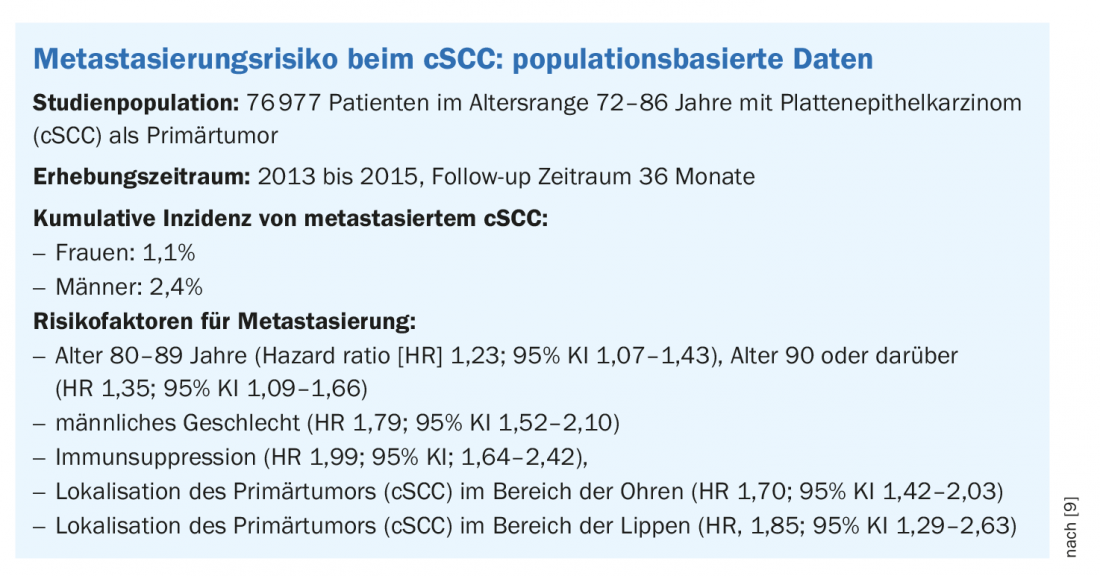
The overall risk of metastasis is estimated to be approximately 4% for squamous cell carcinoma (cSCC) [1]. However, the data in this regard vary depending on the study population and design. Analyses of data collected from 2013 to 2015 from a large population-based study in England (n=76,977, age range 72-86 years) found that 92.9% of metastases occurred within three years of diagnosis of the primary tumor. Age, male sex, immunosuppression, and localization of the primary tumor to the ears and lips were found to be associated with an increased risk of metastasis (Box) [9].

In analyses of an epidemiologic study with a smaller sample (n=1122) in which data were collected from 2005 to 2014, the incidence of metastasis was reported to be 1.2-2%–2,7%, with more than 80% of metastases occurring within two years of diagnosis of the primary tumor [10]. According to the authors, patient education is an important aspect of monitoring during this critical period. Thus, patients should be trained to regularly check for signs of recurrence or possible metastasis and, if necessary, have dermatological clarification performed.

Source: EADV Annual Meeting 2020


Literature:

  1. Forsea AM: Overview of epidemiology of skin cancer, Prof. Ana-Maria Forsea, MD, EADV Annual Meeting, 10/31/2020.
  2. International Agency for Research on Cancer (IARC), www.iarc.who.int
  3. Swiss Cancer League, www.krebsliga.ch/ueber-krebs/krebsarten/hautkrebs-melanom-schwarzer-hautkrebs/
  4. European Cancer Information System (ECIS), https://ecis.jrc.ec.europa.eu
  5. Federal Office of Public Health (FOPH), www.bag.admin.ch/bag/de/home/zahlen-und-statistiken/zahlen-fakten-nichtuebertragbare-krankheiten/krebserkrankungen-schweiz.html
  6. Yang DD, et al: Trends in malignant melanoma mortality in 31 countries from 1985 to 2015. BJD 2020; 183(6): 1056-1064.
  7. Leiter U, et al: Incidence, Mortality, and Trends of Nonmelanoma Skin Cancer in Germany J Invest Dermatol 2017; 137(9): 1860-1867.
  8. Laughter MR, et al: The Burden of Skin and Subcutaneous Diseases in the United States From 1990 to 2017. JAMA Dermatol 2020; 1; 156(8): 874-881.
  9. Venables ZC, et al: Nationwide incidence of metastatic cutaneous squamous cell carcinoma in England. JAMA Dermatol 2019; 155(3): 298-306.
  10. Nelson TG, Ashton, RE: Low incidence of metastasis and recurrence from cutaneous squamous cell carcinoma found in a UK population: Do we need to adjust our thinking on this rare but potentially fatal event? J Surg Oncol 2017; 116(6): 783-788.

DERMATOLOGIE PRAXIS 2021; 31(1): 46 (published 2/23/21, ahead of print).

Autoren
  • Mirjam Peter, M.Sc.
Publikation
  • DERMATOLOGIE PRAXIS
Related Topics
  • Melanoma
  • Skin cancer
Previous Article
  • Mild Cognitive Impairment

Significant cognition improvement through BrainXpert Energy Complex

  • Market & Medicine
  • Neurology
  • RX
  • Studies
View Post
Next Article
  • Parkinson's disease

What to do in case of respiratory disorders?

  • Education
  • Neurology
  • Pneumology
  • RX
View Post
You May Also Like
View Post
  • 5 min
  • Oncolytic virus in stage II melanoma

Innovative method for predicting therapy response

    • Dermatology and venereology
    • Education
    • Oncology
    • RX
    • Studies
View Post
  • 3 min
  • Phimosis and penile cancer under SGLT2i

Increased risk for men with T2D

    • Congress Reports
    • Endocrinology and Diabetology
    • General Internal Medicine
    • RX
    • Studies
    • Urology
View Post
  • 12 min
  • Diabetic ketoacidosis

Recommendations for action in practice

    • Cases
    • CME continuing education
    • Emergency and intensive care medicine
    • Endocrinology and Diabetology
    • Hematology
    • Nephrology
    • RX
View Post
  • 6 min
  • Migraine: better quality of life thanks to multimodal care

Broader selection of innovative migraine prophylactics and acute therapies

    • Congress Reports
    • Neurology
    • Pharmacology and toxicology
    • RX
    • Studies
View Post
  • 4 min
  • Therapy of non-tumor-related pain

Do not prescribe opioids lightly for musculoskeletal pain

    • General Internal Medicine
    • Pharmacology and toxicology
    • Prevention and health care
    • RX
    • Studies
View Post
  • 14 min
  • "Forgotten axis" between plant substances, gut and systemic health

Microbiome and phytotherapy

    • Education
    • Endocrinology and Diabetology
    • Gastroenterology and Hepatology
    • General Internal Medicine
    • Infectiology
    • Neurology
    • Nutrition
    • Pharmaceutical medicine
    • Phytotherapy
    • RX
    • Studies
View Post
  • 3 min
  • Migraine

Fremanezumab for comorbid migraine and depression

    • Neurology
    • Pharmacology and toxicology
    • RX
    • Studies
View Post
  • 6 min
  • Case study

Moyamoya disease in a 23-year-old female patient

    • Angiology
    • Cases
    • Education
    • Neurology
    • Radiology
    • RX
  • IBD matters

    Zum Thema
Top CME content
  • 1
    Causes and prevention at work
  • 2
    Yellow nail and Swyer-James syndrome
  • 3
    Recommendations for action in practice
  • 4
    From the β-cell to the center: the versatile role of amylin
  • 5
    Communication as the key to therapy adherence

Newsletter

Sign up and stay up to date

Subscribe
Medizinonline Medizinonline
  • Contact
  • General terms and conditions
  • Imprint

Input your search keywords and press Enter.