Medizinonline Medizinonline
  • News
    • News
    • Market & Medicine
  • Patients
    • Disease patterns
    • Diagnostics
    • Therapy
  • Partner Content
    • Dermatology
      • Atopic dermatitis and psoriasis news
    • Diabetes
      • Dia-Month Club – Type 2 Diabetes
      • Diabetes in Motion
      • Diabetes Podcasts
    • Gastroenterology
      • IBD matters
    • Oncology
      • Swiss Oncology in motion
    • Orthopedics
      • Osteoporosis in motion
  • Departments
    • Allergology and clinical immunology
    • General Internal Medicine
    • Anesthesiology
    • Angiology
    • Surgery
    • Dermatology and venereology
    • Endocrinology and Diabetology
    • Nutrition
    • Gastroenterology and Hepatology
    • Genetics
    • Geriatrics
    • Gynecology
    • Hematology
    • Infectiology
    • Cardiology
    • Nephrology
    • Neurology
    • Emergency and intensive care medicine
    • Nuclear Medicine
    • Oncology
    • Ophthalmology
    • ORL
    • Orthopedics
    • Pediatrics
    • Pharmacology and toxicology
    • Pharmaceutical medicine
    • Phlebology
    • Physical medicine and rehabilitation
    • Pneumology
    • Prevention and health care
    • Psychiatry and psychotherapy
    • Radiology
    • Forensic Medicine
    • Rheumatology
    • Sports Medicine
    • Traumatology and trauma surgery
    • Tropical and travel medicine
    • Urology
    • Dentistry
  • CME & Congresses
    • CME continuing education
    • Congress Reports
    • Congress calendar
  • Practice
    • Noctimed
    • Practice Management
    • Jobs
    • Interviews
  • Log In
  • Register
  • My account
  • Contact
  • Publications
  • Contact
  • Deutsch
  • English
  • Français
  • Italiano
  • Português
  • Español
Subscribe
Medizinonline Medizinonline
  • News
    • News
    • Market & Medicine
  • Patienten
    • Krankheitsbilder
    • Diagnostik
    • Therapie
  • Partner Content
    • Dermatology
      • Atopic dermatitis and psoriasis news
    • Diabetes
      • Dia-Month Club – Type 2 Diabetes
      • Diabetes in Motion
      • Diabetes Podcasts
    • Gastroenterology
      • IBD matters
    • Oncology
      • Swiss Oncology in motion
    • Orthopedics
      • Osteoporosis in motion
    • Phytotherapie
    • Rheumatology
  • Departments
    • Fachbereiche 1-13
      • Allergology and clinical immunology
      • General Internal Medicine
      • Anesthesiology
      • Angiology
      • Surgery
      • Dermatology and venereology
      • Endocrinology and Diabetology
      • Nutrition
      • Gastroenterology and Hepatology
      • Genetics
      • Geriatrics
      • Gynecology
      • Hematology
    • Fachbereiche 14-26
      • Infectiology
      • Cardiology
      • Nephrology
      • Neurology
      • Emergency and intensive care medicine
      • Nuclear Medicine
      • Oncology
      • Ophthalmology
      • ORL
      • Orthopedics
      • Pediatrics
      • Pharmacology and toxicology
      • Pharmaceutical medicine
    • Fachbereiche 26-38
      • Phlebology
      • Physical medicine and rehabilitation
      • Phytotherapy
      • Pneumology
      • Prevention and health care
      • Psychiatry and psychotherapy
      • Radiology
      • Forensic Medicine
      • Rheumatology
      • Sports Medicine
      • Traumatology and trauma surgery
      • Tropical and travel medicine
      • Urology
      • Dentistry
  • CME & Congresses
    • CME continuing education
    • Congress Reports
    • Congress calendar
  • Practice
    • Noctimed
    • Practice Management
    • Jobs
    • Interviews
Login

Sie haben noch keinen Account? Registrieren

  • On the occasion of the European Antibiotics Day

New algorithm helps distinguish viral and bacterial sore throats

    • Allergology and clinical immunology
    • Congress Reports
    • Infectiology
    • RX
  • 2 minute read

Mr. and Mrs. Swiss swallow sore throat medicines for several million Swiss francs every year. They often treat the pain with antibiotics, even though up to 80% of sore throats are viral. For this reason, experts from pharmacy and medicine have come together in the NEXT group (“New Expert Strategy for the Therapy of Sore Throat”) to develop a strategy to curb the inappropriate use of antibiotics.

“Sore throats are usually self-limiting, run their course without complications and subside after two to three days,” said Dr. med. Hans-Ulrich Kull, Küsnacht, at the fireside chat in Zurich. Dr. Lorenz Schmid, a pharmacist in Zurich, knows from experience that “when it comes to sore throats, the first place sufferers usually go in search of pain relief is the pharmacy. Here, pharmacists are faced with the question of whether the sore throat is caused by viruses or bacteria. We send customers with bacterial infections to the doctor.” To help with this decision, NEXT Group has put together a flowchart for differentiating between viral and bacterial sore throats in the pharmacy. Because one thing is certain: In the case of a bacterial infection, antibiotic-containing sore throat remedies are of no use – in this case, the affected person needs antibiotics from the doctor. This was pointed out by PD Dr. med. Stefan Zimmerli, Bern. The problem is not only that such treatment with superficially applied antibiotics is of no use, but also that any improper use of antibiotics ultimately contributes to the promotion of resistance. Antibiotic resistance has a negative impact on both individuals themselves and society. Resistant bacteria can linger in the body for a very long time and become responsible for an infection that can no longer be fought with common antibiotic therapy. The resistant bacteria are inevitably transferred into the environment or to other fellow humans. In addition, the resistance can be transferred to other bacterial species. Both can lead to the uncontrollable spread of resistant bacteria. All this contributes to the fact that the best weapons against bacteria are gradually becoming blunt and useless – and this with a dwindling number of new antibiotics on the market. Today, infections must therefore be increasingly treated with reserve antibiotics due to resistance.

What is the NEXT algorithm about?

The NEXT algorithm for the management of sore throat in pharmacy (accepted for publication by the Pharmaceutical Journal) is based on the internationally recognized CENTOR score (Table 1), which assesses the main leading symptoms of sore throat and indicates the likelihood of bacterial infection.
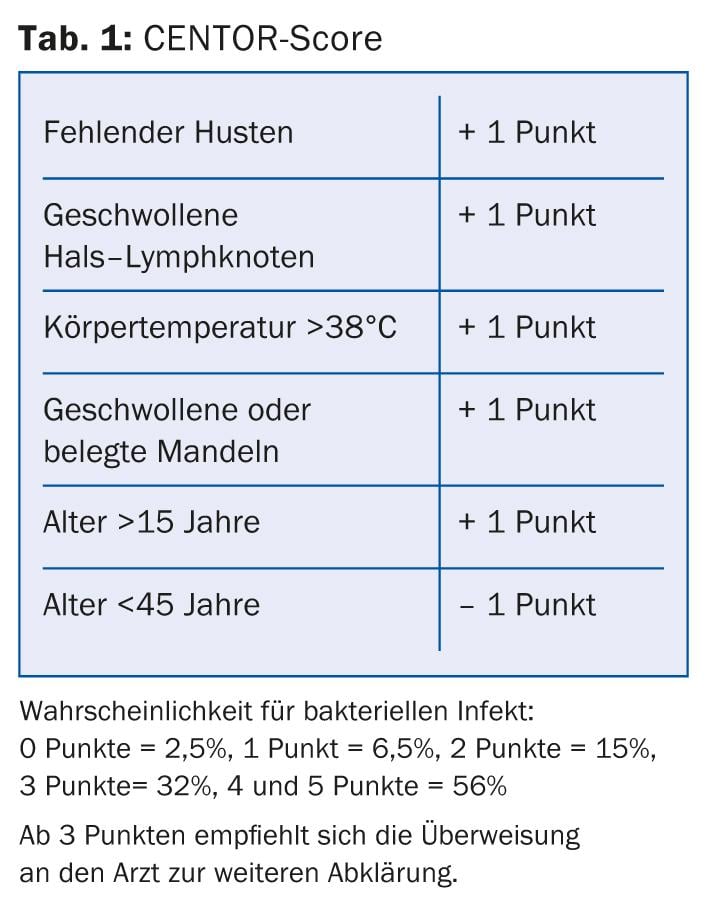
NEXT completes this assessment with specific suggestions for managing sore throats in the pharmacy. The algorithm can provide reassurance to both the patient and the healthcare professional regarding the correct course of action. He contributes to reducing the unnecessary use of antibiotics for sore throats, aiming to treat sore throats according to the patient’s primary desire, pain relief.

Séverine Bonini

Source: Fireside chat on European Antibiotics Day: “Antibiotic resistance in Switzerland – the alarming truth”, Zurich, November 14, 2013.

HAUSARZT PRAXIS 2014; 9(1): 5-6

Publikation
  • HAUSARZT PRAXIS
Related Topics
  • Algorithm
  • Antibiotics
  • Bacteria
  • Infection
  • next-group
  • resistance
Previous Article
  • Faster, stronger, higher...

What is sports medicine anyway?

  • News
  • Orthopedics
  • RX
  • Sports Medicine
View Post
Next Article
  • Reflux/stomach burn

Treat the reflux – not the acidosis

  • Gastroenterology and Hepatology
  • General Internal Medicine
  • Interviews
  • RX
View Post
You May Also Like
View Post
  • 5 min
  • From symptom to diagnosis

Pneumology – Covid-19: a review

    • Cases
    • Education
    • Infectiology
    • Pneumology
    • Prevention and health care
    • Radiology
    • RX
View Post
  • 6 min
  • Abdominal aortic aneurysms in primary care

Risk-stratified screening and prophylaxis

    • Angiology
    • Congress Reports
    • Prevention and health care
    • Radiology
    • RX
    • Studies
    • Surgery
View Post
  • 9 min
  • Cardiology

Minimally invasive – the quiet triumph of modern heart surgery

    • Cardiology
    • CME continuing education
    • RX
    • Studies
    • Surgery
View Post
  • 0 min
  • Plastic surgery and reconstructive microsurgery for DFS

Functional limb preservation between infection control, vascular medicine and resurfacing

    • Angiology
    • CME continuing education
    • Endocrinology and Diabetology
    • General Internal Medicine
    • Geriatrics
    • Physical medicine and rehabilitation
    • RX
    • Surgery
View Post
  • 6 min
  • Age-related neurocognitive disorders

Neuroprotective effects of Ginkgo biloba extract

    • Education
    • Geriatrics
    • Neurology
    • Pharmaceutical medicine
    • Phytotherapy
    • RX
    • Studies
View Post
  • 6 min
    • Education
    • Endocrinology and Diabetology
    • Pneumology
    • Psychiatry and psychotherapy
    • RX
    • Studies

How origin and place of residence promote CF-associated diabetes

View Post
  • 10 min
  • Patients with leg swelling

DVT and other common DDs with peripheral edema

    • Angiology
    • Cardiology
    • Congress Reports
    • Geriatrics
    • RX
View Post
  • 8 min
  • "smarter medicine": Top 5 list for headache treatment

Recommendations of the Swiss Headache Society

    • Dentistry
    • General Internal Medicine
    • Neurology
    • Practice Management
    • RX
    • Studies
  • IBD matters

    Zum Thema
Top CME content
  • 1
    Functional limb preservation between infection control, vascular medicine and resurfacing
  • 2
    Minimally invasive – the quiet triumph of modern heart surgery
  • 3
    HPV prevention, screening innovation and sentinel lymph node biopsy
  • 4
    Clinical care from birth to adulthood
  • 5
    Multidisciplinary teams in oncology

Newsletter

Sign up and stay up to date

Subscribe
Medizinonline Medizinonline
  • Contact
  • General terms and conditions
  • Imprint

Input your search keywords and press Enter.