Medizinonline Medizinonline
  • News
    • News
    • Market & Medicine
  • Patients
    • Disease patterns
    • Diagnostics
    • Therapy
  • Partner Content
    • Dermatology
      • Atopic dermatitis and psoriasis news
    • Diabetes
      • Dia-Month Club – Type 2 Diabetes
      • Diabetes in Motion
      • Diabetes Podcasts
    • Gastroenterology
      • IBD matters
    • Oncology
      • Swiss Oncology in motion
    • Orthopedics
      • Osteoporosis in motion
  • Departments
    • Allergology and clinical immunology
    • General Internal Medicine
    • Anesthesiology
    • Angiology
    • Surgery
    • Dermatology and venereology
    • Endocrinology and Diabetology
    • Nutrition
    • Gastroenterology and Hepatology
    • Genetics
    • Geriatrics
    • Gynecology
    • Hematology
    • Infectiology
    • Cardiology
    • Nephrology
    • Neurology
    • Emergency and intensive care medicine
    • Nuclear Medicine
    • Oncology
    • Ophthalmology
    • ORL
    • Orthopedics
    • Pediatrics
    • Pharmacology and toxicology
    • Pharmaceutical medicine
    • Phlebology
    • Physical medicine and rehabilitation
    • Pneumology
    • Prevention and health care
    • Psychiatry and psychotherapy
    • Radiology
    • Forensic Medicine
    • Rheumatology
    • Sports Medicine
    • Traumatology and trauma surgery
    • Tropical and travel medicine
    • Urology
    • Dentistry
  • CME & Congresses
    • CME continuing education
    • Congress Reports
    • Congress calendar
  • Practice
    • Noctimed
    • Practice Management
    • Jobs
    • Interviews
  • Log In
  • Register
  • My account
  • Contact
  • Publications
  • Contact
  • Deutsch
  • English
  • Français
  • Italiano
  • Português
  • Español
Subscribe
Medizinonline Medizinonline
  • News
    • News
    • Market & Medicine
  • Patienten
    • Krankheitsbilder
    • Diagnostik
    • Therapie
  • Partner Content
    • Dermatology
      • Atopic dermatitis and psoriasis news
    • Diabetes
      • Dia-Month Club – Type 2 Diabetes
      • Diabetes in Motion
      • Diabetes Podcasts
    • Gastroenterology
      • IBD matters
    • Oncology
      • Swiss Oncology in motion
    • Orthopedics
      • Osteoporosis in motion
    • Phytotherapie
    • Rheumatology
  • Departments
    • Fachbereiche 1-13
      • Allergology and clinical immunology
      • General Internal Medicine
      • Anesthesiology
      • Angiology
      • Surgery
      • Dermatology and venereology
      • Endocrinology and Diabetology
      • Nutrition
      • Gastroenterology and Hepatology
      • Genetics
      • Geriatrics
      • Gynecology
      • Hematology
    • Fachbereiche 14-26
      • Infectiology
      • Cardiology
      • Nephrology
      • Neurology
      • Emergency and intensive care medicine
      • Nuclear Medicine
      • Oncology
      • Ophthalmology
      • ORL
      • Orthopedics
      • Pediatrics
      • Pharmacology and toxicology
      • Pharmaceutical medicine
    • Fachbereiche 26-38
      • Phlebology
      • Physical medicine and rehabilitation
      • Phytotherapy
      • Pneumology
      • Prevention and health care
      • Psychiatry and psychotherapy
      • Radiology
      • Forensic Medicine
      • Rheumatology
      • Sports Medicine
      • Traumatology and trauma surgery
      • Tropical and travel medicine
      • Urology
      • Dentistry
  • CME & Congresses
    • CME continuing education
    • Congress Reports
    • Congress calendar
  • Practice
    • Noctimed
    • Practice Management
    • Jobs
    • Interviews
Login

Sie haben noch keinen Account? Registrieren

  • Penile carcinoma

New S3 Guideline: Diagnostics, Therapy and Follow-up Care

    • Congress Reports
    • Oncology
    • RX
    • Urology
  • 2 minute read

The new S3 guideline “Diagnosis, therapy and follow-up of penile carcinoma” aims to improve the quality of care for affected patients. The focus is on organ preservation.

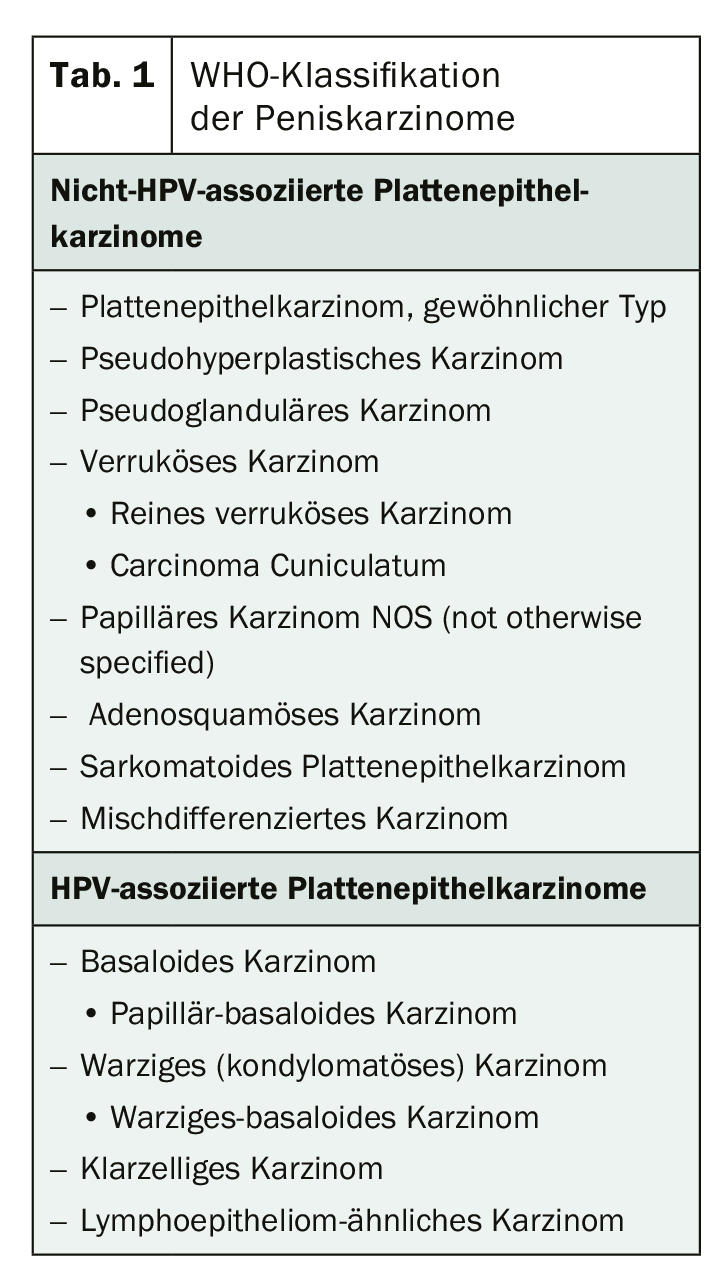
According to the WHO classification, squamous cell carcinoma of the penis is divided into histological subtypes – the non-HPV-associated and the HPV-associated squamous cell carcinomas (Table 1). The common squamous cell carcinoma predominates with 41%, followed by the basaloid penile carcinoma (7%) and the warty subtype with 5%. The macroscopic growth forms largely determine the prognosis. The superficial spreading type, for example, has a rather good prognosis in contrast to the deeply invasive penile carcinoma.


HPV status as a marker for therapy management

Currently, there are no molecular biological markers that can be recommended for routine diagnosis of penile carcinoma. Nevertheless, the pathological findings should include a statement as to whether the disease is HPV-associated or not. This could provide additional decision support for the tumor board, as patients with differential HPV status respond differently to chemotherapeutic agents or checkpoint inhibitors. However, primary oncogenesis factors can currently be distinguished. The development of therapeutic HPV vaccines may provide an additional therapeutic option in the future. These generate cell-mediated, HLA-restricted matched T-cell immunity that destroys HPV-infected cells via cytotoxic lymphocytes.  

Primary goal: organ preservation

Treatment should focus primarily on organ preservation, depending on the stage and degree of differentiation. This is because it has been proven that mutilating procedures on the external genium result in significant psychological and psycho-oncological problems. Especially in younger patients, this can lead to significant social and occupational limitations. The key to organ preservation is a tumor-free incision margin. In the meantime, however, it can be assumed that a safety distance of approx. 1 mm is sufficient to achieve this.

Radiotherapy for small tumors

A real alternative to surgery is radiation therapy – especially for small tumors. The guideline recommends local radiotherapy for T1 and T2 tumors. Especially with regard to organ preservation, brachytherapy is an adequate option for tumors ≤4 cm. However, this should only be done in experienced centers and analogous to the published guidelines. However, patients should be educated about the low local control compared with surgical therapy. The use as adjuvant therapy, on the other hand, has not yet been sufficiently investigated in studies, so that no general recommendation can be made. And even in palliative use, no definitive statements can be made. The S3 guideline for patients with noncurable cancer recommends that the indication for local radiation therapy in malignant wounds to reduce the risk of bleeding, exudation, or to reduce disfiguring or difficult-to-care-for tumor manifestations and to reduce edema should be considered.

Source: 71st Congress of the German Society of Urology (DGU)


InFo ONCOLOGY & HEMATOLOGY 2019; 7(5): 31 (published 10/16/19, ahead of print).

Publikation
  • InFo ONKOLOGIE & HÄMATOLOGIE
Previous Article
  • Hives

Therapy of chronic urticaria

  • Dermatology and venereology
  • Education
  • RX
View Post
Next Article
  • Obesity

Knee osteoarthritis prevention for adolescents

  • Education
  • General Internal Medicine
  • Orthopedics
  • Pediatrics
  • RX
  • Studies
View Post
You May Also Like
View Post
  • 9 min
  • Type 2 diabetes and heart failure: a bidirectional relationship

Proactive preventive measures can reduce the burden of disease

    • Cardiology
    • Education
    • Endocrinology and Diabetology
    • Prevention and health care
    • RX
    • Studies
View Post
  • 4 min
  • Dementia

Delirium risks and treatment strategies

    • Education
    • Geriatrics
    • Neurology
    • Pharmacology and toxicology
    • Psychiatry and psychotherapy
    • RX
    • Studies
View Post
  • 9 min
  • Colorectal cancer screening

Results of the population-based PREEMPT-CRC study

    • Education
    • Gastroenterology and Hepatology
    • Oncology
    • Prevention and health care
    • RX
    • Studies
View Post
  • 5 min
  • Study report: TBS v3 and v4 in comparison

Analysis of OsteoLaus study data

    • Education
    • General Internal Medicine
    • Gynecology
    • Rheumatology
    • RX
    • Studies
View Post
  • 6 min
  • Atopic dermatitis: proven therapeutic principles and innovations

From healthcare research to precision medicine

    • Allergology and clinical immunology
    • Congress Reports
    • Dermatology and venereology
    • Pediatrics
    • RX
    • Studies
View Post
  • 3 min
  • SGLT2 inhibitors and glucocorticoids

Protective effect on kidney function is maintained

    • Congress Reports
    • Endocrinology and Diabetology
    • Nephrology
    • RX
    • Studies
View Post
  • 4 min
  • Study report: Nicotinamide for skin cancer prevention

Cohort study analyzed data from over 30,000 patients

    • Dermatology and venereology
    • Education
    • Oncology
    • Prevention and health care
    • RX
    • Studies
View Post
  • 8 min
  • Psychooncology

Communication as the key to therapy adherence

    • CME continuing education
    • General Internal Medicine
    • Practice Management
    • RX
Top Partner Content
Top CME content
  • 1
    Music therapy in Swiss oncology
  • 2
    Causes and prevention at work
  • 3
    Yellow nail and Swyer-James syndrome
  • 4
    Recommendations for action in practice
  • 5
    From the β-cell to the center: the versatile role of amylin

Newsletter

Sign up and stay up to date

Subscribe
Medizinonline Medizinonline
  • Contact
  • General terms and conditions
  • Imprint

Input your search keywords and press Enter.