Medizinonline Medizinonline
  • News
    • News
    • Market & Medicine
  • Patients
    • Disease patterns
    • Diagnostics
    • Therapy
  • Partner Content
    • Diabetes
      • Dia-Month Club – Type 2 Diabetes
      • Diabetes in Motion
      • Diabetes Podcasts
    • Gastroenterology
      • IBD matters
    • Oncology
      • Swiss Oncology in motion
    • Orthopedics
      • Osteoporosis in motion
  • Departments
    • Allergology and clinical immunology
    • General Internal Medicine
    • Anesthesiology
    • Angiology
    • Surgery
    • Dermatology and venereology
    • Endocrinology and Diabetology
    • Nutrition
    • Gastroenterology and Hepatology
    • Genetics
    • Geriatrics
    • Gynecology
    • Hematology
    • Infectiology
    • Cardiology
    • Nephrology
    • Neurology
    • Emergency and intensive care medicine
    • Nuclear Medicine
    • Oncology
    • Ophthalmology
    • ORL
    • Orthopedics
    • Pediatrics
    • Pharmacology and toxicology
    • Pharmaceutical medicine
    • Phlebology
    • Physical medicine and rehabilitation
    • Pneumology
    • Prevention and health care
    • Psychiatry and psychotherapy
    • Radiology
    • Forensic Medicine
    • Rheumatology
    • Sports Medicine
    • Traumatology and trauma surgery
    • Tropical and travel medicine
    • Urology
    • Dentistry
  • CME & Congresses
    • CME continuing education
    • Congress Reports
    • Congress calendar
  • Practice
    • Noctimed
    • Practice Management
    • Jobs
    • Interviews
  • Log In
  • Register
  • My account
  • Contact
  • Publications
  • Contact
  • Deutsch
  • English
  • Français
  • Italiano
  • Português
  • Español
Subscribe
Medizinonline Medizinonline
  • News
    • News
    • Market & Medicine
  • Patienten
    • Krankheitsbilder
    • Diagnostik
    • Therapie
  • Partner Content
    • Diabetes
      • Dia-Month Club – Type 2 Diabetes
      • Diabetes in Motion
      • Diabetes Podcasts
    • Gastroenterology
      • IBD matters
    • Oncology
      • Swiss Oncology in motion
    • Orthopedics
      • Osteoporosis in motion
    • Phytotherapie
    • Rheumatology
  • Departments
    • Fachbereiche 1-13
      • Allergology and clinical immunology
      • General Internal Medicine
      • Anesthesiology
      • Angiology
      • Surgery
      • Dermatology and venereology
      • Endocrinology and Diabetology
      • Nutrition
      • Gastroenterology and Hepatology
      • Genetics
      • Geriatrics
      • Gynecology
      • Hematology
    • Fachbereiche 14-26
      • Infectiology
      • Cardiology
      • Nephrology
      • Neurology
      • Emergency and intensive care medicine
      • Nuclear Medicine
      • Oncology
      • Ophthalmology
      • ORL
      • Orthopedics
      • Pediatrics
      • Pharmacology and toxicology
      • Pharmaceutical medicine
    • Fachbereiche 26-38
      • Phlebology
      • Physical medicine and rehabilitation
      • Phytotherapy
      • Pneumology
      • Prevention and health care
      • Psychiatry and psychotherapy
      • Radiology
      • Forensic Medicine
      • Rheumatology
      • Sports Medicine
      • Traumatology and trauma surgery
      • Tropical and travel medicine
      • Urology
      • Dentistry
  • CME & Congresses
    • CME continuing education
    • Congress Reports
    • Congress calendar
  • Practice
    • Noctimed
    • Practice Management
    • Jobs
    • Interviews
Login

Sie haben noch keinen Account? Registrieren

  • Depression

Psychopharmacotherapy of depression – what comes after the SSRI?

    • Education
    • Pharmacology and toxicology
    • Psychiatry and psychotherapy
    • RX
  • 2 minute read

Patients with moderate or severe depression in particular require pharmacologic intervention. Experience shows that antidepressants have their permanent place in the treatment regime of the disease. Selective serotonin reuptake inhibitors (SSRIs) are then primarily used as the drugs of choice. But what if these do not take effect?

Treating depression continues to be a challenge. After classification of the disease and psychoeducation, the decision is made between psychotherapy, medication or both. If psychotherapy can usually be started with mild depression, on the other hand, a combination of both therapy regimes is advisable for severe or chronic depression. But what if the symptoms cannot be alleviated by administration of an antidepressant? In principle, treatment should be adjusted or supplemented if there is no improvement after three to four weeks. Up to 70% of all patients are not in remission even after eight weeks of drug treatment. Just under half still do not, even if the first therapy attempt is extended. First changes should be noticed already within the first 14 days. If this is not the case, a modification of the therapy should be considered.

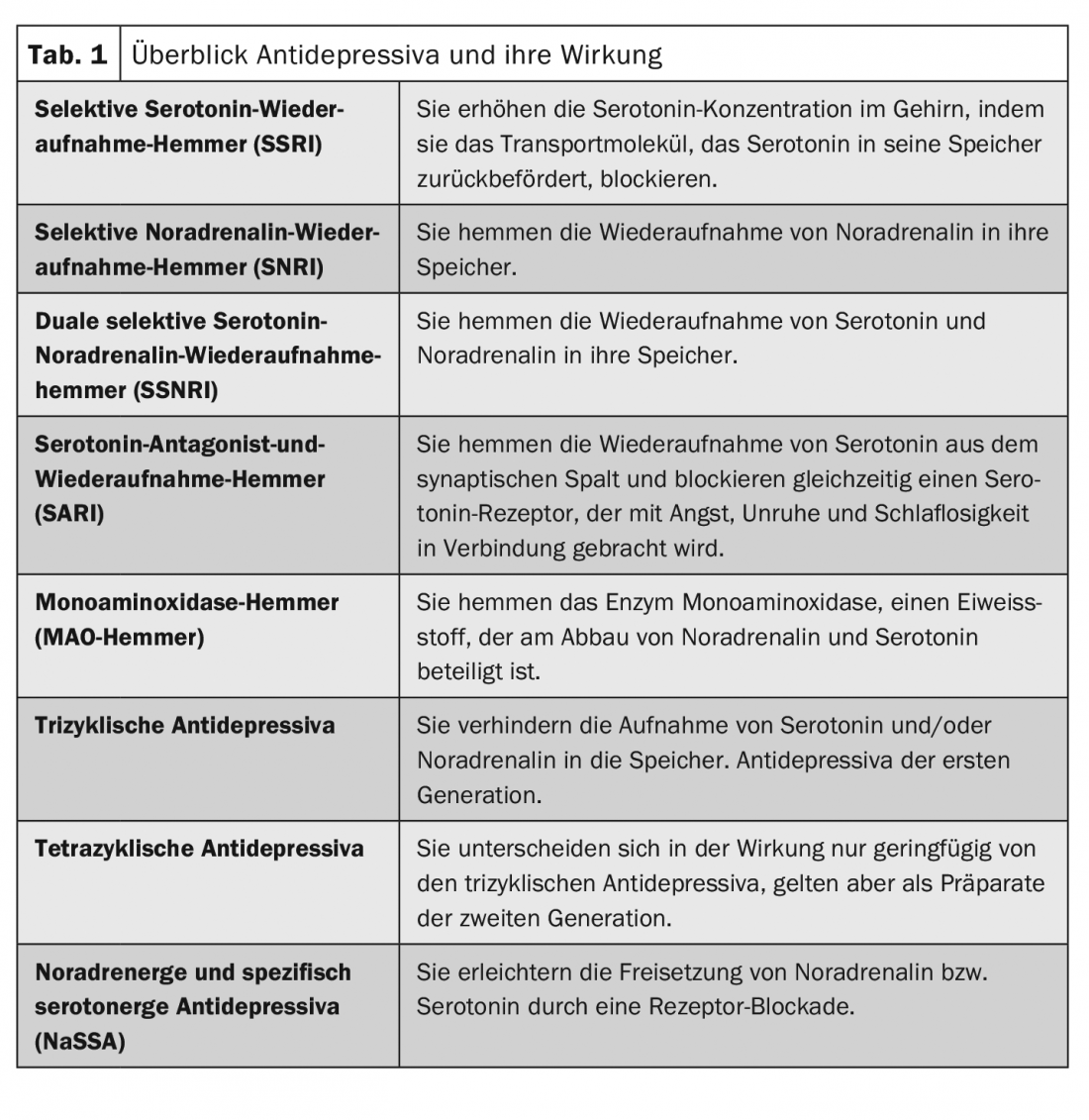
Depending on the preparation, antidepressants have a mood-improving, anxiety-relieving, calming, drive-increasing or drive-dampening effect. Their effect is based on the fact that they make up for the deficiency of the neurotransmitters serotonin and/or norepinephrine. Selective serotonin reuptake inhibitors (SSRIs) are considered the drugs of choice. In addition, there are selective norepinephrine reuptake inhibitors (SNRIs), dual selective serotonin-norepinephrine reuptake inhibitors (SSNRIs), serotonin antagonist-and-reuptake inhibitors (SARIs), noradrenergic and specific serotonergic antidepressants (NaSSAs), monoamine oxidase (MAO) inhibitors, and tri- and tetracyclic antidepressants (Table 1).


If acute therapy is not successful

The general approach is to transition to maintenance therapy for several months after acute therapy. If indicated, recurrence prophylaxis can subsequently be performed for several years. But what can be done if acute therapy does not achieve the desired results? In case of non-response to antidepressant monotherapy despite adequate duration and dose, a choice can be made between different strategies for further treatment:

  • Drop
  • therapeutic drug monitoring
  • Dose increase (not with SSRIs)
  • Combination of specific antidepressants
  • Augmentation with lithium or a second-generation antipsychotic.
  • Switch to a different antidepressant.

Which approach is the right one must be decided on an individual basis. In principle, nonresponse may also indicate low pharmacotherapeutic treatability. Therefore, especially in mild forms, discontinuation of pharmacotherapy should definitely be considered. Further treatment would then be provided via supportive discussions, daily structuring, targeted planning of positive experiences, guided self-help, exercise, awake therapy, or specific psychotherapy. Switching antidepressants is also not a first-line treatment, as no superiority over continuing has been observed to date.
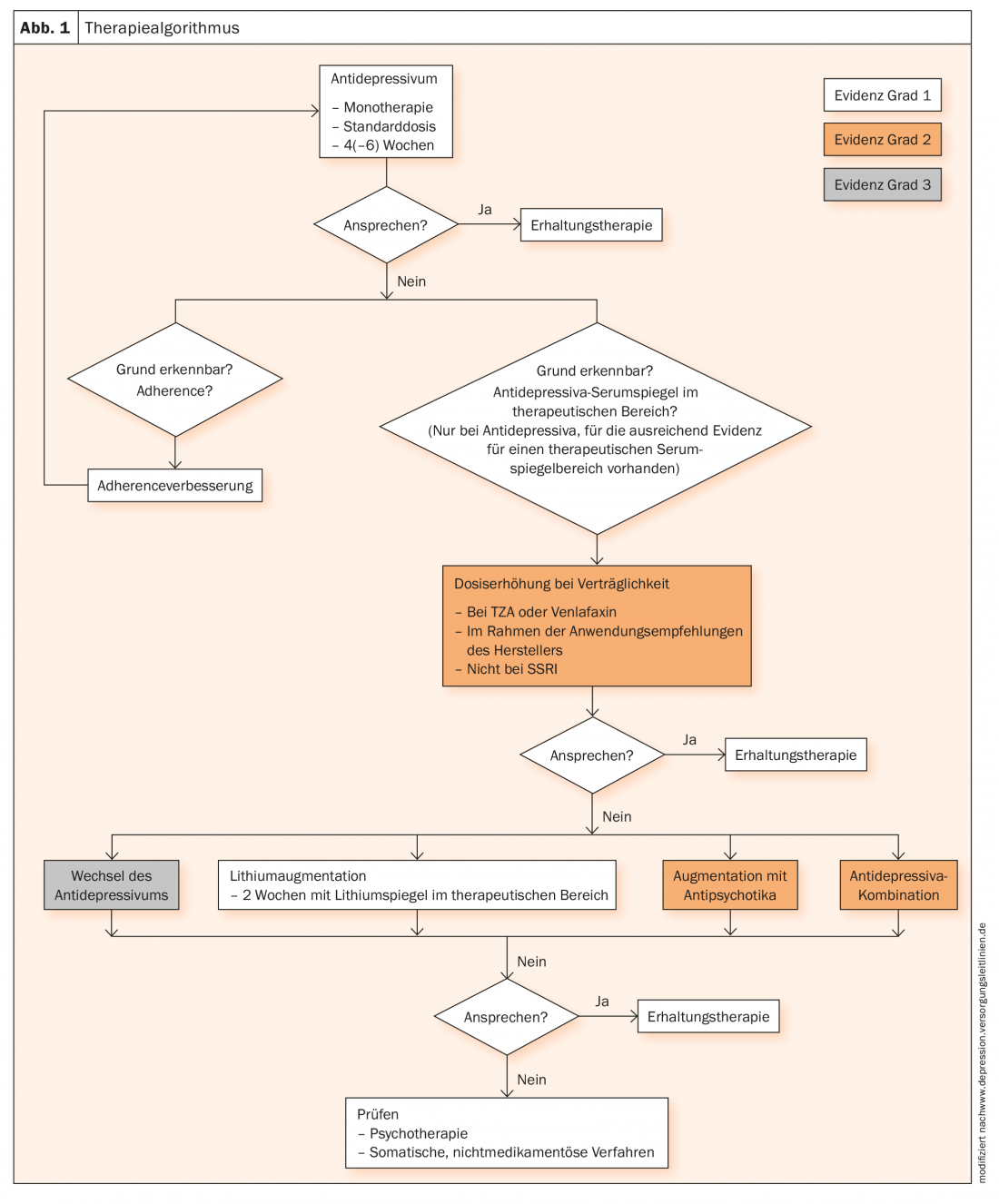


Therapy algorithm promises better results

Following an antidepressant stepwise plan is of great importance for the success of pharmacotherapy, as several studies have demonstrated. The central elements of such a treatment algorithm are a clear concept, an appropriate duration of the treatment stages, and a systematic evaluation of the effectiveness at the end of each stage (Fig. 1).


Further reading:

  • www.akdae.de/Arzneimitteltherapie/AVP/Artikel/201803/141h/index.php (last accessed 07/28/2020)
  • www.therapie.de/psyche/info/index/therapie/psychopharmaka/antidepressiva/ (last accessed 07/28/2020)
  • www.neurologen-und-psychiater-im-netz.org/psychiatrie-psychosomatik-psychotherapie/therapie/pharmakotherapie/antidepressiva/ (last accessed 07/28/2020)
  • www.psychiatrie.de/psychopharmaka/antidepressiva.html (last accessed 07/28/2020)


InFo NEUROLOGY & PSYCHIATRY 2020; 18(5): 22-24.

Autoren
  • Leoni Burggraf
Publikation
  • InFo NEUROLOGIE & PSYCHIATRIE
Related Topics
  • Antidepressants
  • Depression
  • SSRI
Previous Article
  • Atrial fibrillation

Anticoagulation in the elderly patient

  • Cardiology
  • Education
  • Geriatrics
  • RX
View Post
Next Article
  • Congresses in times of COVID-19

Safety first: The virus meets with

  • Congress Reports
  • General Internal Medicine
  • Interviews
  • RX
View Post
You May Also Like
View Post
  • 7 min
  • Crohn's disease: focus on long-term results

“Top-down” approach or classic step therapy?

    • RX
    • Congress Reports
    • Gastroenterology and Hepatology
    • General Internal Medicine
    • Studies
View Post
  • 4 min
  • SwissDiab Study: New Analysis Published

How are diabetes complications associated with quality of life?

    • RX
    • Endocrinology and Diabetology
    • General Internal Medicine
    • Studies
View Post
  • 6 min
  • Pre-acclimatization on Mount Everest

Exploring the physiological limits

    • RX
    • Congress Reports
    • General Internal Medicine
    • Pneumology
    • Studies
    • Tropical and travel medicine
View Post
  • 5 min
  • Viloxazine for ADHD

A non-stimulating option—but with limited evidence

    • RX
    • Education
    • Neurology
    • Pediatrics
    • Pharmacology and toxicology
    • Psychiatry and psychotherapy
    • Studies
View Post
  • 6 min
  • Preclinical study on phytotherapeutic agent

Active ingredient combination of peppermint and caraway oil modified fecal microbiota

    • RX
    • Education
    • Gastroenterology and Hepatology
    • General Internal Medicine
    • Pharmaceutical medicine
    • Phytotherapy
    • Studies
View Post
  • 4 min
  • Casuistry

Rituximab used effectively against IgG4-RD colitis

    • RX
    • Cases
    • Education
    • Gastroenterology and Hepatology
    • General Internal Medicine
    • Radiology
    • Rheumatology
View Post
  • 5 min
  • Sarcoidosis

New options from JAKi to mTOR

    • RX
    • Congress Reports
    • General Internal Medicine
    • Pneumology
    • Studies
View Post
  • 6 min
  • Head and neck squamous cell carcinoma

Precision immunotherapy and local treatment

    • RX
    • Congress Reports
    • Dermatology and venereology
    • Oncology
    • ORL
    • Studies
  • IBD matters

    Zum Thema
Top CME content
  • 1
    Current State of Knowledge and New Therapeutic Approaches
  • 2
    Why is it so hard to lose weight?
  • 3
    Functional limb preservation between infection control, vascular medicine and resurfacing
  • 4
    Algorithms, avatars and the unburdened mind
  • 5
    Communication as the key to therapy adherence

Newsletter

Sign up and stay up to date

Subscribe
Medizinonline Medizinonline
  • Contact
  • General terms and conditions
  • Imprint

Input your search keywords and press Enter.