Medizinonline Medizinonline
  • News
    • News
    • Market & Medicine
  • Patients
    • Disease patterns
    • Diagnostics
    • Therapy
  • Partner Content
    • Diabetes
      • Dia-Month Club – Type 2 Diabetes
      • Diabetes in Motion
      • Diabetes Podcasts
    • Gastroenterology
      • IBD matters
    • Oncology
      • Swiss Oncology in motion
    • Orthopedics
      • Osteoporosis in motion
  • Departments
    • Allergology and clinical immunology
    • General Internal Medicine
    • Anesthesiology
    • Angiology
    • Surgery
    • Dermatology and venereology
    • Endocrinology and Diabetology
    • Nutrition
    • Gastroenterology and Hepatology
    • Genetics
    • Geriatrics
    • Gynecology
    • Hematology
    • Infectiology
    • Cardiology
    • Nephrology
    • Neurology
    • Emergency and intensive care medicine
    • Nuclear Medicine
    • Oncology
    • Ophthalmology
    • ORL
    • Orthopedics
    • Pediatrics
    • Pharmacology and toxicology
    • Pharmaceutical medicine
    • Phlebology
    • Physical medicine and rehabilitation
    • Pneumology
    • Prevention and health care
    • Psychiatry and psychotherapy
    • Radiology
    • Forensic Medicine
    • Rheumatology
    • Sports Medicine
    • Traumatology and trauma surgery
    • Tropical and travel medicine
    • Urology
    • Dentistry
  • CME & Congresses
    • CME continuing education
    • Congress Reports
    • Congress calendar
  • Practice
    • Noctimed
    • Practice Management
    • Jobs
    • Interviews
  • Log In
  • Register
  • My account
  • Contact
  • Publications
  • Contact
  • Deutsch
  • English
  • Français
  • Italiano
  • Português
  • Español
Subscribe
Medizinonline Medizinonline
  • News
    • News
    • Market & Medicine
  • Patienten
    • Krankheitsbilder
    • Diagnostik
    • Therapie
  • Partner Content
    • Diabetes
      • Dia-Month Club – Type 2 Diabetes
      • Diabetes in Motion
      • Diabetes Podcasts
    • Gastroenterology
      • IBD matters
    • Oncology
      • Swiss Oncology in motion
    • Orthopedics
      • Osteoporosis in motion
    • Phytotherapie
    • Rheumatology
  • Departments
    • Fachbereiche 1-13
      • Allergology and clinical immunology
      • General Internal Medicine
      • Anesthesiology
      • Angiology
      • Surgery
      • Dermatology and venereology
      • Endocrinology and Diabetology
      • Nutrition
      • Gastroenterology and Hepatology
      • Genetics
      • Geriatrics
      • Gynecology
      • Hematology
    • Fachbereiche 14-26
      • Infectiology
      • Cardiology
      • Nephrology
      • Neurology
      • Emergency and intensive care medicine
      • Nuclear Medicine
      • Oncology
      • Ophthalmology
      • ORL
      • Orthopedics
      • Pediatrics
      • Pharmacology and toxicology
      • Pharmaceutical medicine
    • Fachbereiche 26-38
      • Phlebology
      • Physical medicine and rehabilitation
      • Phytotherapy
      • Pneumology
      • Prevention and health care
      • Psychiatry and psychotherapy
      • Radiology
      • Forensic Medicine
      • Rheumatology
      • Sports Medicine
      • Traumatology and trauma surgery
      • Tropical and travel medicine
      • Urology
      • Dentistry
  • CME & Congresses
    • CME continuing education
    • Congress Reports
    • Congress calendar
  • Practice
    • Noctimed
    • Practice Management
    • Jobs
    • Interviews
Login

Sie haben noch keinen Account? Registrieren

  • Chest pain

Rely on CT instead of invasive coronary angiography

    • Angiology
    • Cardiology
    • Education
    • General Internal Medicine
    • Radiology
    • RX
    • Studies
  • 3 minute read

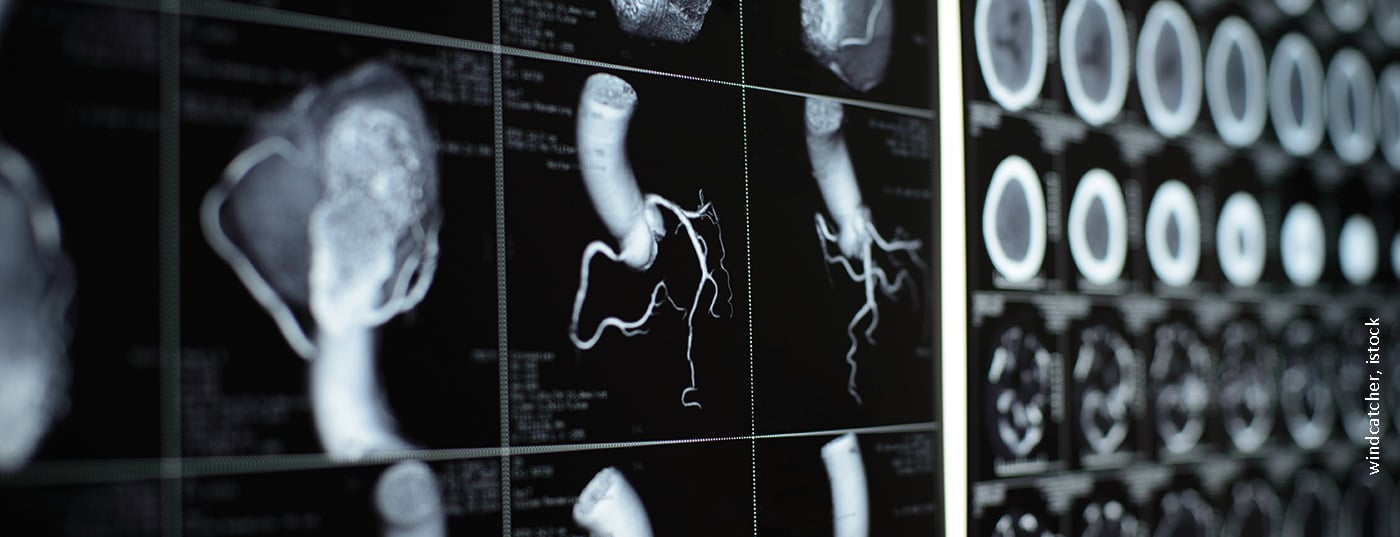
In patients with stable chest pain and an intermediate probability of obstructive coronary artery disease, the benefit-risk profile favors CT rather than invasive coronary angiography as the first diagnostic imaging test.

Studies consistently demonstrate that women who present with stable chest pain and suspected coronary artery disease have more symptoms but less severe myocardial ischemia and less extensive epicardial coronary artery disease than men. This gender paradox leads to increased misdiagnosis and poorer outcomes. This is a problem in view of the fact that coronary heart disease accounts for a similarly high proportion of all causes of death in Western countries in both women and men.

The reference standard for the diagnosis of obstructive coronary artery disease is invasive coronary angiography, which also allows coronary revascularization to be performed in the same session. However, rare but serious procedural complications can occur, and women undergoing invasive coronary screening and treatment are at higher risk for bleeding, vascular complications, and stroke than men. Therefore, the efficacy of computed tomography compared with invasive coronary angiography was evaluated in women and men with stable chest pain suspected of coronary artery disease.

Initial diagnosis CT or invasive coronary angiography

A prospective, multicenter, randomized study included 2002 women and 1559 men (total of 3561 patients) with suspected coronary artery disease due to stable chest pain and a pretest probability of obstructive coronary artery disease of 10-60%. In a 1:1 ratio, they were assigned to either computed tomography or invasive coronary angiography as the initial diagnosis. In addition, an intention-to-treat analysis was performed. The primary end point was serious adverse cardiovascular events (MACE; cardiovascular death, nonfatal myocardial infarction, or nonfatal stroke). Important secondary end points were an extended MACE composite (cardiovascular death, nonfatal myocardial infarction, nonfatal stroke, transient ischemic attack, or serious procedure-related complication) and serious procedure-related complications.

CT superior in terms of complications

No statistically significant gender interaction was found for MACE, the extended MACE composite, or serious procedure-related complications. In both sexes, the rate of MACE did not differ between the computed tomography and invasive coronary angiography groups. In men, the extended composite MACE end point occurred less frequently in the computed tomography group than in the invasive coronary angiography group (2.8% vs 5.3%). Among women, the risk of suffering a major complication related to the procedure was lower in the computed tomography group (0.3%) than in the invasive coronary angiography group (2.1%).

Overall, there was no evidence of a difference between women and men in the utility of computed tomography rather than invasive coronary angiography as the initial diagnosis for the management of stable chest pain in patients with an intermediate pretest probability of coronary artery disease. An initial computed tomographic scan was associated with less severe procedure-related complications in women and a lower incidence of extended MACE composite in men. Sensitivity analysis showed a lower risk of extended MACE in women but no significant interaction between sex and study group for the primary and secondary endpoints. In principle, both men and women benefit from computed tomography as the first diagnostic examination.


Further reading:

  • DISCHARGE Trial Group. Comparative effectiveness of initial computed tomography and invasive coronary angiography in women and men with stable chest pain and suspected coronary artery disease: multicentre randomised trial. BMJ 2022; 379: e071133.


CARDIOVASC 2022; 21(4): 32

Autoren
  • Leoni Burggraf
Publikation
  • CARDIOVASC
Related Topics
  • Coronary angiography
  • Coronary angiography
  • CT. computed tomography
Previous Article
  • From symptom to diagnosis

Dysphagia – Cervical cyst

  • Cases
  • Education
  • General Internal Medicine
  • ORL
  • Radiology
  • RX
  • Surgery
View Post
Next Article
  • Pain therapy with non-opioid analgesics

Benefit-risk assessment and patient education

  • General Internal Medicine
  • Market & Medicine
  • Pharmacology and toxicology
  • Prevention and health care
  • RX
  • Studies
View Post
You May Also Like
View Post
  • 8 min
  • Proteins in wound healing

Do special amino acids lead to success?

    • CME continuing education
    • Dermatology and venereology
    • Endocrinology and Diabetology
    • Nutrition
    • RX
    • Studies
View Post
  • 0 min
  • Psychedelic-assisted therapy

Current status of PAT

    • CME continuing education
    • General Internal Medicine
    • Pharmacology and toxicology
    • Psychiatry and psychotherapy
    • RX
    • Studies
View Post
  • 5 min
  • Hepatitis B prophylaxis

Vaccination protection for healthcare staff with patient contact – an update

    • Congress Reports
    • General Internal Medicine
    • Infectiology
    • Prevention and health care
    • RX
View Post
  • 7 min
  • Plastic surgery and reconstructive microsurgery for DFS

Functional limb preservation between infection control, vascular medicine and resurfacing

    • Angiology
    • CME continuing education
    • Endocrinology and Diabetology
    • General Internal Medicine
    • Geriatrics
    • Physical medicine and rehabilitation
    • RX
    • Surgery
View Post
  • 6 min
  • Chronic urticaria: new treatment alternatives in sight

If antihistamines are not sufficient and IgE levels are low

    • Allergology and clinical immunology
    • Congress Reports
    • Dermatology and venereology
    • Pharmacology and toxicology
    • RX
    • Studies
View Post
  • 14 min
  • Adrenogenital syndrome

Clinical care from birth to adulthood

    • CME continuing education
    • Endocrinology and Diabetology
    • Nephrology
    • Pediatrics
    • RX
    • Studies
View Post
  • 4 min
  • Digital dermatology: innovative project examples

AI and eHealth tools in HS care

    • Dermatology and venereology
    • General Internal Medicine
    • Practice Management
    • Prevention and health care
    • RX
    • Studies
View Post
  • 7 min
  • Atopic dermatitis as a door opener for an atopic cascade?

AD trajectories: Summary of current findings

    • Allergology and clinical immunology
    • Congress Reports
    • Dermatology and venereology
    • RX
    • Studies
  • IBD matters

    Zum Thema
Top CME content
  • 1
    Current status of PAT
  • 2
    Do special amino acids lead to success?
  • 3
    Functional limb preservation between infection control, vascular medicine and resurfacing
  • 4
    Minimally invasive – the quiet triumph of modern heart surgery
  • 5
    HPV prevention, screening innovation and sentinel lymph node biopsy

Newsletter

Sign up and stay up to date

Subscribe
Medizinonline Medizinonline
  • Contact
  • General terms and conditions
  • Imprint

Input your search keywords and press Enter.