Medizinonline Medizinonline
  • News
    • News
    • Market & Medicine
  • Patients
    • Disease patterns
    • Diagnostics
    • Therapy
  • Partner Content
    • Diabetes
      • Dia-Month Club – Type 2 Diabetes
      • Diabetes in Motion
      • Diabetes Podcasts
    • Gastroenterology
      • IBD matters
    • Oncology
      • Swiss Oncology in motion
    • Orthopedics
      • Osteoporosis in motion
  • Departments
    • Allergology and clinical immunology
    • General Internal Medicine
    • Anesthesiology
    • Angiology
    • Surgery
    • Dermatology and venereology
    • Endocrinology and Diabetology
    • Nutrition
    • Gastroenterology and Hepatology
    • Genetics
    • Geriatrics
    • Gynecology
    • Hematology
    • Infectiology
    • Cardiology
    • Nephrology
    • Neurology
    • Emergency and intensive care medicine
    • Nuclear Medicine
    • Oncology
    • Ophthalmology
    • ORL
    • Orthopedics
    • Pediatrics
    • Pharmacology and toxicology
    • Pharmaceutical medicine
    • Phlebology
    • Physical medicine and rehabilitation
    • Pneumology
    • Prevention and health care
    • Psychiatry and psychotherapy
    • Radiology
    • Forensic Medicine
    • Rheumatology
    • Sports Medicine
    • Traumatology and trauma surgery
    • Tropical and travel medicine
    • Urology
    • Dentistry
  • CME & Congresses
    • CME continuing education
    • Congress Reports
    • Congress calendar
  • Practice
    • Noctimed
    • Practice Management
    • Jobs
    • Interviews
  • Log In
  • Register
  • My account
  • Contact
  • Publications
  • Contact
  • Deutsch
  • English
  • Français
  • Italiano
  • Português
  • Español
Subscribe
Medizinonline Medizinonline
  • News
    • News
    • Market & Medicine
  • Patienten
    • Krankheitsbilder
    • Diagnostik
    • Therapie
  • Partner Content
    • Diabetes
      • Dia-Month Club – Type 2 Diabetes
      • Diabetes in Motion
      • Diabetes Podcasts
    • Gastroenterology
      • IBD matters
    • Oncology
      • Swiss Oncology in motion
    • Orthopedics
      • Osteoporosis in motion
    • Phytotherapie
    • Rheumatology
  • Departments
    • Fachbereiche 1-13
      • Allergology and clinical immunology
      • General Internal Medicine
      • Anesthesiology
      • Angiology
      • Surgery
      • Dermatology and venereology
      • Endocrinology and Diabetology
      • Nutrition
      • Gastroenterology and Hepatology
      • Genetics
      • Geriatrics
      • Gynecology
      • Hematology
    • Fachbereiche 14-26
      • Infectiology
      • Cardiology
      • Nephrology
      • Neurology
      • Emergency and intensive care medicine
      • Nuclear Medicine
      • Oncology
      • Ophthalmology
      • ORL
      • Orthopedics
      • Pediatrics
      • Pharmacology and toxicology
      • Pharmaceutical medicine
    • Fachbereiche 26-38
      • Phlebology
      • Physical medicine and rehabilitation
      • Phytotherapy
      • Pneumology
      • Prevention and health care
      • Psychiatry and psychotherapy
      • Radiology
      • Forensic Medicine
      • Rheumatology
      • Sports Medicine
      • Traumatology and trauma surgery
      • Tropical and travel medicine
      • Urology
      • Dentistry
  • CME & Congresses
    • CME continuing education
    • Congress Reports
    • Congress calendar
  • Practice
    • Noctimed
    • Practice Management
    • Jobs
    • Interviews
Login

Sie haben noch keinen Account? Registrieren

  • Hypertension

Uncontrolled hypertension in the elderly: dose increase or another drug?

    • Cardiology
    • Education
    • General Internal Medicine
    • Geriatrics
    • RX
    • Studies
  • 3 minute read

If the target blood pressure is not achieved, there are two approaches to intensify antihypertensive treatment: adding a new drug or maximizing the dose. A large-scale cohort study involving researchers from the University Hospital of Bern addressed this issue. The results were recently published in the Annals of Internal Medicine.

Hypertension is the most important modifiable risk factor for cardiovascular disease, and this is also true for the elderly. A population-based retrospective study analyzed data from 178 562 persons over 65 years of age who received intensified hypertension treatment for uncontrolled hypertension. The mean age was 75.8 years, and an inclusion criterion was that at least one antihypertensive medication was less than the maximum dose [1]. It was found that intensification was done by adding a new drug only in 25.5%, while all others had dose maximization of the existing medication. The proportion of patients in the dose-maximization group who continued the added-dose treatment after three months was 65.0%, which was higher than the proportion of those in the added-dose antihypertensive group who maintained the added-dose medication (49.8%). The suspected reasons for this are side effects and drug interactions. However, with regard to reduction of mean systolic blood pressure, the treatment strategy of adding an antihypertensive proved to be more effective: after three months, the difference in favor of this treatment group was 0.8 mm Hg and after 12 months, 1.1 mm Hg compared to the group with dose maximization (-5.6 vs -4.5 mm Hg).

Therapy decision: differentiated risk-benefit assessment required

That the addition of an antihypertensive agent has a greater impact on lowering systolic blood pressure is not surprising, but especially in elderly patients this benefit must be weighed against the risks. On the one hand, with regard to any comorbidities, especially since multimorbidity is common in elderly patients, and on the other hand, due to age-related increased vulnerability to adverse drug reactions. Another factor to consider is that treatment should be as simple as possible, as this has a favorable effect on adherence. This argues for up-dosing of an existing antihypertensive medication, provided that sufficient treatment effects can be achieved thereby. If the treatment regimen must be changed to add an additional antihypertensive, it is important to explain the need for this to the patient. Regardless of the strategy chosen to intensify hyptertensive treatment, follow-up should occur approximately one month later to assess efficacy, tolerability, and adherence. Adequate blood pressure control is significant because arterial hypertension is one of the most important risk factors for cardiovascular disease and this is associated with an increased risk of mortality [2].


Age-adjusted target range of blood pressure values?

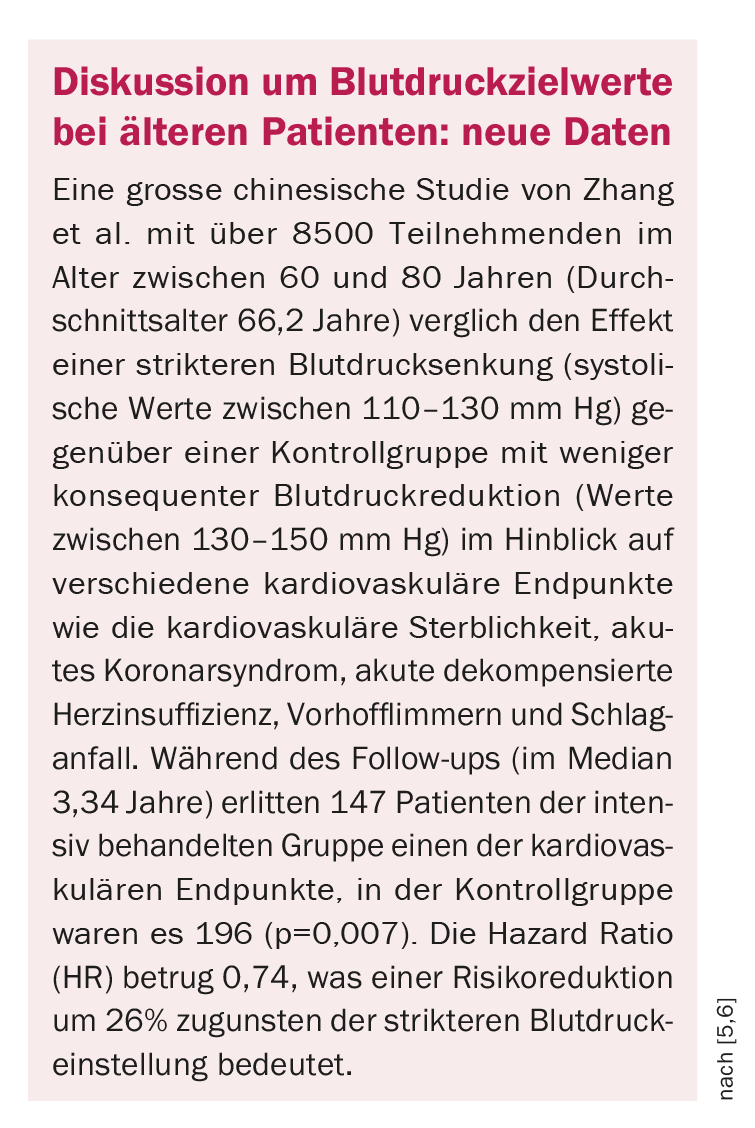
However, the various professional societies do not agree on the specific target values for patients of advanced age. The American guidelines have long recommended that even in older patients, a consistent reduction in blood pressure to values below 130 mm Hg should be aimed for, whereas the current European ESC/ESH guideline defines a systolic blood pressure between 130-139 mmHg as the target corridor in the 65-80 age group [3,4]. A study published in late August in the New England Journal of Medicine reignites the debate about appropriate target levels in this age group (box) [5,6].


Literature:

  1. Aubert CE, et al: Ann Intern Med 2021 Oct 5. doi: 10.7326/M21-1456.
  2. Statista: Causes of death in Germany. ID 687971, https://de.statista.com/themen/69/todesursachen (last accessed Nov. 19, 2021).
  3. Whelton PK, et al: J Am Coll Cardiol 2018; 71: e127-e248.
  4. Williams B, et al: Eur Heart J 2018; 39: 3021-3104.
  5. “New study shows: Older people also benefit from stricter blood pressure reduction”, Deutsche Hochdruckliga, 03.09.2021
  6. Zhang W, et al: NEJM, August 30, 2021. doi: 10.1056/NEJMoa2111437


CARDIOVASC 2021; 20(4): 22
HAUSARZT PRAXIS 2021; 16(12): 44
Autoren
  • Mirjam Peter, M.Sc.
Publikation
  • CARDIOVASC
Related Topics
  • Hypertension
  • Hypertension
Previous Article
  • Dyslipidemia

Effective lipid management – lipid apheresis as a last resort?

  • Angiology
  • Cardiology
  • Education
  • General Internal Medicine
  • RX
View Post
Next Article
  • Therapy of venous occlusions

Endovascular interventions – option for patients with more pronounced symptoms

  • Angiology
  • Cardiology
  • CME continuing education
  • Education
  • General Internal Medicine
  • Oncology
  • Phlebology
  • RX
View Post
You May Also Like
View Post
  • 5 min
  • Viloxazine for ADHD

A non-stimulating option—but with limited evidence

    • RX
    • Education
    • Neurology
    • Pediatrics
    • Pharmacology and toxicology
    • Psychiatry and psychotherapy
    • Studies
View Post
  • 6 min
  • Preclinical study on phytotherapeutic agent

Active ingredient combination of peppermint and caraway oil modified fecal microbiota

    • RX
    • Education
    • Gastroenterology and Hepatology
    • General Internal Medicine
    • Pharmaceutical medicine
    • Phytotherapy
    • Studies
View Post
  • 4 min
  • Casuistry

Rituximab used effectively against IgG4-RD colitis

    • RX
    • Cases
    • Education
    • Gastroenterology and Hepatology
    • General Internal Medicine
    • Radiology
    • Rheumatology
View Post
  • 5 min
  • Sarcoidosis

New options from JAKi to mTOR

    • RX
    • Congress Reports
    • General Internal Medicine
    • Pneumology
    • Studies
View Post
  • 6 min
  • Head and neck squamous cell carcinoma

Precision immunotherapy and local treatment

    • RX
    • Congress Reports
    • Dermatology and venereology
    • Oncology
    • ORL
    • Studies
View Post
  • 3 min
  • From symptom to diagnosis

Abdominal pain – Prostate cysts

    • RX
    • Cases
    • Education
    • General Internal Medicine
    • Radiology
    • Surgery
    • Urology
View Post
  • 0 min
  • Multimodal Parkinson's Treatment

Positive Effects of a Music-Based Intervention

    • RX
    • Education
    • Geriatrics
    • Neurology
    • Physical medicine and rehabilitation
    • Psychiatry and psychotherapy
View Post
  • 8 min
  • Psychooncology

Communication as the key to therapy adherence

    • RX
    • CME continuing education
    • General Internal Medicine
    • Practice Management
  • IBD matters

    Zum Thema
Top CME content
  • 1
    Current State of Knowledge and New Therapeutic Approaches
  • 2
    Why is it so hard to lose weight?
  • 3
    Functional limb preservation between infection control, vascular medicine and resurfacing
  • 4
    Algorithms, avatars and the unburdened mind
  • 5
    Communication as the key to therapy adherence

Newsletter

Sign up and stay up to date

Subscribe
Medizinonline Medizinonline
  • Contact
  • General terms and conditions
  • Imprint

Input your search keywords and press Enter.