Medizinonline Medizinonline
  • News
    • News
    • Market & Medicine
  • Patients
    • Disease patterns
    • Diagnostics
    • Therapy
  • Partner Content
    • Diabetes
      • Dia-Month Club – Type 2 Diabetes
      • Diabetes in Motion
      • Diabetes Podcasts
    • Gastroenterology
      • IBD matters
    • Oncology
      • Swiss Oncology in motion
    • Orthopedics
      • Osteoporosis in motion
  • Departments
    • Allergology and clinical immunology
    • General Internal Medicine
    • Anesthesiology
    • Angiology
    • Surgery
    • Dermatology and venereology
    • Endocrinology and Diabetology
    • Nutrition
    • Gastroenterology and Hepatology
    • Genetics
    • Geriatrics
    • Gynecology
    • Hematology
    • Infectiology
    • Cardiology
    • Nephrology
    • Neurology
    • Emergency and intensive care medicine
    • Nuclear Medicine
    • Oncology
    • Ophthalmology
    • ORL
    • Orthopedics
    • Pediatrics
    • Pharmacology and toxicology
    • Pharmaceutical medicine
    • Phlebology
    • Physical medicine and rehabilitation
    • Pneumology
    • Prevention and health care
    • Psychiatry and psychotherapy
    • Radiology
    • Forensic Medicine
    • Rheumatology
    • Sports Medicine
    • Traumatology and trauma surgery
    • Tropical and travel medicine
    • Urology
    • Dentistry
  • CME & Congresses
    • CME continuing education
    • Congress Reports
    • Congress calendar
  • Practice
    • Noctimed
    • Practice Management
    • Jobs
    • Interviews
  • Log In
  • Register
  • My account
  • Contact
  • Publications
  • Contact
  • Deutsch
  • English
  • Français
  • Italiano
  • Português
  • Español
Subscribe
Medizinonline Medizinonline
  • News
    • News
    • Market & Medicine
  • Patienten
    • Krankheitsbilder
    • Diagnostik
    • Therapie
  • Partner Content
    • Diabetes
      • Dia-Month Club – Type 2 Diabetes
      • Diabetes in Motion
      • Diabetes Podcasts
    • Gastroenterology
      • IBD matters
    • Oncology
      • Swiss Oncology in motion
    • Orthopedics
      • Osteoporosis in motion
    • Phytotherapie
    • Rheumatology
  • Departments
    • Fachbereiche 1-13
      • Allergology and clinical immunology
      • General Internal Medicine
      • Anesthesiology
      • Angiology
      • Surgery
      • Dermatology and venereology
      • Endocrinology and Diabetology
      • Nutrition
      • Gastroenterology and Hepatology
      • Genetics
      • Geriatrics
      • Gynecology
      • Hematology
    • Fachbereiche 14-26
      • Infectiology
      • Cardiology
      • Nephrology
      • Neurology
      • Emergency and intensive care medicine
      • Nuclear Medicine
      • Oncology
      • Ophthalmology
      • ORL
      • Orthopedics
      • Pediatrics
      • Pharmacology and toxicology
      • Pharmaceutical medicine
    • Fachbereiche 26-38
      • Phlebology
      • Physical medicine and rehabilitation
      • Phytotherapy
      • Pneumology
      • Prevention and health care
      • Psychiatry and psychotherapy
      • Radiology
      • Forensic Medicine
      • Rheumatology
      • Sports Medicine
      • Traumatology and trauma surgery
      • Tropical and travel medicine
      • Urology
      • Dentistry
  • CME & Congresses
    • CME continuing education
    • Congress Reports
    • Congress calendar
  • Practice
    • Noctimed
    • Practice Management
    • Jobs
    • Interviews
Login

Sie haben noch keinen Account? Registrieren

  • Cardiac markers

When helpful, when misleading?

    • Angiology
    • Cardiology
    • Congress Reports
    • Hematology
    • RX
  • 4 minute read

The established cardiac markers BNP, NT-pro-BNP, troponins, and D-dimers are important diagnostic tools. However, they can be false-positive and thus lead to misdiagnosis. In a seminar at this year’s KHM Congress, Prof. Franz Eberli, MD, Zurich, explained when the determination of cardiac markers is useful and helpful, and where their limitations lie.

The natriuretic peptides (ANP, BNP, CNP, urodilatin) are very potent and have a whole range of roles such as:

  • Natriuresis
  • Diuresis
  • Vasodilation
  • Improvement of the diastolic function (lusitropic effect)
  • Inhibition of the RAA system (renin-angiotensin-aldosterone system).
  • Inhibition of endothelin release
  • Inhibition of smooth muscle cell and endothelial cell growth
  • Inhibition of cell division.

Enzymatic cleavage produces NT-pro-BNP and BNP from pro-BNP, which have different dynamics. NT-pro-BNP is more stable and fluctuates less than BNP, making it more suitable as a progression parameter. BNP and NT-pro-BNP levels are not elevated in noncardiac dyspnea, helping to distinguish cardiac from noncardiac dyspnea. Further, they correlate relatively well with heart failure severity and, together with clinic, increase diagnostic accuracy. Regarding rule-in and rule-out values, BNP and NT-pro-BNP have to be considered separately.

Heart failure is unlikely at a BNP <100 pg/ml and likely at >400 pg/ml. If the values are in between, the diagnosis is uncertain. When interpreting the values, it must be noted that they are elevated, for example, in renal insufficiency, but also after exercise (tab. 1) .
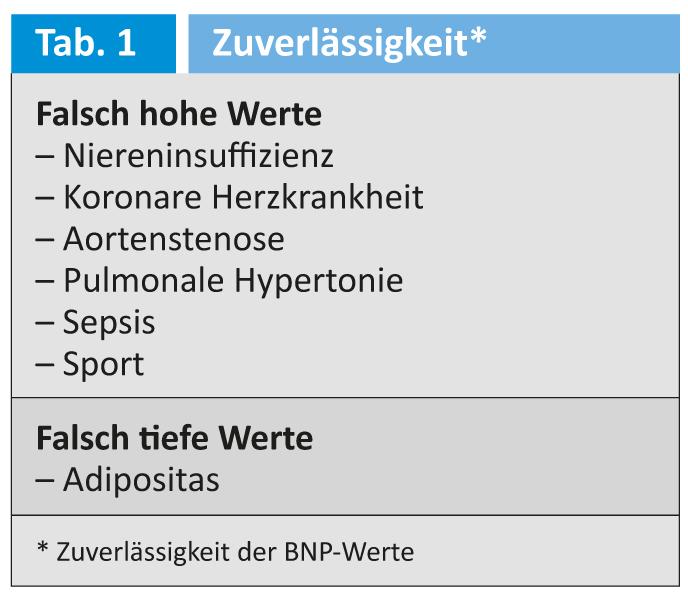
“With a patient who comes to your practice on a bicycle, you cannot utilize the BNP. The resting value is only reached again after one to two hours,” emphasized Prof. Franz Eberli, MD, Zurich.

NT-pro-BNP is more stable than BNP, but it has the disadvantage that the normal values are age-dependent, unlike BNP. “This is not taken into account in the ESC guidelines or by the laboratories. In older patients, it can therefore happen that the laboratory marks a value as pathological, although it would be normal for this age group. This is misleading, and caution is required here,” warned Prof. Eberli. “Combine that with the fact that many labs no longer determine age-independent BNP but automatically provide NT-pro-BNP when you order a BNP.” Rule-in and rule-out values of NT-pro-BNP for different age groups are shown in Figure 1 .
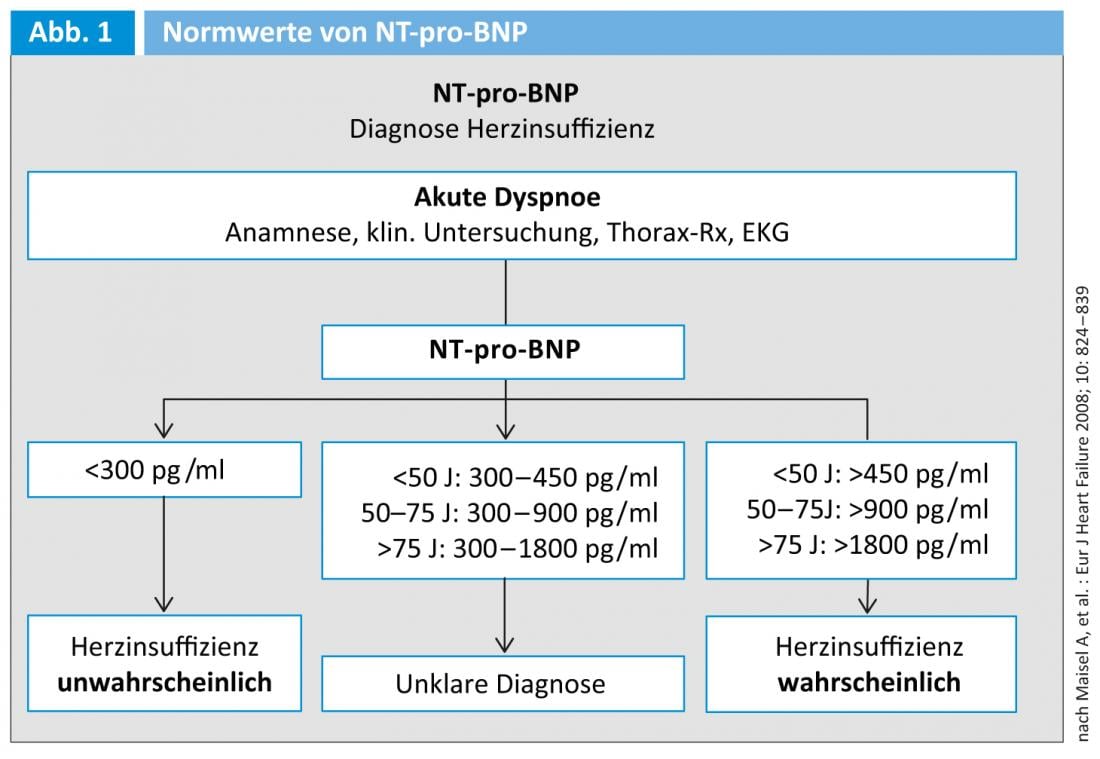
On various occasions, it has been advocated that heart failure treatment should be titrated on the basis of BNP or NT-pro-BNP levels. However, some studies have now shown that no relevant improvement can be achieved by this, at least in the older patients, which is why this procedure is not recommended.

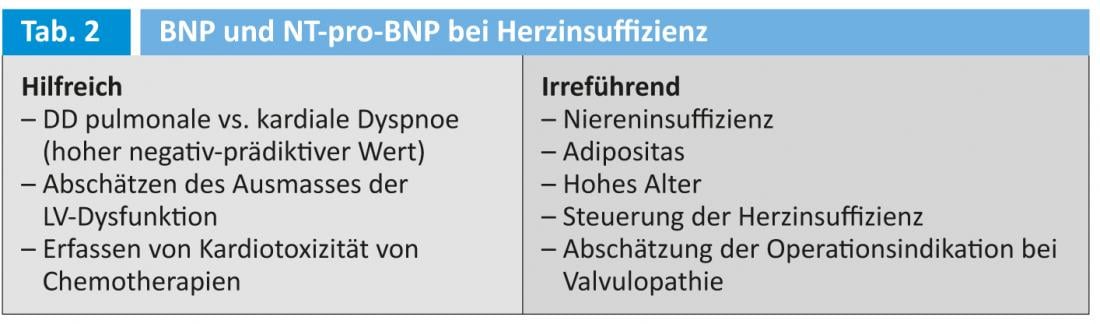
In conclusion, BNP and NT-pro-BNP are helpful in distinguishing cardiac from noncardiac dyspnea and in estimating the extent of left ventricular dysfunction. However, it is important to remember that the values are elevated in renal insufficiency (the worse the kidney, the higher the values) and the normal values of NT-pro-BNP are age-dependent (Table 2).
Risk of misdiagnosis with hs-troponin

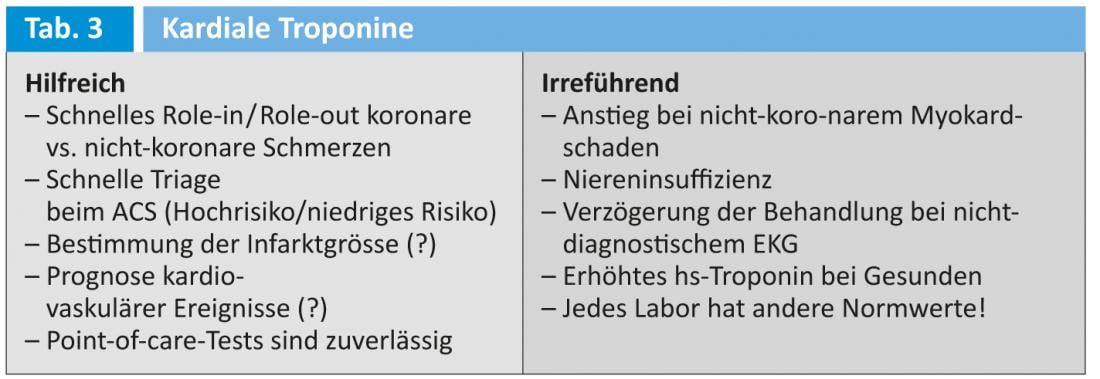
Cardiac troponins are very specific and therefore good markers that are very useful in differentiating between cardiac and noncardiac pain and in risk stratification in acute coronary syndrome (ACS) (Fig. 2, Table 3) .
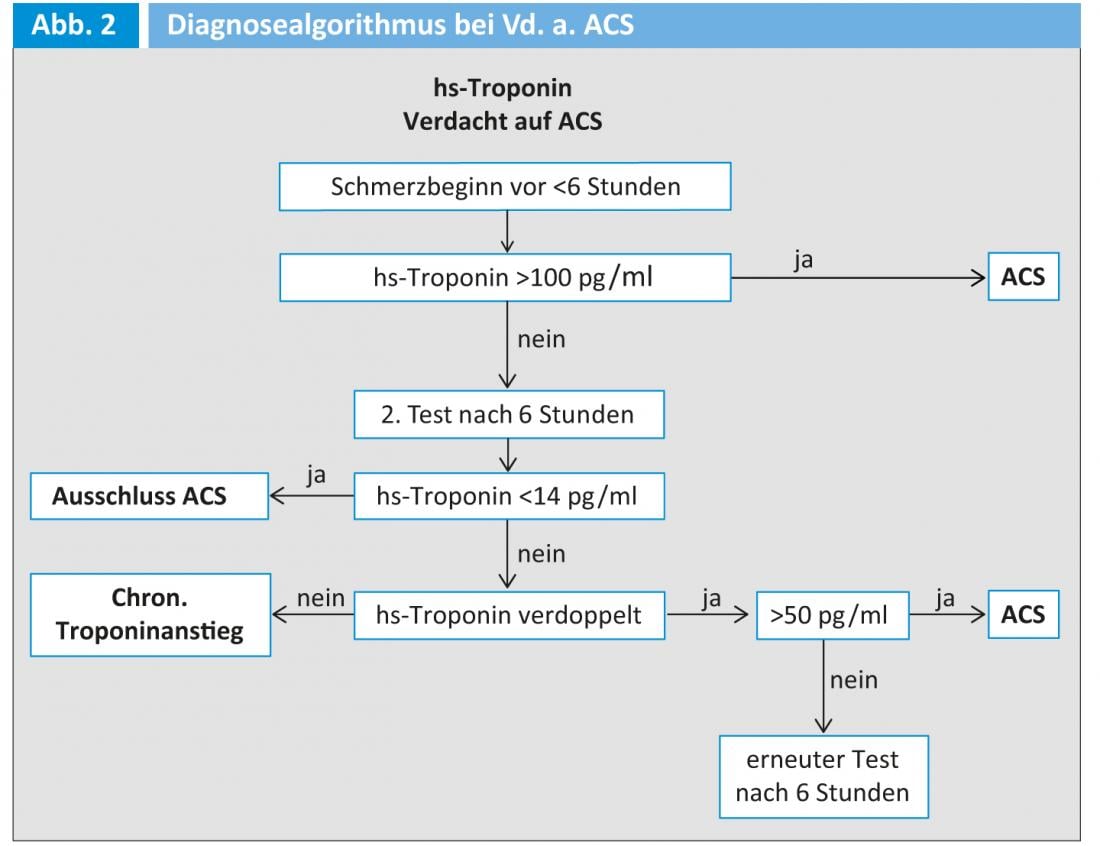
Like natriuretic peptides, troponins have a very high negative-predictive value. However, they have a limited sensitivity and rise only after 4-6 hours, which is why today more and more laboratories determine only the more sensitive hs-troponin, which rises already after 2-3 hours. “There is only one measurement method for hs-troponin, but a low level can also be detected in virtually all healthy individuals. Therefore, diagnosis becomes more complicated and there is a risk of misdiagnosis,” says Prof. Eberli. In contrast, the point-of-care tests for hs-troponin commonly used in practices are very reliable. Troponins are not suitable for follow-up assessment because they have a half-life of 2-3 days.

It should be further considered that troponins may also be elevated in nonischemic myocardial damage, such as myocarditis, pulmonary embolism, tachycardic atrial fibrillation, acute heart failure, pulmonary edema, or cardiac trauma, and also in renal failure, neoplasia, and rhabdomyolysis (Table 3).
D-dimer – high negative predictive value

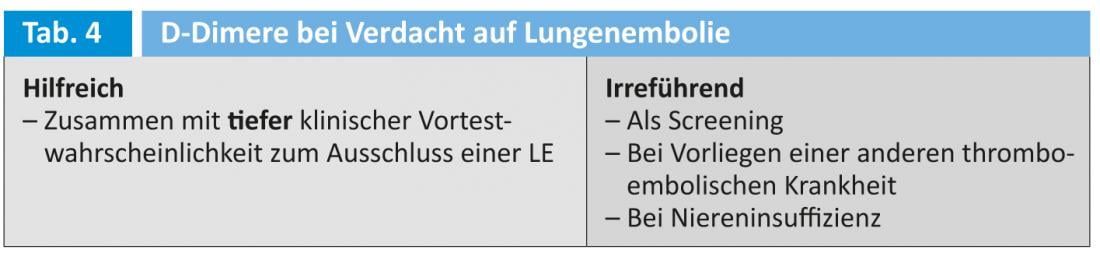
Sensitivity and specificity of clinical assessment in suspected pulmonary embolism are insufficient. Here, the determination of D-dimers can be very helpful. Depending on the assay, the determination time varies between 2 min and >8 hr, the sensitivity between 82% and 95%. “The faster the test, the worse the sensitivity,” Prof. Eberli emphasized. For D-dimers, too, there are many reasons for elevation besides pulmonary embolism (other thromboembolic events, age >70 years, hepatic, renal insufficiency, inflammatory status, stress, physical exertion, surgical procedures, etc.), which is why it is true for D-dimers that the specificity is low, the negative-predictive value at low
clinical probability, however, is very high. The D-dimers are therefore particularly useful in ruling out pulmonary embolism with certainty in cases of low clinical probability (Table 4).
Source: “Cardiac markers, when helpful, when misleading?”, seminar at the 15th Continuing Education Conference of the College of Family Medicine (KHM), June 20-21, 2013, Lucerne.
Autoren
  • Dr. med. Sabina M. Ludin
Publikation
  • CARDIOVASC
Related Topics
  • BNP
  • cardiac markers
  • Cardiac troponins
  • false positive
  • Heart failure
  • KHM Congress
  • Misdiagnosis
  • NT-pro-BNP
  • Pulmonary embolism
  • Reliability
  • Standard value
  • Troponins
Previous Article
  • Acute coronary syndrome

What medications can be used in everyday practice?

  • Angiology
  • Cardiology
  • Congress Reports
  • Endocrinology and Diabetology
  • RX
View Post
Next Article
  • Treatment of chronic and acute heart failure

Innovations in the current ESC guidelines

  • Angiology
  • Cardiology
  • Education
  • Hematology
  • RX
View Post
You May Also Like
View Post
  • 4 min
  • HER2+ early breast cancer

DESTINY-Breast11 – neoadjuvant T-DXd without anthracyclines

    • Education
    • Gynecology
    • Oncology
    • RX
    • Studies
View Post
  • 3 min
  • Lavender aromatherapy

Take away the fear of the dentist

    • Dentistry
    • Education
    • Pharmaceutical medicine
    • Phytotherapy
    • Psychiatry and psychotherapy
    • RX
    • Studies
View Post
  • 4 min
  • Digital dermatology: innovative project examples

AI and eHealth tools in HS care

    • Dermatology and venereology
    • General Internal Medicine
    • Practice Management
    • Prevention and health care
    • RX
    • Studies
View Post
  • 5 min
  • Mantle cell lymphoma

Recurrence after BTK inhibition – prognostic factors and treatment options

    • Education
    • Hematology
    • Oncology
    • RX
View Post
  • 3 min
  • Dementia risk with type 2 diabetes

SGLT2 inhibitors with advantages vs. DPP4 inhibitors

    • Education
    • Endocrinology and Diabetology
    • Geriatrics
    • Neurology
    • Pharmacology and toxicology
    • Psychiatry and psychotherapy
    • RX
    • Studies
View Post
  • 15 min
  • T helper 1 cells

Differentiation and activation of Th1 cells – a multi-omics approach

    • RX
    • CME continuing education
    • General Internal Medicine
    • Genetics
    • Prevention and health care
View Post
  • 4 min
  • Cannabis for schizophrenia

CBD pre-treatment could exacerbate side effects

    • Education
    • Pharmacology and toxicology
    • Phytotherapy
    • Psychiatry and psychotherapy
    • RX
    • Studies
View Post
  • 11 min
  • Type 2 diabetes: cardiovascular risk reduction is realistic

Modern active ingredients and lifestyle – every step counts

    • Cardiology
    • Congress Reports
    • Endocrinology and Diabetology
    • Prevention and health care
    • RX
    • Studies
  • IBD matters

    Zum Thema
Top CME content
  • 1
    Communication as the key to therapy adherence
  • 2
    Solutions to the malnutrition dilemma
  • 3
    Solutions to the malnutrition dilemma
  • 4
    Focus on preventive care options
  • 5
    Fertility preservation from gonads to genomes to genoids

Newsletter

Sign up and stay up to date

Subscribe
Medizinonline Medizinonline
  • Contact
  • General terms and conditions
  • Imprint

Input your search keywords and press Enter.