Medizinonline Medizinonline
  • News
    • News
    • Market & Medicine
  • Patients
    • Disease patterns
    • Diagnostics
    • Therapy
  • Partner Content
    • Dermatology
      • Atopic dermatitis and psoriasis news
    • Diabetes
      • Dia-Month Club – Type 2 Diabetes
      • Diabetes in Motion
      • Diabetes Podcasts
    • Gastroenterology
      • IBD matters
    • Oncology
      • Swiss Oncology in motion
    • Orthopedics
      • Osteoporosis in motion
  • Departments
    • Allergology and clinical immunology
    • General Internal Medicine
    • Anesthesiology
    • Angiology
    • Surgery
    • Dermatology and venereology
    • Endocrinology and Diabetology
    • Nutrition
    • Gastroenterology and Hepatology
    • Genetics
    • Geriatrics
    • Gynecology
    • Hematology
    • Infectiology
    • Cardiology
    • Nephrology
    • Neurology
    • Emergency and intensive care medicine
    • Nuclear Medicine
    • Oncology
    • Ophthalmology
    • ORL
    • Orthopedics
    • Pediatrics
    • Pharmacology and toxicology
    • Pharmaceutical medicine
    • Phlebology
    • Physical medicine and rehabilitation
    • Pneumology
    • Prevention and health care
    • Psychiatry and psychotherapy
    • Radiology
    • Forensic Medicine
    • Rheumatology
    • Sports Medicine
    • Traumatology and trauma surgery
    • Tropical and travel medicine
    • Urology
    • Dentistry
  • CME & Congresses
    • CME continuing education
    • Congress Reports
    • Congress calendar
  • Practice
    • Noctimed
    • Practice Management
    • Jobs
    • Interviews
  • Log In
  • Register
  • My account
  • Contact
  • Publications
  • Contact
  • Deutsch
  • English
  • Français
  • Italiano
  • Português
  • Español
Subscribe
Medizinonline Medizinonline
  • News
    • News
    • Market & Medicine
  • Patienten
    • Krankheitsbilder
    • Diagnostik
    • Therapie
  • Partner Content
    • Dermatology
      • Atopic dermatitis and psoriasis news
    • Diabetes
      • Dia-Month Club – Type 2 Diabetes
      • Diabetes in Motion
      • Diabetes Podcasts
    • Gastroenterology
      • IBD matters
    • Oncology
      • Swiss Oncology in motion
    • Orthopedics
      • Osteoporosis in motion
    • Phytotherapie
    • Rheumatology
  • Departments
    • Fachbereiche 1-13
      • Allergology and clinical immunology
      • General Internal Medicine
      • Anesthesiology
      • Angiology
      • Surgery
      • Dermatology and venereology
      • Endocrinology and Diabetology
      • Nutrition
      • Gastroenterology and Hepatology
      • Genetics
      • Geriatrics
      • Gynecology
      • Hematology
    • Fachbereiche 14-26
      • Infectiology
      • Cardiology
      • Nephrology
      • Neurology
      • Emergency and intensive care medicine
      • Nuclear Medicine
      • Oncology
      • Ophthalmology
      • ORL
      • Orthopedics
      • Pediatrics
      • Pharmacology and toxicology
      • Pharmaceutical medicine
    • Fachbereiche 26-38
      • Phlebology
      • Physical medicine and rehabilitation
      • Phytotherapy
      • Pneumology
      • Prevention and health care
      • Psychiatry and psychotherapy
      • Radiology
      • Forensic Medicine
      • Rheumatology
      • Sports Medicine
      • Traumatology and trauma surgery
      • Tropical and travel medicine
      • Urology
      • Dentistry
  • CME & Congresses
    • CME continuing education
    • Congress Reports
    • Congress calendar
  • Practice
    • Noctimed
    • Practice Management
    • Jobs
    • Interviews
Login

Sie haben noch keinen Account? Registrieren

  • Multiple sclerosis

Effective treatment strategies right from the start – opportunities, risks, benefits

    • Education
    • Neurology
    • Rheumatology
    • RX
    • Studies
  • 3 minute read

Treatment of multiple sclerosis is aimed at reducing relapses, lowering disease activity, and slowing the progression of the disease and increase in disability. Both course and long-term therapy with e.g. immunomodulatory or immunosuppressive drugs can be used for this purpose. But what is indicated and when?

Multiple sclerosis (MS) is not just MS – that is well known. In fact, there certainly seems to be a high proportion of patients with benign courses. A study published last year indicated that after a 30-year follow-up, 40% of those with RRMS were still fully ambulatory (EDSS <3.5) [1]. The study is based on follow-up data of individuals with clinically isolated syndrome (CIS). 80 out of 120 patients developed MS within the observation period. In about one third of the cases, the MS was secondary progressive (SPMS) and all of them had EDSS scores above 3.5 at the end. MS led to premature death in one-fifth of all people with the disease. Because no immunomodulatory therapies were available outside of trials at the time of enrollment, only 11 patients received disease-modifying treatment. This suggests that not all MS takes a malignant course and therefore mild treatment regimens or a wait-and-see strategy may be warranted. Furthermore, in a Swedish cohort study, it was observed that under highly active therapies, the risk of infection in MS patients is increased compared to the normal population [2]. This is due in part to an emerging immunoglobulin deficiency associated with infections that can occur with disease-modifying treatments.

Hit hard and early – the right strategy?

In contrast, a registry analysis concludes that early and intensive therapy can slow the progression of MS disease more than an escalation strategy [3]. For this purpose, an early start of highly active therapy or escalation to higher active treatment in the period up to two years after diagnosis was compared with a later start or escalation four to six years after diagnosis. It was found that the prognosis of MS patients with early onset was better by about one EDSS point after six to ten years of therapy. In addition, studies that have evaluated highly active agents against less active agents demonstrate that immunotherapy is associated with a significantly better outcome [4].

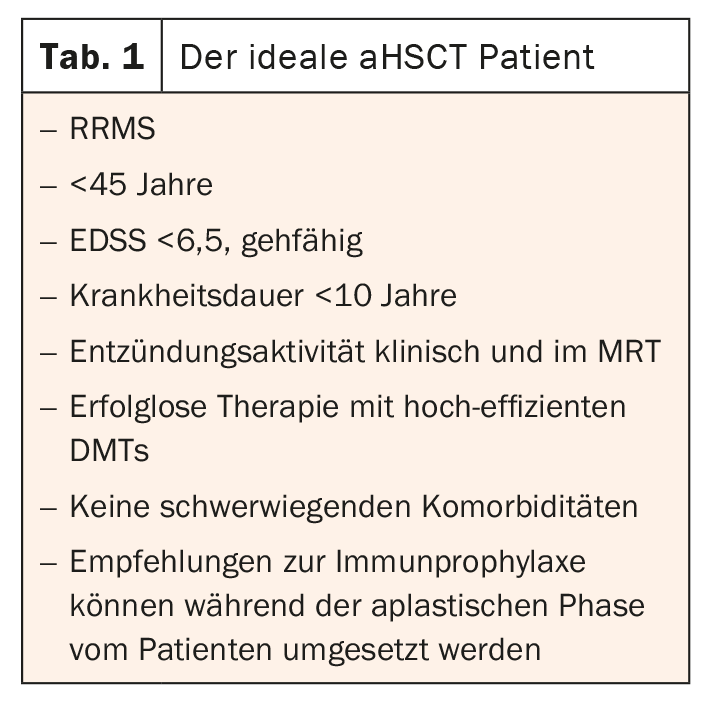
Autologous stem cell transplantation (aHSCT) is available as ultima ratio. However, not all patients are suitable for these. In this case, all other options should be exhausted in advance and the patient should be fully informed (Table 1) [5].


Evidence supports highly effective MS therapy

If the high NEDA rates and improvement in EDSS are taken as a basis, the evidence clearly supports the use of highly effective treatment options from the outset. In the meantime, a better understanding of the possible side effects has also been gained, so that these can be managed well. Nevertheless, the focus should be on comprehensive diagnostics and patients should be selected individually according to the benefit/risk profile.


Literature:

  1. Chung KK, et al: A 30-Year Clinical and Magnetic Resonance Imaging Observational Study of Multiple Sclerosis and Clinically Isolated Syndromes. Ann Neurol 2020; 87(1): 63-74.
  2. Luna G, et al: Infection Risks Among Patients With Multiple Sclerosis Treated With Fingolimod, Natalizumab, Rituximab, and Injectable Therapies. JAMA Neurol 2019; 77(2): 184-191.
  3. He A, et al: Timing of high-efficacy therapy for multiple sclerosis: a retrospective observational cohort study. Lancet Neurol 2020; 19(4): 307-316.
  4. Hauser SL, et al: Ofatumumab versus teriflunomide in multiple sclerosis. N Engl J Med 2020; 383: 546-557.
  5. Gavrillaki, et al: Autologous Hematopoietic Cell Transplantation in Multiple Sclerosis: Changing Paradigms in the Era of Novel Agents. Stem Cells Int 2019; 5840286.


InFo NEUROLOGY & PSYCHIATRY 2021; 19(3): 28.

Autoren
  • Leoni Burggraf
Publikation
  • InFo NEUROLOGIE & PSYCHIATRIE
Related Topics
  • Immunomodulation
  • Immunosuppression
  • Multiple sclerosis
Previous Article
  • Uterine tumors

State of the Art

  • CME continuing education
  • Education
  • Gynecology
  • Oncology
  • RX
  • Studies
  • Surgery
View Post
Next Article
  • Psoriasis vulgaris

Patient-adapted biologics therapy – What does the new S3 guideline say?

  • Congress Reports
  • Dermatology and venereology
  • Rheumatology
  • RX
  • Studies
View Post
You May Also Like
View Post
  • 5 min
  • Heart failure: combination of four as "Guideline-Directed Medical Therapy"

Standard established at HFrEF with individual nuances

    • Cardiology
    • Congress Reports
    • General Internal Medicine
    • Nephrology
    • RX
    • Studies
View Post
  • 7 min
  • Chronic inflammation as a driver of ageing

Immunosenescence and inflammaging

    • Education
    • General Internal Medicine
    • Genetics
    • Geriatrics
    • Oncology
    • Prevention and health care
    • RX
    • Studies
View Post
  • 8 min
  • Evidence, limitations and practical implications

Phytotherapy for anxiety disorders

    • Education
    • General Internal Medicine
    • Pharmaceutical medicine
    • Phytotherapy
    • Psychiatry and psychotherapy
    • RX
    • Studies
View Post
  • 3 min
  • Case report: Hiccups after ketoacidosis

Nebulized lidocaine brings relief

    • Cardiology
    • Cases
    • Education
    • Endocrinology and Diabetology
    • General Internal Medicine
    • Neurology
    • ORL
    • Pneumology
    • RX
    • Studies
View Post
  • 6 min
  • Hidradenitis suppurativa: biologics reduce inflammatory processes

Treatment recommendations depend on the severity and inflammatory activity

    • Allergology and clinical immunology
    • Congress Reports
    • Dermatology and venereology
    • Infectiology
    • RX
    • Studies
View Post
  • 7 min
  • Dizziness as a leading symptom: new consensus paper

Current recommendations for handling in everyday practice

    • Education
    • General Internal Medicine
    • Neurology
    • ORL
    • RX
    • Studies
View Post
  • 12 min
  • Endometrial carcinoma, malignant melanoma and NSCLC in focus

Personalized mRNA and neoantigen vaccines in oncology

    • Education
    • Genetics
    • Infectiology
    • Oncology
    • Prevention and health care
    • RX
    • Studies
View Post
  • 5 min
  • Consequences for pathophysiology, clinic and therapy

The inflammatory subgroup of major depression

    • Education
    • Pharmacology and toxicology
    • Psychiatry and psychotherapy
    • RX
    • Studies
  • IBD matters

    Zum Thema
Top CME content
  • 1
    Control instead of a flood of data: AI makes big data and wearables usable
  • 2
    Causes and prevention at work
  • 3
    Yellow nail and Swyer-James syndrome
  • 4
    Recommendations for action in practice
  • 5
    From the β-cell to the center: the versatile role of amylin

Newsletter

Sign up and stay up to date

Subscribe
Medizinonline Medizinonline
  • Contact
  • General terms and conditions
  • Imprint

Input your search keywords and press Enter.