Medizinonline Medizinonline
  • News
    • News
    • Market & Medicine
  • Patients
    • Disease patterns
    • Diagnostics
    • Therapy
  • Partner Content
    • Dermatology
      • Atopic dermatitis and psoriasis news
    • Diabetes
      • Dia-Month Club – Type 2 Diabetes
      • Diabetes in Motion
      • Diabetes Podcasts
    • Gastroenterology
      • IBD matters
    • Oncology
      • Swiss Oncology in motion
    • Orthopedics
      • Osteoporosis in motion
  • Departments
    • Allergology and clinical immunology
    • General Internal Medicine
    • Anesthesiology
    • Angiology
    • Surgery
    • Dermatology and venereology
    • Endocrinology and Diabetology
    • Nutrition
    • Gastroenterology and Hepatology
    • Genetics
    • Geriatrics
    • Gynecology
    • Hematology
    • Infectiology
    • Cardiology
    • Nephrology
    • Neurology
    • Emergency and intensive care medicine
    • Nuclear Medicine
    • Oncology
    • Ophthalmology
    • ORL
    • Orthopedics
    • Pediatrics
    • Pharmacology and toxicology
    • Pharmaceutical medicine
    • Phlebology
    • Physical medicine and rehabilitation
    • Pneumology
    • Prevention and health care
    • Psychiatry and psychotherapy
    • Radiology
    • Forensic Medicine
    • Rheumatology
    • Sports Medicine
    • Traumatology and trauma surgery
    • Tropical and travel medicine
    • Urology
    • Dentistry
  • CME & Congresses
    • CME continuing education
    • Congress Reports
    • Congress calendar
  • Practice
    • Noctimed
    • Practice Management
    • Jobs
    • Interviews
  • Log In
  • Register
  • My account
  • Contact
  • Publications
  • Contact
  • Deutsch
  • English
  • Français
  • Italiano
  • Português
  • Español
Subscribe
Medizinonline Medizinonline
  • News
    • News
    • Market & Medicine
  • Patienten
    • Krankheitsbilder
    • Diagnostik
    • Therapie
  • Partner Content
    • Dermatology
      • Atopic dermatitis and psoriasis news
    • Diabetes
      • Dia-Month Club – Type 2 Diabetes
      • Diabetes in Motion
      • Diabetes Podcasts
    • Gastroenterology
      • IBD matters
    • Oncology
      • Swiss Oncology in motion
    • Orthopedics
      • Osteoporosis in motion
    • Phytotherapie
    • Rheumatology
  • Departments
    • Fachbereiche 1-13
      • Allergology and clinical immunology
      • General Internal Medicine
      • Anesthesiology
      • Angiology
      • Surgery
      • Dermatology and venereology
      • Endocrinology and Diabetology
      • Nutrition
      • Gastroenterology and Hepatology
      • Genetics
      • Geriatrics
      • Gynecology
      • Hematology
    • Fachbereiche 14-26
      • Infectiology
      • Cardiology
      • Nephrology
      • Neurology
      • Emergency and intensive care medicine
      • Nuclear Medicine
      • Oncology
      • Ophthalmology
      • ORL
      • Orthopedics
      • Pediatrics
      • Pharmacology and toxicology
      • Pharmaceutical medicine
    • Fachbereiche 26-38
      • Phlebology
      • Physical medicine and rehabilitation
      • Phytotherapy
      • Pneumology
      • Prevention and health care
      • Psychiatry and psychotherapy
      • Radiology
      • Forensic Medicine
      • Rheumatology
      • Sports Medicine
      • Traumatology and trauma surgery
      • Tropical and travel medicine
      • Urology
      • Dentistry
  • CME & Congresses
    • CME continuing education
    • Congress Reports
    • Congress calendar
  • Practice
    • Noctimed
    • Practice Management
    • Jobs
    • Interviews
Login

Sie haben noch keinen Account? Registrieren

  • Patients with advanced cancer

How do you recognize approaching death?

    • News
    • Oncology
    • RX
    • Studies
  • 2 minute read

A U.S. study investigated the question of which physical symptoms herald imminent death in seriously ill cancer patients. The authors reviewed more than 50 clinical signs and found high diagnostic relevance in eight of them.

The preliminary results of the prospective cohort study from the United States are available as an online publication of the journal Cancer. Included were 357 patients with advanced cancer who were in palliative care units of two specialized centers in the United States and Brazil. The average age of the patients was just under 60 years.

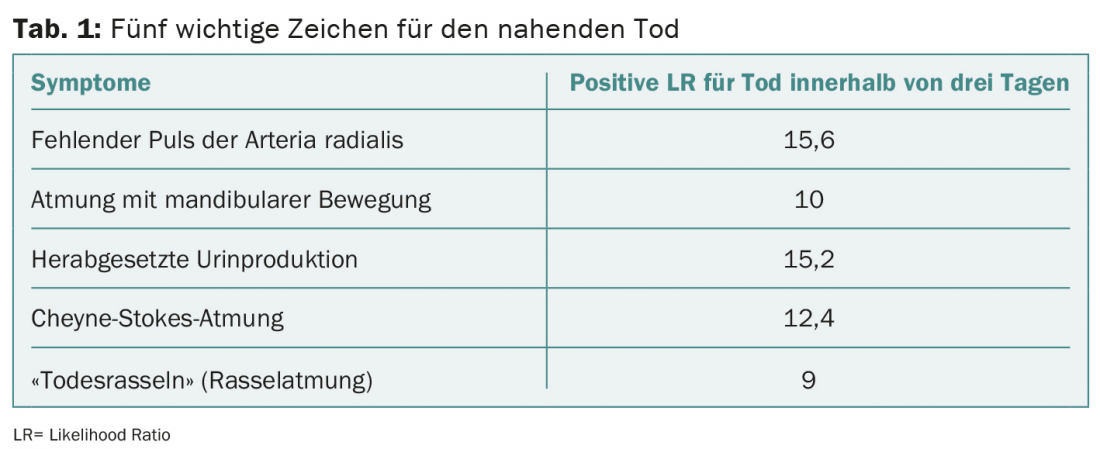
The authors had previously found in the same study population in 2014 that there were five highly specific physical signs associated with death occurring within three days (Table 1) [1]. With these symptoms, a more informed diagnosis of impending death can be made, which is of great importance to both the patient and family members, according to the team led by David Hui, MD, Houston. Aggressive therapies that negatively affect the last hours can be omitted – relatives and patients are offered the opportunity to say goodbye and choose the place of death themselves (e.g. discharge to home).
The present study again significantly extended the diagnostic spectrum: it tested the frequency and onset of 52 additional clinical signs that, according to the literature, may predict imminent death.

Eight physical signs help assess prognosis

From the beginning of entry into the palliative care unit until death or discharge, the 52 physical signs were systematically collected every twelve hours. From this, we calculated the likelihood ratio (LR) of death occurring within three days, as well as the frequency and median time of occurrence.

In addition to the five already known, another eight signs are highly diagnostic of impending death. They occurred in the last days of life in 5-78% of the 203 patients who died. The mortality risk was increased more than fivefold compared with patients without these symptoms (from then on, a sign was considered prognostically relevant). In ascending diagnostic importance were these symptoms:

  • Decreased response to visual stimuli (positive LR 6.7; 95% CI 6.3-7.1).
  • Neck hyperextension (positive LR 7.3; 95% CI 6.7-8).
  • Decreased response to verbal stimuli (positive LR 8.3; 95% CI 7.7-9).
  • Sagging of the nasolabial fold (positive LR 8.3; 95% CI 7.7-8.9).
  • Upper gastrointestinal tract bleeding (positive LR 10.3; 95% CI 9.5-11.1).
  • Grunting sounds on exhalation (positive LR 11.8; 95% CI 10.3-13.4).
  • Inability to close eyelids (positive LR 13.6; 95% CI 11.7-15.5).
  • Nonreactive pupils (positive LR 16.7; 95% CI 14.9-18.6).

So of the 62 clinical signs tested, Hui’s study team has so far been able to define 13 that will help doctors predict impending death in the future.

Source: Hui D, et al: Bedside clinical signs associated with impending death in patients with advanced cancer: preliminary findings of a prospective, longitudinal cohort study. Cancer 2015. doi: 10.1002/cncr.29048.

Literature:

  1. Hui D, et al: Clinical signs of impending death in cancer patients. Oncologist 2014 Jun; 19(6): 681-687.


InFo ONCOLOGY & HEMATOLOGY 2015; 3(5): 6.

Autoren
  • Andreas Grossmann
Publikation
  • InFo ONKOLOGIE & HÄMATOLOGIE
Related Topics
  • Death
  • Dying
  • Likelihood Ratio
  • LR
  • Symptoms
Previous Article
  • Breast Cancer Therapy

Strategies to maintain bone health

  • Congress Reports
  • Endocrinology and Diabetology
  • Gynecology
  • News
  • Oncology
  • RX
  • Studies
View Post
Next Article
  • Performance enhancement with psychotropic drugs

Cognitive Enhancement – a critical review of fifteen years of research.

  • Education
  • Pharmacology and toxicology
  • Psychiatry and psychotherapy
  • RX
View Post
You May Also Like
View Post
  • 5 min
  • Evidence-based diagnostics and treatment in the medical setting

Anxiety and depression disorders in adolescence

    • Education
    • Pediatrics
    • Pharmacology and toxicology
    • Psychiatry and psychotherapy
    • RX
    • Studies
View Post
  • 25 min
  • Neuroenhancement

Can you swallow intelligence? Relevant substance classes times for healthy people

    • CME continuing education
    • Neurology
    • Pharmacology and toxicology
    • Psychiatry and psychotherapy
    • RX
    • Studies
View Post
  • 9 min
  • Microbiome, inflammaging and affective/cognitive health

Gut-brain axis in old age

    • Education
    • Gastroenterology and Hepatology
    • General Internal Medicine
    • Geriatrics
    • Neurology
    • Nutrition
    • Prevention and health care
    • RX
    • Studies
View Post
  • 6 min
  • Vitiligo - the level of suffering should not be underestimated

A lot can be achieved therapeutically nowadays

    • Congress Reports
    • Dermatology and venereology
    • RX
    • Studies
View Post
  • 12 min
  • Patient-centered rounds in medicine

Aligning care with the patient

    • CME continuing education
    • Education
    • General Internal Medicine
    • Prevention and health care
    • RX
    • Studies
View Post
  • 14 min
  • Adrenogenital syndrome

Clinical care from birth to adulthood

    • CME continuing education
    • Endocrinology and Diabetology
    • Nephrology
    • Pediatrics
    • RX
    • Studies
View Post
  • 4 min
  • Communication between hospitals and outpatient care

How does a digital clinical information system prove itself in everyday practice?

    • Education
    • General Internal Medicine
    • Practice Management
    • Prevention and health care
    • RX
View Post
  • 5 min
  • Chronic and hard-to-heal wounds

Benefit from the advantages of outpatient negative pressure wound therapy

    • Congress Reports
    • Dermatology and venereology
    • Endocrinology and Diabetology
    • General Internal Medicine
    • Geriatrics
    • Physical medicine and rehabilitation
    • RX
    • Studies
  • IBD matters

    Zum Thema
Top CME content
  • 1
    Can you swallow intelligence? Relevant substance classes times for healthy people
  • 2
    Clinical care from birth to adulthood
  • 3
    Aligning care with the patient
  • 4
    Control instead of a flood of data: AI makes big data and wearables usable
  • 5
    Causes and prevention at work

Newsletter

Sign up and stay up to date

Subscribe
Medizinonline Medizinonline
  • Contact
  • General terms and conditions
  • Imprint

Input your search keywords and press Enter.