Medizinonline Medizinonline
  • News
    • News
    • Market & Medicine
  • Patients
    • Disease patterns
    • Diagnostics
    • Therapy
  • Partner Content
    • Diabetes
      • Dia-Month Club – Type 2 Diabetes
      • Diabetes in Motion
      • Diabetes Podcasts
    • Gastroenterology
      • IBD matters
    • Oncology
      • Swiss Oncology in motion
    • Orthopedics
      • Osteoporosis in motion
  • Departments
    • Allergology and clinical immunology
    • General Internal Medicine
    • Anesthesiology
    • Angiology
    • Surgery
    • Dermatology and venereology
    • Endocrinology and Diabetology
    • Nutrition
    • Gastroenterology and Hepatology
    • Genetics
    • Geriatrics
    • Gynecology
    • Hematology
    • Infectiology
    • Cardiology
    • Nephrology
    • Neurology
    • Emergency and intensive care medicine
    • Nuclear Medicine
    • Oncology
    • Ophthalmology
    • ORL
    • Orthopedics
    • Pediatrics
    • Pharmacology and toxicology
    • Pharmaceutical medicine
    • Phlebology
    • Physical medicine and rehabilitation
    • Pneumology
    • Prevention and health care
    • Psychiatry and psychotherapy
    • Radiology
    • Forensic Medicine
    • Rheumatology
    • Sports Medicine
    • Traumatology and trauma surgery
    • Tropical and travel medicine
    • Urology
    • Dentistry
  • CME & Congresses
    • CME continuing education
    • Congress Reports
    • Congress calendar
  • Practice
    • Noctimed
    • Practice Management
    • Jobs
    • Interviews
  • Log In
  • Register
  • My account
  • Contact
  • Publications
  • Contact
  • Deutsch
  • English
  • Français
  • Italiano
  • Português
  • Español
Subscribe
Medizinonline Medizinonline
  • News
    • News
    • Market & Medicine
  • Patienten
    • Krankheitsbilder
    • Diagnostik
    • Therapie
  • Partner Content
    • Diabetes
      • Dia-Month Club – Type 2 Diabetes
      • Diabetes in Motion
      • Diabetes Podcasts
    • Gastroenterology
      • IBD matters
    • Oncology
      • Swiss Oncology in motion
    • Orthopedics
      • Osteoporosis in motion
    • Phytotherapie
    • Rheumatology
  • Departments
    • Fachbereiche 1-13
      • Allergology and clinical immunology
      • General Internal Medicine
      • Anesthesiology
      • Angiology
      • Surgery
      • Dermatology and venereology
      • Endocrinology and Diabetology
      • Nutrition
      • Gastroenterology and Hepatology
      • Genetics
      • Geriatrics
      • Gynecology
      • Hematology
    • Fachbereiche 14-26
      • Infectiology
      • Cardiology
      • Nephrology
      • Neurology
      • Emergency and intensive care medicine
      • Nuclear Medicine
      • Oncology
      • Ophthalmology
      • ORL
      • Orthopedics
      • Pediatrics
      • Pharmacology and toxicology
      • Pharmaceutical medicine
    • Fachbereiche 26-38
      • Phlebology
      • Physical medicine and rehabilitation
      • Phytotherapy
      • Pneumology
      • Prevention and health care
      • Psychiatry and psychotherapy
      • Radiology
      • Forensic Medicine
      • Rheumatology
      • Sports Medicine
      • Traumatology and trauma surgery
      • Tropical and travel medicine
      • Urology
      • Dentistry
  • CME & Congresses
    • CME continuing education
    • Congress Reports
    • Congress calendar
  • Practice
    • Noctimed
    • Practice Management
    • Jobs
    • Interviews
Login

Sie haben noch keinen Account? Registrieren

  • Idiopathic Parkinson's syndrome

Causal therapy options within reach!?

    • Education
    • Neurology
    • RX
    • Studies
  • 3 minute read

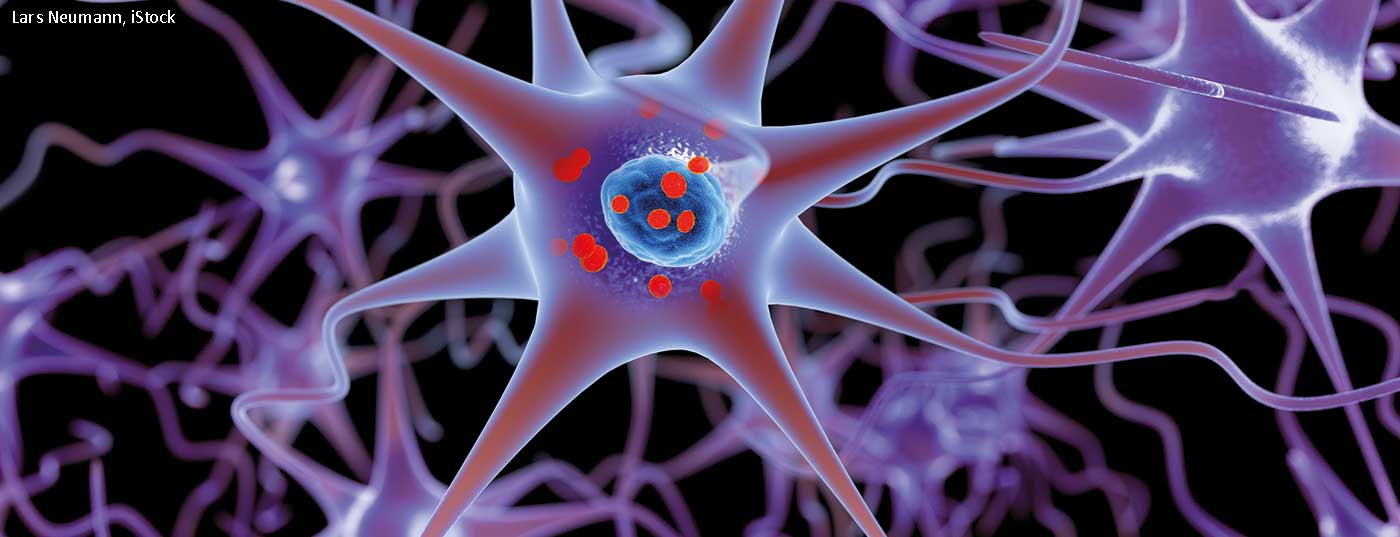
A large proportion of Parkinson’s patients suffer from the sporadic form of the disease, in which no gene mutations can be detected. However, in order to develop drugs using cell line and animal models, the much rarer hereditary Parkinson’s disease has been studied so far. Until now. Now there are first promising findings also on the sporadic form of the disease.

In neurodegenerative Parkinson’s syndrome, dopamine deficiency results from the death of dopaminergic neurons. This leads to the typical symptoms such as tremors and slowing of movement. In about 5-10% of affected individuals, a defined monogenic mutation can be detected. To date, over ten genes, such as the α-synuclein (SNCA) gene, are known to have a point mutation or duplication. What they all have in common is that the mutant protein α-synuclein is deposited in dopaminergic neurons. This accumulation, which can no longer be sufficiently broken down by the cell’s own purification system, leads to the death of the neurons.

Better understand metabolic disorder

However, no gene mutation can be detected in most Parkinson’s patients. In idiopathic Parkinson’s syndrome, which has not been studied as extensively, a number of factors appear to be causative. Thus, it was possible to decipher synuclein production that is increased by environmental factors, as well as a large number of small genetic variants that occur frequently in the population and are considered to be “Parkinson’s-associated”. However, these only increase the risk of disease but do not trigger it until a certain threshold is exceeded. All in all, there is a very complex pathomechanism that had to be explored first.

Increased risk in young sufferers

In one study, therefore, particularly young Parkinson’s patients between the ages of 30 and 39 were examined. They belong to the small group of patients with “young-onset Parkinson’s disease” (YOPD). In these affected individuals, there was no evidence of a hereditary form, no monogenic mutation, and no family history of Parkinson’s disease. However, whole-genome sequencing demonstrated an increased polygenic risk score. Accordingly, the patients had many individual small Parkinson’s-associated risk variants.

Harvested blood cells were genetically reprogrammed into induced pluripotent stem cells (iPSCs). Accordingly, the cells were regressed into undifferentiated cells as in the embryonic stage, which are not fixed to any cell type and can develop into any cell type – including dopaminergic neurons. Ultimately, pluripotent stem cells were grown from fibroblasts of these patients, introduced into cell cultures, and dopaminergic neurons were grown in them. These iPSC neurons were examined and showed increased α-synuclein levels and reduced lysosomal metabolism. From this, the scientists concluded that a cellular biochemical Parkinson’s signature is already laid down at birth in patients with sporadic Parkinson’s disease. The pathological cell signature normalized in further experiments the moment a lysosome activator (“phorbol ester”, PEP005) was added to the iPSC neurons.

Based on this study, scientists have now been able to establish for the first time a cell model of idiopathic Parkinson’s disease on which both existing and newly developed drugs can be tested. The hope is to one day be able to causally intervene in the disease mechanism and rescue the cells or stop the process.

Effectively relieve symptoms

So far, the disease process cannot yet be stopped, but the symptoms can very well be effectively alleviated. The aim is to maintain the independence of those affected for as long as possible, to prevent a need for care and to avoid comorbidities. The most effective drug is levodopa, which is converted to dopamine in the brain. Usually, L-dopa is combined with carbidopa to prevent conversion of the drug to dopamine before it reaches the blood-brain barrier. Alternatively, dopamine agonists are available to stimulate the receptors responsible for the uptake of dopamine. They are used as monotherapy, especially in younger, early-stage patients. In addition, COMT inhibitors or MAO-B inhibitors can still be used, which block the breakdown of dopamine. NMDA antagonists and anticholinergics influence the neurotransmitters downstream of dopamine and thus have a positive effect on their balance. Which preparation is suitable depends on the individual circumstances of the patient. Age, life circumstances, disease stage, symptoms, and possible concomitant diseases should be taken into account to develop the most effective treatment regimen.


Further reading:

  • Laperle AH, Sances S, Yucer N, et al: iPSC modeling of young-onset Parkinson’s disease reveals a molecular signature of disease and novel therapeutic candidates. Nat Med 2020 Jan 27. doi: 10.1038/s41591-019-0739-1. [Epub ahead of print]
  • Mullin S, Smith L, Lee K, et al: Ambroxol for the Treatment of Patients With Parkinson Disease With and Without Glucocerebrosidase Gene Mutations: A Nonrandomized, Noncontrolled Trial. JAMA Neurol 2020 Jan 13. doi: 10.1001/jamaneurol.2019.4611. [Epub ahead of print]
  • www.neurologen-und-psychiater-im-netz.org/neurologie/erkrankungen/parkinson-syndrom/therapie (last accessed on 29.03.2020)
  • https://deutsch.medscape.com/artikelansicht/4908467 (last accessed on 29.03.2020)


InFo NEUROLOGY & PSYCHIATRY 2020, 18(4): 20.
Autoren
  • Leoni Burggraf
Publikation
  • InFo NEUROLOGIE & PSYCHIATRIE
Related Topics
  • idiopathic parkinsonian syndrome
  • Neurodegeneration
  • Parkinson's
Previous Article
  • Cutaneous squamous cell carcinoma

First systemic therapy approved

  • Dermatology and venereology
  • Market & Medicine
  • Oncology
  • RX
  • Studies
View Post
Next Article
  • Diabetes Cases

Cardio-renal prevention: the revolution in diabetes management in 2020

  • Education
  • Endocrinology and Diabetology
  • Partner Content
  • RX
View Post
You May Also Like
View Post
  • 7 min
  • H. pylori infection: current study data

Fewer gastric carcinomas and peptic ulcers after eradication

    • RX
    • Gastroenterology and Hepatology
    • General Internal Medicine
    • Infectiology
    • Oncology
    • Studies
View Post
  • 4 min
  • From symptom to diagnosis

Pneumology – tracheal and bronchial calcifications

    • RX
    • Cases
    • Education
    • General Internal Medicine
    • Pneumology
    • Radiology
View Post
  • 3 min
  • Tinea capitis: Current Guidelines and Recommendations

What should be kept in mind when treating adult patients?

    • Dermatology and venereology
    • Education
    • Infectiology
    • Pharmacology and toxicology
    • RX
View Post
  • 7 min
  • Geriatric patients

Micronutrient Intake in Older Adults

    • RX
    • Education
    • General Internal Medicine
    • Geriatrics
    • Nutrition
View Post
  • 7 min
  • Crohn's disease: focus on long-term results

“Top-down” approach or classic step therapy?

    • RX
    • Congress Reports
    • Gastroenterology and Hepatology
    • General Internal Medicine
    • Studies
View Post
  • 4 min
  • SwissDiab Study: New Analysis Published

How are diabetes complications associated with quality of life?

    • RX
    • Endocrinology and Diabetology
    • General Internal Medicine
    • Studies
View Post
  • 6 min
  • Pre-acclimatization on Mount Everest

Exploring the physiological limits

    • RX
    • Congress Reports
    • General Internal Medicine
    • Pneumology
    • Studies
    • Tropical and travel medicine
View Post
  • 5 min
  • Viloxazine for ADHD

A non-stimulating option—but with limited evidence

    • RX
    • Education
    • Neurology
    • Pediatrics
    • Pharmacology and toxicology
    • Psychiatry and psychotherapy
    • Studies
  • IBD matters

    Zum Thema
Top CME content
  • 1
    Current State of Knowledge and New Therapeutic Approaches
  • 2
    Why is it so hard to lose weight?
  • 3
    Functional limb preservation between infection control, vascular medicine and resurfacing
  • 4
    Algorithms, avatars and the unburdened mind
  • 5
    Communication as the key to therapy adherence

Newsletter

Sign up and stay up to date

Subscribe
Medizinonline Medizinonline
  • Contact
  • General terms and conditions
  • Imprint

Input your search keywords and press Enter.