Medizinonline Medizinonline
  • News
    • News
    • Market & Medicine
  • Patients
    • Disease patterns
    • Diagnostics
    • Therapy
  • Partner Content
    • Diabetes
      • Dia-Month Club – Type 2 Diabetes
      • Diabetes in Motion
      • Diabetes Podcasts
    • Gastroenterology
      • IBD matters
    • Oncology
      • Swiss Oncology in motion
    • Orthopedics
      • Osteoporosis in motion
  • Departments
    • Allergology and clinical immunology
    • General Internal Medicine
    • Anesthesiology
    • Angiology
    • Surgery
    • Dermatology and venereology
    • Endocrinology and Diabetology
    • Nutrition
    • Gastroenterology and Hepatology
    • Genetics
    • Geriatrics
    • Gynecology
    • Hematology
    • Infectiology
    • Cardiology
    • Nephrology
    • Neurology
    • Emergency and intensive care medicine
    • Nuclear Medicine
    • Oncology
    • Ophthalmology
    • ORL
    • Orthopedics
    • Pediatrics
    • Pharmacology and toxicology
    • Pharmaceutical medicine
    • Phlebology
    • Physical medicine and rehabilitation
    • Pneumology
    • Prevention and health care
    • Psychiatry and psychotherapy
    • Radiology
    • Forensic Medicine
    • Rheumatology
    • Sports Medicine
    • Traumatology and trauma surgery
    • Tropical and travel medicine
    • Urology
    • Dentistry
  • CME & Congresses
    • CME continuing education
    • Congress Reports
    • Congress calendar
  • Practice
    • Noctimed
    • Practice Management
    • Jobs
    • Interviews
  • Log In
  • Register
  • My account
  • Contact
  • Publications
  • Contact
  • Deutsch
  • English
  • Français
  • Italiano
  • Português
  • Español
Subscribe
Medizinonline Medizinonline
  • News
    • News
    • Market & Medicine
  • Patienten
    • Krankheitsbilder
    • Diagnostik
    • Therapie
  • Partner Content
    • Diabetes
      • Dia-Month Club – Type 2 Diabetes
      • Diabetes in Motion
      • Diabetes Podcasts
    • Gastroenterology
      • IBD matters
    • Oncology
      • Swiss Oncology in motion
    • Orthopedics
      • Osteoporosis in motion
    • Phytotherapie
    • Rheumatology
  • Departments
    • Fachbereiche 1-13
      • Allergology and clinical immunology
      • General Internal Medicine
      • Anesthesiology
      • Angiology
      • Surgery
      • Dermatology and venereology
      • Endocrinology and Diabetology
      • Nutrition
      • Gastroenterology and Hepatology
      • Genetics
      • Geriatrics
      • Gynecology
      • Hematology
    • Fachbereiche 14-26
      • Infectiology
      • Cardiology
      • Nephrology
      • Neurology
      • Emergency and intensive care medicine
      • Nuclear Medicine
      • Oncology
      • Ophthalmology
      • ORL
      • Orthopedics
      • Pediatrics
      • Pharmacology and toxicology
      • Pharmaceutical medicine
    • Fachbereiche 26-38
      • Phlebology
      • Physical medicine and rehabilitation
      • Phytotherapy
      • Pneumology
      • Prevention and health care
      • Psychiatry and psychotherapy
      • Radiology
      • Forensic Medicine
      • Rheumatology
      • Sports Medicine
      • Traumatology and trauma surgery
      • Tropical and travel medicine
      • Urology
      • Dentistry
  • CME & Congresses
    • CME continuing education
    • Congress Reports
    • Congress calendar
  • Practice
    • Noctimed
    • Practice Management
    • Jobs
    • Interviews
Login

Sie haben noch keinen Account? Registrieren

  • The incomplete hippocampal inversion

Characteristic changes in MR

    • Angiology
    • Cases
    • Neurology
    • RX
  • 2 minute read

Incomplete hippocampal inversion (IHI), also known as hippocampal malrotation, is a fetal developmental disorder with incomplete infolding of the fetal dentate gyrus, ammonic horn, subiculum, and parahippocampal gyrus [1]. In most cases, the IHI is unilateral and located on the left side. Bilateral IHI is very rare [1]. Concomitant cerebral developmental abnormalities are possible. IHI was initially described in patients with epilepsy or severe brain developmental disorders. However, recent studies show that IHI occurs with a frequency ranging from approximately 4% to 19% [1, 2] even in the healthy population, but mostly unilateral and incomplete. We report a case of bilateral complete IHI in a patient with epilepsy.

Case Report:

A 35-year-old female patient presented to our emergency department with severe headache. Personal history included migraine without aura and epilepsy since childhood. The latter manifested itself first of all at the age of eight months by febrile convulsions, which in the further course manifested themselves by generalized tonic-clonic seizures, absences and episodes with negative myoclonia (falls without loss of consciousness and without dropping objects). The clinical neurological examination was unremarkable on admission. The patient was on anticonvulsant therapy with primidone. Past EEG examinations had repeatedly revealed generalized epileptic activity with intermittent focal findings bitemporally and spike-wave patterns with a frequency of 3/second. Cranial imaging had not been performed previously.
MRI performed during the inpatient stay revealed bilateral IHI as the only abnormality.

Imaging:

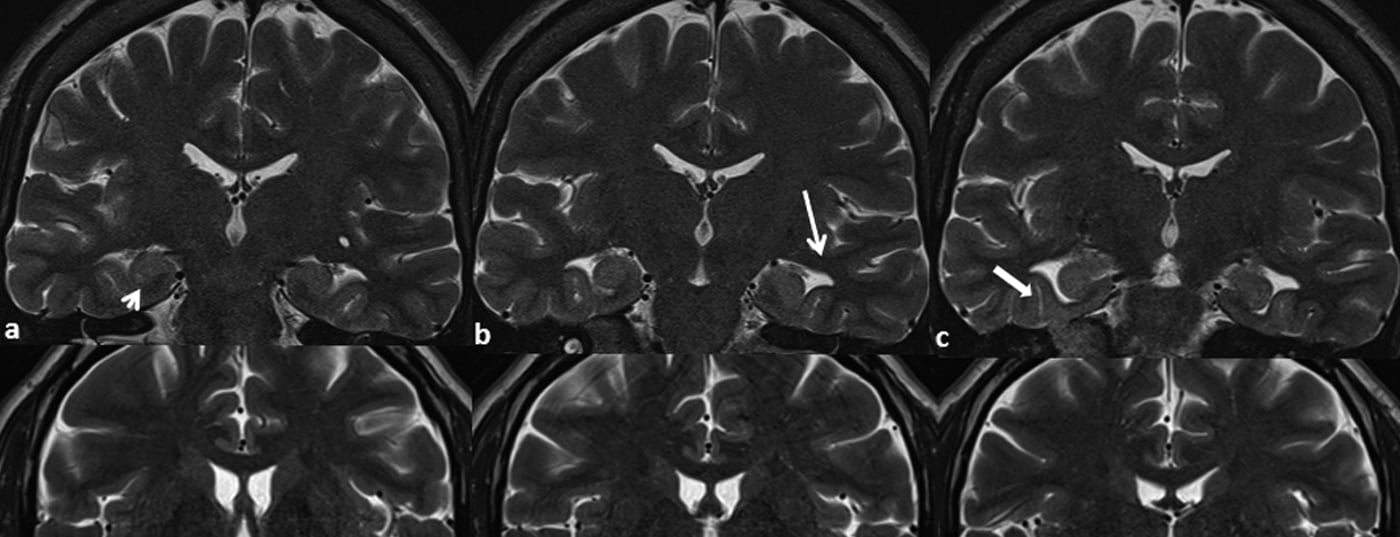
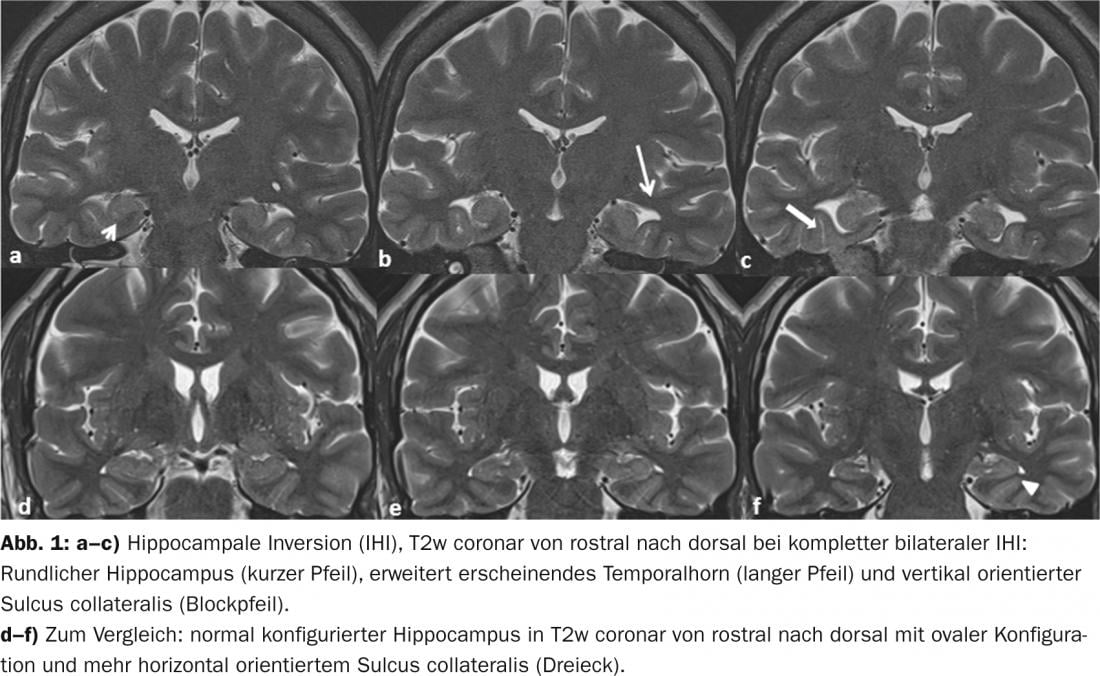
Coronal T2w images (Figs. 1a-c) show the typical signs of IHI from rostral to dorsal: roundishly configured hippocampus (short arrow) with normal signal behavior and volume, fuzzy internal structure of the hippocampus, dilated-appearing temporal horn (long arrow), and vertically oriented sulcus collateralis (block arrow) [1–3]. In comparison, the normally configured hippocampus of a healthy subject in the coronal T2w images (Fig. 1d-f) shows the typical oval shape (triangle) with narrow temporal horn and more horizontally oriented sulcus collateralis.

Discussion: Incomplete infolding of the hippocampal and parahippocampal structures results in a roundish or pyramidal hippocampal formation in coronal sectional plane. In IHI, the total hippocampal volume does not deviate from the norm, but the craniocaudal diameter is equal to or greater than the transverse compared with the normally rotated hippocampus. The temporal horn of the lateral ventricle thus appears dilated. The parahippocampal gyrus appears more vertically oriented due to incomplete infolding. IHI may extend along the entire hippocampus (complete) or affect only parts (partial) [2]. Our patient presents with a complete bilateral IHI.

Despite the structural abnormalities, IHI typically does not exhibit signal aging in T2w [3]. Although IHI appears to be associated with symptomatic epilepsy in most cases, recent literature evidence demonstrates that it can also manifest in healthy individuals without other cerebral developmental abnormalities [1].
Thus, the functional pathologic significance of IHI remains uncertain to date. Further scientific studies are therefore needed to more thoroughly define the pathological value of this entity.
 

Literature:

  1. Bajic et al: Incomplete Inversion of the hippocampus – a common developmental anomaly; Eur Radiol 2008.
  2. Bernasconi et al: Analysis of shape and positioning of the hippocampal formation: an MRI study; Brain 2005.
  3. Gamss RP, et al: Prevalence of hippocampal malrotation in a population without seizures. AJNR Am J Neuroradiol 2009.

Autoren
  • Dr. med. Tilman Schubert
  • Dr. med. Athina Papadopoulou
  • Dr. med. Ulrike Bonati
  • Prof. Dr. med. Christoph Stippich
  • Dr. med. Meritxell Garcia
Publikation
  • InFo NEUROLOGIE & PSYCHIATRIE
Related Topics
  • Brain development disorders
  • Epilepsy
  • hippocampal
  • IHI
  • incomplete
  • Inversion
  • Malrotation
  • Medical history
Previous Article
  • Smoking

Nicotine substitution and relapse prophylaxis lead to success

  • Education
  • Psychiatry and psychotherapy
  • RX
View Post
Next Article
  • Addictive disorders in children and adolescents

Consider comorbidity and family structures

  • Education
  • Pediatrics
  • Psychiatry and psychotherapy
  • RX
View Post
You May Also Like
View Post
  • 4 min
  • HER2+ early breast cancer

DESTINY-Breast11 – neoadjuvant T-DXd without anthracyclines

    • Education
    • Gynecology
    • Oncology
    • RX
    • Studies
View Post
  • 3 min
  • Lavender aromatherapy

Take away the fear of the dentist

    • Dentistry
    • Education
    • Pharmaceutical medicine
    • Phytotherapy
    • Psychiatry and psychotherapy
    • RX
    • Studies
View Post
  • 4 min
  • Digital dermatology: innovative project examples

AI and eHealth tools in HS care

    • Dermatology and venereology
    • General Internal Medicine
    • Practice Management
    • Prevention and health care
    • RX
    • Studies
View Post
  • 5 min
  • Mantle cell lymphoma

Recurrence after BTK inhibition – prognostic factors and treatment options

    • Education
    • Hematology
    • Oncology
    • RX
View Post
  • 3 min
  • Dementia risk with type 2 diabetes

SGLT2 inhibitors with advantages vs. DPP4 inhibitors

    • Education
    • Endocrinology and Diabetology
    • Geriatrics
    • Neurology
    • Pharmacology and toxicology
    • Psychiatry and psychotherapy
    • RX
    • Studies
View Post
  • 15 min
  • T helper 1 cells

Differentiation and activation of Th1 cells – a multi-omics approach

    • RX
    • CME continuing education
    • General Internal Medicine
    • Genetics
    • Prevention and health care
View Post
  • 4 min
  • Cannabis for schizophrenia

CBD pre-treatment could exacerbate side effects

    • Education
    • Pharmacology and toxicology
    • Phytotherapy
    • Psychiatry and psychotherapy
    • RX
    • Studies
View Post
  • 11 min
  • Type 2 diabetes: cardiovascular risk reduction is realistic

Modern active ingredients and lifestyle – every step counts

    • Cardiology
    • Congress Reports
    • Endocrinology and Diabetology
    • Prevention and health care
    • RX
    • Studies
  • IBD matters

    Zum Thema
Top CME content
  • 1
    Communication as the key to therapy adherence
  • 2
    Solutions to the malnutrition dilemma
  • 3
    Solutions to the malnutrition dilemma
  • 4
    Focus on preventive care options
  • 5
    Fertility preservation from gonads to genomes to genoids

Newsletter

Sign up and stay up to date

Subscribe
Medizinonline Medizinonline
  • Contact
  • General terms and conditions
  • Imprint

Input your search keywords and press Enter.