Medizinonline Medizinonline
  • News
    • News
    • Market & Medicine
  • Patients
    • Disease patterns
    • Diagnostics
    • Therapy
  • Partner Content
    • Diabetes
      • Dia-Month Club – Type 2 Diabetes
      • Diabetes in Motion
      • Diabetes Podcasts
    • Gastroenterology
      • IBD matters
    • Oncology
      • Swiss Oncology in motion
    • Orthopedics
      • Osteoporosis in motion
  • Departments
    • Allergology and clinical immunology
    • General Internal Medicine
    • Anesthesiology
    • Angiology
    • Surgery
    • Dermatology and venereology
    • Endocrinology and Diabetology
    • Nutrition
    • Gastroenterology and Hepatology
    • Genetics
    • Geriatrics
    • Gynecology
    • Hematology
    • Infectiology
    • Cardiology
    • Nephrology
    • Neurology
    • Emergency and intensive care medicine
    • Nuclear Medicine
    • Oncology
    • Ophthalmology
    • ORL
    • Orthopedics
    • Pediatrics
    • Pharmacology and toxicology
    • Pharmaceutical medicine
    • Phlebology
    • Physical medicine and rehabilitation
    • Pneumology
    • Prevention and health care
    • Psychiatry and psychotherapy
    • Radiology
    • Forensic Medicine
    • Rheumatology
    • Sports Medicine
    • Traumatology and trauma surgery
    • Tropical and travel medicine
    • Urology
    • Dentistry
  • CME & Congresses
    • CME continuing education
    • Congress Reports
    • Congress calendar
  • Practice
    • Noctimed
    • Practice Management
    • Jobs
    • Interviews
  • Log In
  • Register
  • My account
  • Contact
  • Publications
  • Contact
  • Deutsch
  • English
  • Français
  • Italiano
  • Português
  • Español
Subscribe
Medizinonline Medizinonline
  • News
    • News
    • Market & Medicine
  • Patienten
    • Krankheitsbilder
    • Diagnostik
    • Therapie
  • Partner Content
    • Diabetes
      • Dia-Month Club – Type 2 Diabetes
      • Diabetes in Motion
      • Diabetes Podcasts
    • Gastroenterology
      • IBD matters
    • Oncology
      • Swiss Oncology in motion
    • Orthopedics
      • Osteoporosis in motion
    • Phytotherapie
    • Rheumatology
  • Departments
    • Fachbereiche 1-13
      • Allergology and clinical immunology
      • General Internal Medicine
      • Anesthesiology
      • Angiology
      • Surgery
      • Dermatology and venereology
      • Endocrinology and Diabetology
      • Nutrition
      • Gastroenterology and Hepatology
      • Genetics
      • Geriatrics
      • Gynecology
      • Hematology
    • Fachbereiche 14-26
      • Infectiology
      • Cardiology
      • Nephrology
      • Neurology
      • Emergency and intensive care medicine
      • Nuclear Medicine
      • Oncology
      • Ophthalmology
      • ORL
      • Orthopedics
      • Pediatrics
      • Pharmacology and toxicology
      • Pharmaceutical medicine
    • Fachbereiche 26-38
      • Phlebology
      • Physical medicine and rehabilitation
      • Phytotherapy
      • Pneumology
      • Prevention and health care
      • Psychiatry and psychotherapy
      • Radiology
      • Forensic Medicine
      • Rheumatology
      • Sports Medicine
      • Traumatology and trauma surgery
      • Tropical and travel medicine
      • Urology
      • Dentistry
  • CME & Congresses
    • CME continuing education
    • Congress Reports
    • Congress calendar
  • Practice
    • Noctimed
    • Practice Management
    • Jobs
    • Interviews
Login

Sie haben noch keinen Account? Registrieren

  • Recurrent ovarian cancer

Current developments give hope for a personalized approach

    • Congress Reports
    • Gynecology
    • Oncology
    • RX
  • 3 minute read

At the ESMO Congress in Amsterdam, a review was given of the options available to date in the treatment of recurrent ovarian cancer. Therapy depends on the particular form of recurrence and therefore aims either mainly at symptom improvement or at prolonging progression-free survival. In the future, new biomarkers or imaging agents can be used to personalize the drug approach  and thus significantly improve it in individual cases.

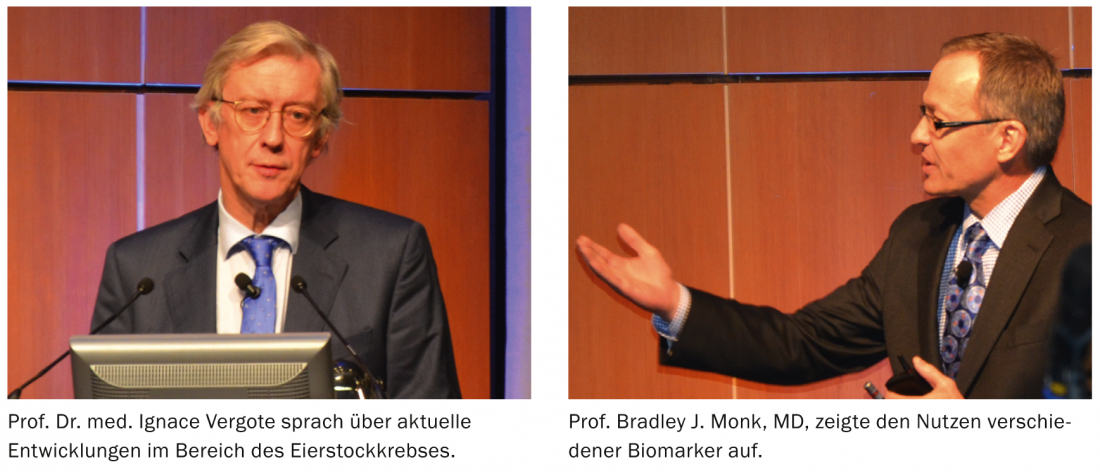
(ag) Prof. Ignace Vergote, MD, Leuven, presented current challenges in the field of recurrent ovarian cancer. First, the definition of this condition must be specified:

  • If the treatment-free interval since the last platinum dose >is 12 months, it is referred to as a platinum-sensitive form.
  • If this period is 6-12 months, one speaks of a partially platinum-sensitive form.
  • If the period is <6 months, it is called a platinum-resistant form.
  • If the period is <4 weeks, it is called a platinum-refractory form.

“The goals of treatment in recurrent ovarian cancer differ depending on platinum sensitivity: in resistant types (0-6 months), the main goal is symptom relief; in partially sensitive, the main goal is to stabilize the disease and delay progression or prolong progression-free survival. These goals are even more important in platinum-sensitive types,” said Prof. Vergote.
Platinum sensitive ovarian cancer

The following should be noted regarding platinum-sensitive ovarian cancer, according to Prof. Vergote:

  • Secondary cytoreductive surgery may be indicated in selected patients (DESKTOP and GOG trials).
  • The European Medicines Agency (EMA) has approved bevacizumab for the platinum-sensitive form.
  • Other anti-angiogenic drugs, PARP inhibitors, etc. are being studied in phase II/III trials.
  • Biological predictors that predict response are urgently needed to be identified.

Platinum-resistant ovarian cancer

In the platinum-resistant form, it is important to balance well the efficacy, toxicity, and timing of the active ingredients. Currently, however, the research field is experiencing a boom due to various studies on new active substances, which has already produced some interesting approaches and results. In addition to inhibiting angiogenesis, future drugs will be needed for other molecular targets that must first be confirmed genetically or by imaging.

Personalized approach

Prof. Bradley J. Monk, MD, Arizona, spoke about biomarkers: “This word has often been inaccurately applied. A biomarker is significant if it aligns with an important clinical indication, is reproducible, and provides a tangible benefit to the individual patient or improves management. This also always means very accurate validation of the biomarker and thus a good understanding of the underlying mechanisms.”
There are prognostic and predictive biomarkers. The former refer to individuals who are already ill. They are useful in predicting the outcome of treatment by comparing marker-positive with marker-negative patients without varying the drug intervention. Predictive biomarkers can be used to predict the outcome of specific targeted treatment in different populations. This can be useful in selecting a therapy for patients on an individual basis. For example, in platinum-sensitive recurrent serous ovarian cancer, one such treatment is PARP inhibitors. The treatment success seems to be partially dependent on the BRCA mutation.
Concomitant imaging agents may also predict response, e.g., etarfolatide. It binds to the folate receptor, which is overexpressed in several cancers, including ovarian cancer, indicating the location of the tumor and the potential response to treatment (e.g., using vintafolide, which is currently in development).

Current developments

Several promising drugs are in the pipeline:
Vintafolide: Vintafolide has orphan drug status and is currently under review in the EU based on data from the PRECEDENT study. Filing for approval in the U.S. is expected in 2015, based on the currently ongoing Phase III PROCEED trial.
MK-1775: MK-1775 is the only WEE1 kinase inhibitor currently in clinical development. It is an oral therapy that could be used in p53-deficient tumors. MK-1775 interferes with the G2 DNA “damage checkpoint” (by inhibiting WEE1), making tumor cells more vulnerable to chemotherapeutic agents that induce DNA damage. In combination with a DNA-destroying chemotherapy agent, this appears to allow promising response rates to be achieved in the platinum-refractory setting.

Source: “Is Personal Medicine a Reality for Recurrent Ovarian Cancer Patients?”, MSD satellite symposium at ESMO Congress, September 27-October 1, 2013, Amsterdam.

InFo Oncology & Hematology 2014; 2(1): 37-38.

Autoren
  • Andreas Grossmann
Publikation
  • InFo ONKOLOGIE & HÄMATOLOGIE
Related Topics
  • Amsterdam
  • Angiogenesis
  • biological predictors
  • Biomarker
  • BRCA mutation
  • ESMO
  • Folate receptor
  • imaging
  • platinum sensitive
  • PRECENDENT study
  • predictive
  • prognostic
  • Recurrence
  • recurrent ovarian cancer
  • Symptom
  • Vintafolid
Previous Article
  • That was 2013

News and views around the heart

  • Cardiology
  • News
  • Prevention and health care
  • RX
View Post
Next Article
  • Non-Hodgkin's lymphoma and myelodysplastic syndrome

What are the benefits of lenalidomide and pomalidomide?

  • Congress Reports
  • Oncology
  • Pharmacology and toxicology
  • RX
  • Studies
View Post
You May Also Like
View Post
  • 3 min
  • From symptom to diagnosis

Abdominal pain – Prostate cysts

    • RX
    • Cases
    • Education
    • General Internal Medicine
    • Radiology
    • Surgery
    • Urology
View Post
  • 0 min
  • Multimodal Parkinson's Treatment

Positive Effects of a Music-Based Intervention

    • RX
    • Education
    • Geriatrics
    • Neurology
    • Physical medicine and rehabilitation
    • Psychiatry and psychotherapy
View Post
  • 8 min
  • Psychooncology

Communication as the key to therapy adherence

    • RX
    • CME continuing education
    • General Internal Medicine
    • Practice Management
View Post
  • 9 min
  • Cardiology

Minimally invasive – the quiet triumph of modern heart surgery

    • RX
    • Cardiology
    • CME continuing education
    • Studies
    • Surgery
View Post
  • 6 min
  • Schizophrenia in the early-onset stage

Which antipsychotic should be used for treatment-naive patients?

    • RX
    • Education
    • Pharmacology and toxicology
    • Psychiatry and psychotherapy
    • Studies
View Post
  • 4 min
  • Diarrhea in children

The problem of parental expectations

    • RX
    • Education
    • Gastroenterology and Hepatology
    • General Internal Medicine
    • Infectiology
    • Pediatrics
    • Studies
View Post
  • 4 min
  • From symptom to diagnosis

Multilocular cystic renal cell carcinoma (MCRCC)

    • RX
    • Cases
    • Education
    • Nephrology
    • Oncology
    • Radiology
    • Studies
    • Surgery
View Post
  • 3 min
  • Shaping the Future with LLM & Co.

AI in Everyday Clinical Practice: Friend or Foe?

    • RX
    • General Internal Medicine
    • Practice Management
    • Prevention and health care
  • IBD matters

    Zum Thema
Top CME content
  • 1
    Current State of Knowledge and New Therapeutic Approaches
  • 2
    Why is it so hard to lose weight?
  • 3
    Functional limb preservation between infection control, vascular medicine and resurfacing
  • 4
    Algorithms, avatars and the unburdened mind
  • 5
    Communication as the key to therapy adherence

Newsletter

Sign up and stay up to date

Subscribe
Medizinonline Medizinonline
  • Contact
  • General terms and conditions
  • Imprint

Input your search keywords and press Enter.