Medizinonline Medizinonline
  • News
    • News
    • Market & Medicine
  • Patients
    • Disease patterns
    • Diagnostics
    • Therapy
  • Partner Content
    • Diabetes
      • Dia-Month Club – Type 2 Diabetes
      • Diabetes in Motion
      • Diabetes Podcasts
    • Gastroenterology
      • IBD matters
    • Oncology
      • Swiss Oncology in motion
    • Orthopedics
      • Osteoporosis in motion
  • Departments
    • Allergology and clinical immunology
    • General Internal Medicine
    • Anesthesiology
    • Angiology
    • Surgery
    • Dermatology and venereology
    • Endocrinology and Diabetology
    • Nutrition
    • Gastroenterology and Hepatology
    • Genetics
    • Geriatrics
    • Gynecology
    • Hematology
    • Infectiology
    • Cardiology
    • Nephrology
    • Neurology
    • Emergency and intensive care medicine
    • Nuclear Medicine
    • Oncology
    • Ophthalmology
    • ORL
    • Orthopedics
    • Pediatrics
    • Pharmacology and toxicology
    • Pharmaceutical medicine
    • Phlebology
    • Physical medicine and rehabilitation
    • Pneumology
    • Prevention and health care
    • Psychiatry and psychotherapy
    • Radiology
    • Forensic Medicine
    • Rheumatology
    • Sports Medicine
    • Traumatology and trauma surgery
    • Tropical and travel medicine
    • Urology
    • Dentistry
  • CME & Congresses
    • CME continuing education
    • Congress Reports
    • Congress calendar
  • Practice
    • Noctimed
    • Practice Management
    • Jobs
    • Interviews
  • Log In
  • Register
  • My account
  • Contact
  • Publications
  • Contact
  • Deutsch
  • English
  • Français
  • Italiano
  • Português
  • Español
Subscribe
Medizinonline Medizinonline
  • News
    • News
    • Market & Medicine
  • Patienten
    • Krankheitsbilder
    • Diagnostik
    • Therapie
  • Partner Content
    • Diabetes
      • Dia-Month Club – Type 2 Diabetes
      • Diabetes in Motion
      • Diabetes Podcasts
    • Gastroenterology
      • IBD matters
    • Oncology
      • Swiss Oncology in motion
    • Orthopedics
      • Osteoporosis in motion
    • Phytotherapie
    • Rheumatology
  • Departments
    • Fachbereiche 1-13
      • Allergology and clinical immunology
      • General Internal Medicine
      • Anesthesiology
      • Angiology
      • Surgery
      • Dermatology and venereology
      • Endocrinology and Diabetology
      • Nutrition
      • Gastroenterology and Hepatology
      • Genetics
      • Geriatrics
      • Gynecology
      • Hematology
    • Fachbereiche 14-26
      • Infectiology
      • Cardiology
      • Nephrology
      • Neurology
      • Emergency and intensive care medicine
      • Nuclear Medicine
      • Oncology
      • Ophthalmology
      • ORL
      • Orthopedics
      • Pediatrics
      • Pharmacology and toxicology
      • Pharmaceutical medicine
    • Fachbereiche 26-38
      • Phlebology
      • Physical medicine and rehabilitation
      • Phytotherapy
      • Pneumology
      • Prevention and health care
      • Psychiatry and psychotherapy
      • Radiology
      • Forensic Medicine
      • Rheumatology
      • Sports Medicine
      • Traumatology and trauma surgery
      • Tropical and travel medicine
      • Urology
      • Dentistry
  • CME & Congresses
    • CME continuing education
    • Congress Reports
    • Congress calendar
  • Practice
    • Noctimed
    • Practice Management
    • Jobs
    • Interviews
Login

Sie haben noch keinen Account? Registrieren

  • Boehringer Ingelheim Diabetes Key Notes Session, Bern

Diabetes management in 2027

    • Congress Reports
    • Endocrinology and Diabetology
    • General Internal Medicine
    • News
    • Partner Content
    • RX
  • 3 minute read

Aggressive therapy or conservative? Renowned scientists – Prof. George Grunberger and Prof. Marc Donath – spoke about the status and future possibilities of diabetes therapy.

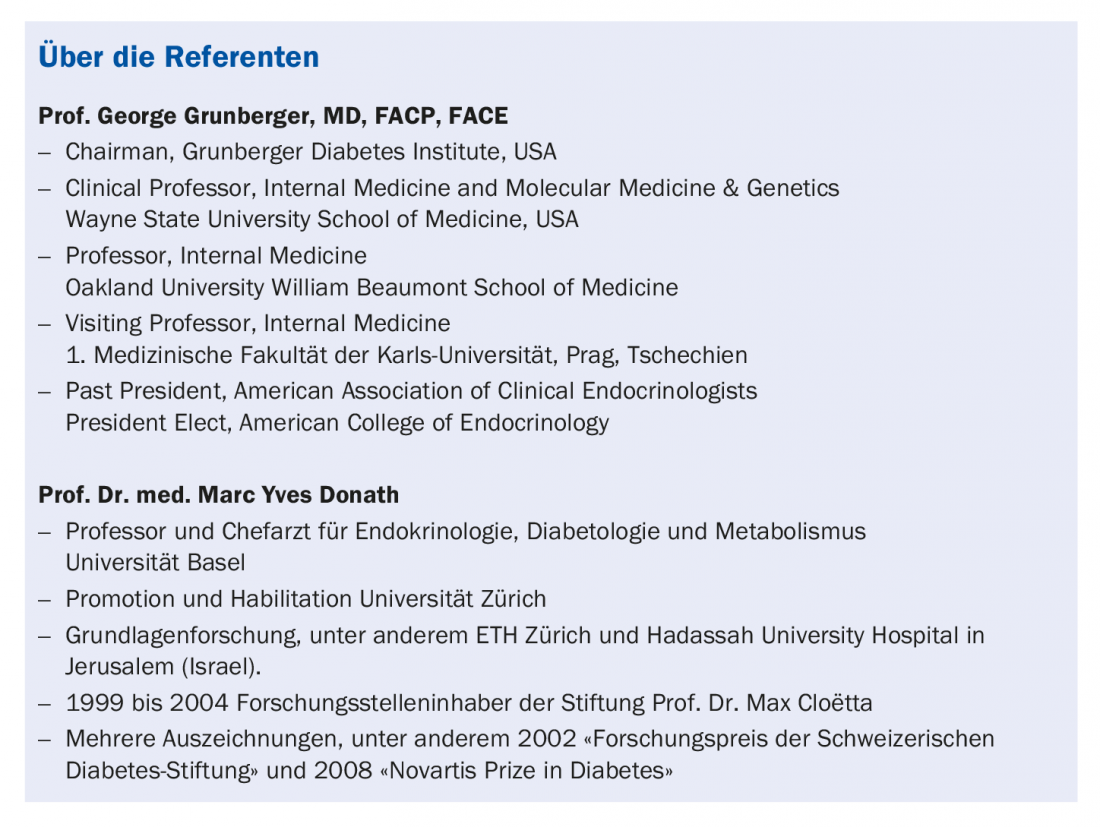
Prof. George Grunberger, Wayne State University Detroit (USA) and others, and Prof. Marc Donath, University Hospital Basel, spoke about the status and future possibilities of diabetes therapy. Prof. Grunberger postulated against the background that type 2 diabetes often shows no symptoms in the early stages, an aggressive form of therapy that addresses the possible complications such as renal insufficiency, vascular disease of the eyes or peripheral arterial occlusive disease at an early stage. Prof. Donath was cautious in his assessment of this paradigm shift from “treat to fail” to “treat to target”. Waiting until blood glucose levels rise before intensifying therapy is still the more common family practice today. The first step is to examine whether lifestyle changes – more exercise, reduction of overweight, balanced diet – bring about a change in the HbA1C target value. For an early more aggressive therapeutic approach, Donath said, the data are still unclear.


Prof. Grunberger also focuses on prevention, but weights the impact of complications as the main risk and health care cost driver. Therefore, he argued, early intervention to prevent complications is another key element of therapy. “Comprehensive approaches are needed to prevent cardiovascular and other complications. It is not useful to focus only on HbA1C until the patient suffers a complication,” he reiterated. Grunberger anticipates that more specific biomarkers will be known in the future to predict complications. “This will allow us to treat patients in an increasingly personalized way based on individual risks.” This approach is followed by the current recommendations of the SGED (Swiss Society of Endocrinology and Diabetology) with their focus on best individual therapy [4]). Grunberger goes further in his prognosis for the future: “The choice of which drug to use must be tailored to the patient’s individual risk factors.” There is no one-fits-all approach to diabetes treatment, Grunberger says; instead, it must be understood as a highly complex disease. The therapeutic approaches of the future point this way to data-based, precise and individualized therapy.

Diabetes therapy 2027

In the future, patient profiling will enable treatment decisions based on comprehensive data. Developments are at a stage where diabetes technologies are on the verge of convergence (Fig. 1) – devices and data will merge to create new therapies that enable higher precision and more automation (see box “Recommended reading on the topic”).


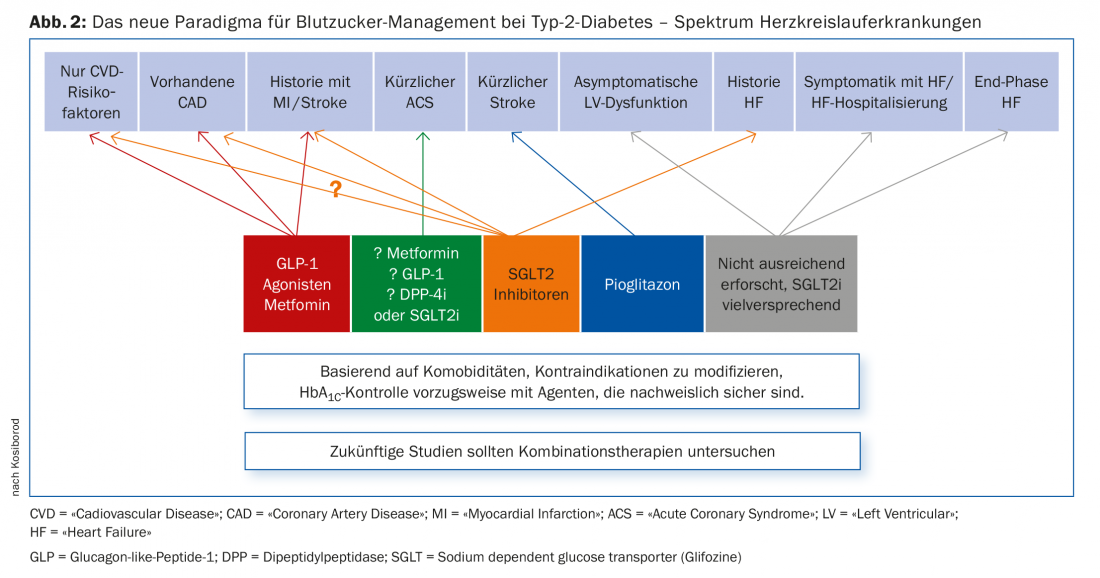
On the one hand, advances in digital medicine are playing a major role: for example, microchips that can control precise drug delivery when transplanted under the skin. Sensors measure glucose, metabolites and vital signs in real time and transmit the data via app to the patient’s smartphone or to the doctor. Genetic factors are to be identified using digital analytics intelligence. In therapy, on this basis, agents can be assigned individually according to risk factors, comorbidities, and contraindications after initial metformin, although research is still needed in the area of combination therapies (Fig. 2) – the unanimous conclusion of the speakers.


While Grunberger decisively criticizes metformin’s role as monotherapy as too limited, he sees increasing evidence that it will continue to have relevance in the context of the microbiome, which it influences. Research on the microbiome also showed surprising effects regarding insulin sensitivity after stool transplantation in metabolic, obese patients [5] – an indicator for another therapeutic strategy.


Prof. Grunberger predicted that existing therapies will become safer and develop a longer duration of action, and their handling will become increasingly easier for physicians and patients, for example through oral dosage forms for insulin and GLP-1 analogues. Combination therapies, administered in a tablet or injection, will contribute to compliance, as will “smart insulin,” which is delivered in doses from capsules or via patches depending on glucose concentration, allowing continuous glucose regulation. Hyper- or hypoglycemia are thus eliminated and insulin injections are no longer necessary. These scenarios are not expected to wait until 2027. Further research is devoted to β-cell disease and is examining the possibilities of islet cell transplantation.

Prof. Donath shared Grunberger’s optimistic outlook, but remained clear in his message: There will only be fewer patients in 2027 if preventive measures are effective!


References:

  1. IDF Diabetes Atlas Seventh Edition – Country Report Switzerland
  2. Wieser S, Raguzzi M, et al: The cost of non-communicable diseases in Switzerland. Federal Office of Public Health FOPH, Bern, 2014; 63.
  3. Boehringer Ingelheim Diabetetes Key Note Session 2017, November 14, 2017, Bern
  4. Diabetes Update Refresher: The current Swiss therapy recommendations. CardioVasc 2018; 17(1): 34-36. www.medizinonline.ch/artikel/die-aktuellen-schweizer-therapieempfehlungen
  5. Kootte RS, et al: Improvement of insulin sensitivity after lean donor feces in metabolic syndrome is driven by baseline intestinal microbiota composition. Cell metabolism 2017; 26(4): 611-619.


HAUSARZT PRAXIS 2018; 13(3): 8-9

Autoren
  • Karen Heidl
Publikation
  • HAUSARZT PRAXIS
Related Topics
  • Diabetes
  • key notes session
  • SGED
Previous Article
  • Sleep, anxiety, epilepsy, gynecology

Valerian – not only to calm down

  • General Internal Medicine
  • Gynecology
  • Neurology
  • News
  • Pharmacology and toxicology
  • RX
  • Studies
View Post
Next Article
  • Autoimmune neurological diseases

Progress in clarification

  • Education
  • Neurology
  • RX
View Post
You May Also Like
View Post
  • 5 min
  • Omaveloxolone for Friedreich's Ataxia

Efficacy and Safety Studied Over 6 Years

    • Neurology
    • Congress Reports
    • Endocrinology and Diabetology
    • RX
    • Studies
View Post
  • 6 min
  • Psoriasis: therapy with biologics and TYK-2-i

Progress assessments based on current long-term and real-world data

    • RX
    • Congress Reports
    • Dermatology and venereology
    • Pharmacology and toxicology
    • Rheumatology
    • Studies
View Post
  • 4 min
  • Hypertension: the most important facts for daily practice

Early dual antihypertensive therapy is usually indicated

    • RX
    • Cardiology
    • Congress Reports
    • General Internal Medicine
View Post
  • 4 min
  • Escitalopram for anxiety disorders

Positive effect, but no immediate improvement in symptoms

    • RX
    • Education
    • Neurology
    • Pharmacology and toxicology
    • Psychiatry and psychotherapy
    • Studies
View Post
  • 4 min
  • Helicobacter pylori infection

Simplified dual therapy beats quadruple regimen

    • RX
    • Education
    • Gastroenterology and Hepatology
    • General Internal Medicine
    • Infectiology
    • Studies
View Post
  • 3 min
  • Gastric carcinoma

Ways of precision oncology

    • RX
    • Congress Reports
    • Gastroenterology and Hepatology
    • Oncology
    • Studies
View Post
  • 8 min
  • Endometrial Cancer

Immunological drivers and new therapeutic pathways

    • RX
    • Education
    • Gynecology
    • Oncology
    • Studies
View Post
  • 6 min
  • Exercise for type 1 diabetes

Cyclists and runners with an increased risk of hypoglycemia

    • RX
    • Education
    • Endocrinology and Diabetology
    • Sports Medicine
    • Studies
Landingpage Fachinfo Landingpage Button
  • IBD matters

    Zum Thema
Top CME content
  • 1
    Communication as the key to therapy adherence
  • 2
    Solutions to the malnutrition dilemma
  • 3
    Solutions to the malnutrition dilemma
  • 4
    Focus on preventive care options
  • 5
    Fertility preservation from gonads to genomes to genoids

Newsletter

Sign up and stay up to date

Subscribe
Medizinonline Medizinonline
  • Contact
  • General terms and conditions
  • Imprint

Input your search keywords and press Enter.