Medizinonline Medizinonline
  • News
    • News
    • Market & Medicine
  • Patients
    • Disease patterns
    • Diagnostics
    • Therapy
  • Partner Content
    • Diabetes
      • Dia-Month Club – Type 2 Diabetes
      • Diabetes in Motion
    • Gastroenterology
      • IBD matters
    • Oncology
      • Swiss Oncology in motion
    • Orthopedics
      • Osteoporosis in motion
  • Departments
    • Allergology and clinical immunology
    • General Internal Medicine
    • Anesthesiology
    • Angiology
    • Surgery
    • Dermatology and venereology
    • Endocrinology and Diabetology
    • Nutrition
    • Gastroenterology and Hepatology
    • Genetics
    • Geriatrics
    • Gynecology
    • Hematology
    • Infectiology
    • Cardiology
    • Nephrology
    • Neurology
    • Emergency and intensive care medicine
    • Nuclear Medicine
    • Oncology
    • Ophthalmology
    • ORL
    • Orthopedics
    • Pediatrics
    • Pharmacology and toxicology
    • Pharmaceutical medicine
    • Phlebology
    • Physical medicine and rehabilitation
    • Pneumology
    • Prevention and health care
    • Psychiatry and psychotherapy
    • Radiology
    • Forensic Medicine
    • Rheumatology
    • Sports Medicine
    • Traumatology and trauma surgery
    • Tropical and travel medicine
    • Urology
    • Dentistry
  • CME & Congresses
    • CME continuing education
    • Congress Reports
    • Congress calendar
  • Practice
    • Noctimed
    • Practice Management
    • Jobs
    • Interviews
  • Log In
  • Register
  • My account
  • Contact
  • Publications
  • Contact
  • Deutsch
  • English
  • Français
  • Italiano
  • Português
  • Español
Subscribe
Medizinonline Medizinonline
  • News
    • News
    • Market & Medicine
  • Patienten
    • Krankheitsbilder
    • Diagnostik
    • Therapie
  • Partner Content
    • Diabetes
      • Dia-Month Club – Type 2 Diabetes
      • Diabetes in Motion
    • Gastroenterology
      • IBD matters
    • Oncology
      • Swiss Oncology in motion
    • Orthopedics
      • Osteoporosis in motion
    • Phytotherapie
    • Rheumatology
  • Departments
    • Fachbereiche 1-13
      • Allergology and clinical immunology
      • General Internal Medicine
      • Anesthesiology
      • Angiology
      • Surgery
      • Dermatology and venereology
      • Endocrinology and Diabetology
      • Nutrition
      • Gastroenterology and Hepatology
      • Genetics
      • Geriatrics
      • Gynecology
      • Hematology
    • Fachbereiche 14-26
      • Infectiology
      • Cardiology
      • Nephrology
      • Neurology
      • Emergency and intensive care medicine
      • Nuclear Medicine
      • Oncology
      • Ophthalmology
      • ORL
      • Orthopedics
      • Pediatrics
      • Pharmacology and toxicology
      • Pharmaceutical medicine
    • Fachbereiche 26-38
      • Phlebology
      • Physical medicine and rehabilitation
      • Phytotherapy
      • Pneumology
      • Prevention and health care
      • Psychiatry and psychotherapy
      • Radiology
      • Forensic Medicine
      • Rheumatology
      • Sports Medicine
      • Traumatology and trauma surgery
      • Tropical and travel medicine
      • Urology
      • Dentistry
  • CME & Congresses
    • CME continuing education
    • Congress Reports
    • Congress calendar
  • Practice
    • Noctimed
    • Practice Management
    • Jobs
    • Interviews
Login

Sie haben noch keinen Account? Registrieren

  • Reflux

Endoscopy – necessary or superfluous?

    • Congress Reports
    • Gastroenterology and Hepatology
    • General Internal Medicine
    • ORL
    • RX
  • 3 minute read

Heartburn and acid regurgitation are symptoms that are a common cause for presentation to the primary care physician’s office. If there are no other complaints, however, an endoscopy can usually be dispensed with at first. Rather, probationary PPI treatment should be relied upon. Only if there is no improvement with this pharmacotherapy do further measures come into play.

Reflux disease manifests clinically as esophageal syndromes with heartburn and acid regurgitation and extraesophageal syndromes. If no endoscopic lesions can be detected, the disease is non-erosive reflux disease (NERD), which is found in 70% of cases. As Prof. Dr. med. Wolfgang Fischbach, Aschaffenburg (D), further explained, the remaining 30% can be assigned to erosive reflux disease (ERD). In them, strictures, Barrett’s esophagus, or carcinoma can be seen. Extraesophageal syndromes manifest predominantly laryngopharyngeally with dental erosions. The therapy goals are clear: patients primarily want to achieve freedom from symptoms. Physicians go a step further and additionally aim to cure lesions, achieve remission, and prevent complications and progression. In addition to general measures, drug interventions and surgical antireflux surgery are available for this purpose.

Diagnosis and therapy algorithm

Patients with reflux symptoms should first be treated with a proton pump inhibitor (PPI) on a trial basis for four to eight weeks. This is followed by an outlet attempt. However, PPIs should not be discontinued abruptly, but should be phased out at half the dose for one week and then only every other day for another week, the expert emphasized. If discomfort occurs, an antacid or alginate may also be administered. If the affected person does not respond to the PPI after eight weeks of treatment, an endoscopy should be performed. However, at the patient’s request or in the event of alarm symptoms such as dysphagia, anemia, and weight loss, this is used earlier – namely even before the probatory PPI administration (Fig. 1) .
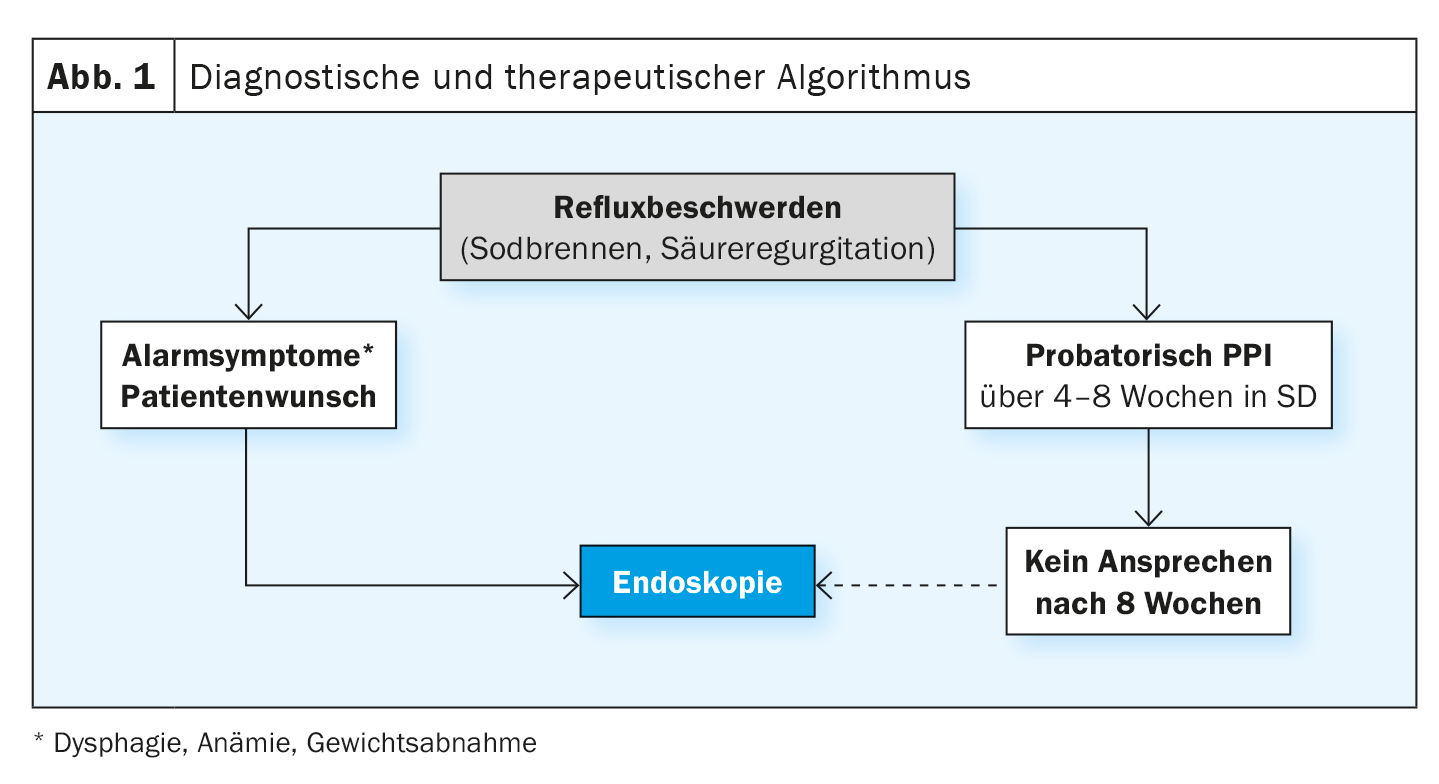
PPIs are first-line agents in acute therapy and in maintenance therapy as permanent or on-demand medication. In most cases, they are very well tolerated. However, fatigue, dizziness, headache, sleep disturbances, skin changes or increased liver levels may rarely occur. If pharmacotherapy is not tolerated or if symptoms persist, a switch to another PPI as well as another drug treatment option and add-on therapy may be considered. Laparoscopic antireflux surgery is appropriate for patients who do not respond to adequate doses of PPIs, do not desire long-term medication, and have nonacid or high-volume reflux. However, sufferers should be aware that in more than 50% of cases, acid inhibition will be required again down the road, Fischbach said.

General measures that can support treatment management include weight reduction, avoidance of late meals, exclusion of individual food intolerances, upper body elevation, smoking cessation, and reduction of alcohol consumption.

Conclusion

The expert summarized that reflux complaints are very common. PPIs are very effective and safe in treatment. They can be used primarily on a trial basis and, if necessary, as a permanent medication. Endoscopy should be performed when there are alarm symptoms or during the course of the disease. If a patient does not respond to first-line treatment with PPIs, alternatives and adjunctive measures can be considered. In addition, if symptoms are not present, a discontinuation of pharmacotherapy should be considered.

Source: “Gastroenterology I: Esophagus, Stomach, Small Intestine, Pancreatitis”, Prof. Dr. med. Wolfgang Fischbach, Aschaffenburg, fresh up Hausarztmedizin, March/April 2023.

HAUSARZT PRAXIS 2023; 18(6): 37 (published 6/23, ahead of print)

Autoren
  • Leoni Burggraf
Publikation
  • HAUSARZT PRAXIS
Related Topics
  • Acid regurgitation
  • Reflux
Previous Article
  • System therapy for atopic dermatitis: biologics or JAK inhibitors?

Balancing benefits and risks

  • Allergology and clinical immunology
  • Congress Reports
  • Dermatology and venereology
  • RX
  • Studies
View Post
Next Article
  • Invasive pulmonary aspergillosis

Correctly diagnose and treat IPA

  • RX
  • Allergology and clinical immunology
  • CME continuing education
  • General Internal Medicine
  • Infectiology
  • Oncology
  • Pneumology
  • Radiology
  • Unkategorisiert
View Post
You May Also Like
View Post
  • 6 min
  • Sjögren's Syndrome in Early Childhood

Children often develop lymphomas

    • RX
    • Education
    • Pediatrics
    • Rheumatology
    • Studies
View Post
  • 12 min
  • Multidrug-Resistant Pathogens in Wound Care

An Enemy in the Microbiome?

    • Dermatology and venereology
    • CME continuing education
    • Infectiology
    • Physical medicine and rehabilitation
    • Prevention and health care
    • RX
    • Surgery
View Post
  • 14 min
  • Rare Genodermatoses: From Diagnosis to Treatment

Darier’s Disease, also known as Follicular Keratosis – Update 2026

    • CME continuing education
    • Cases
    • Dermatology and venereology
    • Pharmacology and toxicology
    • RX
    • Studies
View Post
  • 9 min
  • Psychedelic-assisted therapy

Current status of PAT

    • RX
    • CME continuing education
    • General Internal Medicine
    • Pharmacology and toxicology
    • Psychiatry and psychotherapy
    • Studies
View Post
  • 7 min
  • Osgood-Schlatter Disease

Clinical Presentation, Diagnosis, and Treatment

    • RX
    • Cases
    • Education
    • Orthopedics
    • Pediatrics
View Post
  • 4 min
  • Cardiovascular Risk in Rheumatoid Arthritis

What is the most dangerous thing for RA?

    • RX
    • Cardiology
    • Education
    • General Internal Medicine
    • Rheumatology
    • Studies
View Post
  • 3 min
  • Antisense oligonucleotide for severe hypertriglyceridemia

Reduced Incidence of Acute Pancreatitis

    • RX
    • Education
    • Gastroenterology and Hepatology
    • General Internal Medicine
    • Studies
View Post
  • 5 min
  • Hereditary Transthyretin Amyloidosis with Polyneuropathy

New Treatment Options for ATTRv-PN

    • RX
    • Cardiology
    • Education
    • Gastroenterology and Hepatology
    • General Internal Medicine
    • Neurology
    • Pharmacology and toxicology
    • Studies
  • IBD matters

    Zum Thema
Top CME content
  • 1
    Darier’s Disease, also known as Follicular Keratosis – Update 2026
  • 2
    An Enemy in the Microbiome?
  • 3
    Evidence-Based Neuromodulation Based on Clinical Trials and Real-World Data
  • 4
    Current status of PAT
  • 5
    Development, Diagnosis, Epidemiology, and Treatment of a Disease Entity

Newsletter

Sign up and stay up to date

Subscribe
Medizinonline Medizinonline
  • Contact
  • General terms and conditions
  • Imprint

Input your search keywords and press Enter.