Medizinonline Medizinonline
  • News
    • News
    • Market & Medicine
  • Patients
    • Disease patterns
    • Diagnostics
    • Therapy
  • Partner Content
    • Diabetes
      • Dia-Month Club – Type 2 Diabetes
      • Diabetes in Motion
      • Diabetes Podcasts
    • Gastroenterology
      • IBD matters
    • Oncology
      • Swiss Oncology in motion
    • Orthopedics
      • Osteoporosis in motion
  • Departments
    • Allergology and clinical immunology
    • General Internal Medicine
    • Anesthesiology
    • Angiology
    • Surgery
    • Dermatology and venereology
    • Endocrinology and Diabetology
    • Nutrition
    • Gastroenterology and Hepatology
    • Genetics
    • Geriatrics
    • Gynecology
    • Hematology
    • Infectiology
    • Cardiology
    • Nephrology
    • Neurology
    • Emergency and intensive care medicine
    • Nuclear Medicine
    • Oncology
    • Ophthalmology
    • ORL
    • Orthopedics
    • Pediatrics
    • Pharmacology and toxicology
    • Pharmaceutical medicine
    • Phlebology
    • Physical medicine and rehabilitation
    • Pneumology
    • Prevention and health care
    • Psychiatry and psychotherapy
    • Radiology
    • Forensic Medicine
    • Rheumatology
    • Sports Medicine
    • Traumatology and trauma surgery
    • Tropical and travel medicine
    • Urology
    • Dentistry
  • CME & Congresses
    • CME continuing education
    • Congress Reports
    • Congress calendar
  • Practice
    • Noctimed
    • Practice Management
    • Jobs
    • Interviews
  • Log In
  • Register
  • My account
  • Contact
  • Publications
  • Contact
  • Deutsch
  • English
  • Français
  • Italiano
  • Português
  • Español
Subscribe
Medizinonline Medizinonline
  • News
    • News
    • Market & Medicine
  • Patienten
    • Krankheitsbilder
    • Diagnostik
    • Therapie
  • Partner Content
    • Diabetes
      • Dia-Month Club – Type 2 Diabetes
      • Diabetes in Motion
      • Diabetes Podcasts
    • Gastroenterology
      • IBD matters
    • Oncology
      • Swiss Oncology in motion
    • Orthopedics
      • Osteoporosis in motion
    • Phytotherapie
    • Rheumatology
  • Departments
    • Fachbereiche 1-13
      • Allergology and clinical immunology
      • General Internal Medicine
      • Anesthesiology
      • Angiology
      • Surgery
      • Dermatology and venereology
      • Endocrinology and Diabetology
      • Nutrition
      • Gastroenterology and Hepatology
      • Genetics
      • Geriatrics
      • Gynecology
      • Hematology
    • Fachbereiche 14-26
      • Infectiology
      • Cardiology
      • Nephrology
      • Neurology
      • Emergency and intensive care medicine
      • Nuclear Medicine
      • Oncology
      • Ophthalmology
      • ORL
      • Orthopedics
      • Pediatrics
      • Pharmacology and toxicology
      • Pharmaceutical medicine
    • Fachbereiche 26-38
      • Phlebology
      • Physical medicine and rehabilitation
      • Phytotherapy
      • Pneumology
      • Prevention and health care
      • Psychiatry and psychotherapy
      • Radiology
      • Forensic Medicine
      • Rheumatology
      • Sports Medicine
      • Traumatology and trauma surgery
      • Tropical and travel medicine
      • Urology
      • Dentistry
  • CME & Congresses
    • CME continuing education
    • Congress Reports
    • Congress calendar
  • Practice
    • Noctimed
    • Practice Management
    • Jobs
    • Interviews
Login

Sie haben noch keinen Account? Registrieren

  • Neuroimmunology

Mechanisms of neurodegeneration in the focus of multiple sclerosis.

    • Education
    • Neurology
    • RX
  • 2 minute read

To date, not all details of the pathophysiology of multiple sclerosis have been fully elucidated. But one important finding has been made: the earlier you intervene in the disease, the better it is. Therefore, one focus of research is to understand the mechanisms of neurodegeneration and then, in the course, to develop neuroprotective strategies.

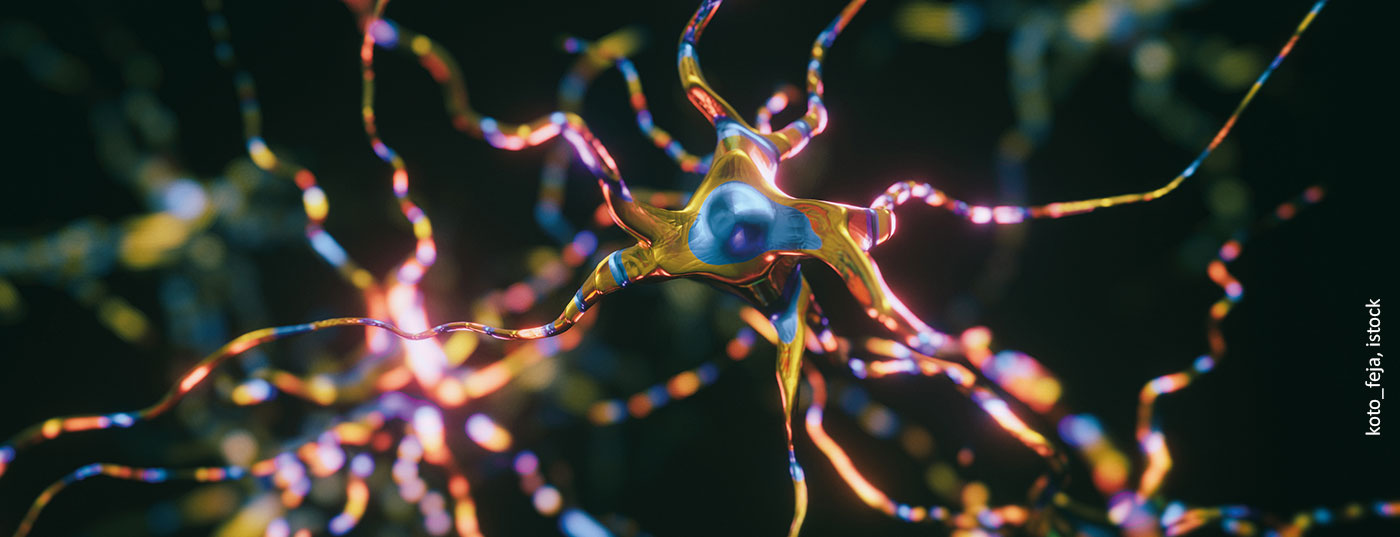
Multiple sclerosis (MS) is an autoimmune disease that starts in the periphery – for example, the lymph nodes. There, a misregulation of different immune cells occurs. This dysregulation leads to infiltration of activated T cells into the CNS and eventual onset of MS [1]. As a result, certain immune cells settle and inflammatory mediators are continuously released, resulting in damage to the nerve cells. Later in the course of the disease, the number of inflammatory cells in the CNS decreases in favor of an “organized” inflammatory response. This further drives neuronal cell death and demyelination. During the disease, the brain shows cortical atrophy, atrophy of white matter as well as gray matter, and cerebellum.

Chronic inflammation of the CNS is thought to be present at the onset of MS. This releases different reactive species, such as nitrogen or oxygen, glutamate or cytokines. This leads to mitochondrial damage and demyelination in addition to oxidative stress. An energy deficit and a redistribution of ion channels are the result. Ion imbalance occurs, as well as calcium and sodium excess. The activation of degradative enzymes as well as the swelling of cells then ultimately contributes to neuroaxonal damage [2]. In overview, continuous microglial activity and meningeal inflammation can be said to be associated with neuronal injury of white and gray matter. There is an imbalance between stressor load and neuronal buffer capacity. The compensation via anti-inflammatory therapy strategies and thus the reduction of the stressor load is a possibility that is currently also being intensively pursued. But strengthening protective pathways should not be ignored. It has now been demonstrated that modulation of the immune response is beneficial in the early stages of MS. Accordingly, there is a high clinical need for neuroprotective strategies aimed at strengthening neuronal resilience to inflammatory challenges.

On the trail of neurodegeneration

Using single cell sequencing, it was observed that most differentially expressed genes in MS patients are found in excitatory neurons [3]. This in turn triggers, among other things, neurotransmitter secretion, energy metabolism, mitochondrial permeability, and a reaction against unfolded proteins. A starting point for a possible rebalancing is now offered by glutamate excitotoxicity. This is because glutamate receptor genes are associated with more severe MS courses [4]. As has been shown, GRM8 in particular is a potent modulator of glutamate excitotoxicity and thus potentially neuroprotective. This is because GRM8 activity limits toxic cytosolic and nuclear calcium accumulation. Accordingly, GRM8 activation could be an effective therapeutic approach to increase neuronal resistance and counteract inflammatory neurodegeneration in MS.


Literature:

  1. Dendrou CA, Fugger L, Friese MA: Nat Rev Immunol 2015; 15: 545-558.
  2. Friese MA, et al: Nat Rev Neurol. 2014; 10: 225-238.
  3. Schirmer L, et al: Nature 2019; 573: 75-82.
  4. Woo MS, et al: J Exp Med. 2021; 218(5): e20201290.


InFo NEUROLOGY & PSYCHIATRY 2022; 20(1): 32.

Autoren
  • Leoni Burggraf
Publikation
  • InFo NEUROLOGIE & PSYCHIATRIE
Related Topics
  • MS
  • Multiple sclerosis
  • Neurodegeneration
  • neuroimmunology
Previous Article
  • Pressure ulcus

Properly relieved and cared for in the long term

  • Congress Reports
  • Dermatology and venereology
  • Endocrinology and Diabetology
  • Orthopedics
  • Physical medicine and rehabilitation
  • Prevention and health care
  • RX
View Post
Next Article
  • Severe nail psoriasis: treatment with biologics

Complete healing is achievable with some patience

  • Congress Reports
  • Dermatology and venereology
  • RX
  • Studies
View Post
You May Also Like
View Post
  • 12 min
  • Wound treatment

Surgical wound complications

    • CME continuing education
    • Dermatology and venereology
    • Endocrinology and Diabetology
    • Geriatrics
    • Physical medicine and rehabilitation
    • RX
    • Surgery
View Post
  • 8 min
  • Proteins in wound healing

Do special amino acids lead to success?

    • CME continuing education
    • Dermatology and venereology
    • Endocrinology and Diabetology
    • Nutrition
    • RX
    • Studies
View Post
  • 8 min
  • Proteins in wound healing

Do special amino acids lead to success?

    • CME continuing education
    • Dermatology and venereology
    • Endocrinology and Diabetology
    • Nutrition
    • RX
    • Studies
View Post
  • 0 min
  • Psychedelic-assisted therapy

Current status of PAT

    • CME continuing education
    • General Internal Medicine
    • Pharmacology and toxicology
    • Psychiatry and psychotherapy
    • RX
    • Studies
View Post
  • 5 min
  • Hepatitis B prophylaxis

Vaccination protection for healthcare staff with patient contact – an update

    • Congress Reports
    • General Internal Medicine
    • Infectiology
    • Prevention and health care
    • RX
View Post
  • 7 min
  • Plastic surgery and reconstructive microsurgery for DFS

Functional limb preservation between infection control, vascular medicine and resurfacing

    • Angiology
    • CME continuing education
    • Endocrinology and Diabetology
    • General Internal Medicine
    • Geriatrics
    • Physical medicine and rehabilitation
    • RX
    • Surgery
View Post
  • 6 min
  • Chronic urticaria: new treatment alternatives in sight

If antihistamines are not sufficient and IgE levels are low

    • Allergology and clinical immunology
    • Congress Reports
    • Dermatology and venereology
    • Pharmacology and toxicology
    • RX
    • Studies
View Post
  • 14 min
  • Adrenogenital syndrome

Clinical care from birth to adulthood

    • CME continuing education
    • Endocrinology and Diabetology
    • Nephrology
    • Pediatrics
    • RX
    • Studies
  • IBD matters

    Zum Thema
Top CME content
  • 1
    Do special amino acids lead to success?
  • 2
    Current status of PAT
  • 3
    Surgical wound complications
  • 4
    Do special amino acids lead to success?
  • 5
    Functional limb preservation between infection control, vascular medicine and resurfacing

Newsletter

Sign up and stay up to date

Subscribe
Medizinonline Medizinonline
  • Contact
  • General terms and conditions
  • Imprint

Input your search keywords and press Enter.