Medizinonline Medizinonline
  • News
    • News
    • Market & Medicine
  • Patients
    • Disease patterns
    • Diagnostics
    • Therapy
  • Partner Content
    • Diabetes
      • Dia-Month Club – Type 2 Diabetes
      • Diabetes in Motion
    • Gastroenterology
      • IBD matters
    • Oncology
      • Swiss Oncology in motion
    • Orthopedics
      • Osteoporosis in motion
  • Departments
    • Allergology and clinical immunology
    • General Internal Medicine
    • Anesthesiology
    • Angiology
    • Surgery
    • Dermatology and venereology
    • Endocrinology and Diabetology
    • Nutrition
    • Gastroenterology and Hepatology
    • Genetics
    • Geriatrics
    • Gynecology
    • Hematology
    • Infectiology
    • Cardiology
    • Nephrology
    • Neurology
    • Emergency and intensive care medicine
    • Nuclear Medicine
    • Oncology
    • Ophthalmology
    • ORL
    • Orthopedics
    • Pediatrics
    • Pharmacology and toxicology
    • Pharmaceutical medicine
    • Phlebology
    • Physical medicine and rehabilitation
    • Pneumology
    • Prevention and health care
    • Psychiatry and psychotherapy
    • Radiology
    • Forensic Medicine
    • Rheumatology
    • Sports Medicine
    • Traumatology and trauma surgery
    • Tropical and travel medicine
    • Urology
    • Dentistry
  • CME & Congresses
    • CME continuing education
    • Congress Reports
    • Congress calendar
  • Practice
    • Noctimed
    • Practice Management
    • Jobs
    • Interviews
  • Log In
  • Register
  • My account
  • Contact
  • Publications
  • Contact
  • Deutsch
  • English
  • Français
  • Italiano
  • Português
  • Español
Subscribe
Medizinonline Medizinonline
  • News
    • News
    • Market & Medicine
  • Patienten
    • Krankheitsbilder
    • Diagnostik
    • Therapie
  • Partner Content
    • Diabetes
      • Dia-Month Club – Type 2 Diabetes
      • Diabetes in Motion
    • Gastroenterology
      • IBD matters
    • Oncology
      • Swiss Oncology in motion
    • Orthopedics
      • Osteoporosis in motion
    • Phytotherapie
    • Rheumatology
  • Departments
    • Fachbereiche 1-13
      • Allergology and clinical immunology
      • General Internal Medicine
      • Anesthesiology
      • Angiology
      • Surgery
      • Dermatology and venereology
      • Endocrinology and Diabetology
      • Nutrition
      • Gastroenterology and Hepatology
      • Genetics
      • Geriatrics
      • Gynecology
      • Hematology
    • Fachbereiche 14-26
      • Infectiology
      • Cardiology
      • Nephrology
      • Neurology
      • Emergency and intensive care medicine
      • Nuclear Medicine
      • Oncology
      • Ophthalmology
      • ORL
      • Orthopedics
      • Pediatrics
      • Pharmacology and toxicology
      • Pharmaceutical medicine
    • Fachbereiche 26-38
      • Phlebology
      • Physical medicine and rehabilitation
      • Phytotherapy
      • Pneumology
      • Prevention and health care
      • Psychiatry and psychotherapy
      • Radiology
      • Forensic Medicine
      • Rheumatology
      • Sports Medicine
      • Traumatology and trauma surgery
      • Tropical and travel medicine
      • Urology
      • Dentistry
  • CME & Congresses
    • CME continuing education
    • Congress Reports
    • Congress calendar
  • Practice
    • Noctimed
    • Practice Management
    • Jobs
    • Interviews
Login

Sie haben noch keinen Account? Registrieren

  • Hematologic neoplasms

New findings change the standards of diagnostics and therapy

    • Congress Reports
    • Hematology
    • Oncology
    • RX
    • Studies
  • 3 minute read

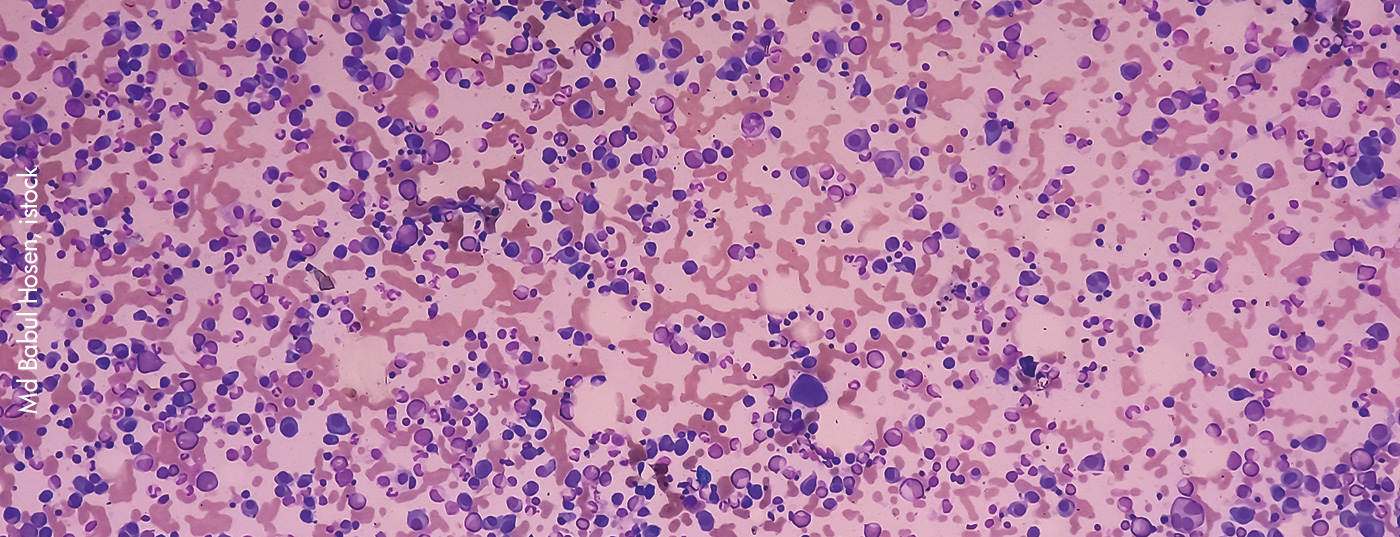
There is a lot happening in the landscape of hematologic neoplasms. This year, several potentially standard-changing studies could be presented to Congress at . Fitting to the claim of the annual congress of the European Hematology Association, which aims to bring state-of-the-art evidence-based approaches to diagnosis and therapy as well as the latest developments from research into practice.

30 years of EHA were celebrated in a very special way this year. Especially in the field of hematologic neoplasms, some groundbreaking study results could be presented. Hematologic malignancies account for only about 7% of all tumors, but they continue to pose significant challenges to practitioners. Especially the very heterogeneous manifestations require an exact diagnosis as well as very specific therapy management in order to achieve the best possible prognosis for the patients. Therefore, combination treatments are increasingly used to exploit additive effects of the individual parameters.

For example, in FLT3-IDT+ acute myeloid leukemia, intensive chemotherapy in combination with quizartinib prolonged overall survival. In activated PI3Kδ syndrome, the specific PI3Kδ inhibitor leniosilib resulted in an increase in naive B lymphocytes, achieving a decrease in lymphadenopathy and cytopenia. Patients with symptomatic, treatment-naive, primary or secondary myelofibrosis benefit from therapy with the JAK1/2 inhibitor momelotinib after pretreatment with JAK inhibitors. This was able to achieve a reduction in symptomatology and spleen size, as well as an increase in transfusion independence.

Focus on multiple myeloma

Exciting study results were also presented in multiple myeloma (MM). The triple combination of lenalidomide, bortezomib, and dexamethasone (RVd) have long been the standard of care for patients with newly diagnosed MM who are eligible for transplantation. Now, combination of RVd with autologous stem cell transplantation and lenalidomide maintenance until progression was studied in more detail. It resulted in a 21.4-month increase in median progression-free survival compared with RVd alone. However, overall survival was not prolonged.

The addition of an anti-CD38 antibody to RVd looks promising. A phase III study was conducted to further elucidate the efficacy of the combination of isatuximab with RVd in induction therapy. It was investigated whether quadruple treatment could repress disease activity as much as possible and achieve the greatest MRD (measurable residual disease) negativity. Achieving MRD negativity was defined as failure to detect residual disease in the bone marrow prior to high-dose therapy followed by autologous hematopoietic stem cell transplantation. MRD negativity is an important clinical endpoint associated with improved outcome. This is especially important in the present patient clientele, who frequently relapse. It was shown that the four-agent combination resulted in a deeper response after induction and that the benefit in terms of MRD was consistent. MRD negativity rates in bone marrow after induction therapy were 50.1% versus 35.6% with RVd. A significant influence on the safety profile by the additional administration of the anti-CD38 antibody could not be detected. Rates of all observed adverse events were 63.6% for the isatuximab combination versus 61.3% for RVd, and serious adverse events and discontinuations were similar in both study arms (34.8% and 36.3%, respectively). The study will be continued with further analysis of progression-free survival after the next therapy interventions.

Comparison of therapy in Burkitt’s lymphoma

High-risk Burkitt’s lymphoma is said to occur when patients have elevated LDH levels, WHO performance status ≥2, stage III/IV, or a tumor mass at least 10 cm in diameter. The problem with this disease is that there is currently no standard of care. Ultimately, the choice is between two immunotherapies. R-CODOX-M/R-IVAC is a high-dose treatment management, whereas DA-EPOCH-R is less aggressive and thus tends to appear less effective. This assumption has now been refuted in a direct comparison. Dose-adapted EPOCH-R resulted in equal remission rates and survival at two years as R-CODOX-M/R-IVAC, but was associated with fewer side effects.

Congress: EHA 2022


InFo ONCOLOGY & HEMATOLOGY 2022; 10(4): 22.

Autoren
  • Leoni Burggraf
Publikation
  • InFo ONKOLOGIE & HÄMATOLOGIE
Related Topics
  • EHA
  • MRD
  • Multiple Myeloma
  • RVd
Previous Article
  • IgE autoreactivity in atopic dermatitis.

Study shows association with type 2 comorbidities

  • Allergology and clinical immunology
  • Congress Reports
  • Dermatology and venereology
  • Partner Content
  • RX
  • Studies
View Post
Next Article
  • IBD matters

How do you treat patients with IBD who are at risk?

  • Education
  • Gastroenterology and Hepatology
  • Partner Content
  • RX
View Post
You May Also Like
View Post
  • 3 min
  • Casuistry

Chronic eosinophilic pneumonia in RA

    • RX
    • Cases
    • Education
    • General Internal Medicine
    • Pneumology
    • Rheumatology
View Post
  • 4 min
  • Case Study: Secondary Pseudohypoaldosteronism

Severe electrolyte imbalances and nonspecific symptoms in an infant

    • RX
    • Cases
    • Education
    • General Internal Medicine
    • Nephrology
    • Pediatrics
    • Urology
View Post
  • 4 min
  • CKD and High Blood Pressure

Keeping an Eye on Bidirectional Interactions

    • RX
    • Cardiology
    • Congress Reports
    • General Internal Medicine
    • Nephrology
    • Studies
View Post
  • 20 min
  • Molecular Classification, FIGO 2023, and Chemoimmunotherapy

Endometrial carcinoma

    • RX
    • CME continuing education
    • Gynecology
    • Oncology
    • Studies
View Post
  • 4 min
  • Psoriatic Arthritis

Older patients at risk for tachyarrhythmias

    • RX
    • Cardiology
    • Dermatology and venereology
    • Education
    • General Internal Medicine
    • Geriatrics
    • Pharmacology and toxicology
    • Rheumatology
    • Studies
View Post
  • 3 min
  • Genetic Kidney Disease: DOUBLE PROTECT Alport

The SGLT-2 inhibitor dapagliflozin as an add-on to RAS blockade

    • RX
    • Education
    • General Internal Medicine
    • Genetics
    • Nephrology
    • Studies
View Post
  • 4 min
  • Case Study: Cystic Fibrosis in Adults

Recurrent Pneumonia as a Manifestation of Cystic Fibrosis

    • RX
    • Education
    • Infectiology
    • Pneumology
View Post
  • 5 min
  • Long COVID/Fatigue Clinic

An Innovative Approach: Neuroplasticity and Predictive Processing

    • RX
    • Congress Reports
    • General Internal Medicine
    • Infectiology
    • Neurology
    • Physical medicine and rehabilitation
    • Pneumology
    • Psychiatry and psychotherapy
  • IBD matters

    Zum Thema
Top CME content
  • 1
    Endometrial carcinoma
  • 2
    Clinical Presentation, Diagnosis, and Treatment of DSPN
  • 3
    Why is it so hard to lose weight?
  • 4
    Four-Legged Medical Assistants – Therapy Dogs in Clinical Settings
  • 5
    Functional limb preservation between infection control, vascular medicine and resurfacing

Newsletter

Sign up and stay up to date

Subscribe
Medizinonline Medizinonline
  • Contact
  • General terms and conditions
  • Imprint

Input your search keywords and press Enter.