Medizinonline Medizinonline
  • News
    • News
    • Market & Medicine
  • Patients
    • Disease patterns
    • Diagnostics
    • Therapy
  • Partner Content
    • Diabetes
      • Dia-Month Club – Type 2 Diabetes
      • Diabetes in Motion
      • Diabetes Podcasts
    • Gastroenterology
      • IBD matters
    • Oncology
      • Swiss Oncology in motion
    • Orthopedics
      • Osteoporosis in motion
  • Departments
    • Allergology and clinical immunology
    • General Internal Medicine
    • Anesthesiology
    • Angiology
    • Surgery
    • Dermatology and venereology
    • Endocrinology and Diabetology
    • Nutrition
    • Gastroenterology and Hepatology
    • Genetics
    • Geriatrics
    • Gynecology
    • Hematology
    • Infectiology
    • Cardiology
    • Nephrology
    • Neurology
    • Emergency and intensive care medicine
    • Nuclear Medicine
    • Oncology
    • Ophthalmology
    • ORL
    • Orthopedics
    • Pediatrics
    • Pharmacology and toxicology
    • Pharmaceutical medicine
    • Phlebology
    • Physical medicine and rehabilitation
    • Pneumology
    • Prevention and health care
    • Psychiatry and psychotherapy
    • Radiology
    • Forensic Medicine
    • Rheumatology
    • Sports Medicine
    • Traumatology and trauma surgery
    • Tropical and travel medicine
    • Urology
    • Dentistry
  • CME & Congresses
    • CME continuing education
    • Congress Reports
    • Congress calendar
  • Practice
    • Noctimed
    • Practice Management
    • Jobs
    • Interviews
  • Log In
  • Register
  • My account
  • Contact
  • Publications
  • Contact
  • Deutsch
  • English
  • Français
  • Italiano
  • Português
  • Español
Subscribe
Medizinonline Medizinonline
  • News
    • News
    • Market & Medicine
  • Patienten
    • Krankheitsbilder
    • Diagnostik
    • Therapie
  • Partner Content
    • Diabetes
      • Dia-Month Club – Type 2 Diabetes
      • Diabetes in Motion
      • Diabetes Podcasts
    • Gastroenterology
      • IBD matters
    • Oncology
      • Swiss Oncology in motion
    • Orthopedics
      • Osteoporosis in motion
    • Phytotherapie
    • Rheumatology
  • Departments
    • Fachbereiche 1-13
      • Allergology and clinical immunology
      • General Internal Medicine
      • Anesthesiology
      • Angiology
      • Surgery
      • Dermatology and venereology
      • Endocrinology and Diabetology
      • Nutrition
      • Gastroenterology and Hepatology
      • Genetics
      • Geriatrics
      • Gynecology
      • Hematology
    • Fachbereiche 14-26
      • Infectiology
      • Cardiology
      • Nephrology
      • Neurology
      • Emergency and intensive care medicine
      • Nuclear Medicine
      • Oncology
      • Ophthalmology
      • ORL
      • Orthopedics
      • Pediatrics
      • Pharmacology and toxicology
      • Pharmaceutical medicine
    • Fachbereiche 26-38
      • Phlebology
      • Physical medicine and rehabilitation
      • Phytotherapy
      • Pneumology
      • Prevention and health care
      • Psychiatry and psychotherapy
      • Radiology
      • Forensic Medicine
      • Rheumatology
      • Sports Medicine
      • Traumatology and trauma surgery
      • Tropical and travel medicine
      • Urology
      • Dentistry
  • CME & Congresses
    • CME continuing education
    • Congress Reports
    • Congress calendar
  • Practice
    • Noctimed
    • Practice Management
    • Jobs
    • Interviews
Login

Sie haben noch keinen Account? Registrieren

  • Hypertension Management

Optimized blood pressure setting in everyday practice

    • Cardiology
    • Education
    • RX
  • 3 minute read

High blood pressure is still one of the leading causes of death. Despite good diagnostic possibilities, a large proportion of hypertension patients are not well controlled. That has to change.

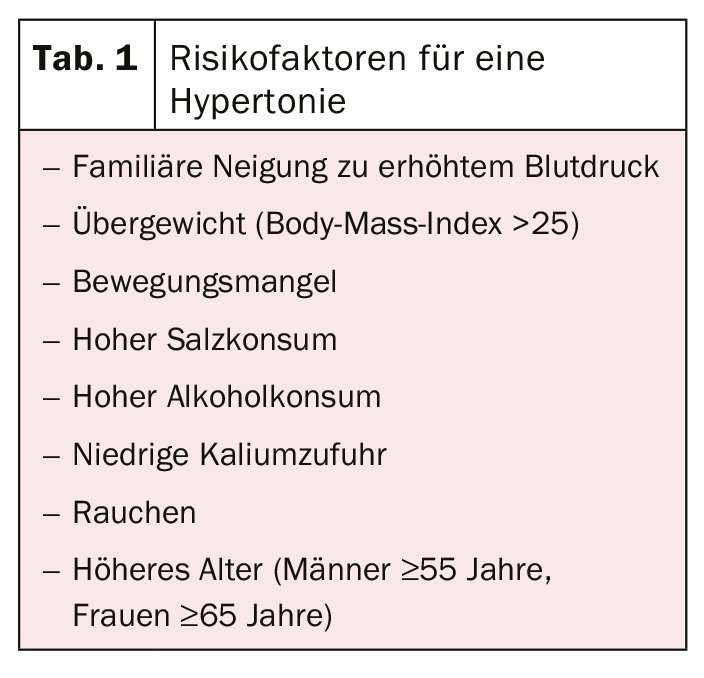
High blood pressure does not hurt. It is not felt and does not cause any discomfort for a long time. Until the consequences such as apoplexy, myocardial infarction, angina pectoris, heart failure or kidney damage can no longer be ignored. Early diagnosis and effective treatment are therefore indicated to reduce the most important risk factor for cardiovascular disease and premature death [1]. It is estimated that one in four adults in Switzerland suffers from arterial hypertension [2]. The spectrum of vascular diseases, which are predominantly triggered by hypertension, is wide and ranges from loss of elasticity and the associated increase in resistance to ischemia. Exactly what causes the disease is not yet fully understood. However, several factors may contribute to its development (Table 1) .
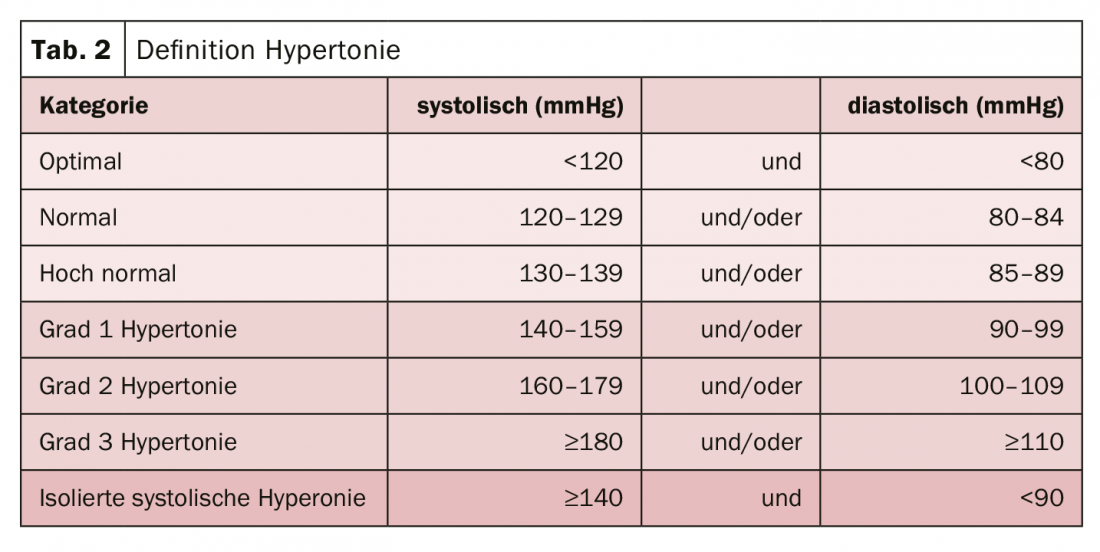
Current guidelines generally recommend initiation of therapy at values ≥140/90 mmHg with a target value <130/80 mmHg (Table 2) [3]. These specifications are independent of possible comorbidities. Only in frail people over 80 years of age should treatment be started only at a value of ≥160/90 mmHg.


Despite a range of therapeutic options, hypertension control is just 50% [4]. The younger the patients, the less well adjusted they are. However, since prevention is always better than cure, greater attention should be paid to individual blood pressure control. Results of a systematic review and meta-analysis demonstrate that as little as a 10 mmHg sBP reduction in blood pressure can reduce the risk of cardiovascular events by 20%, heart failure by 28%, stroke by 27%, coronary artery disease by 17%, and mortality by 13% [5]. There are many reasons for uncontrolled hypertension. Often, treatment options are underutilized. Hypertension is said to be refractory to therapy only when, despite three antihypertensive drugs in optimal dosage incl. diuretic does not reach the target value. This is the case in only about 2% of patients [6].

Reach for combination therapy right away

The maximum response rate to monotherapy is 30-40%. Therefore, the administration of a twofold combination is now also initially propagated. In contrast to dose escalation, the combination is much more effective [7]. The dual combination has an 80% response rate and also strengthens adherence. This is because up to 70% of patients do not take their medication as prescribed. According to studies, the risk of non-adherence increases from the administration of three tablets daily [8,9]. Fixed-dose combinations effectively support the therapeutic regimen in this case.

In the first step, a combination of an ACE inhibitor, renin-angiotensin blocker, or sartan with a calcium antagonist should be resorted to. This was shown to be metabolically advantageous over beta-blockers [10]. The greatest protection against heart failure is promised by the combination of an ACE inhibitor with a diuretic [11]. Beta-blockers should now only be prescribed for specific indications. If no effective blood pressure reduction can be achieved under the two-drug combination at optimal dosage, a switch should be made to a three-drug combination, e.g., ACE inhibitor, calcium antagonist, and diuretic.


Literature:

  1. https://vizhub.healthdata.org/gbd-compare (last call 01.07.2019)
  2. www.swissheart.ch/herzkrankheiten-hirnschlag/risikofaktoren/blutdruck.html (last call 01.07.2019)
  3. Williams B, et al: Eur Heart J 2018. 39: 3021-3104.
  4. Bundesgesundheitsbl 2013. 56: 795-801.
  5. Ettehad D, et al: Lancet 2016. 387: 957-967.
  6. Weitzmann D, et al: Hypertension 2014. 64: 501-507.
  7. Wald DS, et al: Am J Med 2009. 122: 290-300.
  8. Strauch B, et al: J Hypertens 2013. 31: 2455-2461.
  9. Gupta P, et al: Hypertension 2017. 69: 1113-1120.
  10. Elliott WJ, et al: Lancet 2007. 369: 201-207.
  11. Sciaretta S, et al: Arch Int Med 2011. 171: 384-394.


CARDIOVASC 2019; 18(4): 22
Autoren
  • Leoni Burggraf
Publikation
  • CARDIOVASC
Related Topics
  • Combination therapy
  • Hypertension
  • Target value setting
Previous Article
  • Bacterial meningitis

Central nervous system survival strategy of pneumococci identified.

  • Infectiology
  • Neurology
  • News
  • RX
  • Studies
View Post
Next Article
  • Hymenoptera

Insect venom allergy

  • Allergology and clinical immunology
  • Education
  • Emergency and intensive care medicine
  • General Internal Medicine
  • RX
View Post
You May Also Like
View Post
  • 6 min
  • Acute pulmonary embolism: new AHA/ACC guideline

Practical recommendations for risk-stratified triage

    • Cardiology
    • Education
    • Pneumology
    • RX
    • Studies
View Post
  • 13 min
  • Why lipoprotein(a) is the biggest therapeutic vacuum in cardiology

Lp(a): The underestimated risk factor before the turning point

    • Cardiology
    • Education
    • Endocrinology and Diabetology
    • RX
    • Studies
View Post
  • 11 min
  • Modern system therapeutics for hidradenitis suppurativa

Immunological dysregulation in the sights of several biologics and “small molecules”

    • Allergology and clinical immunology
    • Dermatology and venereology
    • Education
    • RX
    • Studies
View Post
  • 15 min
  • Perimenopausal depression, PMDS and tokophobia

Psychosomatics and mental health in gynecology

    • Education
    • Gynecology
    • Psychiatry and psychotherapy
    • RX
    • Studies
View Post
  • 8 min
  • Proteins in wound healing

Do special amino acids lead to success?

    • CME continuing education
    • Dermatology and venereology
    • Endocrinology and Diabetology
    • Nutrition
    • RX
    • Studies
View Post
  • 7 min
  • Plastic surgery and reconstructive microsurgery for DFS

Functional limb preservation between infection control, vascular medicine and resurfacing

    • Angiology
    • CME continuing education
    • Endocrinology and Diabetology
    • General Internal Medicine
    • Geriatrics
    • Physical medicine and rehabilitation
    • RX
    • Surgery
View Post
  • 9 min
  • Polycystic ovary syndrome 2025/2026

New pathophysiology, updated diagnostics and the age of incretin mimetics

    • Education
    • Gastroenterology and Hepatology
    • General Internal Medicine
    • Gynecology
    • Pharmacology and toxicology
    • RX
    • Studies
View Post
  • 14 min
  • Heart failure and type 2 diabetes

Oral semaglutide and cardiac decompensation in type 2 diabetes

    • Cardiology
    • Education
    • Endocrinology and Diabetology
    • RX
    • Studies
  • IBD matters

    Zum Thema
Top CME content
  • 1
    Functional limb preservation between infection control, vascular medicine and resurfacing
  • 2
    Do special amino acids lead to success?
  • 3
    Do special amino acids lead to success?
  • 4
    Current status of PAT
  • 5
    Surgical wound complications

Newsletter

Sign up and stay up to date

Subscribe
Medizinonline Medizinonline
  • Contact
  • General terms and conditions
  • Imprint

Input your search keywords and press Enter.