Medizinonline Medizinonline
  • News
    • News
    • Market & Medicine
  • Patients
    • Disease patterns
    • Diagnostics
    • Therapy
  • Partner Content
    • Diabetes
      • Dia-Month Club – Type 2 Diabetes
      • Diabetes in Motion
      • Diabetes Podcasts
    • Gastroenterology
      • IBD matters
    • Oncology
      • Swiss Oncology in motion
    • Orthopedics
      • Osteoporosis in motion
  • Departments
    • Allergology and clinical immunology
    • General Internal Medicine
    • Anesthesiology
    • Angiology
    • Surgery
    • Dermatology and venereology
    • Endocrinology and Diabetology
    • Nutrition
    • Gastroenterology and Hepatology
    • Genetics
    • Geriatrics
    • Gynecology
    • Hematology
    • Infectiology
    • Cardiology
    • Nephrology
    • Neurology
    • Emergency and intensive care medicine
    • Nuclear Medicine
    • Oncology
    • Ophthalmology
    • ORL
    • Orthopedics
    • Pediatrics
    • Pharmacology and toxicology
    • Pharmaceutical medicine
    • Phlebology
    • Physical medicine and rehabilitation
    • Pneumology
    • Prevention and health care
    • Psychiatry and psychotherapy
    • Radiology
    • Forensic Medicine
    • Rheumatology
    • Sports Medicine
    • Traumatology and trauma surgery
    • Tropical and travel medicine
    • Urology
    • Dentistry
  • CME & Congresses
    • CME continuing education
    • Congress Reports
    • Congress calendar
  • Practice
    • Noctimed
    • Practice Management
    • Jobs
    • Interviews
  • Log In
  • Register
  • My account
  • Contact
  • Publications
  • Contact
  • Deutsch
  • English
  • Français
  • Italiano
  • Português
  • Español
Subscribe
Medizinonline Medizinonline
  • News
    • News
    • Market & Medicine
  • Patienten
    • Krankheitsbilder
    • Diagnostik
    • Therapie
  • Partner Content
    • Diabetes
      • Dia-Month Club – Type 2 Diabetes
      • Diabetes in Motion
      • Diabetes Podcasts
    • Gastroenterology
      • IBD matters
    • Oncology
      • Swiss Oncology in motion
    • Orthopedics
      • Osteoporosis in motion
    • Phytotherapie
    • Rheumatology
  • Departments
    • Fachbereiche 1-13
      • Allergology and clinical immunology
      • General Internal Medicine
      • Anesthesiology
      • Angiology
      • Surgery
      • Dermatology and venereology
      • Endocrinology and Diabetology
      • Nutrition
      • Gastroenterology and Hepatology
      • Genetics
      • Geriatrics
      • Gynecology
      • Hematology
    • Fachbereiche 14-26
      • Infectiology
      • Cardiology
      • Nephrology
      • Neurology
      • Emergency and intensive care medicine
      • Nuclear Medicine
      • Oncology
      • Ophthalmology
      • ORL
      • Orthopedics
      • Pediatrics
      • Pharmacology and toxicology
      • Pharmaceutical medicine
    • Fachbereiche 26-38
      • Phlebology
      • Physical medicine and rehabilitation
      • Phytotherapy
      • Pneumology
      • Prevention and health care
      • Psychiatry and psychotherapy
      • Radiology
      • Forensic Medicine
      • Rheumatology
      • Sports Medicine
      • Traumatology and trauma surgery
      • Tropical and travel medicine
      • Urology
      • Dentistry
  • CME & Congresses
    • CME continuing education
    • Congress Reports
    • Congress calendar
  • Practice
    • Noctimed
    • Practice Management
    • Jobs
    • Interviews
Login

Sie haben noch keinen Account? Registrieren

  • From symptom to diagnosis

Pulmonary complaints – Pneumothorax

    • Cases
    • Education
    • Pneumology
    • Radiology
    • RX
    • Surgery
    • Traumatology and trauma surgery
  • 4 minute read

Pneumothorax is the term used to describe the entry of air into the pleural cavity. There are many different causes. Tension pneumothorax is a life-threatening complication. X-rays and computer tomography play an important role in the diagnosis. As far as treatment options are concerned, there is the possibility of chest drainage in addition to conservative therapy.

The entry of air between the parietal and visceral leaflets of the pleura causes the capillary forces in the pleural cavity to be suspended. The adhesion between the pleural sheets is lost and the lung no longer follows the thoracic movements. The result is a partial or complete collapse of the affected lung. Air can enter from the outside (through an injury) or from the inside (through a tear in the lung tissue or a bronchopleural fistula). Upper lobe segments 1, 2 and 3 are particularly predisposed to pneumothorax, as these are relatively more stretched during deep inspiration [1].

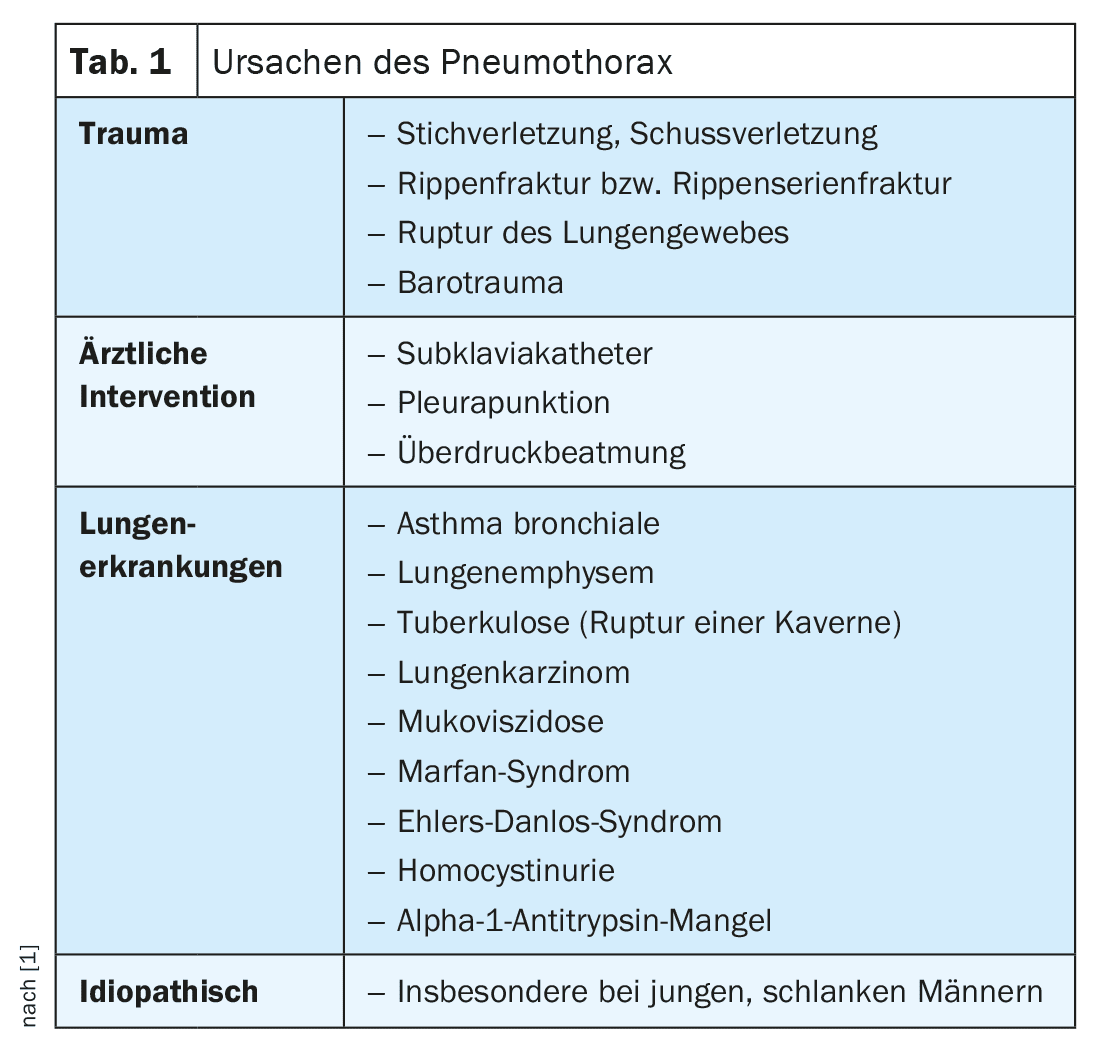
The causes of pneumothorax are listed in Table 1.
A rupture of the visceral pleura with a connection between the pleural cavity and the lung in a transthoracic or transdiaphragmatic fistula with pre-existing pneumoperitoneum leads to pneumothorax. Spontaneous pneumothorax can also be caused by subpleural emphysema blisters and esophageal rupture [6]. Smoking is also a risk factor for spontaneous pneumothorax [5].

The symptoms manifest themselves with sudden, stabbing, possibly breathing-dependent pain in the affected half of the thorax, dyspnoea and shortness of breath. Coughing and a dry cough may also occur, as well as the affected half of the thorax “lagging behind” when breathing.

Various classifications help to better categorize the clinical picture of pneumothorax (Table 2).

The therapeutic aim is to remove the air from the pleural cavity with complete expansion of the lung and to prevent recurrence [2,3]. If it is an idiopathic spontaneous pneumothorax and occurs for the first time, it can usually be treated conservatively. If the spontaneous pneumothorax is less severe, treatment consists of close monitoring of the X-ray findings, albeit in close conjunction with the clinical symptoms. In all other cases, a so-called thoracic drainage is inserted so that the negative pressure within the thorax is restored and the lung expands.

If the pneumothorax is caused by other traumatic injuries such as rib fractures or a hemothorax (blood in the pleural cavity), a chest drain must always be inserted to drain the pneumothorax and any abnormal fluids such as blood or other effusion. In the case of a tension pneumothorax, there is a maximum emergency indication and the drain must be inserted immediately.

Surgical correction is often recommended in the event of a recurrence of a pneumothorax, persistent air loss over 3-4 days or in the presence of a secondary pneumothorax (i.e. a lung disease). This involves endoscopy (thoracoscopy) of the affected chest cavity under general anesthesia. In order to close the leak in the pleura, a sparing wedge resection is performed in the affected section of the lung. In addition, a so-called abrasion of the pleura is performed. In certain cases of recurrence of pneumothorax, a talc pleurodesis, an adhesion of the visceral and parietal pleura using talcum powder, is performed [4].

X-rays of the lungs should be taken in a standing position and – if not possible – in a lateral position. The image in expiration enlarges the intrapleural air relative to the lung air, the pneumothorax becomes more clearly recognizable, and in a tension pneumothorax the lung is collapsed and almost homogeneously compressed. The diaphragm is low, the intercostal spaces are dilated and the mediastinum is displaced contralaterally [6].

Computed tomography scans are also very good at detecting pneumothorax. In traumatized patients, a reliable distinction can be made between an accompanying serothorax or haemothorax.

Magnetic resonance imaging does not play a role in the diagnosis of pneumothorax.

Case study

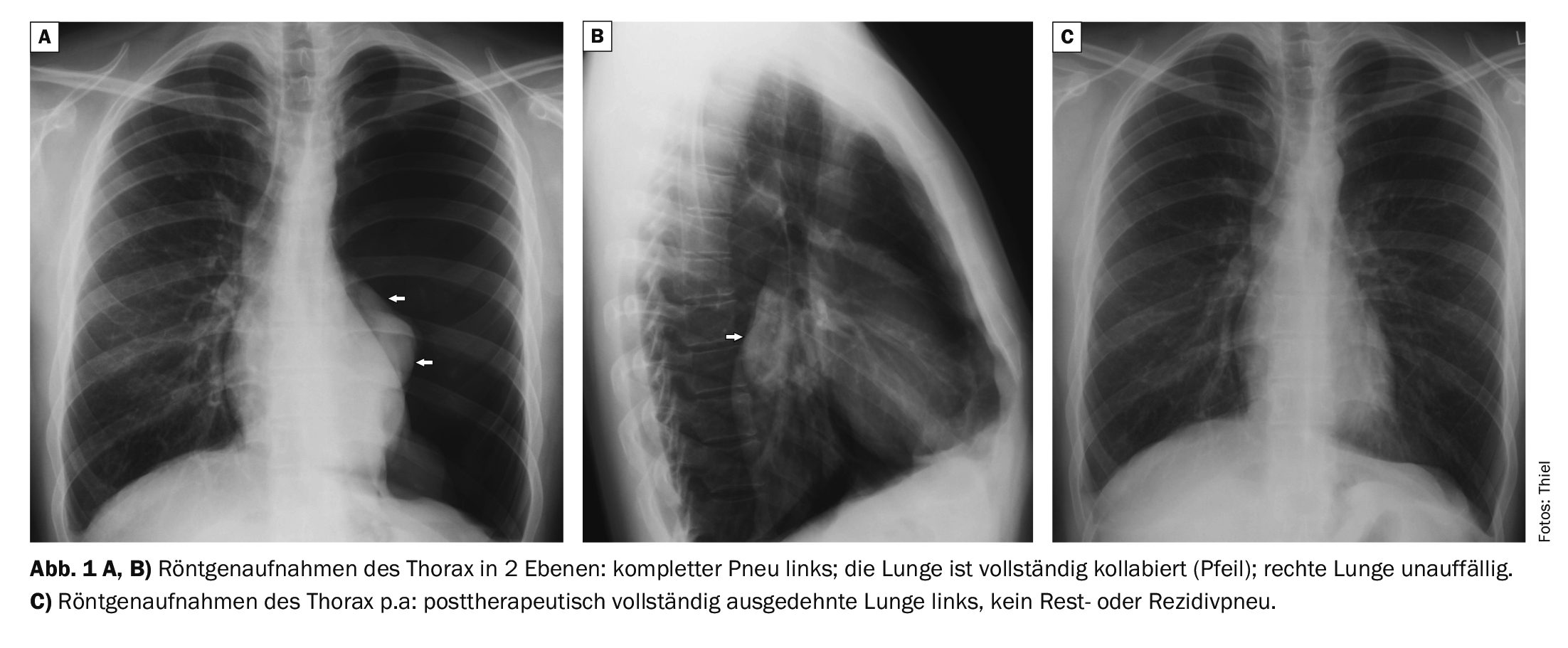
Case report 1 shows a complete left-sided pneumonia (Fig. 1A and B) in a 32-year-old patient on chest X-ray. The patient complained of spontaneous dyspnea and clinically presented with tracheobronchitis. On auscultation, a reduced ventilation on the left was conspicuous. There was no evidence of trauma in the medical history.

X-ray control showed a restitutio ad integrum (Fig. 1C).
Case 2 demonstrates the course after initial diagnosis of a right mantle pneumothorax following blunt chest trauma with subsequent dyspnea (Fig. 2A). A small pleural effusion was present on the right basolateral side. A CT scan more than a year later showed a small residual basal pleural effusion with a scar at the edge (Fig. 2B).

Take-Home-Messages

  • In pneumothorax, air enters between the parietal and visceral leaflets of the pleura.
  • The loss of adhesion of the pleural sheets can result in a partial or complete pneumothorax.
  • There are various causes of pneumothorax.
  • Spontaneous pneumothorax can be treated conservatively, depending on the symptoms.
  • Suction drainage or pleurodesis are recommended for recurrence or secondary pneumothorax.

Literature:

  1. Hircin E, Antwerpes F: Pneumothorax, https://flexikon.doccheck.com/de,(last accessed 02.04.2024)
  2. Arshad H, et al: Acute pneumothorax. Crit Care Nurs Q 2016; 39(2).
  3. DeMaio A, Semaan R: Management of Pneumothorax. Clin Chest Med 2021; 42(4): 729–738.
  4. Pneumothorax Therapie, www.usz.ch/fachbereich/thoraxchirurgie/angebot/pneumothorax, (last accessed 02.04.2024)
  5. Huan NC, Sidhu C, Thomas R: Pneumothorax: Classification and Etiology. Clin Chest Med 2021; 42(4): 711–727.
  6. Lange S: Radiologische Diagnostik der Thoraxerkrankungen. 2., völlig neu bearbeitete und erweiterte Auflage. Georg Thieme Verlag Stuttgart, New York: 1996; pp. 179–180.

InFo PNEUMOLOGIE & ALLERGOLOGIE 2024; 6(3): 37–39

Autoren
  • Dr. med. Hans-Joachim Thiel
Publikation
  • InFo PNEUMOLOGIE & ALLERGOLOGIE
Related Topics
  • Chest Drainage
  • Computed tomography
  • Pleural cavity
  • pneumothorax
  • Tension pneumothorax
  • X-ray diagnostics
Previous Article
  • Hyperthyroidism

Casuistry of the most common etiologies

  • RX
  • Cases
  • Congress Reports
  • Endocrinology and Diabetology
  • Gastroenterology and Hepatology
View Post
Next Article
  • Treatment of Legionnaires' disease

Findings from the Swiss LEGIO multicenter study

  • RX
  • Congress Reports
  • General Internal Medicine
  • Infectiology
  • Pneumology
  • Studies
  • Tropical and travel medicine
View Post
You May Also Like
View Post
  • 5 min
  • Omaveloxolone for Friedreich's Ataxia

Efficacy and Safety Studied Over 6 Years

    • Neurology
    • Congress Reports
    • Endocrinology and Diabetology
    • RX
    • Studies
View Post
  • 6 min
  • Psoriasis: therapy with biologics and TYK-2-i

Progress assessments based on current long-term and real-world data

    • RX
    • Congress Reports
    • Dermatology and venereology
    • Pharmacology and toxicology
    • Rheumatology
    • Studies
View Post
  • 4 min
  • Hypertension: the most important facts for daily practice

Early dual antihypertensive therapy is usually indicated

    • RX
    • Cardiology
    • Congress Reports
    • General Internal Medicine
View Post
  • 4 min
  • Escitalopram for anxiety disorders

Positive effect, but no immediate improvement in symptoms

    • RX
    • Education
    • Neurology
    • Pharmacology and toxicology
    • Psychiatry and psychotherapy
    • Studies
View Post
  • 4 min
  • Helicobacter pylori infection

Simplified dual therapy beats quadruple regimen

    • RX
    • Education
    • Gastroenterology and Hepatology
    • General Internal Medicine
    • Infectiology
    • Studies
View Post
  • 3 min
  • Gastric carcinoma

Ways of precision oncology

    • RX
    • Congress Reports
    • Gastroenterology and Hepatology
    • Oncology
    • Studies
View Post
  • 8 min
  • Endometrial Cancer

Immunological drivers and new therapeutic pathways

    • RX
    • Education
    • Gynecology
    • Oncology
    • Studies
View Post
  • 6 min
  • Exercise for type 1 diabetes

Cyclists and runners with an increased risk of hypoglycemia

    • RX
    • Education
    • Endocrinology and Diabetology
    • Sports Medicine
    • Studies
Landingpage Fachinfo Landingpage Button
  • IBD matters

    Zum Thema
Top CME content
  • 1
    Communication as the key to therapy adherence
  • 2
    Solutions to the malnutrition dilemma
  • 3
    Solutions to the malnutrition dilemma
  • 4
    Focus on preventive care options
  • 5
    Fertility preservation from gonads to genomes to genoids

Newsletter

Sign up and stay up to date

Subscribe
Medizinonline Medizinonline
  • Contact
  • General terms and conditions
  • Imprint

Input your search keywords and press Enter.