Medizinonline Medizinonline
  • News
    • News
    • Market & Medicine
  • Patients
    • Disease patterns
    • Diagnostics
    • Therapy
  • Partner Content
    • Diabetes
      • Dia-Month Club – Type 2 Diabetes
      • Diabetes in Motion
      • Diabetes Podcasts
    • Gastroenterology
      • IBD matters
    • Oncology
      • Swiss Oncology in motion
    • Orthopedics
      • Osteoporosis in motion
  • Departments
    • Allergology and clinical immunology
    • General Internal Medicine
    • Anesthesiology
    • Angiology
    • Surgery
    • Dermatology and venereology
    • Endocrinology and Diabetology
    • Nutrition
    • Gastroenterology and Hepatology
    • Genetics
    • Geriatrics
    • Gynecology
    • Hematology
    • Infectiology
    • Cardiology
    • Nephrology
    • Neurology
    • Emergency and intensive care medicine
    • Nuclear Medicine
    • Oncology
    • Ophthalmology
    • ORL
    • Orthopedics
    • Pediatrics
    • Pharmacology and toxicology
    • Pharmaceutical medicine
    • Phlebology
    • Physical medicine and rehabilitation
    • Pneumology
    • Prevention and health care
    • Psychiatry and psychotherapy
    • Radiology
    • Forensic Medicine
    • Rheumatology
    • Sports Medicine
    • Traumatology and trauma surgery
    • Tropical and travel medicine
    • Urology
    • Dentistry
  • CME & Congresses
    • CME continuing education
    • Congress Reports
    • Congress calendar
  • Practice
    • Noctimed
    • Practice Management
    • Jobs
    • Interviews
  • Log In
  • Register
  • My account
  • Contact
  • Publications
  • Contact
  • Deutsch
  • English
  • Français
  • Italiano
  • Português
  • Español
Subscribe
Medizinonline Medizinonline
  • News
    • News
    • Market & Medicine
  • Patienten
    • Krankheitsbilder
    • Diagnostik
    • Therapie
  • Partner Content
    • Diabetes
      • Dia-Month Club – Type 2 Diabetes
      • Diabetes in Motion
      • Diabetes Podcasts
    • Gastroenterology
      • IBD matters
    • Oncology
      • Swiss Oncology in motion
    • Orthopedics
      • Osteoporosis in motion
    • Phytotherapie
    • Rheumatology
  • Departments
    • Fachbereiche 1-13
      • Allergology and clinical immunology
      • General Internal Medicine
      • Anesthesiology
      • Angiology
      • Surgery
      • Dermatology and venereology
      • Endocrinology and Diabetology
      • Nutrition
      • Gastroenterology and Hepatology
      • Genetics
      • Geriatrics
      • Gynecology
      • Hematology
    • Fachbereiche 14-26
      • Infectiology
      • Cardiology
      • Nephrology
      • Neurology
      • Emergency and intensive care medicine
      • Nuclear Medicine
      • Oncology
      • Ophthalmology
      • ORL
      • Orthopedics
      • Pediatrics
      • Pharmacology and toxicology
      • Pharmaceutical medicine
    • Fachbereiche 26-38
      • Phlebology
      • Physical medicine and rehabilitation
      • Phytotherapy
      • Pneumology
      • Prevention and health care
      • Psychiatry and psychotherapy
      • Radiology
      • Forensic Medicine
      • Rheumatology
      • Sports Medicine
      • Traumatology and trauma surgery
      • Tropical and travel medicine
      • Urology
      • Dentistry
  • CME & Congresses
    • CME continuing education
    • Congress Reports
    • Congress calendar
  • Practice
    • Noctimed
    • Practice Management
    • Jobs
    • Interviews
Login

Sie haben noch keinen Account? Registrieren

  • Patient Blood Management

Targeted treatment of preoperative anemia!

    • Congress Reports
    • General Internal Medicine
    • Hematology
    • RX
  • 3 minute read

Perioperative anemia, blood loss, and allogeneic blood transfusions are associated with increased postoperative morbidity and mortality and prolonged hospital stay. About 40% of patients undergoing major surgery are anemic. Target group-specific approaches are in demand.

(Red) The importance of preoperative anemia is still underestimated, and its detection should lead to routine testing and treatment before elective surgery. Patient blood management (PBM) is a multimodal approach to address this problem. It focuses on three pillars: The detection and treatment of preoperative anemia; the reduction of preoperative blood loss; and the utilization and optimization of in individual physiologic reserve of anemia, including restrictive hemoglobin transfusion triggers (Table 1) . Patients undergoing major surgery (potential blood loss >500 ml), should be optimized if their hemoglobin concentration at screening is below 130 g/l. Evidence of anemia should be obtained as soon as possible after listing the surgeries – at least 14 days before surgery, ideally more than 30 days before – to allow sufficient time for optimization (Fig. 1). The most common cause of preoperative anemia is iron deficiency, which can be treated with iron therapy.
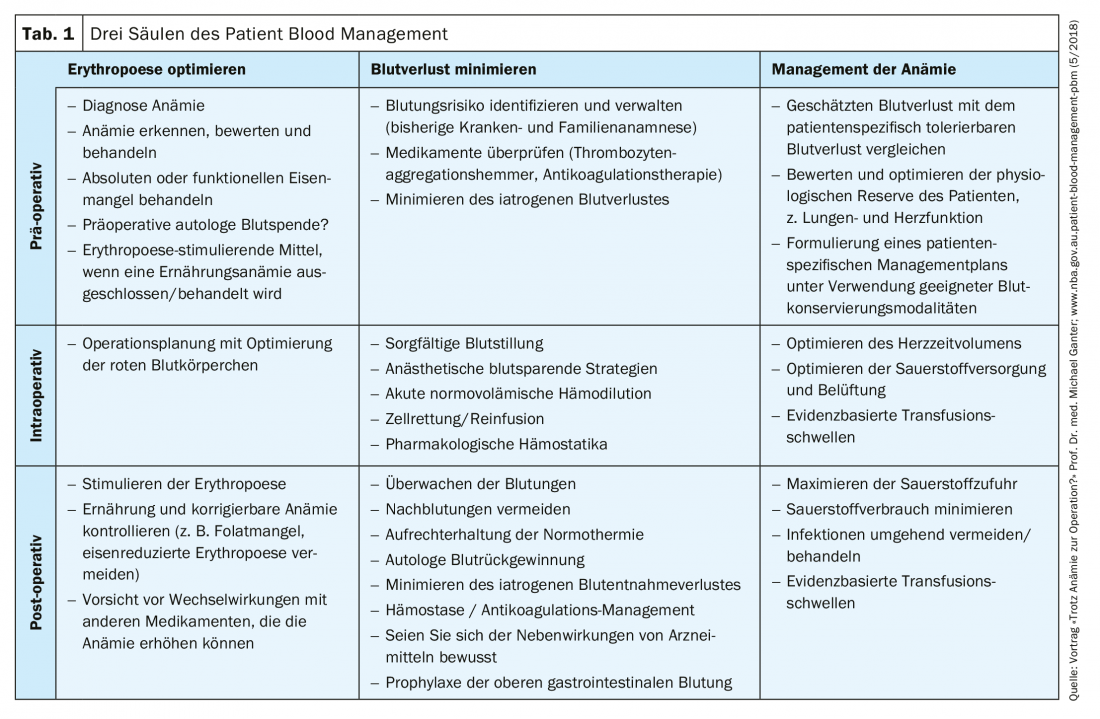
This is where the primary care physician comes in: laboratory tests to detect and diagnose anemia can be performed immediately after the decision to perform surgery is made in primary care. When anemia is discovered and treated, good communication between the general practitioner and the surgical team is critical to provide timely and effective treatment. Treatment of iron deficiency anemia should be performed with iron supplementation. If the interval between examination and surgery is > 6 weeks, oral iron treatment may be considered. However, gastrointestinal side effects may result in poor adherence to oral iron treatment. In practice, it is recommended to monitor the effectiveness of oral iron after four weeks of treatment. Intravenous iron is indicated when oral iron is poorly tolerated, ineffective (no increase in hemoglobin after 4 weeks), when time to surgery is insufficient, or when functional iron deficiency is present.
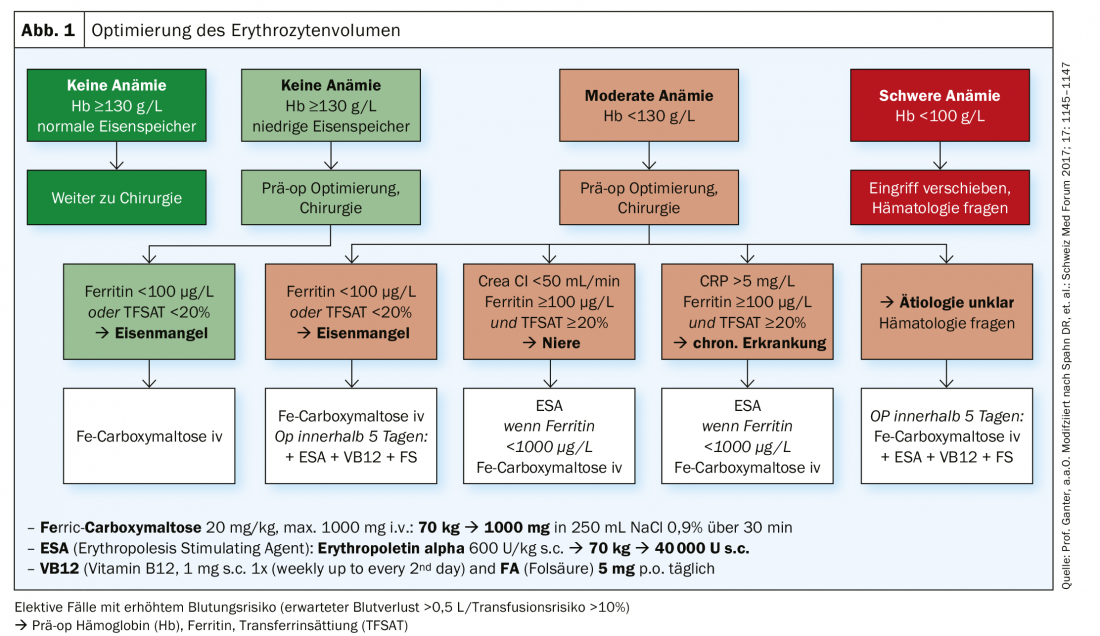


Caveat for iv supplementation: patients must be monitored (oxygen saturation, heart rate and non-invasive blood pressure) for 30 minutes afterwards during an iron infusion (which takes 15-30 minutes)! Resuscitation equipment and trained personnel should be available.

Iron deficiency anemia has a complex origin, including nutrient deficiency and a chronic inflammatory state leading to absolute iron deficiency, functional iron deficiency, or iron deposition. Absolute iron deficiency is a condition in which iron stores are severely reduced, resulting in anemia. Functional iron deficiency, on the other hand, refers to inadequate iron mobilization despite normal or elevated iron stores. An important role in iron binding is played by inflammation, in which upregulation of hepcidin, a hormone produced in the liver that is regulated by iron stores and erythropoietic activity, inhibits intestinal iron absorption and increases iron binding in liver and macrophages, also known as anemia in chronic disease. Hepcidin thus prevents absorption of dietary iron from the gastrointestinal tract, resulting in iron-restricted erythropoiesis and functional iron deficiency. Such a condition is the most common cause of anemia in patients undergoing cardiac surgery. In general, chronic diseases, inflammatory diseases, and malignancies are common triggers of functional iron deficiency in surgical patients. Functional iron deficiency is the most common cause of anemia in chronic disease and occurs in approximately 50 percent of anemic surgical patients.

Source: Iron Academy 2019


HAUSARZT PRAXIS 2019; 14(6): 18-20 (published 5/24/19, ahead of print).
 

Publikation
  • HAUSARZT PRAXIS
Related Topics
  • Allogeneic blood transfusions
  • Anemia
  • blood loss
  • Iron deficiency
  • Morbidity
  • Mortality
  • Perioperative anemia
  • postoperative
  • Transfusion
Previous Article
  • Chronic Disease Management

Self-management support for type 2 diabetes is effective and efficient

  • Endocrinology and Diabetology
  • General Internal Medicine
  • News
  • Partner Content
  • RX
View Post
Next Article
  • Scar Management

A broad arsenal of combinable therapeutic options

  • Congress Reports
  • Dermatology and venereology
  • RX
  • Surgery
View Post
You May Also Like
View Post
  • 4 min
  • From symptom to diagnosis

Multilocular cystic renal cell carcinoma (MCRCC)

    • RX
    • Cases
    • Education
    • Nephrology
    • Oncology
    • Radiology
    • Studies
    • Surgery
View Post
  • 3 min
  • Shaping the Future with LLM & Co.

AI in Everyday Clinical Practice: Friend or Foe?

    • RX
    • General Internal Medicine
    • Practice Management
    • Prevention and health care
View Post
  • 5 min
  • Ulcerative colitis: current evidence on anti-inflammatory therapies

Remission induction and maintenance with biologics and JAK-i

    • RX
    • Congress Reports
    • Gastroenterology and Hepatology
    • General Internal Medicine
    • Studies
View Post
  • 4 min
  • Bronchiectasis

New strategies against neutrophilic inflammation

    • RX
    • Congress Reports
    • General Internal Medicine
    • Infectiology
    • Pneumology
    • Studies
View Post
  • 3 min
  • IBD in childhood

Pneumococcal vaccination without negative consequences

    • RX
    • Education
    • Gastroenterology and Hepatology
    • General Internal Medicine
    • Infectiology
    • Pediatrics
    • Prevention and health care
View Post
  • 7 min
  • Plastic surgery and reconstructive microsurgery for DFS

Functional limb preservation between infection control, vascular medicine and resurfacing

    • RX
    • Angiology
    • CME continuing education
    • Dermatology and venereology
    • Endocrinology and Diabetology
    • General Internal Medicine
    • Geriatrics
    • Physical medicine and rehabilitation
    • Surgery
View Post
  • 14 min
  • Seborrheic Dermatitis in Adults and Adolescents

Current State of Knowledge and New Therapeutic Approaches

    • RX
    • CME continuing education
    • Dermatology and venereology
    • Studies
View Post
  • 7 min
  • Orthobiologics for knee osteoarthritis

PRP and hyaluronic acid injections as building blocks in a multimodal concept

    • RX
    • Congress Reports
    • General Internal Medicine
    • Orthopedics
    • Rheumatology
    • Sports Medicine
    • Studies
    • Surgery
  • IBD matters

    Zum Thema
Top CME content
  • 1
    Current State of Knowledge and New Therapeutic Approaches
  • 2
    Why is it so hard to lose weight?
  • 3
    Functional limb preservation between infection control, vascular medicine and resurfacing
  • 4
    Algorithms, avatars and the unburdened mind
  • 5
    Communication as the key to therapy adherence

Newsletter

Sign up and stay up to date

Subscribe
Medizinonline Medizinonline
  • Contact
  • General terms and conditions
  • Imprint

Input your search keywords and press Enter.