Medizinonline Medizinonline
  • News
    • News
    • Market & Medicine
  • Patients
    • Disease patterns
    • Diagnostics
    • Therapy
  • Partner Content
    • Diabetes
      • Dia-Month Club – Type 2 Diabetes
      • Diabetes in Motion
    • Gastroenterology
      • IBD matters
    • Oncology
      • Swiss Oncology in motion
    • Orthopedics
      • Osteoporosis in motion
  • Departments
    • Allergology and clinical immunology
    • General Internal Medicine
    • Anesthesiology
    • Angiology
    • Surgery
    • Dermatology and venereology
    • Endocrinology and Diabetology
    • Nutrition
    • Gastroenterology and Hepatology
    • Genetics
    • Geriatrics
    • Gynecology
    • Hematology
    • Infectiology
    • Cardiology
    • Nephrology
    • Neurology
    • Emergency and intensive care medicine
    • Nuclear Medicine
    • Oncology
    • Ophthalmology
    • ORL
    • Orthopedics
    • Pediatrics
    • Pharmacology and toxicology
    • Pharmaceutical medicine
    • Phlebology
    • Physical medicine and rehabilitation
    • Pneumology
    • Prevention and health care
    • Psychiatry and psychotherapy
    • Radiology
    • Forensic Medicine
    • Rheumatology
    • Sports Medicine
    • Traumatology and trauma surgery
    • Tropical and travel medicine
    • Urology
    • Dentistry
  • CME & Congresses
    • CME continuing education
    • Congress Reports
    • Congress calendar
  • Practice
    • Noctimed
    • Practice Management
    • Jobs
    • Interviews
  • Log In
  • Register
  • My account
  • Contact
  • Publications
  • Contact
  • Deutsch
  • English
  • Français
  • Italiano
  • Português
  • Español
Subscribe
Medizinonline Medizinonline
  • News
    • News
    • Market & Medicine
  • Patienten
    • Krankheitsbilder
    • Diagnostik
    • Therapie
  • Partner Content
    • Diabetes
      • Dia-Month Club – Type 2 Diabetes
      • Diabetes in Motion
    • Gastroenterology
      • IBD matters
    • Oncology
      • Swiss Oncology in motion
    • Orthopedics
      • Osteoporosis in motion
    • Phytotherapie
    • Rheumatology
  • Departments
    • Fachbereiche 1-13
      • Allergology and clinical immunology
      • General Internal Medicine
      • Anesthesiology
      • Angiology
      • Surgery
      • Dermatology and venereology
      • Endocrinology and Diabetology
      • Nutrition
      • Gastroenterology and Hepatology
      • Genetics
      • Geriatrics
      • Gynecology
      • Hematology
    • Fachbereiche 14-26
      • Infectiology
      • Cardiology
      • Nephrology
      • Neurology
      • Emergency and intensive care medicine
      • Nuclear Medicine
      • Oncology
      • Ophthalmology
      • ORL
      • Orthopedics
      • Pediatrics
      • Pharmacology and toxicology
      • Pharmaceutical medicine
    • Fachbereiche 26-38
      • Phlebology
      • Physical medicine and rehabilitation
      • Phytotherapy
      • Pneumology
      • Prevention and health care
      • Psychiatry and psychotherapy
      • Radiology
      • Forensic Medicine
      • Rheumatology
      • Sports Medicine
      • Traumatology and trauma surgery
      • Tropical and travel medicine
      • Urology
      • Dentistry
  • CME & Congresses
    • CME continuing education
    • Congress Reports
    • Congress calendar
  • Practice
    • Noctimed
    • Practice Management
    • Jobs
    • Interviews
Login

Sie haben noch keinen Account? Registrieren

  • Suddenly appearing nodules on knees and elbows

The Bump That Rashes

    • Cases
    • Dermatology and venereology
    • Pediatrics
    • RX
  • 3 minute read

Case report: The parents report that their 6-year-old boy has had itchy nodules on his knees and elbows for several days. Until now, he had never had such lesions. He was in the best general condition. Apart from a few dimples, which have been treated by an alternative practitioner for several months, he has no other skin problems.

Clinical Presentation: Multiple, confluent, rather coarse, erythematous papules and plaques with scattered crusts are seen in the area of the knees and elbows (Fig. 1) . In addition, there are several, centrally dented, skin-colored small papules on the integument.

Quiz

Based on this information, what is the most likely diagnosis?

A Gianotti-Crosti syndrome
B Gianotti-Crosti-like reaction
C Dermatitis papulosa juvenilis (sandbox dermatitis)
D Coxsackie exanthema
E Strophulus infantum
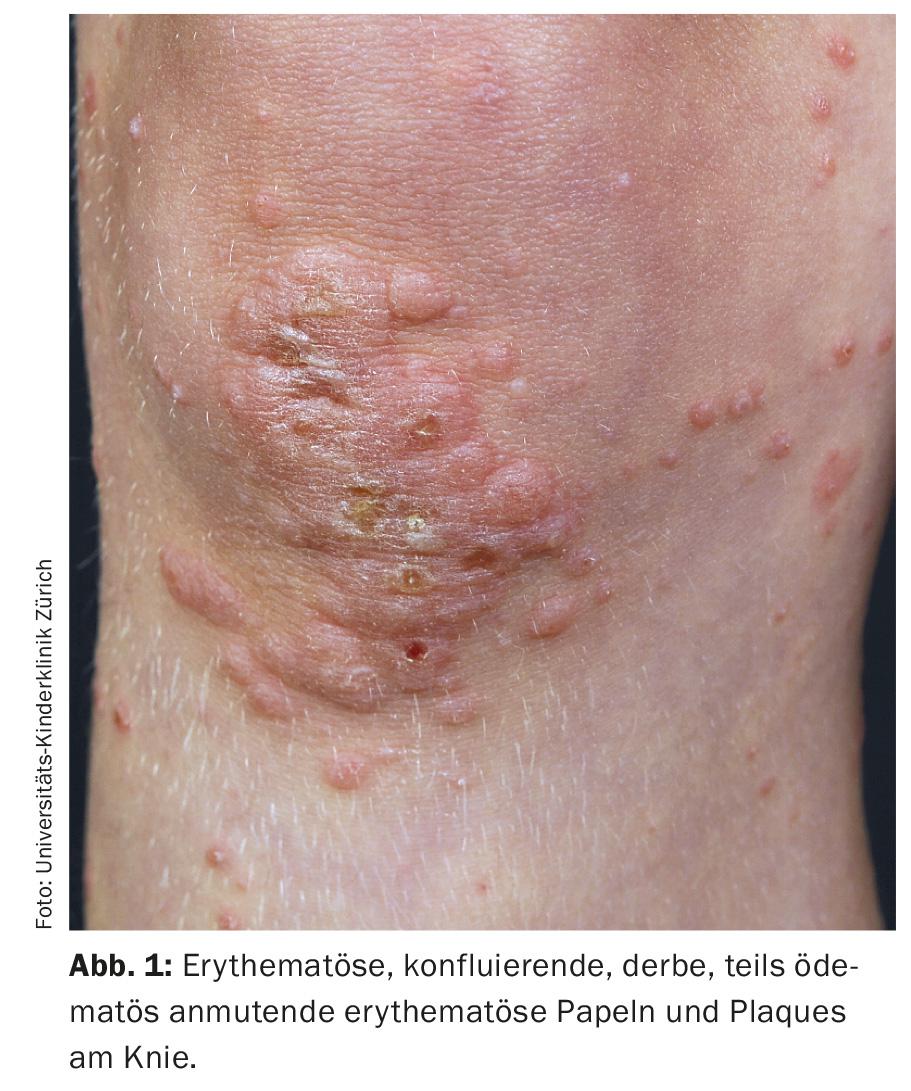
 

Correct answer and diagnosis: The correct answer is B. This is a Gianotti-Crosti type reaction.

Diagnosis and Discussion: The clinical presentation is suggestive of the presence of a Gianotti-Crosti-like reaction (“GCLR”), which is not infrequently seen in the setting of molluscan infections. Although quite common, this clinical picture is only occasionally encountered in the literature and has only recently been described precisely [1]. The disease is characterized by the sudden appearance of itchy, extensor-sided, monomorphic, edematous papules and papulovesicles. The face, trunk and gluteal region can also sometimes be affected. In the mentioned cohort of 696 children with molluscum, this type of exanthema occurred in 4.9% of all patients. This is likely to be a form of id reaction [2]. Interestingly, the appearance of this exanthema was associated with healing of the mollusks after an average of 2 months, so it may be interpreted as a favorable sign. The duration of GCLR is usually 4-6 weeks, although topical steroids may be used supportively.

Differentially, the classic Gianotti-Crosti syndrome (GCS) should be considered in particular. It is a parainfectious exanthema seen primarily in preschoolers after various viral infections (EBV, hepatitis B, and others) as well as vaccinations. It is characterized by the appearance of monomorphic, dermal papules on the cheeks, extensor sides of the extremities and buttocks, which disappear spontaneously after 2-3 months. GCLR differs from classic GCS by more pronounced pruritus, often more localized distribution of lesions, concomitant presence of mollusks, and better response to treatment with topical steroids [1].

In general, mollusks often lead to inflammatory skin manifestations secondarily. The most common is molluscum dermatitis, which is seen especially in children with atopic diathesis. Eczematization of the area affected by mollusks occurs, resulting in itching, scratching, and persistence of the mollusks often for many months. In this situation, consistent therapy of the eczema component using topical steroid is indicated. In addition, inflammation of the mollusks also occurs repeatedly, which manifests itself in swelling, redness, pain and sometimes abscessing. Usually, however, no pathogenic bacterium is detectable.

The frequent inflammatory complications of molluscs have also earned this clinical picture the name “the bump that rashes” in English-speaking countries, in reference to atopic eczema (“the itch that rashes”).

The knowledge of the GCLR allows the simple classification of this sometimes impressive clinical picture and can be understood on the part of the affected persons as a hopeful sign of a soon healing of the molluscs.


Literature:

  1. Berger EM, et al: Experience with Molluscum contagiosum and Associated Inflammatory Reactions in a Pediatric Dermatology Practice. Arch Dermatol 2012; 148(11): 1257-1264.
  2. Rocamora V, et al: Id reaction to molluscum contagiosum. Pediatr Dermatol 1996; 13(4): 349-350.


DERMATOLOGIE PRAXIS 2016; 26(4): 31-32

Autoren
  • Dr. med. Martin Theiler
  • Dr. med. Agnes Schwieger-Briel
  • Dr. med. Aline Büchner
  • PD Dr. med. Lisa Weibel
Publikation
  • DERMATOLOGIE PRAXIS
Related Topics
  • atopic
  • crosti
  • Eczema
  • GCS
  • Gianotti
  • Nodule
Previous Article
  • ASCO Congress in Chicago

Modern drugs and digital media improve cancer therapy

  • Congress Reports
  • Gastroenterology and Hepatology
  • Neurology
  • Oncology
  • Pneumology
  • RX
  • Studies
View Post
Next Article
  • Memories of an allergist

Campari anaphylaxis at garden party – what does the scale insect have to do with it?

  • Allergology and clinical immunology
  • Cases
  • RX
View Post
You May Also Like
View Post
  • 3 min
  • Genetic Kidney Disease: DOUBLE PROTECT Alport

The SGLT-2 inhibitor dapagliflozin as an add-on to RAS blockade

    • RX
    • Education
    • General Internal Medicine
    • Genetics
    • Nephrology
    • Studies
View Post
  • 4 min
  • Case Study: Cystic Fibrosis in Adults

Recurrent Pneumonia as a Manifestation of Cystic Fibrosis

    • RX
    • Education
    • Infectiology
    • Pneumology
View Post
  • 5 min
  • Long COVID/Fatigue Clinic

An Innovative Approach: Neuroplasticity and Predictive Processing

    • RX
    • Congress Reports
    • General Internal Medicine
    • Infectiology
    • Neurology
    • Physical medicine and rehabilitation
    • Pneumology
    • Psychiatry and psychotherapy
View Post
  • 6 min
  • T-cell lymphomas

Diagnostic Challenges and New Treatment Options

    • RX
    • Education
    • Hematology
    • Oncology
    • Studies
View Post
  • 6 min
  • Interbrain Synchrony

Two Brains, One Thought

    • RX
    • Education
    • Neurology
    • Psychiatry and psychotherapy
    • Studies
View Post
  • 8 min
  • Atopic Dermatitis in Children and Adults

Topically Applied “Small Molecules”: Janus Kinases or PDE-4 as Targets?

    • RX
    • Allergology and clinical immunology
    • Dermatology and venereology
    • Education
    • Pharmacology and toxicology
    • Studies
View Post
  • 4 min
  • Dermatomyositis

Glucocorticoids for more than one year

    • RX
    • Dermatology and venereology
    • Education
    • General Internal Medicine
    • Pneumology
    • Rheumatology
    • Studies
View Post
  • 12 min
  • The Brain and the Motivation to Eat

Why is it so hard to lose weight?

    • RX
    • CME continuing education
    • Endocrinology and Diabetology
    • General Internal Medicine
    • Nutrition
    • Pharmacology and toxicology
    • Prevention and health care
    • Psychiatry and psychotherapy
    • Studies
  • IBD matters

    Zum Thema
Top CME content
  • 1
    Clinical Presentation, Diagnosis, and Treatment of DSPN
  • 2
    Why is it so hard to lose weight?
  • 3
    Four-Legged Medical Assistants – Therapy Dogs in Clinical Settings
  • 4
    Functional limb preservation between infection control, vascular medicine and resurfacing
  • 5
    Update on Idiopathic Pulmonary Fibrosis

Newsletter

Sign up and stay up to date

Subscribe
Medizinonline Medizinonline
  • Contact
  • General terms and conditions
  • Imprint

Input your search keywords and press Enter.