Medizinonline Medizinonline
  • News
    • News
    • Market & Medicine
  • Patients
    • Disease patterns
    • Diagnostics
    • Therapy
  • Partner Content
    • Diabetes
      • Dia-Month Club – Type 2 Diabetes
      • Diabetes in Motion
      • Diabetes Podcasts
    • Gastroenterology
      • IBD matters
    • Oncology
      • Swiss Oncology in motion
    • Orthopedics
      • Osteoporosis in motion
  • Departments
    • Allergology and clinical immunology
    • General Internal Medicine
    • Anesthesiology
    • Angiology
    • Surgery
    • Dermatology and venereology
    • Endocrinology and Diabetology
    • Nutrition
    • Gastroenterology and Hepatology
    • Genetics
    • Geriatrics
    • Gynecology
    • Hematology
    • Infectiology
    • Cardiology
    • Nephrology
    • Neurology
    • Emergency and intensive care medicine
    • Nuclear Medicine
    • Oncology
    • Ophthalmology
    • ORL
    • Orthopedics
    • Pediatrics
    • Pharmacology and toxicology
    • Pharmaceutical medicine
    • Phlebology
    • Physical medicine and rehabilitation
    • Pneumology
    • Prevention and health care
    • Psychiatry and psychotherapy
    • Radiology
    • Forensic Medicine
    • Rheumatology
    • Sports Medicine
    • Traumatology and trauma surgery
    • Tropical and travel medicine
    • Urology
    • Dentistry
  • CME & Congresses
    • CME continuing education
    • Congress Reports
    • Congress calendar
  • Practice
    • Noctimed
    • Practice Management
    • Jobs
    • Interviews
  • Log In
  • Register
  • My account
  • Contact
  • Publications
  • Contact
  • Deutsch
  • English
  • Français
  • Italiano
  • Português
  • Español
Subscribe
Medizinonline Medizinonline
  • News
    • News
    • Market & Medicine
  • Patienten
    • Krankheitsbilder
    • Diagnostik
    • Therapie
  • Partner Content
    • Diabetes
      • Dia-Month Club – Type 2 Diabetes
      • Diabetes in Motion
      • Diabetes Podcasts
    • Gastroenterology
      • IBD matters
    • Oncology
      • Swiss Oncology in motion
    • Orthopedics
      • Osteoporosis in motion
    • Phytotherapie
    • Rheumatology
  • Departments
    • Fachbereiche 1-13
      • Allergology and clinical immunology
      • General Internal Medicine
      • Anesthesiology
      • Angiology
      • Surgery
      • Dermatology and venereology
      • Endocrinology and Diabetology
      • Nutrition
      • Gastroenterology and Hepatology
      • Genetics
      • Geriatrics
      • Gynecology
      • Hematology
    • Fachbereiche 14-26
      • Infectiology
      • Cardiology
      • Nephrology
      • Neurology
      • Emergency and intensive care medicine
      • Nuclear Medicine
      • Oncology
      • Ophthalmology
      • ORL
      • Orthopedics
      • Pediatrics
      • Pharmacology and toxicology
      • Pharmaceutical medicine
    • Fachbereiche 26-38
      • Phlebology
      • Physical medicine and rehabilitation
      • Phytotherapy
      • Pneumology
      • Prevention and health care
      • Psychiatry and psychotherapy
      • Radiology
      • Forensic Medicine
      • Rheumatology
      • Sports Medicine
      • Traumatology and trauma surgery
      • Tropical and travel medicine
      • Urology
      • Dentistry
  • CME & Congresses
    • CME continuing education
    • Congress Reports
    • Congress calendar
  • Practice
    • Noctimed
    • Practice Management
    • Jobs
    • Interviews
Login

Sie haben noch keinen Account? Registrieren

  • Benign tumors in childhood

Validated tool for triage in infantile hemangiomas.

    • Congress Reports
    • Dermatology and venereology
    • Pediatrics
    • RX
  • 4 minute read

Infantile hemangioma is the most common benign tumor in childhood. If therapy is initiated in time, the treatment options are very good, otherwise it can have unpleasant late consequences for those affected. The Infantile Hemangioma Referral Score (IHReS) was developed as a decision support tool to determine whether a patient should be referred to specialists. This clinically validated assignment score was presented at the SGDV annual congress.

Lisa Weibel, MD, Head of the Department of Pediatric Dermatology, University Children’s Hospital Zurich, demonstrated that pediatric hemangiomas are nowadays very well treatable with early intervention, using the example of a periocular hemangioma in which an excellent result could be achieved by therapy with oral propanolol [1]. “However, it’s not always straightforward, especially if you don’t recognize critical signs of a hemangioma,” Dr. Weibel cautions. These include, but are not limited to, certain risk localizations, and certain growth stages beginning at four to five weeks of age. Specific subtypes of hemangiomas require specific workups. “If everything goes wrong, grotesque, huge hemangiomas can develop, which then never heal without a trace and scar the child for life,” she said.

Do not miss critical time window for therapy

Infantile hemangioma is the most common benign tumor in childhood with a prevalence of 4-10%. Characteristic features are a proliferative rapid growth phase starting after a few weeks of life, followed by a slow regression phase. If disfigurement or a life-threatening course is feared, systemic therapy should be initiated immediately [2]. The pathogenesis of infantile hemangioma has not been fully elucidated. Studies show that in the proliferation phase, there is an imbalance of angiogenesis factors and an increase in the levels of vascular endothelial growth factor (VEGF), basic fibroblast growth factor (bFGF), and matrix metalloproteinases (MMPs) 2 and 9 [3–5]. In the regression phase, the levels of these factors decrease, whereas those of antiangiogenic factors, including tissue inhibitors of metalloproteinases, increase [2].
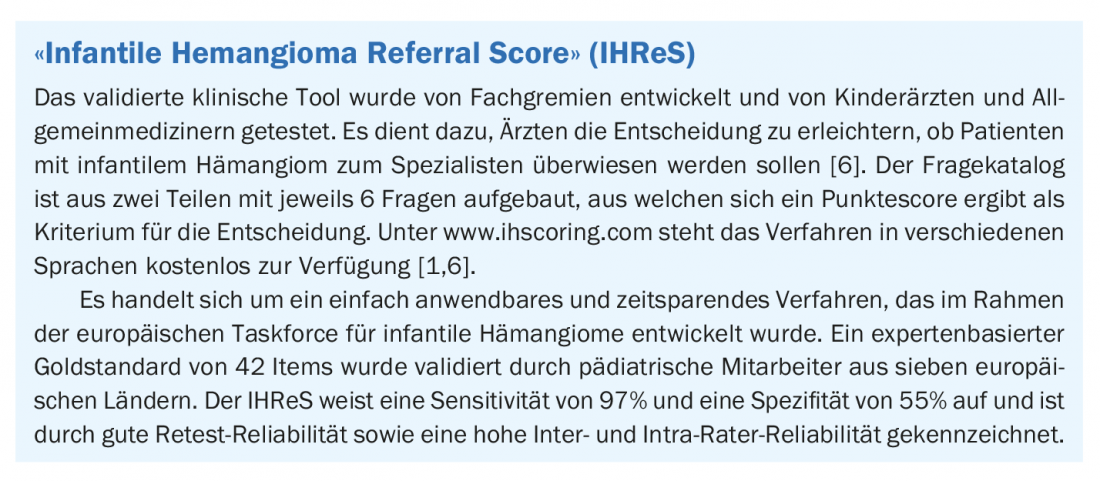


“IHReS” is a user-friendly, validated clarification procedure

In guidelines for the treatment of hemangiomas, there is a consensus that high-risk hemangiomas should ideally be evaluated at 1 month of age with regard to potential therapy, Dr. Weibel explained [1]. Against this background, the Infantile Hemangioma Referral Score (IHReS) was developed within the European Task Force on Infantile Hemangiomas, in which Dr. Weibel represents Switzerland, with the aim to provide a score as simple as possible for primary care providers to evaluate patients in time for adequate therapy. (Box). The Infantile Hemangioma Referral Score is composed of two parts: Part A and Part B both contain 6 Questions. The questions in part A can be answered by “Yes” or “No”. If one is affirmative, the recommendation is to refer further. The questions in Part B are somewhat more complex; here, the criterion for referral is a score ≥4. The speaker uses two examples to illustrate the whole thing:

Case report 1: This is a 4-week-old girl with a plaque-type hemangioma in the left breast. Most of the questions in part A can be answered in the negative: There are no complications such as ulceration or airway restriction or visual impairment and the face is not affected. But because breast involvement is present in a girl, the Part A result is a referral recommendation. In this case, the questions of part B were unnecessary.

Case study 2: This is a 5-week-old child. In this case, all of the 6 questions in Part A can be answered in the negative. No complications such as ulceration are present. The midface, ears or chest are not affected, nor is the lumbosacral region. The question of whether the hemangioma is 4 cm or larger can also be answered in the negative, and there are not 5 or more hemangiomas present before. Thus, in this example, the questions of part B come into play: there is no hemangioma in the facial region, not even in the diaper region. The extent of hemangiomas is not more than 1 cm in the rest of the face and not more than 2 cm in other parts of the body. But since the child is only 5 weeks old, the proliferation potential is relevant. This results in a score of 3 points and the recommendation for active monitoring.

The Infantile Hemangioma Referral Score (IHReS) is available for free download in several languages at the web link www.ihscoring.com [6]. “I highly recommend you take a look at it if you’re faced with cases like this,” the speaker concludes.

Congress: SGDV Annual Meeting 2020
 

Literature:

  1. Weibel L: The infantile hemangioma referral score (IHReS): a validated tool for physicians. PD Lisa Weibel, MD, SGDV Annual Meeting, Sept. 16-18, 2020
  2. Rotter A, et al: JDDG 2017; 15(12): 1185-1191.
  3. Greenberger S, Bischoff J: Br J Dermatol 2013; 169(1): 12-19.
  4. Itinteang T, et al: Front Surg 2014; 1: 38.
  5. Boscolo E, Bischoff J: Angiogenesis 2009; 12(2): 197-207.
  6. Infantile Hemangioma Referral Score (IHReS), www.ihscoring.com/de, (last accessed Feb. 16, 2021).
  7. Léauté-Labrèze C, et al: Pediatrics 2020; 145(4): e20191628.


DERMATOLOGIE PRAXIS 2021; 31(2): 36 (published 4/13/21, ahead of print).

Autoren
  • Mirjam Peter, M.Sc.
Publikation
  • DERMATOLOGIE PRAXIS
Related Topics
  • hemangioma
Previous Article
  • Glucagon-like peptide 1 (GLP1) analogues

The future of diabetes management has begun

  • Cardiology
  • Education
  • Endocrinology and Diabetology
  • General Internal Medicine
  • Partner Content
  • RX
View Post
Next Article
  • "Mild Cognitive Impairment" (MCI).

How can progression be delayed?

  • Education
  • General Internal Medicine
  • Geriatrics
  • Neurology
  • Psychiatry and psychotherapy
  • RX
  • Studies
View Post
You May Also Like
View Post
  • 5 min
  • Omaveloxolone for Friedreich's Ataxia

Efficacy and Safety Studied Over 6 Years

    • Neurology
    • Congress Reports
    • Endocrinology and Diabetology
    • RX
    • Studies
View Post
  • 6 min
  • Psoriasis: therapy with biologics and TYK-2-i

Progress assessments based on current long-term and real-world data

    • RX
    • Congress Reports
    • Dermatology and venereology
    • Pharmacology and toxicology
    • Rheumatology
    • Studies
View Post
  • 4 min
  • Hypertension: the most important facts for daily practice

Early dual antihypertensive therapy is usually indicated

    • RX
    • Cardiology
    • Congress Reports
    • General Internal Medicine
View Post
  • 4 min
  • Escitalopram for anxiety disorders

Positive effect, but no immediate improvement in symptoms

    • RX
    • Education
    • Neurology
    • Pharmacology and toxicology
    • Psychiatry and psychotherapy
    • Studies
View Post
  • 4 min
  • Helicobacter pylori infection

Simplified dual therapy beats quadruple regimen

    • RX
    • Education
    • Gastroenterology and Hepatology
    • General Internal Medicine
    • Infectiology
    • Studies
View Post
  • 3 min
  • Gastric carcinoma

Ways of precision oncology

    • RX
    • Congress Reports
    • Gastroenterology and Hepatology
    • Oncology
    • Studies
View Post
  • 8 min
  • Endometrial Cancer

Immunological drivers and new therapeutic pathways

    • RX
    • Education
    • Gynecology
    • Oncology
    • Studies
View Post
  • 6 min
  • Exercise for type 1 diabetes

Cyclists and runners with an increased risk of hypoglycemia

    • RX
    • Education
    • Endocrinology and Diabetology
    • Sports Medicine
    • Studies
Landingpage Fachinfo Landingpage Button
  • IBD matters

    Zum Thema
Top CME content
  • 1
    Communication as the key to therapy adherence
  • 2
    Solutions to the malnutrition dilemma
  • 3
    Solutions to the malnutrition dilemma
  • 4
    Focus on preventive care options
  • 5
    Fertility preservation from gonads to genomes to genoids

Newsletter

Sign up and stay up to date

Subscribe
Medizinonline Medizinonline
  • Contact
  • General terms and conditions
  • Imprint

Input your search keywords and press Enter.