Medizinonline Medizinonline
  • News
    • News
    • Market & Medicine
  • Patients
    • Disease patterns
    • Diagnostics
    • Therapy
  • Partner Content
    • Diabetes
      • Dia-Month Club – Type 2 Diabetes
      • Diabetes in Motion
      • Diabetes Podcasts
    • Gastroenterology
      • IBD matters
    • Oncology
      • Swiss Oncology in motion
    • Orthopedics
      • Osteoporosis in motion
  • Departments
    • Allergology and clinical immunology
    • General Internal Medicine
    • Anesthesiology
    • Angiology
    • Surgery
    • Dermatology and venereology
    • Endocrinology and Diabetology
    • Nutrition
    • Gastroenterology and Hepatology
    • Genetics
    • Geriatrics
    • Gynecology
    • Hematology
    • Infectiology
    • Cardiology
    • Nephrology
    • Neurology
    • Emergency and intensive care medicine
    • Nuclear Medicine
    • Oncology
    • Ophthalmology
    • ORL
    • Orthopedics
    • Pediatrics
    • Pharmacology and toxicology
    • Pharmaceutical medicine
    • Phlebology
    • Physical medicine and rehabilitation
    • Pneumology
    • Prevention and health care
    • Psychiatry and psychotherapy
    • Radiology
    • Forensic Medicine
    • Rheumatology
    • Sports Medicine
    • Traumatology and trauma surgery
    • Tropical and travel medicine
    • Urology
    • Dentistry
  • CME & Congresses
    • CME continuing education
    • Congress Reports
    • Congress calendar
  • Practice
    • Noctimed
    • Practice Management
    • Jobs
    • Interviews
  • Log In
  • Register
  • My account
  • Contact
  • Publications
  • Contact
  • Deutsch
  • English
  • Français
  • Italiano
  • Português
  • Español
Subscribe
Medizinonline Medizinonline
  • News
    • News
    • Market & Medicine
  • Patienten
    • Krankheitsbilder
    • Diagnostik
    • Therapie
  • Partner Content
    • Diabetes
      • Dia-Month Club – Type 2 Diabetes
      • Diabetes in Motion
      • Diabetes Podcasts
    • Gastroenterology
      • IBD matters
    • Oncology
      • Swiss Oncology in motion
    • Orthopedics
      • Osteoporosis in motion
    • Phytotherapie
    • Rheumatology
  • Departments
    • Fachbereiche 1-13
      • Allergology and clinical immunology
      • General Internal Medicine
      • Anesthesiology
      • Angiology
      • Surgery
      • Dermatology and venereology
      • Endocrinology and Diabetology
      • Nutrition
      • Gastroenterology and Hepatology
      • Genetics
      • Geriatrics
      • Gynecology
      • Hematology
    • Fachbereiche 14-26
      • Infectiology
      • Cardiology
      • Nephrology
      • Neurology
      • Emergency and intensive care medicine
      • Nuclear Medicine
      • Oncology
      • Ophthalmology
      • ORL
      • Orthopedics
      • Pediatrics
      • Pharmacology and toxicology
      • Pharmaceutical medicine
    • Fachbereiche 26-38
      • Phlebology
      • Physical medicine and rehabilitation
      • Phytotherapy
      • Pneumology
      • Prevention and health care
      • Psychiatry and psychotherapy
      • Radiology
      • Forensic Medicine
      • Rheumatology
      • Sports Medicine
      • Traumatology and trauma surgery
      • Tropical and travel medicine
      • Urology
      • Dentistry
  • CME & Congresses
    • CME continuing education
    • Congress Reports
    • Congress calendar
  • Practice
    • Noctimed
    • Practice Management
    • Jobs
    • Interviews
Login

Sie haben noch keinen Account? Registrieren

  • Hypothyroidism

When the thyroid gland lacks hormones

    • Education
    • Endocrinology and Diabetology
    • General Internal Medicine
    • RX
  • 3 minute read

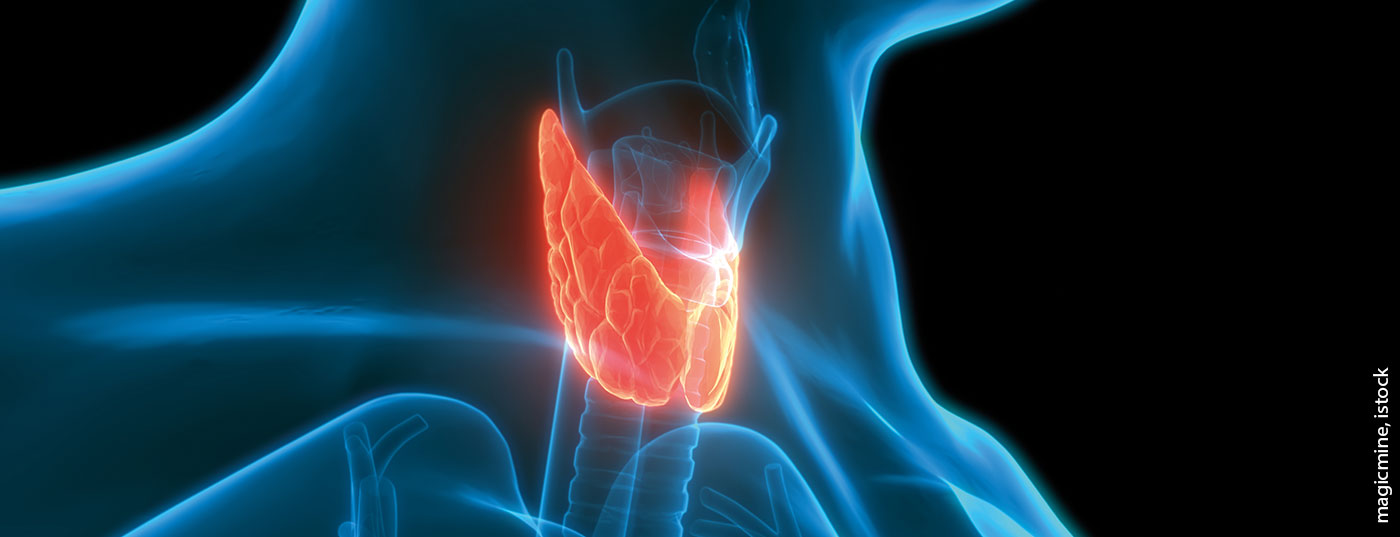
If the body is deficient in thyroid hormones, there may be a reduction in basal metabolic rate with multiple clinical consequences. Hypothyroidism is often acquired due to an autoimmune genesis, then occurs in adulthood and requires lifelong substitution with L-thyroxine.

Symptoms such as fatigue, lethargy, cold intolerance, and weight gain may indicate hypothyroidism (Tab. 1). This thyroid hormone deficiency is present in about 5% of the European population, with women and the elderly being more frequently affected. The disease is differentiated into primary (autoimmune genesis), secondary (TSH deficiency) and tertiary (TRH deficiency) hypothyroidism. As a rule, a primary form is present, which in turn is subdivided into manifest and latent hypothyroidism. Dysregulation of the immune system leads to the formation of antibodies measurable in the blood, which impair the function of the thyroid gland and in the long term lead to extensive loss of organ function or destruction of the gland. Hypothyroidism is diagnosed by an excessively high level of the regulatory hormone TSH (thyroid stimulating hormone) with a simultaneous decrease in one or both of the levels of the thyroid hormones free T3 (triiodothyronine) and free T4 (levothyroxine). A latent manifestation is when only the TSH level is elevated, but the other values are still within the normal range.


When testing should be done is highly controversial and there is no international consensus on which indications and how often diagnosis or screening for thyroid dysfunction should be done. Symptom-oriented testing is recommended, although this leaves a lot of room for maneuver. This is because the symptoms attributed to hypothyroidism are generally common in the population. In addition, TSH levels are often somewhat elevated in obesity, for example. A decrease in TSH is then observed with weight loss. It is assumed here that leptin, among other things, exerts an effect on TSH levels. Conversely, current observations do not show that latent hypothyroidism always leads to weight gain and that adequate therapy will reduce this weight again.

Root Cause Analysis

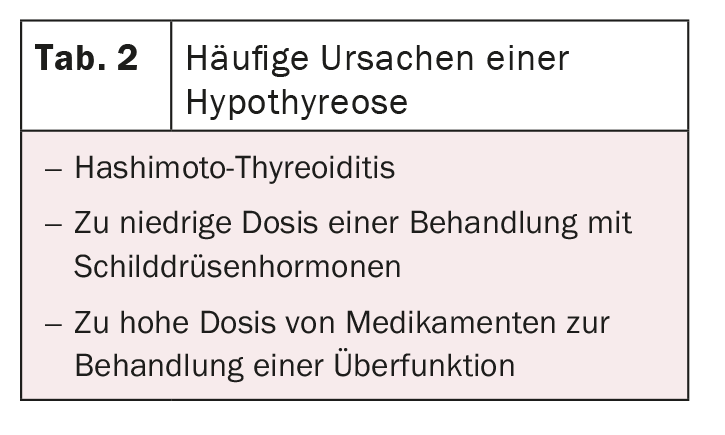
The most common cause of hypothyroidism is Hashimoto’s thyroiditis (Tab. 2). Therefore, thyroperoxidase antibodies (TPO-AK) and thyroglobulin antibodies (Tg-AK) should always be determined in addition to TSH. TPO-AK are positive in 90-95%, Tg-AK in 60-80%. Especially a particularly high AK value seems to correlate with the activity of the disease. A quarter of the patients also have another autoimmune disease, so that screening for Addison’s disease, diabetes mellitus, pernicious anemia, or celiac disease seems reasonable. Other causes of hypothyroidism may include iatrogenic causes after thyroid surgery or radioiodine therapy, in addition to poor control in hyperthyroidism.


Quality of life severely limited

In contrast to patients with latent hypothyroidism, the quality of life is significantly reduced in those with manifest hypothyroidism. In addition to the known symptoms, study data seem to suggest that increasing severity of the disease with very high TSH is associated with increased cardiovascular risk. In addition, hypothyroidism affects lipid metabolism, which is characterized by, among other things, higher LDL cholesterol and higher triglycerides. Therefore, adequate therapy management is indicated.

If hypothyroidism is detected for the first time, no treatment should be given initially. Only when the diagnosis is confirmed after a laboratory control 2-3 months later, a therapy with L-thyroxine can be initiated depending on the age as well as the symptoms. The recommended dosage for latent hypothyroidism is approximately 1.5 µg/kg/day, which corresponds to approximately 75-100 µg in women and approximately 100-125 µg in men. Serum TSH should be after approximately two months, aiming for a target range of 0.4-2.5 mU/L.


Further reading:

  • www.endokrinologie.net/krankheiten-schilddruese-unterfunktion.php
  • www.medix.ch/wissen/guidelines/stoffwechselkrankheiten/schilddruesenerkrankungen
  • Pilz S, Theiler-Schwetz V, Malle O, et al: Hypothyroidism: guidelines, new evidence and clinical practice. Journal of Clinical Endocrinology and Metabolism 2020; 13: 88-95.


CARDIOVASC 2021; 20(1): 20
Autoren
  • Leoni Burggraf
Publikation
  • CARDIOVASC
Related Topics
  • Hypothyroidism
  • Thyroid gland
Previous Article
  • Severe eosinophilic asthma

Small airways as a predictor of biologics

  • Education
  • General Internal Medicine
  • Pneumology
  • RX
  • Studies
View Post
Next Article
  • Ten years of living with Fukushima

The nuclear disaster and cancer

  • Congress Reports
  • Endocrinology and Diabetology
  • Oncology
  • RX
View Post
You May Also Like
View Post
  • 4 min
  • Bronchiectasis

New strategies against neutrophilic inflammation

    • RX
    • Congress Reports
    • General Internal Medicine
    • Infectiology
    • Pneumology
    • Studies
View Post
  • 3 min
  • IBD in childhood

Pneumococcal vaccination without negative consequences

    • RX
    • Education
    • Gastroenterology and Hepatology
    • General Internal Medicine
    • Infectiology
    • Pediatrics
    • Prevention and health care
View Post
  • 14 min
  • Seborrheic Dermatitis in Adults and Adolescents

Current State of Knowledge and New Therapeutic Approaches

    • RX
    • CME continuing education
    • Dermatology and venereology
    • Studies
View Post
  • 7 min
  • Plastic surgery and reconstructive microsurgery for DFS

Functional limb preservation between infection control, vascular medicine and resurfacing

    • RX
    • Angiology
    • CME continuing education
    • Dermatology and venereology
    • Endocrinology and Diabetology
    • General Internal Medicine
    • Geriatrics
    • Physical medicine and rehabilitation
    • Surgery
View Post
  • 7 min
  • Orthobiologics for knee osteoarthritis

PRP and hyaluronic acid injections as building blocks in a multimodal concept

    • RX
    • Congress Reports
    • General Internal Medicine
    • Orthopedics
    • Rheumatology
    • Sports Medicine
    • Studies
    • Surgery
View Post
  • 3 min
  • Soft tissue sarcomas of the lower extremity

Diagnostics, subtypes and treatment options

    • RX
    • Education
    • Oncology
View Post
  • 38 min
  • Psychological dependence on AI assistants, smartphones and short videos

Algorithms, avatars and the unburdened mind

    • RX
    • CME continuing education
    • Neurology
    • Pediatrics
    • Prevention and health care
    • Psychiatry and psychotherapy
    • Studies
View Post
  • 8 min
  • Psychooncology

Communication as the key to therapy adherence

    • CME continuing education
    • Practice Management
    • RX
  • IBD matters

    Zum Thema
Top CME content
  • 1
    Current State of Knowledge and New Therapeutic Approaches
  • 2
    Why is it so hard to lose weight?
  • 3
    Functional limb preservation between infection control, vascular medicine and resurfacing
  • 4
    Algorithms, avatars and the unburdened mind
  • 5
    Communication as the key to therapy adherence

Newsletter

Sign up and stay up to date

Subscribe
Medizinonline Medizinonline
  • Contact
  • General terms and conditions
  • Imprint

Input your search keywords and press Enter.