Medizinonline Medizinonline
  • News
    • News
    • Market & Medicine
  • Patients
    • Disease patterns
    • Diagnostics
    • Therapy
  • Partner Content
    • Diabetes
      • Dia-Month Club – Type 2 Diabetes
      • Diabetes in Motion
      • Diabetes Podcasts
    • Gastroenterology
      • IBD matters
    • Oncology
      • Swiss Oncology in motion
    • Orthopedics
      • Osteoporosis in motion
  • Departments
    • Allergology and clinical immunology
    • General Internal Medicine
    • Anesthesiology
    • Angiology
    • Surgery
    • Dermatology and venereology
    • Endocrinology and Diabetology
    • Nutrition
    • Gastroenterology and Hepatology
    • Genetics
    • Geriatrics
    • Gynecology
    • Hematology
    • Infectiology
    • Cardiology
    • Nephrology
    • Neurology
    • Emergency and intensive care medicine
    • Nuclear Medicine
    • Oncology
    • Ophthalmology
    • ORL
    • Orthopedics
    • Pediatrics
    • Pharmacology and toxicology
    • Pharmaceutical medicine
    • Phlebology
    • Physical medicine and rehabilitation
    • Pneumology
    • Prevention and health care
    • Psychiatry and psychotherapy
    • Radiology
    • Forensic Medicine
    • Rheumatology
    • Sports Medicine
    • Traumatology and trauma surgery
    • Tropical and travel medicine
    • Urology
    • Dentistry
  • CME & Congresses
    • CME continuing education
    • Congress Reports
    • Congress calendar
  • Practice
    • Noctimed
    • Practice Management
    • Jobs
    • Interviews
  • Log In
  • Register
  • My account
  • Contact
  • Publications
  • Contact
  • Deutsch
  • English
  • Français
  • Italiano
  • Português
  • Español
Subscribe
Medizinonline Medizinonline
  • News
    • News
    • Market & Medicine
  • Patienten
    • Krankheitsbilder
    • Diagnostik
    • Therapie
  • Partner Content
    • Diabetes
      • Dia-Month Club – Type 2 Diabetes
      • Diabetes in Motion
      • Diabetes Podcasts
    • Gastroenterology
      • IBD matters
    • Oncology
      • Swiss Oncology in motion
    • Orthopedics
      • Osteoporosis in motion
    • Phytotherapie
    • Rheumatology
  • Departments
    • Fachbereiche 1-13
      • Allergology and clinical immunology
      • General Internal Medicine
      • Anesthesiology
      • Angiology
      • Surgery
      • Dermatology and venereology
      • Endocrinology and Diabetology
      • Nutrition
      • Gastroenterology and Hepatology
      • Genetics
      • Geriatrics
      • Gynecology
      • Hematology
    • Fachbereiche 14-26
      • Infectiology
      • Cardiology
      • Nephrology
      • Neurology
      • Emergency and intensive care medicine
      • Nuclear Medicine
      • Oncology
      • Ophthalmology
      • ORL
      • Orthopedics
      • Pediatrics
      • Pharmacology and toxicology
      • Pharmaceutical medicine
    • Fachbereiche 26-38
      • Phlebology
      • Physical medicine and rehabilitation
      • Phytotherapy
      • Pneumology
      • Prevention and health care
      • Psychiatry and psychotherapy
      • Radiology
      • Forensic Medicine
      • Rheumatology
      • Sports Medicine
      • Traumatology and trauma surgery
      • Tropical and travel medicine
      • Urology
      • Dentistry
  • CME & Congresses
    • CME continuing education
    • Congress Reports
    • Congress calendar
  • Practice
    • Noctimed
    • Practice Management
    • Jobs
    • Interviews
Login

Sie haben noch keinen Account? Registrieren

  • Vitamin D substitution

Which dosages for which groups of people?

    • Geriatrics
    • News
    • Nutrition
    • Pediatrics
    • RX
  • 3 minute read

A sufficient vitamin D supply is essential for healthy bone metabolism. However, studies show that in Switzerland around 50% of the population is undersupplied with vitamin D. Therefore, vitamin D supplementation is recommended especially for young children, the elderly, and pregnant and lactating women.

Vitamin D is a fat-soluble substance that is ingested either with foods of plant origin (vitamin D2) or animal origin (vitamin D3, cholecalciferol), but is mainly produced in human skin. Because of this hormonal nature of cholecalciferol, it cannot in principle be classified as a vitamin.

Vitamin D is indispensable for mineral metabolism: it ensures that calcium and phosphate are absorbed from the intestine, and it is important for the incorporation of calcium and phosphate into bone and tooth substance. In addition, the organism also needs vitamin D for the normal functioning of the muscles and the entire musculoskeletal system. In addition, vitamin D is also involved in the differentiation of cells and in the maintenance of the immune system.

Little sun – little vitamin D

90% of the biologically active vitamin D in the body is formed from cholesterol precursors in the skin. The prerequisite for this is sufficient exposure to sunlight (UVB). Since this is not always and not everywhere the same, in Switzerland there are the following risk factors for insufficient formation of vitamin D in the skin:

  • Wintertime: In winter, the sun does not shine long and strong enough for enough vitamin D to be formed. Besides, in winter the skin is usually covered with clothes.
  • Skin type: The darker the skin type, the worse the vitamin D formation in the skin.
  • Duration of sun exposure: people who spend a lot of time outdoors have more frequent opportunities for vitamin D formation than people who are mostly indoors (e.g., residents of nursing homes, hospital patients).
  • Age: In older people, the skin’s ability to produce vitamin D decreases.
  • Sunscreen: The use of sunscreen prevents the formation of vitamin D in the skin.

At least 50 nmol/l hydroxy vitamin D in the blood

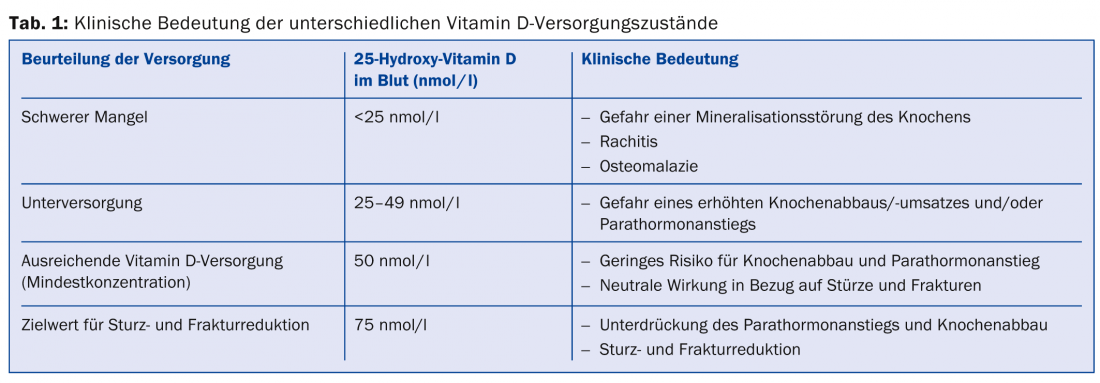
To investigate vitamin D supply, 25-hydroxy vitamin D (25[OH]D) is determined in the blood. Values ≥50 nmol/l 25(OH)D are considered sufficient according to the 2012 expert report of the Swiss Federal Commission on Nutrition. At values below 50 nmol/l, a distinction is made between undersupply and severe deficiency (Tab. 1) .
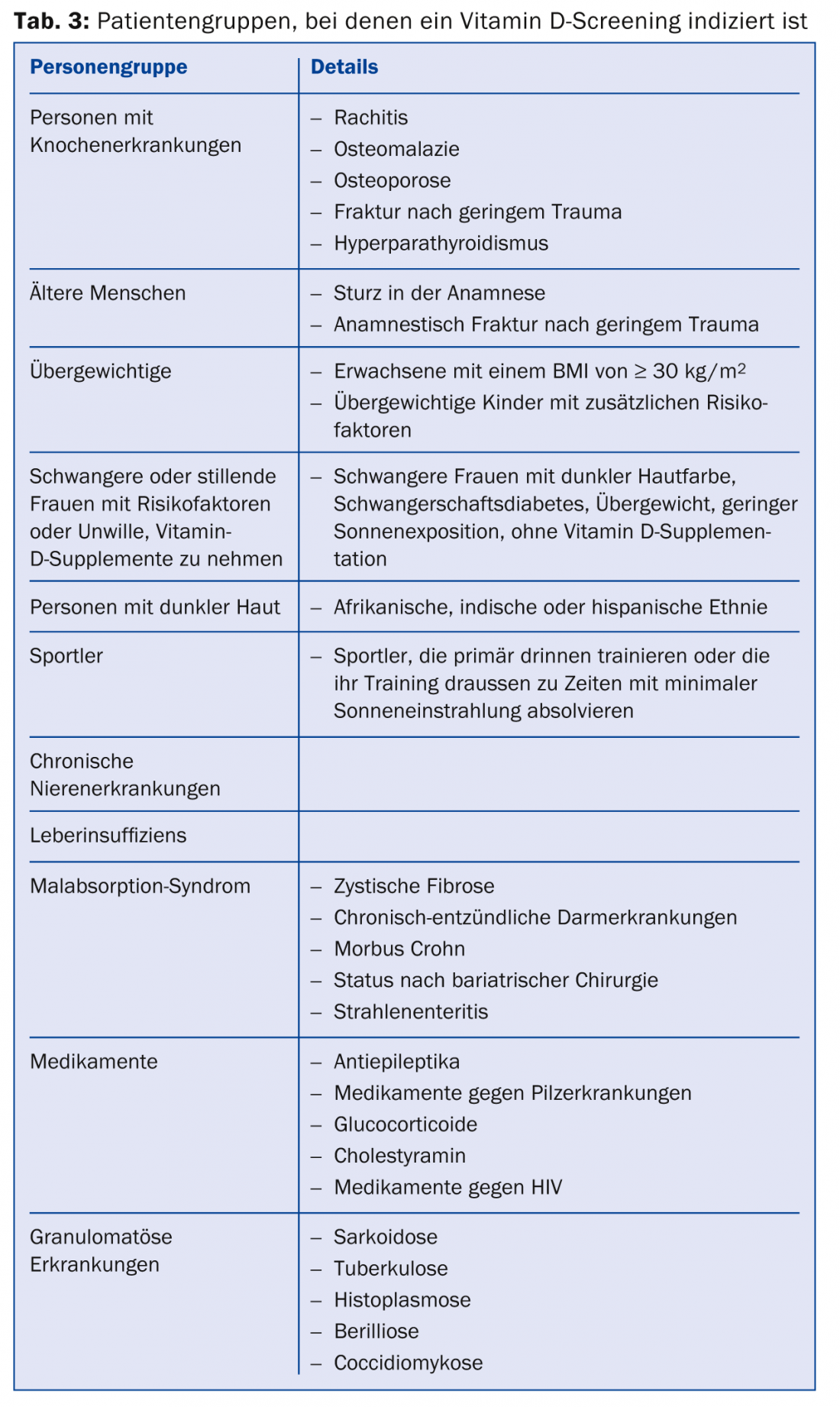
According to the FOPH, 80% of the Swiss population is sufficiently supplied with vitamin D during the summer season. However, in winter, more than 60% of the population is undersupplied or shows serum levels (concentration of 25[OH]D) below the recommended level of 50 nmol/l. Some populations are more at risk than others for vitamin D deficiency; these include infants and young children, pregnant women, and the elderly. Determination of blood 25(OH)D levels is recommended for certain groups of individuals at increased risk for vitamin D insufficiency (Table 3).
Vitamin D and osteoporosis

Vitamin D insufficiency or deficiency increases the risk of osteoporosis because vitamin D is necessary for calcium to be absorbed from the intestine, and vitamin D deficiency results in increased breakdown of calcium and phosphate from bone. Studies have shown that a sufficiently high concentration of vitamin D reduces the risk of falls and bone fractures in people over 60. For risk reduction, concentrations of ≥75 nmol/l must be present in the blood. To achieve such a concentration, supplementation requires dosages of at least 800 IU/d. According to recent studies, the benefit in individuals with high vitamin D supplementation (800 IU/d) is greater when less than 1000 mg/d of calcium per day is taken as a supplement. Vitamin D supplementation appears to have a calcium-sparing effect.

Recommendations for vitamin D supply

In 2012, the FOPH updated the recommendations for vitamin D supply (Tab. 2) .
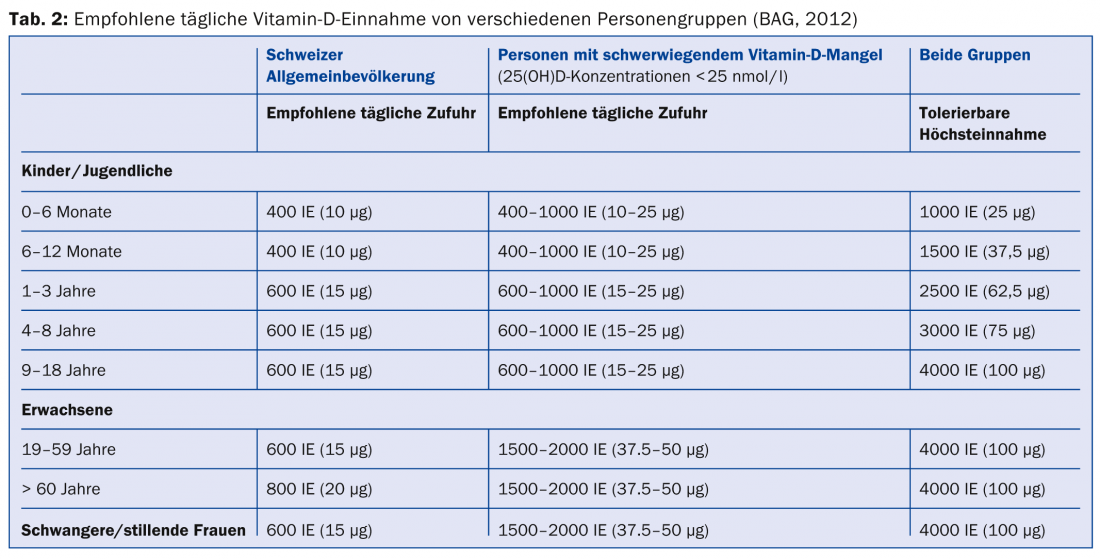
The doses given aim to have at least 97% of the population reach a vitamin D concentration of >50 nmol/l. Vitamin D should be supplemented in children under three years of age, the elderly, and pregnant and lactating women, since sufficient vitamin D supply can hardly be achieved in these groups of people through diet and sun exposure.

Literature:

  1. Federal Commission for Nutrition. Vitamin D deficiency: Evidence, safety, and recommendations for the Swiss Population. Expert report of the FCN. Zurich: Federal Office for Public Health, 2012. www.blv.admin.ch/themen/04679/05065/05104/index.html?lang=de
  2. Vitamin D Recommendations of the Federal Food Safety and Veterinary Office, June 2012. www.blv.admin.ch/themen/04679/05065/05104/index.html?lang=de
  3. Vitamin D – the most important facts. Federal Office of Public Health, 2012. www.blv.admin.ch/themen/04679/05065/05104/index.html?lang=de
  4. Bischoff-Ferrari H, Stähelin H: Vitamin D and calcium supplementation. New guidelines and public health aspects. Switzerland Med Forum 2011; 11(50): 930-936.
  5. Bischoff-Ferrari H: Calcium and vitamin D for osteoporosis prevention. the informed physician 2013 (03): 20-25.

HAUSARZT PRAXIS 2014; 9(9): 34-36

Autoren
  • Dr. med. Eva Ebnöther
Publikation
  • HAUSARZT PRAXIS
Related Topics
  • BAG
  • Cholesterol precursor
  • Hydroxy vitamin D
  • Osteoporosis
  • Substitution
  • Sunscreen
  • UVB
  • Vitamin D
Previous Article
  • Update 2014

Treat otitis media correctly

  • Education
  • ORL
  • Pediatrics
  • RX
View Post
Next Article
  • Diseases of the prostate

What is the potential of phytotherapy?

  • Congress Reports
  • Oncology
  • Phytotherapy
  • RX
  • Urology
View Post
You May Also Like
View Post
  • 6 min
  • Type 2 diabetes: sarcopenia and frailty

How can the breakdown of skeletal muscles be stopped?

    • Congress Reports
    • Endocrinology and Diabetology
    • General Internal Medicine
    • Geriatrics
    • Nutrition
    • Orthopedics
    • RX
    • Sports Medicine
View Post
  • 4 min
  • Cholangiocarcinoma

Modern molecular diagnostics and targeted therapy options

    • Education
    • Gastroenterology and Hepatology
    • Oncology
    • RX
    • Studies
View Post
  • 6 min
  • Treatment resistant depression

Esketamine nasal spray as monotherapy? New for treatment-resistant depression

    • Education
    • General Internal Medicine
    • ORL
    • Pharmacology and toxicology
    • Psychiatry and psychotherapy
    • RX
    • Studies
View Post
  • 6 min
  • Analysis of SNVCS data from the period 2005-2022

TBE vaccination for children and adolescents in Switzerland

    • Education
    • General Internal Medicine
    • Infectiology
    • Neurology
    • Pediatrics
    • Prevention and health care
    • RX
View Post
  • 4 min
  • Tuberculosis

Detecting diabetes in TB patients early and efficiently

    • Education
    • Endocrinology and Diabetology
    • Infectiology
    • Pneumology
    • RX
    • Studies
View Post
  • 4 min
  • Trichophyton indotineae

Terbinafine-resistant dermatophytoses are on the rise in Central Europe

    • Allergology and clinical immunology
    • Congress Reports
    • Dermatology and venereology
    • Infectiology
    • RX
    • Studies
    • Tropical and travel medicine
View Post
  • 11 min
  • Peristomal skin health

Focus on preventive care options

    • Cases
    • CME continuing education
    • Dermatology and venereology
    • Gastroenterology and Hepatology
    • Infectiology
    • Physical medicine and rehabilitation
    • Prevention and health care
    • RX
    • Surgery
View Post
  • 7 min
  • Disease-modifying therapies for ATTR-CM

TTR stabilizers, gene silencing and gene scissors: where do we stand?

    • Cardiology
    • Congress Reports
    • Genetics
    • RX
    • Studies
Landingpage Fachinfo Landingpage Button
  • IBD matters

    Zum Thema
Top CME content
  • 1
    Communication as the key to therapy adherence
  • 2
    Solutions to the malnutrition dilemma
  • 3
    Solutions to the malnutrition dilemma
  • 4
    Focus on preventive care options
  • 5
    Fertility preservation from gonads to genomes to genoids

Newsletter

Sign up and stay up to date

Subscribe
Medizinonline Medizinonline
  • Contact
  • General terms and conditions
  • Imprint

Input your search keywords and press Enter.