Medizinonline Medizinonline
  • News
    • News
    • Market & Medicine
  • Patients
    • Disease patterns
    • Diagnostics
    • Therapy
  • Partner Content
    • Diabetes
      • Dia-Month Club – Type 2 Diabetes
      • Diabetes in Motion
      • Diabetes Podcasts
    • Gastroenterology
      • IBD matters
    • Oncology
      • Swiss Oncology in motion
    • Orthopedics
      • Osteoporosis in motion
  • Departments
    • Allergology and clinical immunology
    • General Internal Medicine
    • Anesthesiology
    • Angiology
    • Surgery
    • Dermatology and venereology
    • Endocrinology and Diabetology
    • Nutrition
    • Gastroenterology and Hepatology
    • Genetics
    • Geriatrics
    • Gynecology
    • Hematology
    • Infectiology
    • Cardiology
    • Nephrology
    • Neurology
    • Emergency and intensive care medicine
    • Nuclear Medicine
    • Oncology
    • Ophthalmology
    • ORL
    • Orthopedics
    • Pediatrics
    • Pharmacology and toxicology
    • Pharmaceutical medicine
    • Phlebology
    • Physical medicine and rehabilitation
    • Pneumology
    • Prevention and health care
    • Psychiatry and psychotherapy
    • Radiology
    • Forensic Medicine
    • Rheumatology
    • Sports Medicine
    • Traumatology and trauma surgery
    • Tropical and travel medicine
    • Urology
    • Dentistry
  • CME & Congresses
    • CME continuing education
    • Congress Reports
    • Congress calendar
  • Practice
    • Noctimed
    • Practice Management
    • Jobs
    • Interviews
  • Log In
  • Register
  • My account
  • Contact
  • Publications
  • Contact
  • Deutsch
  • English
  • Français
  • Italiano
  • Português
  • Español
Subscribe
Medizinonline Medizinonline
  • News
    • News
    • Market & Medicine
  • Patienten
    • Krankheitsbilder
    • Diagnostik
    • Therapie
  • Partner Content
    • Diabetes
      • Dia-Month Club – Type 2 Diabetes
      • Diabetes in Motion
      • Diabetes Podcasts
    • Gastroenterology
      • IBD matters
    • Oncology
      • Swiss Oncology in motion
    • Orthopedics
      • Osteoporosis in motion
    • Phytotherapie
    • Rheumatology
  • Departments
    • Fachbereiche 1-13
      • Allergology and clinical immunology
      • General Internal Medicine
      • Anesthesiology
      • Angiology
      • Surgery
      • Dermatology and venereology
      • Endocrinology and Diabetology
      • Nutrition
      • Gastroenterology and Hepatology
      • Genetics
      • Geriatrics
      • Gynecology
      • Hematology
    • Fachbereiche 14-26
      • Infectiology
      • Cardiology
      • Nephrology
      • Neurology
      • Emergency and intensive care medicine
      • Nuclear Medicine
      • Oncology
      • Ophthalmology
      • ORL
      • Orthopedics
      • Pediatrics
      • Pharmacology and toxicology
      • Pharmaceutical medicine
    • Fachbereiche 26-38
      • Phlebology
      • Physical medicine and rehabilitation
      • Phytotherapy
      • Pneumology
      • Prevention and health care
      • Psychiatry and psychotherapy
      • Radiology
      • Forensic Medicine
      • Rheumatology
      • Sports Medicine
      • Traumatology and trauma surgery
      • Tropical and travel medicine
      • Urology
      • Dentistry
  • CME & Congresses
    • CME continuing education
    • Congress Reports
    • Congress calendar
  • Practice
    • Noctimed
    • Practice Management
    • Jobs
    • Interviews
Login

Sie haben noch keinen Account? Registrieren

  • Interdisciplinary Case Management

If symptoms are nonspecific, also consider multiple chemical sensitivity

    • Allergology and clinical immunology
    • Education
    • General Internal Medicine
    • Practice Management
    • Prevention and health care
    • RX
    • Studies
  • 3 minute read

Multiple Chemical Sensitivity” (MCS) is a subjectively experienced increased sensitivity to chemicals from the environment. Affected persons react with a variety of non-specific complaints. The level of suffering can be very high. Differential diagnosis is to exclude other possible causes for the symptoms, including allergies, . Where MCS can also occur as a comorbidity.

General symptoms such as fatigue, exhaustion, respiratory problems, gastrointestinal symptoms, and other disorders of various organ systems are associated by affected individuals with exposure to various chemicals and environmental exposures [1–3]. Chemicals include, in particular, wood preservatives, solvents, insecticides, heavy metals, disinfectants and fragrances. The symptoms are already triggered by very low concentrations that do not cause any reactions in healthy people [1–3]. Thresholds are very individual and not generally known. Symptoms such as itching, burning skin, dry mouth, or feelings of anxiety may also occur [1–3].

It remains unclear whether MCS is a disease entity in its own right [3]. It is clear that psychosomatic stress often occurs together with MCS complaints. However, it is uncertain whether in the case of such comorbidity, the MCS symptoms are the cause or the consequence of psychosomatic complaints.

Exposure prevention as most important measure

Bartha et al. have noted the following consensus criteria for defining MCS [4]:

  1. Symptoms are reproducible with repeated chemical exposures.
  2. The condition is chronic.
  3. Symptoms are triggered by low levels of exposure that are generally tolerated by others or were tolerated before the onset of the disease.
  4. Symptoms improve or disappear completely when the triggers are avoided or removed.
  5. Symptoms are triggered by various chemically unrelated substances.
  6. Multiple organs or organ systems are affected by symptoms.
    a) MCS should also be diagnosed alongside other diagnoses that partially lead to fulfillment of criteria 1 to 6 (asthma, allergies, migraine).
    b) Exclusion of MCS: The reported complaints can be fully explained (full spectrum) by a known disease of the patient.
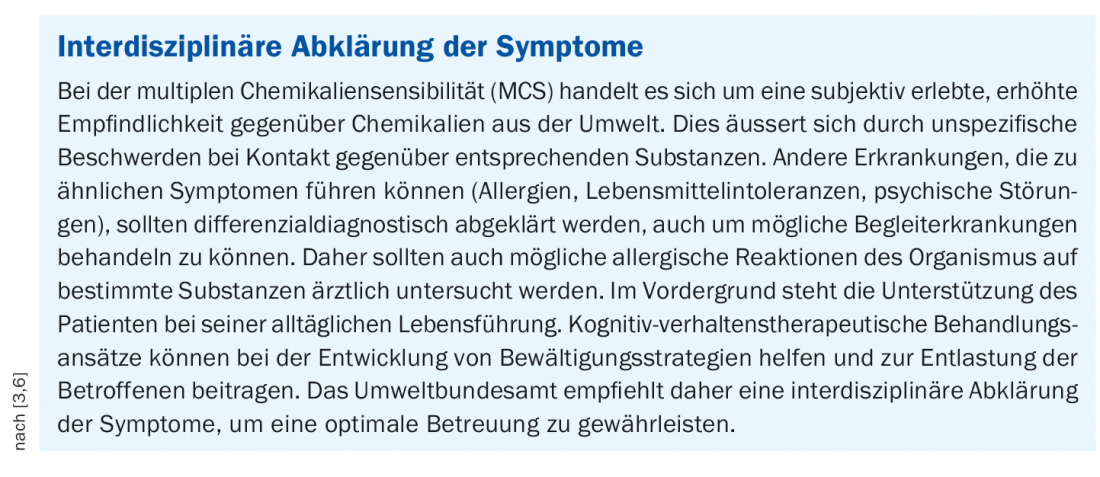


The personal consequences of MCS are – just like the symptoms – manifold. Affected individuals report, among other things, limitations in quality of life and performance and often find themselves unable to perform their jobs [3]. Doing everyday chores and socializing with friends and family are also often experienced as problematic and conflictual. The suffering of MCS patients can be very high and in extreme cases can even lead to social isolation. It is recommended to initiate interdisciplinary clarifications (box).
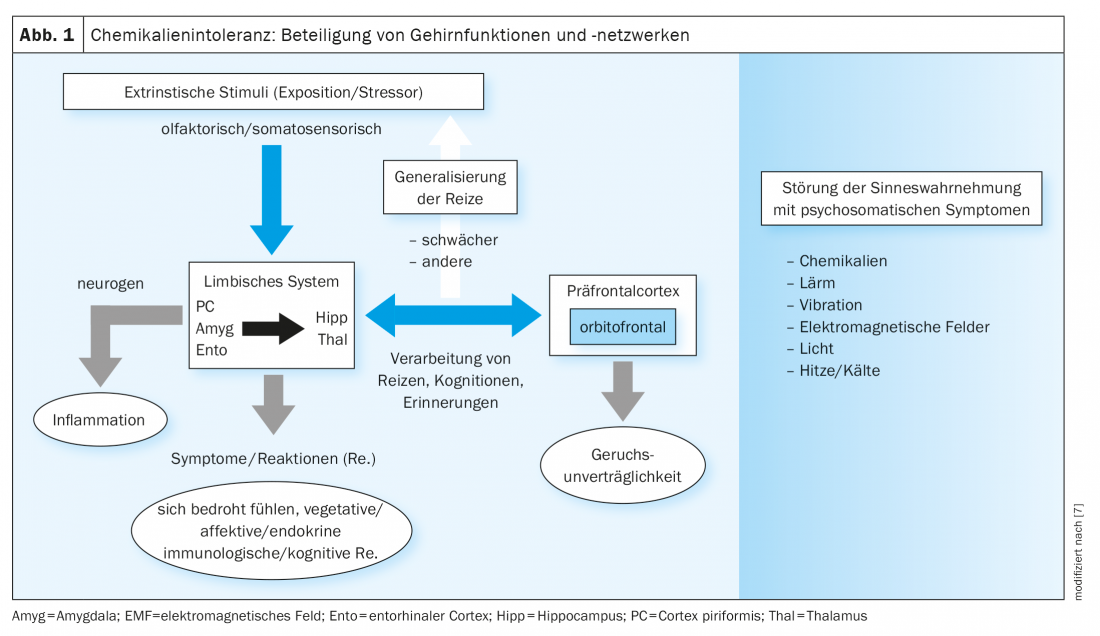


To date, it has not been conclusively clarified whether, and if so, which mechanisms are involved in the development of MCS. A wide variety of etiological processes have been proposed, which can be classified as disorders of immunological or allergic processes, modifications of the function of the nervous system, deviations from the norm of biochemical processes, or changes in psychological or neurobehavioral functions [5]. A 2019 publication in the Journal Environmental Health and Preventive Medicine proposed an explanatory model showing possible links between sensory inputs and neural processing pathways in MCS (Fig. 1) [7]. The authors included in their secondary analysis data from 23 studies published in peer-reviewed journals between 2000-2019.


Literature:

  1. Harth W, Gieler U: Multiple-chemical-sensitivity syndrome (MCS). In: Harth W, Gieler U (eds.): Psychosomatic Dermatology. Heidelberg: Springer Medizin Verlag, 2006: 43.
  2. Rossi S, Pitidis A: Multiple Chemical Sensitivity: Review of the state of the art in epidemiology, diagnosis, and future perspectives. J Occup Environ Med 2018; 60(2): 138-146.
  3. “Multiple Chemical Sensitivity,” Federal Environmental Agency, Dec. 15, 2021, www.umweltbundesamt.de (last accessed Aug. 15, 2022).
  4. Bartha L, et al: Multiple chemical sensitivity: a 1999 consensus. Arch Environ Health 1999; 54(3): 147-149.
  5. Winder C: Mechanisms of multiple chemical sensitivity. Toxicology letters 2002; 128(1): 85-97.
  6. Harter K, et al: Multiple chemical sensitivity (MCS) – A dermatology guide to the management of affected individuals. J Dtsch Dermatol Ges 2020; 18(2): 119-131.
  7. Azuma K, et al: Chemical intolerance: involvement of brain function and networks after exposure to extrinsic stimuli perceived as hazardous. Environ Health Prev Med 2019; 24(1): 61.


HAUSARZT PRAXIS 2022; 17(8): 4-5
CARDIOVASC 2022; 21(3): 42
Autoren
  • Mirjam Peter, M.Sc.
Publikation
  • HAUSARZT PRAXIS
Related Topics
  • Chemical sensitivity
  • Interdisciplinary Case Management
  • practice management
Previous Article
  • Palliative Care

An increasing challenge for the medical profession

  • CME continuing education
  • Education
  • General Internal Medicine
  • Prevention and health care
  • RX
View Post
Next Article
  • Guiltiness and Co.

Forensic psychiatry in a criminal justice context.

  • CME continuing education
  • Education
  • Forensic Medicine
  • General Internal Medicine
  • Prevention and health care
  • Psychiatry and psychotherapy
  • RX
View Post
You May Also Like
View Post
  • 3 min
  • Shaping the Future with LLM & Co.

AI in Everyday Clinical Practice: Friend or Foe?

    • RX
    • General Internal Medicine
    • Practice Management
    • Prevention and health care
View Post
  • 5 min
  • Ulcerative colitis: current evidence on anti-inflammatory therapies

Remission induction and maintenance with biologics and JAK-i

    • RX
    • Congress Reports
    • Gastroenterology and Hepatology
    • General Internal Medicine
    • Studies
View Post
  • 4 min
  • Bronchiectasis

New strategies against neutrophilic inflammation

    • RX
    • Congress Reports
    • General Internal Medicine
    • Infectiology
    • Pneumology
    • Studies
View Post
  • 3 min
  • IBD in childhood

Pneumococcal vaccination without negative consequences

    • RX
    • Education
    • Gastroenterology and Hepatology
    • General Internal Medicine
    • Infectiology
    • Pediatrics
    • Prevention and health care
View Post
  • 14 min
  • Seborrheic Dermatitis in Adults and Adolescents

Current State of Knowledge and New Therapeutic Approaches

    • RX
    • CME continuing education
    • Dermatology and venereology
    • Studies
View Post
  • 7 min
  • Plastic surgery and reconstructive microsurgery for DFS

Functional limb preservation between infection control, vascular medicine and resurfacing

    • RX
    • Angiology
    • CME continuing education
    • Dermatology and venereology
    • Endocrinology and Diabetology
    • General Internal Medicine
    • Geriatrics
    • Physical medicine and rehabilitation
    • Surgery
View Post
  • 7 min
  • Orthobiologics for knee osteoarthritis

PRP and hyaluronic acid injections as building blocks in a multimodal concept

    • RX
    • Congress Reports
    • General Internal Medicine
    • Orthopedics
    • Rheumatology
    • Sports Medicine
    • Studies
    • Surgery
View Post
  • 3 min
  • Soft tissue sarcomas of the lower extremity

Diagnostics, subtypes and treatment options

    • RX
    • Education
    • Oncology
  • IBD matters

    Zum Thema
Top CME content
  • 1
    Current State of Knowledge and New Therapeutic Approaches
  • 2
    Why is it so hard to lose weight?
  • 3
    Functional limb preservation between infection control, vascular medicine and resurfacing
  • 4
    Algorithms, avatars and the unburdened mind
  • 5
    Communication as the key to therapy adherence

Newsletter

Sign up and stay up to date

Subscribe
Medizinonline Medizinonline
  • Contact
  • General terms and conditions
  • Imprint

Input your search keywords and press Enter.