Medizinonline Medizinonline
  • News
    • News
    • Market & Medicine
  • Patients
    • Disease patterns
    • Diagnostics
    • Therapy
  • Partner Content
    • Diabetes
      • Dia-Month Club – Type 2 Diabetes
      • Diabetes in Motion
    • Gastroenterology
      • IBD matters
    • Oncology
      • Swiss Oncology in motion
    • Orthopedics
      • Osteoporosis in motion
  • Departments
    • Allergology and clinical immunology
    • General Internal Medicine
    • Anesthesiology
    • Angiology
    • Surgery
    • Dermatology and venereology
    • Endocrinology and Diabetology
    • Nutrition
    • Gastroenterology and Hepatology
    • Genetics
    • Geriatrics
    • Gynecology
    • Hematology
    • Infectiology
    • Cardiology
    • Nephrology
    • Neurology
    • Emergency and intensive care medicine
    • Nuclear Medicine
    • Oncology
    • Ophthalmology
    • ORL
    • Orthopedics
    • Pediatrics
    • Pharmacology and toxicology
    • Pharmaceutical medicine
    • Phlebology
    • Physical medicine and rehabilitation
    • Pneumology
    • Prevention and health care
    • Psychiatry and psychotherapy
    • Radiology
    • Forensic Medicine
    • Rheumatology
    • Sports Medicine
    • Traumatology and trauma surgery
    • Tropical and travel medicine
    • Urology
    • Dentistry
  • CME & Congresses
    • CME continuing education
    • Congress Reports
    • Congress calendar
  • Practice
    • Noctimed
    • Practice Management
    • Jobs
    • Interviews
  • Log In
  • Register
  • My account
  • Contact
  • Publications
  • Contact
  • Deutsch
  • English
  • Français
  • Italiano
  • Português
  • Español
Subscribe
Medizinonline Medizinonline
  • News
    • News
    • Market & Medicine
  • Patienten
    • Krankheitsbilder
    • Diagnostik
    • Therapie
  • Partner Content
    • Diabetes
      • Dia-Month Club – Type 2 Diabetes
      • Diabetes in Motion
    • Gastroenterology
      • IBD matters
    • Oncology
      • Swiss Oncology in motion
    • Orthopedics
      • Osteoporosis in motion
    • Phytotherapie
    • Rheumatology
  • Departments
    • Fachbereiche 1-13
      • Allergology and clinical immunology
      • General Internal Medicine
      • Anesthesiology
      • Angiology
      • Surgery
      • Dermatology and venereology
      • Endocrinology and Diabetology
      • Nutrition
      • Gastroenterology and Hepatology
      • Genetics
      • Geriatrics
      • Gynecology
      • Hematology
    • Fachbereiche 14-26
      • Infectiology
      • Cardiology
      • Nephrology
      • Neurology
      • Emergency and intensive care medicine
      • Nuclear Medicine
      • Oncology
      • Ophthalmology
      • ORL
      • Orthopedics
      • Pediatrics
      • Pharmacology and toxicology
      • Pharmaceutical medicine
    • Fachbereiche 26-38
      • Phlebology
      • Physical medicine and rehabilitation
      • Phytotherapy
      • Pneumology
      • Prevention and health care
      • Psychiatry and psychotherapy
      • Radiology
      • Forensic Medicine
      • Rheumatology
      • Sports Medicine
      • Traumatology and trauma surgery
      • Tropical and travel medicine
      • Urology
      • Dentistry
  • CME & Congresses
    • CME continuing education
    • Congress Reports
    • Congress calendar
  • Practice
    • Noctimed
    • Practice Management
    • Jobs
    • Interviews
Login

Sie haben noch keinen Account? Registrieren

  • Cardiology Update Davos

Hopeful therapy for acute heart failure

    • Cardiology
    • Congress Reports
    • RX
    • Studies
  • 2 minute read

Although the symptoms of acute heart failure can be treated successfully for the most part, the long-term prognosis remains poor. This could change, at least for some patients, as a study with the active ingredient Serelaxin shows.

The RELAX-AHF trial investigated the effect of serelaxin in patients with acute heart failure [1]. Serelaxin is the recombinant form of the human peptide hormone relaxin-2, which is produced more abundantly during pregnancy and mediates various hemodynamic adaptations.

These include increases in cardiac ejection fraction, decreases in systemic vascular resistance, and increased renal blood flow. Relaxin-2 also appears to possess anti-ischemic, anti-inflammatory, and anti-fibrotic properties.

The multicenter, double-blind, placebo-controlled RELAX-AHF trial included 1150 patients hospitalized for acute heart failure. With the aim of minimizing the development of end-organ damage by early initiation of therapy, subjects were administered placebo or serelaxin 30 μg/kg/day i.v. for 48 hours in addition to standard therapy within 16 hours of admission. Primary endpoints of the study were first, the decrease in dyspnea after five days as measured by the visual analog scale (VAS), and second, the proportion of patients who reported moderate or marked improvement in their dyspnea on the Likert scale during the first 24 hours. Secondary end points were defined as days of survival and days out of hospital, and the number of cardiovascular deaths and re-hospitalizations 60 days after treatment. In addition, all-cause mortality was recorded after 180 days (safety endpoint).

Results of the RELAX-AF study

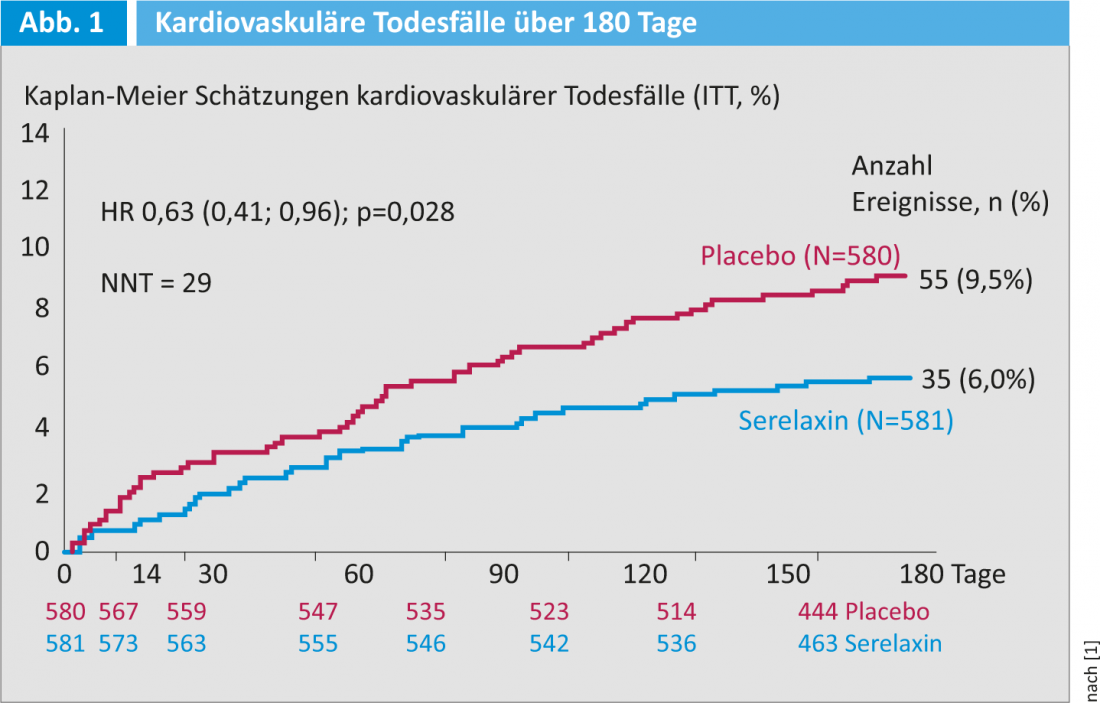
As the results of the study showed, dyspnea had significantly improved in the Serelaxin group compared to baseline at five days (VAS). No difference to placebo was observed regarding the other endpoints. The result of the six-month follow-up was all the more surprising. This showed that 37% fewer deaths occurred in the Serelaxin group than with placebo (42 vs. 65, HR 0.63 [95% CI 0.43-0.93; p=0.02]). An equally large reduction was seen in cardiovascular-related deaths (Fig. 1) . “The significance of this result is limited by the fact that the study was not planned to investigate mortality,” said Prof. Piotr Ponikowski, MD. For the first time, however, it has been possible to show that mortality can be influenced by early intervention.
Paradigparadigm shift in heart failure therapy is called for.

The study results are consistent with Prof. Ponikowski’s call for a paradigm shift in acute heart failure therapy. Current treatment focuses primarily on rapid symptom relief. “What we need is a treatment that works quickly while improving the long-term prognosis,” Prof. Ponikowski said. For the study population under investigation, which includes elderly patients with normal to elevated blood pressure and various comorbidities, Serelaxin may represent such a treatment. “However, to believe that the different entities of acute heart failure can be treated with only one therapy is naive.”

Source: Cardiology Update Davos 2013,February 10-15.

Literature:

  1. Teerlink JR, et al: Serelaxin, recombinant human relaxin-2, for treatment of acute heart failure (RELAX-AHF): a randomised, placebo-controlled trial. Lancet 2013; 381(9860): 29-39.

Autoren
  • Regina Scharf
Publikation
  • CARDIOVASC
Related Topics
  • Cardiology Update
  • Heart failure
  • RELAX-AHF Study
Previous Article
  • Obesity

Diets make you fat

  • Cardiology
  • Education
  • Gastroenterology and Hepatology
  • Nutrition
  • RX
View Post
Next Article
  • Swiss Derma Day in Lucerne

Properly treat contact dermatitis

  • Congress Reports
  • Dermatology and venereology
  • RX
View Post
You May Also Like
View Post
  • 6 min
  • Myasthenia gravis: immunomodulatory therapies for long-term treatment

Expanded Possibilities Thanks to Innovative Classes of Active Ingredients

    • RX
    • Congress Reports
    • General Internal Medicine
    • Neurology
    • Ophthalmology
    • Studies
View Post
  • 7 min
  • Plastic surgery and reconstructive microsurgery for DFS

Functional limb preservation between infection control, vascular medicine and resurfacing

    • RX
    • Angiology
    • CME continuing education
    • Dermatology and venereology
    • Endocrinology and Diabetology
    • General Internal Medicine
    • Geriatrics
    • Physical medicine and rehabilitation
    • Surgery
View Post
  • 10 min
  • Interstitial Lung Diseases

Update on Idiopathic Pulmonary Fibrosis

    • RX
    • CME continuing education
    • Pneumology
    • Studies
View Post
  • 7 min
  • Ischemic stroke: Are smaller or larger brain arteries affected?

Recent study findings on intravenous lysis therapy with fibrinolytic agents

    • RX
    • Congress Reports
    • Emergency and intensive care medicine
    • General Internal Medicine
    • Neurology
    • Pharmacology and toxicology
    • Studies
    • Surgery
View Post
  • 7 min
  • Interview

“On par with the gold standards for trauma”

    • RX
    • Education
    • Interviews
    • Neurology
    • Physical medicine and rehabilitation
    • Psychiatry and psychotherapy
    • Studies
View Post
  • 5 min
  • Psychology: Emotional Freedom Techniques (EFT)

Emotional Healing Through Tapping

    • RX
    • Education
    • General Internal Medicine
    • Neurology
    • Physical medicine and rehabilitation
    • Psychiatry and psychotherapy
    • Studies
View Post
  • 5 min
  • Systemic Lupus (SLE): What Does the Diagnosis and Treatment Toolbox Have to Offer?

Treat-to-Target – Consensus Recommendations for GC Tapering and the Use of DMARDs

    • RX
    • Congress Reports
    • General Internal Medicine
    • Nephrology
    • Rheumatology
    • Studies
View Post
  • 9 min
  • Psychedelic-assisted therapy

Current status of PAT

    • RX
    • CME continuing education
    • General Internal Medicine
    • Pharmacology and toxicology
    • Psychiatry and psychotherapy
    • Studies
  • IBD matters

    Zum Thema
Top CME content
  • 1
    Functional limb preservation between infection control, vascular medicine and resurfacing
  • 2
    Update on Idiopathic Pulmonary Fibrosis
  • 3
    Update on Idiopathic Pulmonary Fibrosis
  • 4
    Current status of PAT
  • 5
    Darier’s Disease, also known as Follicular Keratosis – Update 2026

Newsletter

Sign up and stay up to date

Subscribe
Medizinonline Medizinonline
  • Contact
  • General terms and conditions
  • Imprint

Input your search keywords and press Enter.