Medizinonline Medizinonline
  • News
    • News
    • Market & Medicine
  • Patients
    • Disease patterns
    • Diagnostics
    • Therapy
  • Partner Content
    • Diabetes
      • Dia-Month Club – Type 2 Diabetes
      • Diabetes in Motion
    • Gastroenterology
      • IBD matters
    • Oncology
      • Swiss Oncology in motion
    • Orthopedics
      • Osteoporosis in motion
  • Departments
    • Allergology and clinical immunology
    • General Internal Medicine
    • Anesthesiology
    • Angiology
    • Surgery
    • Dermatology and venereology
    • Endocrinology and Diabetology
    • Nutrition
    • Gastroenterology and Hepatology
    • Genetics
    • Geriatrics
    • Gynecology
    • Hematology
    • Infectiology
    • Cardiology
    • Nephrology
    • Neurology
    • Emergency and intensive care medicine
    • Nuclear Medicine
    • Oncology
    • Ophthalmology
    • ORL
    • Orthopedics
    • Pediatrics
    • Pharmacology and toxicology
    • Pharmaceutical medicine
    • Phlebology
    • Physical medicine and rehabilitation
    • Pneumology
    • Prevention and health care
    • Psychiatry and psychotherapy
    • Radiology
    • Forensic Medicine
    • Rheumatology
    • Sports Medicine
    • Traumatology and trauma surgery
    • Tropical and travel medicine
    • Urology
    • Dentistry
  • CME & Congresses
    • CME continuing education
    • Congress Reports
    • Congress calendar
  • Practice
    • Noctimed
    • Practice Management
    • Jobs
    • Interviews
  • Log In
  • Register
  • My account
  • Contact
  • Publications
  • Contact
  • Deutsch
  • English
  • Français
  • Italiano
  • Português
  • Español
Subscribe
Medizinonline Medizinonline
  • News
    • News
    • Market & Medicine
  • Patienten
    • Krankheitsbilder
    • Diagnostik
    • Therapie
  • Partner Content
    • Diabetes
      • Dia-Month Club – Type 2 Diabetes
      • Diabetes in Motion
    • Gastroenterology
      • IBD matters
    • Oncology
      • Swiss Oncology in motion
    • Orthopedics
      • Osteoporosis in motion
    • Phytotherapie
    • Rheumatology
  • Departments
    • Fachbereiche 1-13
      • Allergology and clinical immunology
      • General Internal Medicine
      • Anesthesiology
      • Angiology
      • Surgery
      • Dermatology and venereology
      • Endocrinology and Diabetology
      • Nutrition
      • Gastroenterology and Hepatology
      • Genetics
      • Geriatrics
      • Gynecology
      • Hematology
    • Fachbereiche 14-26
      • Infectiology
      • Cardiology
      • Nephrology
      • Neurology
      • Emergency and intensive care medicine
      • Nuclear Medicine
      • Oncology
      • Ophthalmology
      • ORL
      • Orthopedics
      • Pediatrics
      • Pharmacology and toxicology
      • Pharmaceutical medicine
    • Fachbereiche 26-38
      • Phlebology
      • Physical medicine and rehabilitation
      • Phytotherapy
      • Pneumology
      • Prevention and health care
      • Psychiatry and psychotherapy
      • Radiology
      • Forensic Medicine
      • Rheumatology
      • Sports Medicine
      • Traumatology and trauma surgery
      • Tropical and travel medicine
      • Urology
      • Dentistry
  • CME & Congresses
    • CME continuing education
    • Congress Reports
    • Congress calendar
  • Practice
    • Noctimed
    • Practice Management
    • Jobs
    • Interviews
Login

Sie haben noch keinen Account? Registrieren

  • Type 2 diabetes therapy

Three steps to the goal

    • Cardiology
    • Congress Reports
    • Endocrinology and Diabetology
    • Nephrology
    • Partner Content
    • RX
  • 2 minute read

Firstly, lifestyle measures, secondly metformin, thirdly individualization – according to Prof. Marc Donath, MD, Basel, Switzerland, this is how type 2 diabetics are treated today. Depending on the individual situation, either DPP4 inhibitors, GLP-1 analogues or basal insulin are used in the third step.

Lifestyle measures, when applied consistently and over the long term, can make a very large contribution to the control of diabetes and are therefore at the forefront of every type 2 diabetic’s treatment. “Give your patients concrete instructions for incorporating physical activity into their daily routine and emphasize the positive effects of this measure. When it comes to diet, you should not use prohibitions either, but rather encourage patients to really enjoy eating again,” advised Prof. Marc Donath, MD, Basel, to the audience at a satellite symposium at the SGIM Congress in Basel. If these measures are not sufficient, drug therapy with metformin is started. “Metformin is still the best drug prognostically, and you should really never stop it,” Prof. Donath emphasized. Lactic acidosis is really only a problem in patients with renal insufficiency. Swiss diabetologists have agreed that metformin should be given safely up to a GFR of 45 ml/min and safely not given above a GFR ≤30 ml/min. For values in between, it is at the discretion of the treating physician whether or not to give metformin in the individual case.

Individualize therapy

Only in a third step, if the target blood glucose levels are not reached despite lifestyle measures and metformin, does the individualized expansion of treatment follow (Tab. 1) . Prof. Donath recommends adding a DPP4 inhibitor in the first instance. Compared with sulfonylureas, gliptins have the advantage of being weight neutral and, most importantly, do not cause hypoglycemia.
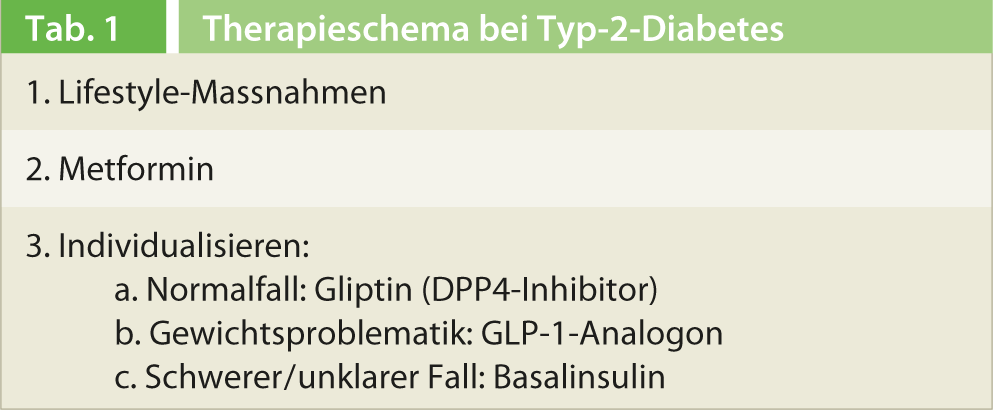
Overall, there are no major differences between the various DPP4 inhibitors; from case to case, one or the other preparation is more suitable. If the weight problem is in the foreground, Prof. Donath advises the administration of a GLP-1 analog. A distinction must be made here between short-acting preparations administered prandially, which delay gastric emptying and thus have a pronounced effect on postprandial blood glucose, and long-acting preparations administered once daily or even only once a week, which act mainly on fasting blood glucose.

In severe type 2 diabetics and in unclear cases, basal insulin is ideally given. “Insulin is always right in principle. It is never wrong to give insulin because all diabetics, including type 2 diabetics, have an insulin deficiency,” Prof. Donath explained. The so-called treat-to-target regimen has proven effective here, in which one starts with 10 IU of a basic insulin and gradually increases the dose until the target blood glucose value is reached. After three months, HbA1c is measured; if the target value has not yet been reached, an oral antidiabetic (primarily a DPP4 inhibitor) or a GLP-1 analogue is also given.

Source: “Type 2 diabetes – The right therapy for the right patient”. Satellite Symposium of Bristol-Myers Squibb and AstraZeneca at the SGIM Congress, May 29-31, 2013, Basel.


Autoren
  • Dr. med. Sabina M. Ludin
Publikation
  • HAUSARZT PRAXIS
Related Topics
  • Basal insulin
  • DPP4 inhibitors
  • GLP-1 analogue
  • GLP-1 analogues
  • HbA1c
  • Individualize
  • Lifestyle
  • Metformin
  • Target blood glucose levels
  • Therapy
  • Treat-to-target scheme
Previous Article
  • Diagnostics and therapy of anorexia and bulimia nervosa

When food becomes a problem

  • Education
  • Nutrition
  • Psychiatry and psychotherapy
  • RX
View Post
Next Article
  • Questionable financial incentives

Swiss surgeons want to prevent abuse with charter

  • Congress Reports
  • Prevention and health care
  • RX
  • Surgery
View Post
You May Also Like
View Post
  • 4 min
  • From symptom to diagnosis

Abdominal Pain – Focal Nodular Hyperplasia

    • RX
    • Education
    • Gastroenterology and Hepatology
    • General Internal Medicine
    • Oncology
    • Radiology
View Post
  • 12 min
  • Hepatology and Metabolism

The Mediterranean Diet for MASLD/MASH—What the EASL-EASD-EASO Guidelines Specifically Recommend

    • RX
    • Cardiology
    • Endocrinology and Diabetology
    • Gastroenterology and Hepatology
    • General Internal Medicine
    • Nutrition
    • Prevention and health care
    • Studies
View Post
  • 11 min
  • Peristomal skin health

Focus on preventive care options

    • RX
    • Cases
    • CME continuing education
    • Dermatology and venereology
    • Gastroenterology and Hepatology
    • Infectiology
    • Physical medicine and rehabilitation
    • Prevention and health care
    • Surgery
View Post
  • 5 min
  • Case study

Discoid Lupus Erythematosus in a 38-Year-Old Woman

    • RX
    • Allergology and clinical immunology
    • Cases
    • Dermatology and venereology
    • Education
    • General Internal Medicine
    • Pharmacology and toxicology
    • Rheumatology
View Post
  • 6 min
  • Hand and Finger Injuries

Preventing Permanent Functional Limitations

    • RX
    • Congress Reports
    • General Internal Medicine
    • Orthopedics
    • Physical medicine and rehabilitation
    • Sports Medicine
    • Surgery
View Post
  • 18 min
  • From an antidiabetic drug to a distinct class of cardiorenal therapies

The Incretin Revolution in Cardiology

    • RX
    • Cardiology
    • Education
    • Endocrinology and Diabetology
    • Nephrology
    • Studies
View Post
  • 3 min
  • Prostate Cancer

Intracrine and Metabolic Tumor Adaptation Under Androgen Deprivation

    • RX
    • Education
    • Oncology
    • Studies
    • Urology
View Post
  • 10 min
  • Alopecia areata in children, adolescents, and adults

New Guideline Classifies the Evidence Base for Topical and Systemic Therapies

    • RX
    • Allergology and clinical immunology
    • Dermatology and venereology
    • Education
    • Studies
  • IBD matters

    Zum Thema
Top CME content
  • 1
    Update on Anti-Rheumatic Medications
  • 2
    Psychiatry versus Neuro-Oncology: Diagnostic Pitfalls
  • 3
    Focus on preventive care options
  • 4
    Inflammation as a Treatment Goal in Its Own Right
  • 5
    Personalized Treatment Before a Planned Pregnancy

Newsletter

Sign up and stay up to date

Subscribe
Medizinonline Medizinonline
  • Contact
  • General terms and conditions
  • Imprint

Input your search keywords and press Enter.