Medizinonline Medizinonline
  • News
    • News
    • Market & Medicine
  • Patients
    • Disease patterns
    • Diagnostics
    • Therapy
  • Partner Content
    • Diabetes
      • Dia-Month Club – Type 2 Diabetes
      • Diabetes in Motion
      • Diabetes Podcasts
    • Gastroenterology
      • IBD matters
    • Oncology
      • Swiss Oncology in motion
    • Orthopedics
      • Osteoporosis in motion
  • Departments
    • Allergology and clinical immunology
    • General Internal Medicine
    • Anesthesiology
    • Angiology
    • Surgery
    • Dermatology and venereology
    • Endocrinology and Diabetology
    • Nutrition
    • Gastroenterology and Hepatology
    • Genetics
    • Geriatrics
    • Gynecology
    • Hematology
    • Infectiology
    • Cardiology
    • Nephrology
    • Neurology
    • Emergency and intensive care medicine
    • Nuclear Medicine
    • Oncology
    • Ophthalmology
    • ORL
    • Orthopedics
    • Pediatrics
    • Pharmacology and toxicology
    • Pharmaceutical medicine
    • Phlebology
    • Physical medicine and rehabilitation
    • Pneumology
    • Prevention and health care
    • Psychiatry and psychotherapy
    • Radiology
    • Forensic Medicine
    • Rheumatology
    • Sports Medicine
    • Traumatology and trauma surgery
    • Tropical and travel medicine
    • Urology
    • Dentistry
  • CME & Congresses
    • CME continuing education
    • Congress Reports
    • Congress calendar
  • Practice
    • Noctimed
    • Practice Management
    • Jobs
    • Interviews
  • Log In
  • Register
  • My account
  • Contact
  • Publications
  • Contact
  • Deutsch
  • English
  • Français
  • Italiano
  • Português
  • Español
Subscribe
Medizinonline Medizinonline
  • News
    • News
    • Market & Medicine
  • Patienten
    • Krankheitsbilder
    • Diagnostik
    • Therapie
  • Partner Content
    • Diabetes
      • Dia-Month Club – Type 2 Diabetes
      • Diabetes in Motion
      • Diabetes Podcasts
    • Gastroenterology
      • IBD matters
    • Oncology
      • Swiss Oncology in motion
    • Orthopedics
      • Osteoporosis in motion
    • Phytotherapie
    • Rheumatology
  • Departments
    • Fachbereiche 1-13
      • Allergology and clinical immunology
      • General Internal Medicine
      • Anesthesiology
      • Angiology
      • Surgery
      • Dermatology and venereology
      • Endocrinology and Diabetology
      • Nutrition
      • Gastroenterology and Hepatology
      • Genetics
      • Geriatrics
      • Gynecology
      • Hematology
    • Fachbereiche 14-26
      • Infectiology
      • Cardiology
      • Nephrology
      • Neurology
      • Emergency and intensive care medicine
      • Nuclear Medicine
      • Oncology
      • Ophthalmology
      • ORL
      • Orthopedics
      • Pediatrics
      • Pharmacology and toxicology
      • Pharmaceutical medicine
    • Fachbereiche 26-38
      • Phlebology
      • Physical medicine and rehabilitation
      • Phytotherapy
      • Pneumology
      • Prevention and health care
      • Psychiatry and psychotherapy
      • Radiology
      • Forensic Medicine
      • Rheumatology
      • Sports Medicine
      • Traumatology and trauma surgery
      • Tropical and travel medicine
      • Urology
      • Dentistry
  • CME & Congresses
    • CME continuing education
    • Congress Reports
    • Congress calendar
  • Practice
    • Noctimed
    • Practice Management
    • Jobs
    • Interviews
Login

Sie haben noch keinen Account? Registrieren

  • Tumor patients

A significantly increased risk of severe pulmonary embolism

    • Congress Reports
    • Oncology
    • RX
  • 3 minute read

At the 24th Physicians’ Continuing Education Course in Clinical Oncology in St. Gallen was about the risk for venous thrombosis and pulmonary embolism in patients with malignant tumors. Not only is it increased per se in this population, but those affected are more likely to suffer recurrences after such an event. The risk for blood coagulation disorders is determined by the following factors: tumor, tumor therapy, non-specific other factors. A good aid for quick orientation is the Khorana risk score.

(red) Tumor patients are three times more likely to suffer fatal pulmonary embolism than patients without malignancies. Up to 15% of all cancer patients experience venous thromboembolism (VTE), one of the leading causes of death in tumor patients. It is not infrequently the first indication of tumor disease. This was pointed out by Dr. med. Thomas Lehmann, head physician at the Center for Laboratory Medicine in St. Gallen. The topic is therefore highly explosive and topical.

VTE as a paraneoplastic syndrome, although less common, is better in focus. In a narrow sense, the term Trousseau’s syndrome means the occurrence of thrombosis and pulmonary embolism as an indicator event of a previously unrecognized tumor disease. The expert emphasized that in idiopathic thrombosis, a limited tumor search (chest x-ray, sonography, blood count, and routine serum values) is indicated.

Tumor patients as a high-risk population

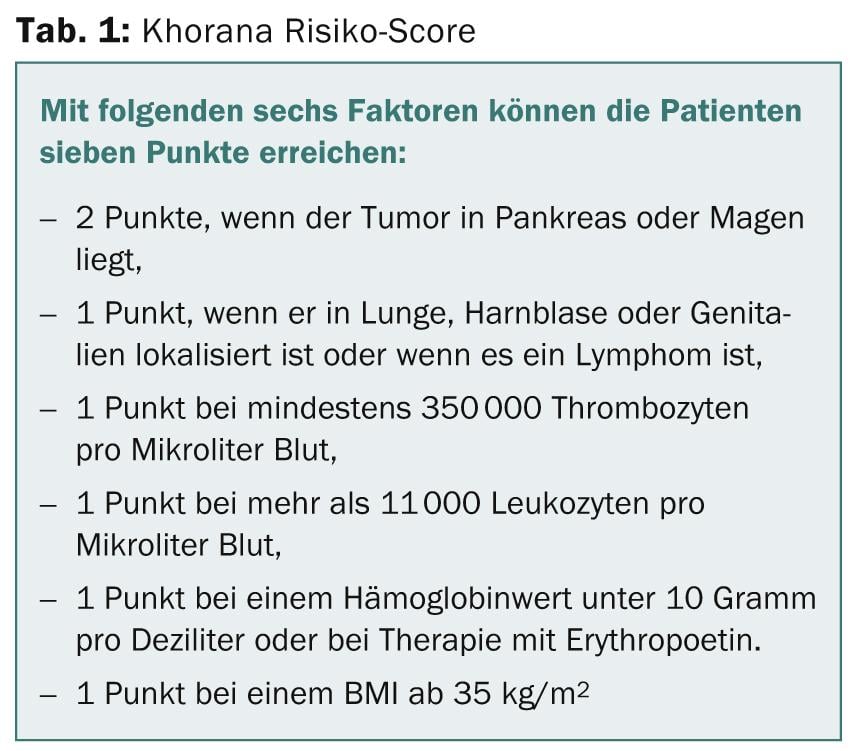
The risk of VTE is not only increased by an underlying pathomechanism. The increased clot activation is possible due to several factors: tumor, tumor therapy, supportive therapy, and nonspecific other factors. In addition, age, comorbidities, infection, gender, ethnicity, obesity, history of VTE, pulmonary and renal disease should be included. It is recommended by professional societies or in their guidelines to classify tumor patients as high-risk patients for VTE. But how can the risk be determined? The Khorana risk score, which Dr. Lehmann presented at the DESO in St. Gallen (Tab. 1), is helpful here. According to Dr. Lehmann, the risk of venous thromboembolism is low only if zero points are reached. One or two points, on the other hand, indicate a medium risk of VTE, and three points or more indicate a high risk.
Prophylaxis?

Drug thromboprophylaxis is established for visceral surgery and gynecologic procedures. Tumor-associated VTE is treated with low-molecular-weight heparin as long-term prophylaxis. Provided the malignancy is active and the risk of bleeding is low, prophylaxis should be continued for up to six months or longer. In contrast, oral anticoagulation does not play a role.

Other events

In 7% of cases, solid tumors lead to disseminated intravascular coagulation (DIC), which is usually characterized by a decrease in the activity of the fibrinolytic system. The driving force is cytokines: IL-6, TNF-α and interleukins of coagulation activation. Consumption of coagulation factors is gradual, rarely fulminant in tumor patients. Thrombocytopenia  is the best known sign of DIC.
If the tumor disease is put into remission, DIC disappears at the same time. Routine anticoagulation and, in individual cases, platelet transfusion or factor substitution may be considered as supportive therapy.
Thrombotic microangiopathy (TAM) has an incidence of  2-8% in the high-dose chemotherapy population. Platelet adhesion to endothelial cells often occurs two to nine months after the end of chemotherapy, followed by thrombocytopenia.

Source: 24th Physician Continuing Education Course in Clinical Oncology, February 20-22, 2014, St. Gallen.

InFo Oncology & Hematology 2014; 2(3): 25-26.
Publikation
  • InFo ONKOLOGIE & HÄMATOLOGIE
Related Topics
  • Khorana Risk Score
  • Pulmonary embolisms
  • St. Gallen
  • Turmor patients
Previous Article
  • Frontal meningioma

Good prognosis after surgical extirpation

  • Cases
  • Neurology
  • Oncology
  • Radiology
  • RX
  • Surgery
View Post
Next Article
  • Hepatocellular carcinoma

What comes after sorafenib?

  • Congress Reports
  • Oncology
  • RX
View Post
You May Also Like
View Post
  • 7 min
  • Vector-borne infections with skin manifestations

Arboviruses and leishmaniasis in Europe

    • Congress Reports
    • Infectiology
    • Prevention and health care
    • RX
    • Studies
    • Tropical and travel medicine
View Post
  • 6 min
  • Multimorbidity and functional capacity in old age

Clarify individual health status and reduce risks

    • Congress Reports
    • General Internal Medicine
    • Geriatrics
    • Neurology
    • Orthopedics
    • Physical medicine and rehabilitation
    • Prevention and health care
    • Rheumatology
    • RX
View Post
  • 6 min
  • Tick season: danger from early summer meningoencephalitis

TBE vaccination recommended for adults and children aged 3 and over

    • Education
    • Infectiology
    • Neurology
    • Prevention and health care
    • RX
    • Studies
View Post
  • 13 min
  • New WHO guideline, updated stimulation protocols, focus on PGT-A

Fertility and reproductive medicine 2026

    • Education
    • Gynecology
    • RX
    • Studies
View Post
  • 12 min
  • Wound treatment

Surgical wound complications

    • CME continuing education
    • Dermatology and venereology
    • Endocrinology and Diabetology
    • Geriatrics
    • Physical medicine and rehabilitation
    • RX
    • Surgery
View Post
  • 8 min
  • Proteins in wound healing

Do special amino acids lead to success?

    • CME continuing education
    • Dermatology and venereology
    • Endocrinology and Diabetology
    • Nutrition
    • RX
    • Studies
View Post
  • 8 min
  • Proteins in wound healing

Do special amino acids lead to success?

    • CME continuing education
    • Dermatology and venereology
    • Endocrinology and Diabetology
    • Nutrition
    • RX
    • Studies
View Post
  • 0 min
  • Psychedelic-assisted therapy

Current status of PAT

    • CME continuing education
    • General Internal Medicine
    • Pharmacology and toxicology
    • Psychiatry and psychotherapy
    • RX
    • Studies
  • IBD matters

    Zum Thema
Top CME content
  • 1
    Do special amino acids lead to success?
  • 2
    Current status of PAT
  • 3
    Surgical wound complications
  • 4
    Do special amino acids lead to success?
  • 5
    Functional limb preservation between infection control, vascular medicine and resurfacing

Newsletter

Sign up and stay up to date

Subscribe
Medizinonline Medizinonline
  • Contact
  • General terms and conditions
  • Imprint

Input your search keywords and press Enter.