Medizinonline Medizinonline
  • News
    • News
    • Market & Medicine
  • Patients
    • Disease patterns
    • Diagnostics
    • Therapy
  • Partner Content
    • Diabetes
      • Dia-Month Club – Type 2 Diabetes
      • Diabetes in Motion
      • Diabetes Podcasts
    • Gastroenterology
      • IBD matters
    • Oncology
      • Swiss Oncology in motion
    • Orthopedics
      • Osteoporosis in motion
  • Departments
    • Allergology and clinical immunology
    • General Internal Medicine
    • Anesthesiology
    • Angiology
    • Surgery
    • Dermatology and venereology
    • Endocrinology and Diabetology
    • Nutrition
    • Gastroenterology and Hepatology
    • Genetics
    • Geriatrics
    • Gynecology
    • Hematology
    • Infectiology
    • Cardiology
    • Nephrology
    • Neurology
    • Emergency and intensive care medicine
    • Nuclear Medicine
    • Oncology
    • Ophthalmology
    • ORL
    • Orthopedics
    • Pediatrics
    • Pharmacology and toxicology
    • Pharmaceutical medicine
    • Phlebology
    • Physical medicine and rehabilitation
    • Pneumology
    • Prevention and health care
    • Psychiatry and psychotherapy
    • Radiology
    • Forensic Medicine
    • Rheumatology
    • Sports Medicine
    • Traumatology and trauma surgery
    • Tropical and travel medicine
    • Urology
    • Dentistry
  • CME & Congresses
    • CME continuing education
    • Congress Reports
    • Congress calendar
  • Practice
    • Noctimed
    • Practice Management
    • Jobs
    • Interviews
  • Log In
  • Register
  • My account
  • Contact
  • Publications
  • Contact
  • Deutsch
  • English
  • Français
  • Italiano
  • Português
  • Español
Subscribe
Medizinonline Medizinonline
  • News
    • News
    • Market & Medicine
  • Patienten
    • Krankheitsbilder
    • Diagnostik
    • Therapie
  • Partner Content
    • Diabetes
      • Dia-Month Club – Type 2 Diabetes
      • Diabetes in Motion
      • Diabetes Podcasts
    • Gastroenterology
      • IBD matters
    • Oncology
      • Swiss Oncology in motion
    • Orthopedics
      • Osteoporosis in motion
    • Phytotherapie
    • Rheumatology
  • Departments
    • Fachbereiche 1-13
      • Allergology and clinical immunology
      • General Internal Medicine
      • Anesthesiology
      • Angiology
      • Surgery
      • Dermatology and venereology
      • Endocrinology and Diabetology
      • Nutrition
      • Gastroenterology and Hepatology
      • Genetics
      • Geriatrics
      • Gynecology
      • Hematology
    • Fachbereiche 14-26
      • Infectiology
      • Cardiology
      • Nephrology
      • Neurology
      • Emergency and intensive care medicine
      • Nuclear Medicine
      • Oncology
      • Ophthalmology
      • ORL
      • Orthopedics
      • Pediatrics
      • Pharmacology and toxicology
      • Pharmaceutical medicine
    • Fachbereiche 26-38
      • Phlebology
      • Physical medicine and rehabilitation
      • Phytotherapy
      • Pneumology
      • Prevention and health care
      • Psychiatry and psychotherapy
      • Radiology
      • Forensic Medicine
      • Rheumatology
      • Sports Medicine
      • Traumatology and trauma surgery
      • Tropical and travel medicine
      • Urology
      • Dentistry
  • CME & Congresses
    • CME continuing education
    • Congress Reports
    • Congress calendar
  • Practice
    • Noctimed
    • Practice Management
    • Jobs
    • Interviews
Login

Sie haben noch keinen Account? Registrieren

  • Severe asthma

A switch can be worthwhile – most of the time

    • Congress Reports
    • General Internal Medicine
    • Pneumology
    • RX
    • Studies
  • 3 minute read

A proportion of patients with severe eosinophilic bronchial asthma show inadequate effects under IL-5 antibody therapy. Switching to an IL-5 receptor antibody may promise success under certain conditions. A recent study investigated who would particularly benefit from a change.

All pulmonologists know the problem: there is a wide range of antibodies in patients with Th2-weighted bronchial asthma and now the task is to choose the right drug for the patient. It is known from studies that about a quarter of patients respond non-significantly to anti-eosinophil therapy despite actually “correct” selection criteria and the presence of eosinophils. This group is grouped together as non-responders. In responders, lung function (at least in some) and quality of life improve markedly with therapy; residual volume may also decrease; all patients have a decrease in eosinophils and a majority have an improvement in ACT.

Switching antibody therapy from omalizumab to mepolizumab may improve asthma control and decrease exacerbations. Considering that anti-IL-5 and anti-IL-5 receptor therapy with an antibody provide different starting points, the consequence is that switching may be a possible therapeutic option: With anti-IL-5 the messenger is intercepted, with anti-IL-5 receptor antibody just the receptor and by cytotoxic T cells the eosinophils are further reduced.

83% have benefited from conversion

PD Dr. Hendrik Suhling, Department of Pneumology, Hannover Medical School (D), presented a multicenter study in which several German centers participated [1]. 665 patients were included who received anti-IL-5 therapy. Of these, 70 patients were identified who were switched due to lack of response; sufficient data were available from 60 of these patients for further evaluation. Fifty participants in this group continued to receive therapy, and 10 had to discontinue it or were switched on or back. The researchers defined a baseline time point prior to antibody (AK) therapy and compared this to a time point of therapy under the first AK or just before switching to the second AK after 4 months. There was a balanced sex ratio, the median age was 54 years, the collective was slightly heavier compared to the normal population, matching 68% of the group had long-term steroid therapy with a mean of 10 mg prednisolone per day.

Therapy was more often mepolizumab than reslizumab, 40% were prior smokers, and over half had chronic rhinosinusitis as a comorbidity. The reasons for the switch were manifold, and in some cases there were multiple triggers (Fig. 1) . In particular, exacerbations were a problem, as was the need for further steroid therapy, poor exercise tolerance, and poor lung function or the assumption that this could still be improved.


Fifty of 60 patients (83%) benefited from the change. Of the 10 patients (17%) who did not continue therapy, 4 had no response to therapy, 2 experienced a decrease in efficacy, and one each experienced weight loss, coronary spasm, there was no effect on nasal polyps, and chronic urticaria developed. Two of these patients were subsequently switched back to the original anti-IL-5 antibody, two to an anti-IL-4R antibody (dupilumab), and the others had their therapy terminated without replacement.

Criteria must be defined

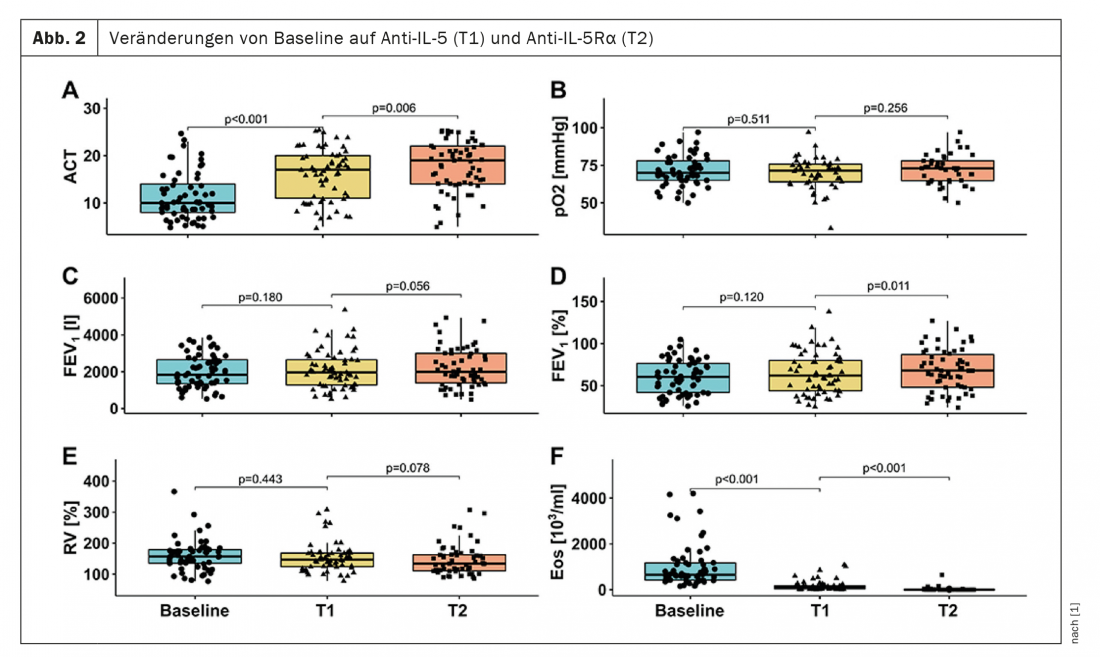
The results of the study already showed a significant improvement in the ACT under the first AK therapy compared to baseline, but this was further improved under the second AK. The eosinophils – possibly also as a reason for this improvement – could also be reduced even further after the change from AK1 to AK2. Lung function tended to improve, but only significantly under the second AK therapy. The residual volume could only be reduced by trend, the pO2 not significantly at all (fig. 2) . The steroid dose decreased again under the second AK therapy.
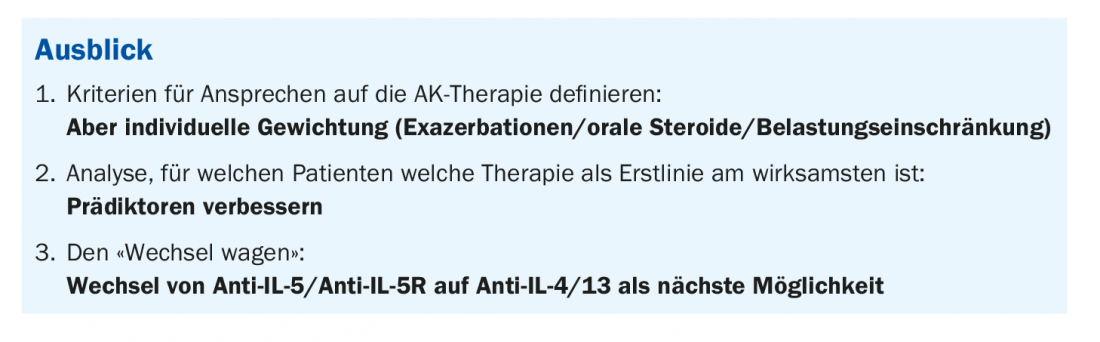


In conclusion, Dr. Suhling found that switching AK therapy increased responder rates, with nearly 90% improvement in patients. The only question that remains open is which patients will benefit from a changeover. So the change may be effective in some, but the question is whether a cut-off in eosinophils really counts. The expert considers the responder criteria to be a sensitive issue; they would have to be defined individually in order to enable therapy optimization in the future, even with objective control (box).

Source: Lecture “Switching antibody therapy in severe eosinophilic bronchial asthma from anti-IL-5 to anti-IL-5 receptor antibodies“ in the session “Free lectures of the section Allergology and Immunology“. 61st Congress of the German Society for Pneumology and Respiratory Medicine e.V., 3.6.2021.

Congress: DGP 2021 digital


Literature:

  1. Drick N, Milger K, Seeliger B, et al: Switch from IL-5 to IL-5 receptor α antibody treatment in Severe Eosinophilic Asthma. J Asthma Allergy 2020; 13: 605-614; doi: 10.2147/JAA.S270298.


InFo PNEUMOLOGY & ALLERGOLOGY 2021; 3(3): 27-28 (published 9/17-21, ahead of print).

Autoren
  • Jens Dehn
Publikation
  • InFo PNEUMOLOGIE & ALLERGOLOGIE
Related Topics
  • Change of therapy
  • eosinophils
  • Exacerbations
  • IL-5 antibody therapy
  • Interleukin-5
  • OCS
  • Severe asthma
Previous Article
  • Osteoporosis in Motion

CME video training on osteoporosis management

  • Partner Content
  • RX
View Post
Next Article
  • Osteopenia

Prevent bone loss – avoid vitamin D deficiency

  • Education
  • General Internal Medicine
  • Geriatrics
  • Nutrition
  • Orthopedics
  • Rheumatology
  • RX
View Post
You May Also Like
View Post
  • 4 min
  • Trichophyton indotineae

Terbinafine-resistant dermatophytoses are on the rise in Central Europe

    • Allergology and clinical immunology
    • Congress Reports
    • Dermatology and venereology
    • Infectiology
    • RX
    • Studies
    • Tropical and travel medicine
View Post
  • 11 min
  • Peristomal skin health

Focus on preventive care options

    • Cases
    • CME continuing education
    • Dermatology and venereology
    • Gastroenterology and Hepatology
    • Infectiology
    • Physical medicine and rehabilitation
    • Prevention and health care
    • RX
    • Surgery
View Post
  • 7 min
  • Disease-modifying therapies for ATTR-CM

TTR stabilizers, gene silencing and gene scissors: where do we stand?

    • Cardiology
    • Congress Reports
    • Genetics
    • RX
    • Studies
View Post
  • 8 min
  • Proteins in wound healing

Do special amino acids lead to success?

    • CME continuing education
    • Dermatology and venereology
    • Endocrinology and Diabetology
    • Nutrition
    • RX
    • Studies
View Post
  • 4 min
  • HER2+ early breast cancer

DESTINY-Breast11 – neoadjuvant T-DXd without anthracyclines

    • Education
    • Gynecology
    • Oncology
    • RX
    • Studies
View Post
  • 3 min
  • Lavender aromatherapy

Take away the fear of the dentist

    • Dentistry
    • Education
    • Pharmaceutical medicine
    • Phytotherapy
    • Psychiatry and psychotherapy
    • RX
    • Studies
View Post
  • 4 min
  • Digital dermatology: innovative project examples

AI and eHealth tools in HS care

    • Dermatology and venereology
    • General Internal Medicine
    • Practice Management
    • Prevention and health care
    • RX
    • Studies
View Post
  • 5 min
  • Mantle cell lymphoma

Recurrence after BTK inhibition – prognostic factors and treatment options

    • Education
    • Hematology
    • Oncology
    • RX
  • IBD matters

    Zum Thema
Top CME content
  • 1
    Communication as the key to therapy adherence
  • 2
    Solutions to the malnutrition dilemma
  • 3
    Solutions to the malnutrition dilemma
  • 4
    Focus on preventive care options
  • 5
    Fertility preservation from gonads to genomes to genoids

Newsletter

Sign up and stay up to date

Subscribe
Medizinonline Medizinonline
  • Contact
  • General terms and conditions
  • Imprint

Input your search keywords and press Enter.