Medizinonline Medizinonline
  • News
    • News
    • Market & Medicine
  • Patients
    • Disease patterns
    • Diagnostics
    • Therapy
  • Partner Content
    • Diabetes
      • Dia-Month Club – Type 2 Diabetes
      • Diabetes in Motion
      • Diabetes Podcasts
    • Gastroenterology
      • IBD matters
    • Oncology
      • Swiss Oncology in motion
    • Orthopedics
      • Osteoporosis in motion
  • Departments
    • Allergology and clinical immunology
    • General Internal Medicine
    • Anesthesiology
    • Angiology
    • Surgery
    • Dermatology and venereology
    • Endocrinology and Diabetology
    • Nutrition
    • Gastroenterology and Hepatology
    • Genetics
    • Geriatrics
    • Gynecology
    • Hematology
    • Infectiology
    • Cardiology
    • Nephrology
    • Neurology
    • Emergency and intensive care medicine
    • Nuclear Medicine
    • Oncology
    • Ophthalmology
    • ORL
    • Orthopedics
    • Pediatrics
    • Pharmacology and toxicology
    • Pharmaceutical medicine
    • Phlebology
    • Physical medicine and rehabilitation
    • Pneumology
    • Prevention and health care
    • Psychiatry and psychotherapy
    • Radiology
    • Forensic Medicine
    • Rheumatology
    • Sports Medicine
    • Traumatology and trauma surgery
    • Tropical and travel medicine
    • Urology
    • Dentistry
  • CME & Congresses
    • CME continuing education
    • Congress Reports
    • Congress calendar
  • Practice
    • Noctimed
    • Practice Management
    • Jobs
    • Interviews
  • Log In
  • Register
  • My account
  • Contact
  • Publications
  • Contact
  • Deutsch
  • English
  • Français
  • Italiano
  • Português
  • Español
Subscribe
Medizinonline Medizinonline
  • News
    • News
    • Market & Medicine
  • Patienten
    • Krankheitsbilder
    • Diagnostik
    • Therapie
  • Partner Content
    • Diabetes
      • Dia-Month Club – Type 2 Diabetes
      • Diabetes in Motion
      • Diabetes Podcasts
    • Gastroenterology
      • IBD matters
    • Oncology
      • Swiss Oncology in motion
    • Orthopedics
      • Osteoporosis in motion
    • Phytotherapie
    • Rheumatology
  • Departments
    • Fachbereiche 1-13
      • Allergology and clinical immunology
      • General Internal Medicine
      • Anesthesiology
      • Angiology
      • Surgery
      • Dermatology and venereology
      • Endocrinology and Diabetology
      • Nutrition
      • Gastroenterology and Hepatology
      • Genetics
      • Geriatrics
      • Gynecology
      • Hematology
    • Fachbereiche 14-26
      • Infectiology
      • Cardiology
      • Nephrology
      • Neurology
      • Emergency and intensive care medicine
      • Nuclear Medicine
      • Oncology
      • Ophthalmology
      • ORL
      • Orthopedics
      • Pediatrics
      • Pharmacology and toxicology
      • Pharmaceutical medicine
    • Fachbereiche 26-38
      • Phlebology
      • Physical medicine and rehabilitation
      • Phytotherapy
      • Pneumology
      • Prevention and health care
      • Psychiatry and psychotherapy
      • Radiology
      • Forensic Medicine
      • Rheumatology
      • Sports Medicine
      • Traumatology and trauma surgery
      • Tropical and travel medicine
      • Urology
      • Dentistry
  • CME & Congresses
    • CME continuing education
    • Congress Reports
    • Congress calendar
  • Practice
    • Noctimed
    • Practice Management
    • Jobs
    • Interviews
Login

Sie haben noch keinen Account? Registrieren

  • Modern treatment of type 2 diabetes

Combine metformin with new substance classes at an early stage

    • Congress Reports
    • Endocrinology and Diabetology
    • General Internal Medicine
    • Partner Content
    • RX
    • Studies
  • 4 minute read

Lifestyle modification alone is usually not sufficient in type 2 diabetes. Metformin is still considered the first-line drug. However, SGED and international professional societies recommend early combination with an SGLT-2 inhibitor and/or a GLP-1 receptor agonist. These two new classes of compounds have repeatedly demonstrated additional cardiovascular and nephroprotective benefits.

Around 90% of all adult diabetics are affected by type 2 diabetes, i.e. insufficient action of insulin on the body’s cells (insulin resistance). A key message of current therapy studies is that multimodal individually adapted treatment is most promising in type 2 diabetes. The effectiveness of the therapy should be optimal and the burdens as low as possible. HbA1c is currently still considered the standard glycemic target for long-term therapy management. It is important to strive for optimal blood glucose control in patients with newly diagnosed diabetes, according to Prof. Dr. Michael Brändle, Head of the Department of General Internal Medicine/House Medicine at the Cantonal Hospital of St. Gallen [1]. Specifically, this means HbA1c<7% and avoidance of hypoglycemia. However, in modern diabetes therapy, in addition to glycemic control, an additional reduction of micro- and macrovascular complications is aimed for, which is why new substance classes with a corresponding efficacy profile have received a higher priority. And for good reason. “Diabetes mellitus is a relevant cardiovascular risk factor,” emphasizes Prof. Brändle [1].


Multimodal therapy involving  SGLT-2-i and/or GLP-1-RA.

Lifestyle changes (diet, physical activity, patient education) are an important component of modern type 2 diabetes therapy, but as stand-alone measures often do not achieve the goal. The pharmacotherapeutic approach recommended by current guidelines prioritizes metformin, SGLT-2 inhibitors, and GLP-1 analogues. In clinical practice, the question now arises: How to proceed in selecting the appropriate drug therapy? Metformin is still considered the first choice, although it is now believed that early combination with an SGLT-2 inhibitor and/or a GLP-1 receptor agonist helps to lower glycemic load and reduce microvascular and macrovascular sequelae. Metformin (Glucophage® and generics) [2] reduces blood glucose levels in a dose-dependent manner after oral administration in diabetics as a result of inhibition of glycogenolysis and gluconeogenesis in the liver and leads to improved glucose utilization in peripheral tissues. Although metformin did not show a significant reduction in cardiovascular events in a recently published meta-analysis, it remains the preferred first-line drug because all modern studies of cardiovascular outcomes are based on therapy with metformin [3,4]. According to SGED recommendations, metformin can be used at reduced doses up to an estimated glomerular filtration rate (eGFR) of 30 ml/min. However, it should not be re-prescribed at an eGFR <45 ml/min, and existing doses should be halved [6].


The new substance classes protect the heart and kidney

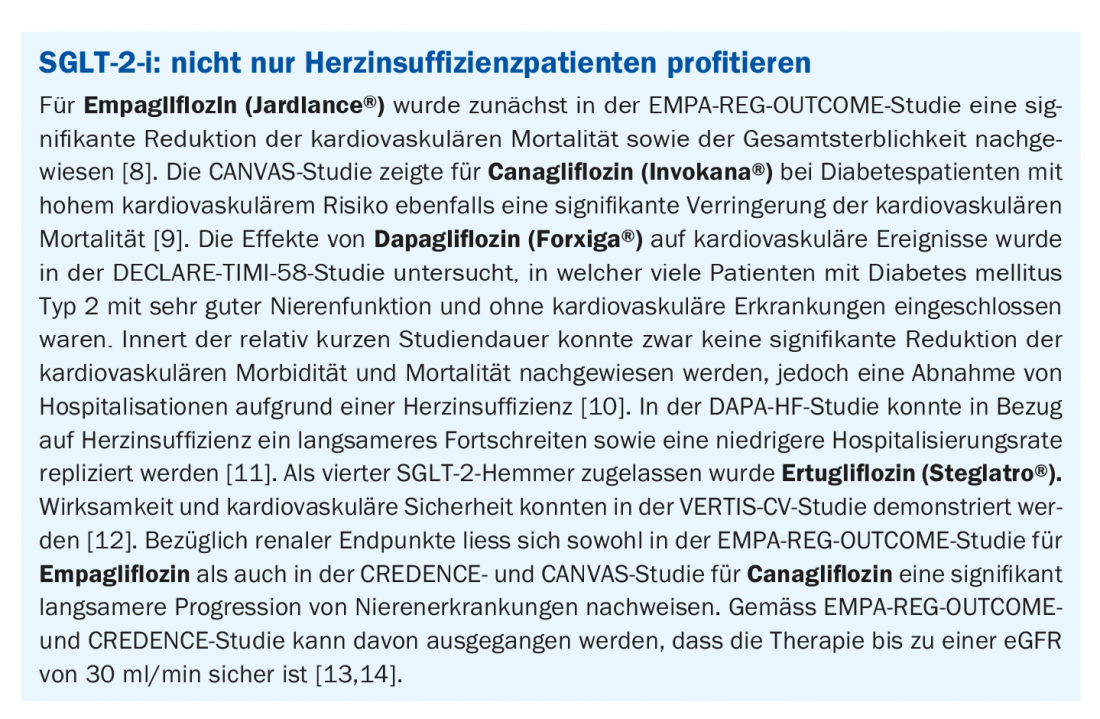
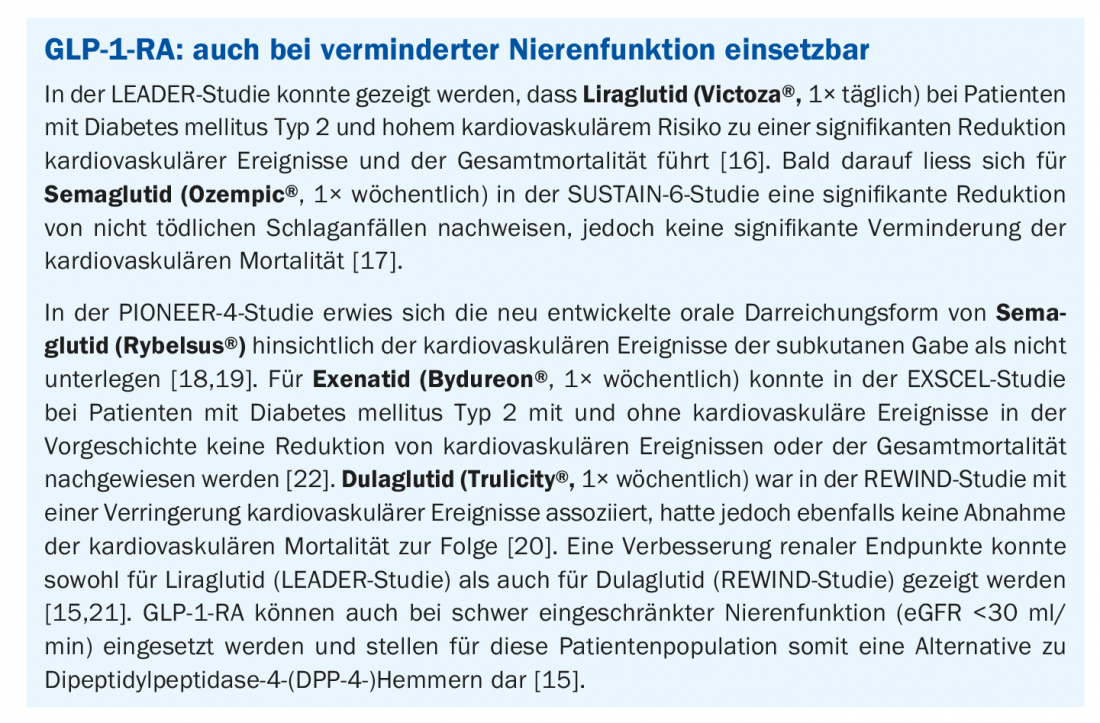
Studies show that the use of SGLT-2 inhibitors and/or GLP-1 receptor agonists can significantly reduce cardiovascular events (box) . In particular, SGLT-2 inhibitors should be started early in chronic heart failure or renal insufficiency. “The SGLT-2 inhibitors reduce albuminuria, stabilize eGFR, and reduce progression of renal failure,” Prof. Brändle explains.

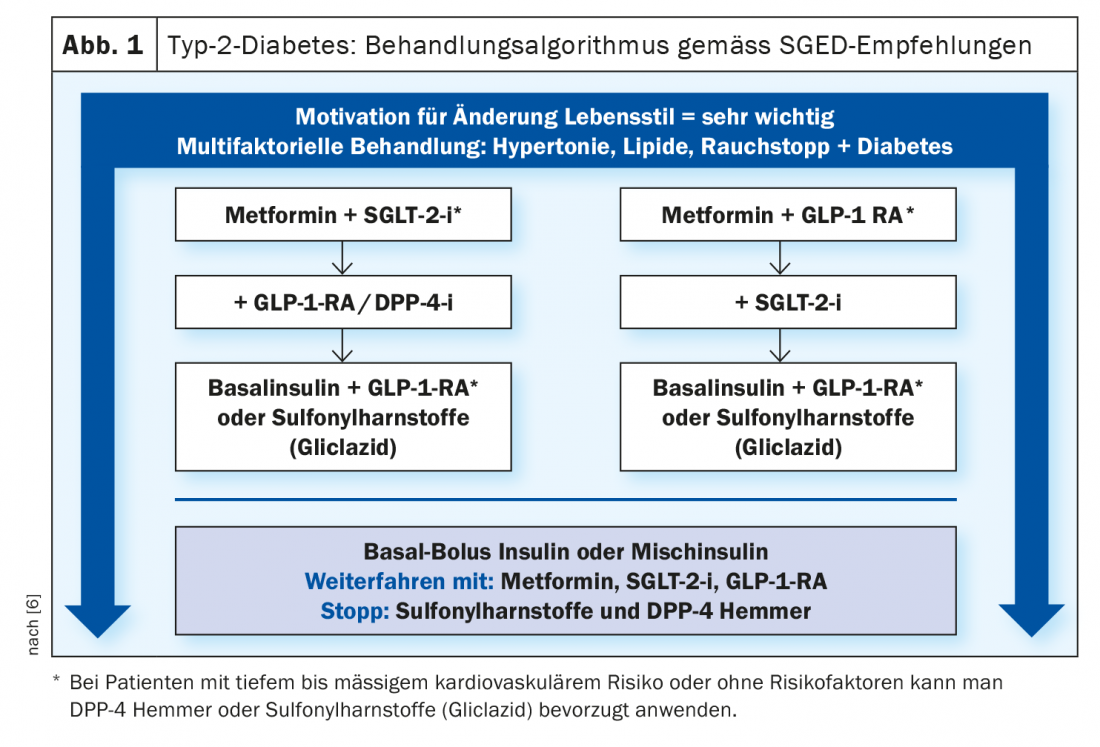
Even patients without diabetes with cardiac and/or renal insufficiency benefit from the cardio- and nephroprotective effects of this substance class. If metformin is contraindicated or intolerable, the use of an SGLT-2 inhibitor or GLP-1 analogue can be considered at the outset, especially in cases of increased cardiovascular risk (Fig. 1) . Possible alternatives are DPP-4 inhibitors or sulfonylureas (gliclazide retard) [5]. GLP-1-RA, like the endogenous incretin GLP-1, bind to GLP-1 receptors and lead to increased insulin secretion and inhibition of glucagon release. In addition, they inhibit appetite and are therefore particularly suitable for overweight diabetic patients.


Which patients need insulin treatment?

In addition to cardiovascular disease and renal insufficiency/ nephropathy, the presence of insulin deficiency is the third important criterion for the indication of therapy according to SGED recommendations. Insulin treatment should be considered from an HbA1c of 8.5-9% [5]. That glycemic control (HbA1c 7-7.5%) is still of long-term relevance in both newly diagnosed and long-term diabetic patients with complications is shown, among others, by an analysis of Swedish registry data. In it, cardiovascular mortality was calculated as a function of glycemic control (HbA1c) and age. There was a positive correlation between the level of HbA1c values  (<6.9% to >9.7%) and cardiovascular risk in the age groups studied (<55- to >75-year-olds). This was highest for the group of diabetes patients younger than 55 years [7].

Congress: FomF Family Doctor Training Days


Literature:

  1. Brändle M: Diabetes mellitus type 2 – challenges in daily practice, Hausarzt Fortbildungstage St. Gallen, 11.03.2021
  2. Drug Information, www.swissmedicinfo.ch, (last accessed 07/19/2021).
  3. Griffin SJ, Leaver JK, Irving G: Diabetologia 2017; 60(9): 1620-1629.
  4. Schneider L, Lehmann R: Swiss Med Forum 2021; 21(1516): 251-256.
  5. Kohler S, Beise U, Huber F: Diabetes mellitus, MediX, Last modified 02/2021 Diabetes mellitus, www.medix.ch (last accessed 07/19/2021).
  6. Lehmann R, et al: Swiss Society of Endocrinology and Diabetology (SGED/SSED) Recommendations for the Treatment of Type 2 Diabetes Mellitus 2020, www.sgedssed.ch (last accessed 07/19/2021).
  7. Tancredi M, et al. NEJM 2015; 373: 1720-1732.
  8. Zinman B, et al: NEJM 2015; 373(22): 2117-2128.
  9. Neal B, et al: NEJM 2017; 377(7): 644-657.
  10. Wiviott SD, et al: NEJM 2019; 380(4): 347-357.
  11. McMurray JJV, et al: NEJM 2019; 381(21): 1995-2008.
  12. Cannon CP, et al: NEJM 2020; 383(15): 1425-1435.
  13. Wanner C, et al: NEJM 2016; 375(4): 323-334.
  14. Perkovic V, et al: NEJM 2019; 380(24): 2295-2306.
  15. Mann JFE, et al: NEJM 2017; 377(9): 839-848.
  16. Marso SP, et al: NEJM 2016; 375(4): 311-322.
  17. Marso SP, et al: NEJM 2016; 375(19): 1834-1844.
  18. Husain M, et al: NEJM 2019; 381(9): 841-851.
  19. Pratley R, et al: Lancet 2019; 394(10192): 39-50.
  20. Gerstein HC, et al: Lancet 2019; 394(10193): 121-130.
  21. Gerstein HC, et al: Lancet 2019; 394(10193): 131-138.
  22. Holman RR, al: NEJM 2017; 377(13): 1228-1239.


HAUSARZT PRAXIS 2021; 16(8): 34-35 (published 8/18-21, ahead of print).

Autoren
  • Mirjam Peter, M.Sc.
Publikation
  • HAUSARZT PRAXIS
Related Topics
  • Diabetes
  • Metformin
  • Type 2 diabetes
Previous Article
  • Axial spondyloarthritis

The road to diagnosis is still far too long

  • Congress Reports
  • General Internal Medicine
  • Orthopedics
  • Rheumatology
  • RX
  • Studies
View Post
Next Article
  • COPD

Treating patients with chronic lung disease optimally

  • Pneumology
  • RX
View Post
You May Also Like
View Post
  • 4 min
  • From symptom to diagnosis

Multilocular cystic renal cell carcinoma (MCRCC)

    • RX
    • Cases
    • Education
    • Nephrology
    • Oncology
    • Radiology
    • Studies
    • Surgery
View Post
  • 3 min
  • Shaping the Future with LLM & Co.

AI in Everyday Clinical Practice: Friend or Foe?

    • RX
    • General Internal Medicine
    • Practice Management
    • Prevention and health care
View Post
  • 5 min
  • Ulcerative colitis: current evidence on anti-inflammatory therapies

Remission induction and maintenance with biologics and JAK-i

    • RX
    • Congress Reports
    • Gastroenterology and Hepatology
    • General Internal Medicine
    • Studies
View Post
  • 4 min
  • Bronchiectasis

New strategies against neutrophilic inflammation

    • RX
    • Congress Reports
    • General Internal Medicine
    • Infectiology
    • Pneumology
    • Studies
View Post
  • 3 min
  • IBD in childhood

Pneumococcal vaccination without negative consequences

    • RX
    • Education
    • Gastroenterology and Hepatology
    • General Internal Medicine
    • Infectiology
    • Pediatrics
    • Prevention and health care
View Post
  • 7 min
  • Plastic surgery and reconstructive microsurgery for DFS

Functional limb preservation between infection control, vascular medicine and resurfacing

    • RX
    • Angiology
    • CME continuing education
    • Dermatology and venereology
    • Endocrinology and Diabetology
    • General Internal Medicine
    • Geriatrics
    • Physical medicine and rehabilitation
    • Surgery
View Post
  • 14 min
  • Seborrheic Dermatitis in Adults and Adolescents

Current State of Knowledge and New Therapeutic Approaches

    • RX
    • CME continuing education
    • Dermatology and venereology
    • Studies
View Post
  • 7 min
  • Orthobiologics for knee osteoarthritis

PRP and hyaluronic acid injections as building blocks in a multimodal concept

    • RX
    • Congress Reports
    • General Internal Medicine
    • Orthopedics
    • Rheumatology
    • Sports Medicine
    • Studies
    • Surgery
  • IBD matters

    Zum Thema
Top CME content
  • 1
    Current State of Knowledge and New Therapeutic Approaches
  • 2
    Why is it so hard to lose weight?
  • 3
    Functional limb preservation between infection control, vascular medicine and resurfacing
  • 4
    Algorithms, avatars and the unburdened mind
  • 5
    Communication as the key to therapy adherence

Newsletter

Sign up and stay up to date

Subscribe
Medizinonline Medizinonline
  • Contact
  • General terms and conditions
  • Imprint

Input your search keywords and press Enter.