Medizinonline Medizinonline
  • News
    • News
    • Market & Medicine
  • Patients
    • Disease patterns
    • Diagnostics
    • Therapy
  • Partner Content
    • Diabetes
      • Dia-Month Club – Type 2 Diabetes
      • Diabetes in Motion
      • Diabetes Podcasts
    • Gastroenterology
      • IBD matters
    • Oncology
      • Swiss Oncology in motion
    • Orthopedics
      • Osteoporosis in motion
  • Departments
    • Allergology and clinical immunology
    • General Internal Medicine
    • Anesthesiology
    • Angiology
    • Surgery
    • Dermatology and venereology
    • Endocrinology and Diabetology
    • Nutrition
    • Gastroenterology and Hepatology
    • Genetics
    • Geriatrics
    • Gynecology
    • Hematology
    • Infectiology
    • Cardiology
    • Nephrology
    • Neurology
    • Emergency and intensive care medicine
    • Nuclear Medicine
    • Oncology
    • Ophthalmology
    • ORL
    • Orthopedics
    • Pediatrics
    • Pharmacology and toxicology
    • Pharmaceutical medicine
    • Phlebology
    • Physical medicine and rehabilitation
    • Pneumology
    • Prevention and health care
    • Psychiatry and psychotherapy
    • Radiology
    • Forensic Medicine
    • Rheumatology
    • Sports Medicine
    • Traumatology and trauma surgery
    • Tropical and travel medicine
    • Urology
    • Dentistry
  • CME & Congresses
    • CME continuing education
    • Congress Reports
    • Congress calendar
  • Practice
    • Noctimed
    • Practice Management
    • Jobs
    • Interviews
  • Log In
  • Register
  • My account
  • Contact
  • Publications
  • Contact
  • Deutsch
  • English
  • Français
  • Italiano
  • Português
  • Español
Subscribe
Medizinonline Medizinonline
  • News
    • News
    • Market & Medicine
  • Patienten
    • Krankheitsbilder
    • Diagnostik
    • Therapie
  • Partner Content
    • Diabetes
      • Dia-Month Club – Type 2 Diabetes
      • Diabetes in Motion
      • Diabetes Podcasts
    • Gastroenterology
      • IBD matters
    • Oncology
      • Swiss Oncology in motion
    • Orthopedics
      • Osteoporosis in motion
    • Phytotherapie
    • Rheumatology
  • Departments
    • Fachbereiche 1-13
      • Allergology and clinical immunology
      • General Internal Medicine
      • Anesthesiology
      • Angiology
      • Surgery
      • Dermatology and venereology
      • Endocrinology and Diabetology
      • Nutrition
      • Gastroenterology and Hepatology
      • Genetics
      • Geriatrics
      • Gynecology
      • Hematology
    • Fachbereiche 14-26
      • Infectiology
      • Cardiology
      • Nephrology
      • Neurology
      • Emergency and intensive care medicine
      • Nuclear Medicine
      • Oncology
      • Ophthalmology
      • ORL
      • Orthopedics
      • Pediatrics
      • Pharmacology and toxicology
      • Pharmaceutical medicine
    • Fachbereiche 26-38
      • Phlebology
      • Physical medicine and rehabilitation
      • Phytotherapy
      • Pneumology
      • Prevention and health care
      • Psychiatry and psychotherapy
      • Radiology
      • Forensic Medicine
      • Rheumatology
      • Sports Medicine
      • Traumatology and trauma surgery
      • Tropical and travel medicine
      • Urology
      • Dentistry
  • CME & Congresses
    • CME continuing education
    • Congress Reports
    • Congress calendar
  • Practice
    • Noctimed
    • Practice Management
    • Jobs
    • Interviews
Login

Sie haben noch keinen Account? Registrieren

  • Guideline Diabetes and Road Traffic

Diabetics are allowed to drive – but exceptions prove the rule

    • Education
    • Endocrinology and Diabetology
    • News
    • RX
  • 2 minute read

For a long time, it was not clearly established whether diabetics are generally suitable for driving a vehicle or not. With the adoption of the S2e guideline “Diabetes and Road Traffic”, legal certainty was created for physicians for the first time.

Participation in road traffic in Switzerland is regulated by the Road Traffic Act. This states that motor vehicle drivers must be fit and competent to drive. As the guideline states, fitness to drive is understood to mean the ability to drive a motor vehicle in road traffic that is largely stable over time and independent of current situation and state of mind parameters. Physical and psychological characteristics can have a detrimental effect here. There has long been debate about whether patients with diabetes are fit to drive. Particularly with regard to professional drivers, it has often been argued that insulin-dependent patients should be denied a driver’s license.


The guideline has put the assessment of fitness to drive in diabetes on a medical-scientific footing. For example, the results of a 2016 meta-analysis show that the risk of accidents is increased by only about 11% for people with diabetes – much lower than the risk for people with sleep apnea syndrome (140%) or attention-deficit/hyperactivity disorder (340%). Analyses suggest that the disease per se is not associated with an increased risk of accidents. Accordingly, almost all diabetes patients can participate in road traffic, both in private cars and professionally. However, high-risk groups have been identified within the disease where the risk assessment is significantly worse.

High long-term blood sugar is not a reason for driving ban

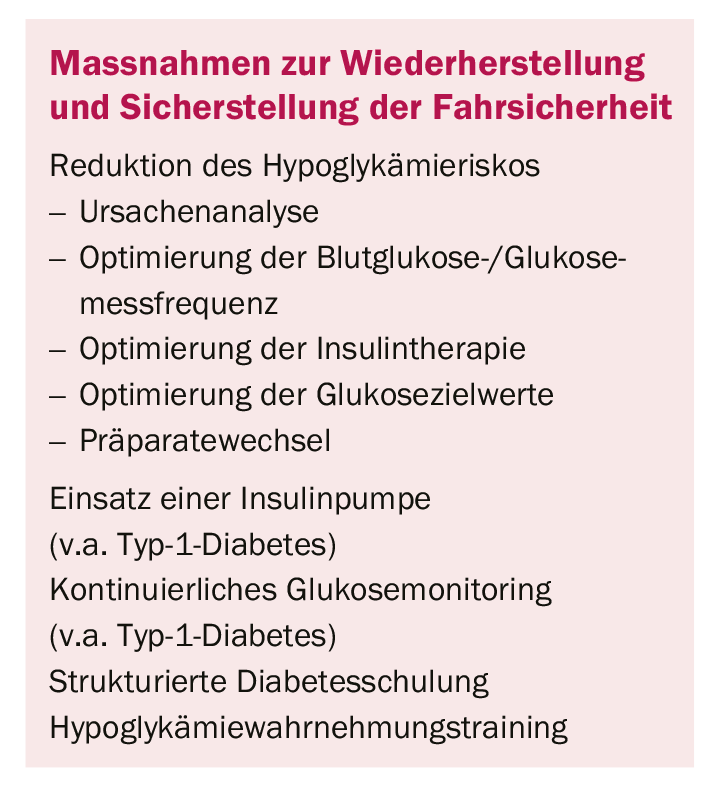
While a high HbA1c level or insulin therapy are not grounds for banning driving, caution should be exercised with two or more episodes of severe hypoglycemia while awake within a year or untreated sleep apnea. Comorbidities should also be kept in mind. Temporary incapacity to drive occurs, for example, in the case of severe metabolic derailments or during the phase of adjustment to insulin or dose adjustments. In this case, it is necessary to wait until the blood glucose metabolism is stable again.
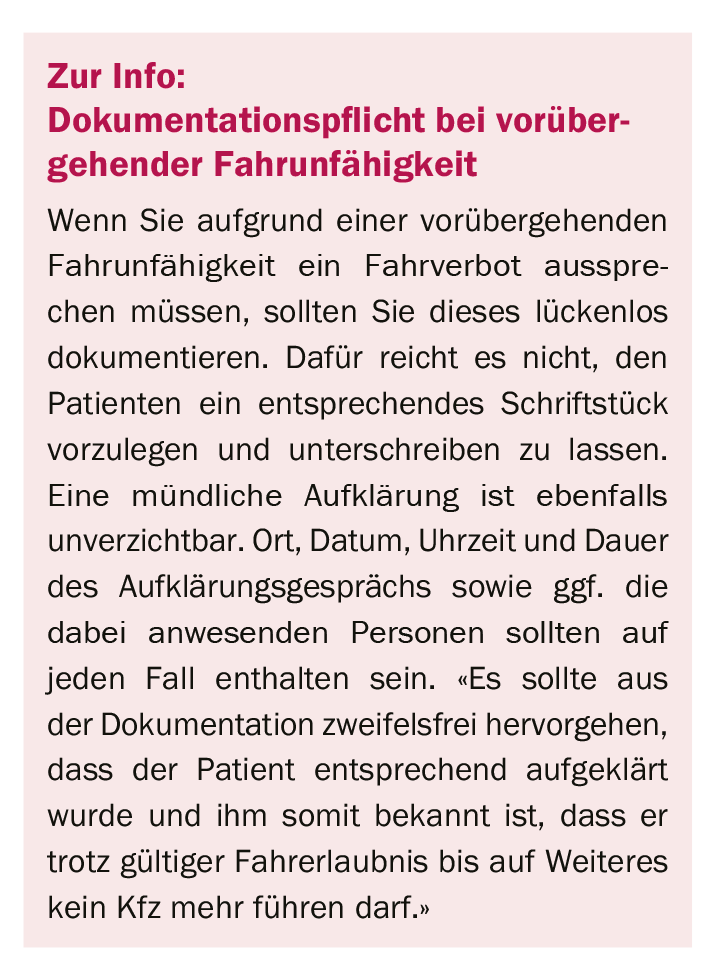


The top priority should, of course, be to avoid hypoglycemia. Accordingly, the patient is advised to perform a blood glucose self-monitoring before starting a journey. In addition, fast-acting carbohydrates such as glucose or similar should always be available in the vehicle so that the blood glucose can be raised in a targeted manner if necessary.

According to an initial assessment, the guideline has provided (legal) certainty for patients, physicians and even experts. Structuring through clear criteria based on scientific findings leaves less room for interpretation and provides comprehensible recommendations for action.


CARDIOVASC 2019; 18(3): 34

Autoren
  • Leoni Burggraf
Publikation
  • CARDIOVASC
Related Topics
  • Diabetes Guideline
  • Driving license
  • Fitness of diabetics to drive
  • Road traffic
Previous Article
  • RMS and PPMS

Early therapy with ocrelizumab slows the disease

  • Market & Medicine
  • Neurology
  • Rheumatology
  • RX
  • Studies
View Post
Next Article
  • Interview with Dunja Kern

Look Good…Feel Better: What Appearance Has to Do with Convalescence

  • Interviews
  • Oncology
  • Physical medicine and rehabilitation
  • Prevention and health care
  • RX
View Post
You May Also Like
View Post
  • 6 min
  • Secondary prevention after ACS: individually optimized lipid management

Trend towards early combination therapy and new strategies for lowering Lp(a)

    • RX
    • Cardiology
    • Congress Reports
    • General Internal Medicine
    • Studies
View Post
  • 27 min
  • Pediatric Brain Tumors

Psychiatry versus Neuro-Oncology: Diagnostic Pitfalls

    • RX
    • CME continuing education
    • Neurology
    • Oncology
    • Pediatrics
    • Psychiatry and psychotherapy
    • Studies
View Post
  • 13 min
  • What the latest studies on the entire EF spectrum mean for clinical practice

Heart Failure – The 2026 Evidence Update

    • RX
    • Cardiology
    • Education
    • Endocrinology and Diabetology
    • Studies
View Post
  • 5 min
  • Acute ischemic stroke

Alteplase and Tenecteplase Are on the Same Level

    • RX
    • Education
    • Emergency and intensive care medicine
    • Neurology
    • Pharmacology and toxicology
    • Studies
View Post
  • 5 min
  • CKD in People with Type 2 Diabetes: Evidence-Based, Optimized Treatment

SGLT-2 inhibitors and GLP-1 receptor agonists: significant improvement in renal outcomes

    • RX
    • Education
    • Endocrinology and Diabetology
    • General Internal Medicine
    • Nephrology
    • Studies
View Post
  • 2 min
  • Wearables: screening via smartwatch?

New study on atrial fibrillation in high-risk patients

    • RX
    • Cardiology
    • Practice Management
    • Prevention and health care
    • Studies
View Post
  • 13 min
  • Planning a Family, Pregnancy, and Breastfeeding

Update on Anti-Rheumatic Medications

    • RX
    • CME continuing education
    • General Internal Medicine
    • Gynecology
    • Pharmacology and toxicology
    • Rheumatology
    • Studies
View Post
  • 11 min
  • Peristomal skin health

Focus on preventive care options

    • RX
    • Cases
    • CME continuing education
    • Dermatology and venereology
    • Gastroenterology and Hepatology
    • Infectiology
    • Physical medicine and rehabilitation
    • Prevention and health care
    • Surgery
Landingpage Fachinfo Landingpage Button
  • IBD matters

    Zum Thema
Top CME content
  • 1
    Update on Anti-Rheumatic Medications
  • 2
    Psychiatry versus Neuro-Oncology: Diagnostic Pitfalls
  • 3
    Focus on preventive care options
  • 4
    Inflammation as a Treatment Goal in Its Own Right
  • 5
    Personalized Treatment Before a Planned Pregnancy

Newsletter

Sign up and stay up to date

Subscribe
Medizinonline Medizinonline
  • Contact
  • General terms and conditions
  • Imprint

Input your search keywords and press Enter.