Medizinonline Medizinonline
  • News
    • News
    • Market & Medicine
  • Patients
    • Disease patterns
    • Diagnostics
    • Therapy
  • Partner Content
    • Diabetes
      • Dia-Month Club – Type 2 Diabetes
      • Diabetes in Motion
      • Diabetes Podcasts
    • Gastroenterology
      • IBD matters
    • Oncology
      • Swiss Oncology in motion
    • Orthopedics
      • Osteoporosis in motion
  • Departments
    • Allergology and clinical immunology
    • General Internal Medicine
    • Anesthesiology
    • Angiology
    • Surgery
    • Dermatology and venereology
    • Endocrinology and Diabetology
    • Nutrition
    • Gastroenterology and Hepatology
    • Genetics
    • Geriatrics
    • Gynecology
    • Hematology
    • Infectiology
    • Cardiology
    • Nephrology
    • Neurology
    • Emergency and intensive care medicine
    • Nuclear Medicine
    • Oncology
    • Ophthalmology
    • ORL
    • Orthopedics
    • Pediatrics
    • Pharmacology and toxicology
    • Pharmaceutical medicine
    • Phlebology
    • Physical medicine and rehabilitation
    • Pneumology
    • Prevention and health care
    • Psychiatry and psychotherapy
    • Radiology
    • Forensic Medicine
    • Rheumatology
    • Sports Medicine
    • Traumatology and trauma surgery
    • Tropical and travel medicine
    • Urology
    • Dentistry
  • CME & Congresses
    • CME continuing education
    • Congress Reports
    • Congress calendar
  • Practice
    • Noctimed
    • Practice Management
    • Jobs
    • Interviews
  • Log In
  • Register
  • My account
  • Contact
  • Publications
  • Contact
  • Deutsch
  • English
  • Français
  • Italiano
  • Português
  • Español
Subscribe
Medizinonline Medizinonline
  • News
    • News
    • Market & Medicine
  • Patienten
    • Krankheitsbilder
    • Diagnostik
    • Therapie
  • Partner Content
    • Diabetes
      • Dia-Month Club – Type 2 Diabetes
      • Diabetes in Motion
      • Diabetes Podcasts
    • Gastroenterology
      • IBD matters
    • Oncology
      • Swiss Oncology in motion
    • Orthopedics
      • Osteoporosis in motion
    • Phytotherapie
    • Rheumatology
  • Departments
    • Fachbereiche 1-13
      • Allergology and clinical immunology
      • General Internal Medicine
      • Anesthesiology
      • Angiology
      • Surgery
      • Dermatology and venereology
      • Endocrinology and Diabetology
      • Nutrition
      • Gastroenterology and Hepatology
      • Genetics
      • Geriatrics
      • Gynecology
      • Hematology
    • Fachbereiche 14-26
      • Infectiology
      • Cardiology
      • Nephrology
      • Neurology
      • Emergency and intensive care medicine
      • Nuclear Medicine
      • Oncology
      • Ophthalmology
      • ORL
      • Orthopedics
      • Pediatrics
      • Pharmacology and toxicology
      • Pharmaceutical medicine
    • Fachbereiche 26-38
      • Phlebology
      • Physical medicine and rehabilitation
      • Phytotherapy
      • Pneumology
      • Prevention and health care
      • Psychiatry and psychotherapy
      • Radiology
      • Forensic Medicine
      • Rheumatology
      • Sports Medicine
      • Traumatology and trauma surgery
      • Tropical and travel medicine
      • Urology
      • Dentistry
  • CME & Congresses
    • CME continuing education
    • Congress Reports
    • Congress calendar
  • Practice
    • Noctimed
    • Practice Management
    • Jobs
    • Interviews
Login

Sie haben noch keinen Account? Registrieren

  • Influenza virus A and B

Do not miss flu vaccination

    • Education
    • General Internal Medicine
    • Infectiology
    • Prevention and health care
    • RX
    • Studies
  • 2 minute read

During the current COVID-19 pandemic, inpatient health care services could be severely strained as the number of cases increases. Flu vaccination can help reduce the burden of illness in winter and protect at-risk individuals. Vaccination is recommended for chronically ill patients with an increased risk of complications and their regular contacts, as well as for all health professionals.

In Switzerland, 100,000 to more than 300,000 people consult a doctor every winter because of an influenza-like illness. Vaccination remains the simplest, most effective and most economical preventive measure to protect oneself and one’s environment from influenza and its complications. More vaccine doses will be available in 2020 than in previous years to meet the expected increased demand. However, some of the cans will not arrive in Switzerland until the end of the year. Therefore, the recommended period for vaccination is from mid-October and until the beginning of the flu season. In most winters, the flu epidemic begins in January.


Who should get vaccinated?

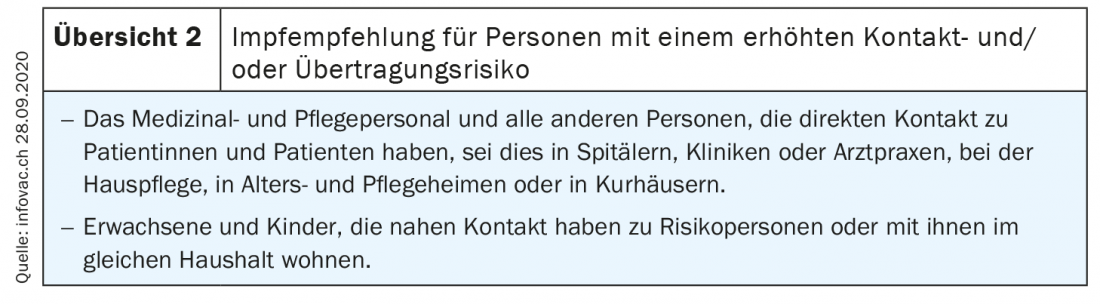
Vaccination is recommended for individuals at increased risk of complications. This includes all persons over 65 years of age and persons 6 months of age or older with certain chronic diseases (overview 1). In addition, pregnant women from the 2nd trimester of pregnancy and women who have given birth in the last 4 weeks should be vaccinated. This also applies to premature babies (born before 33 weeks or with a birth weight below 1500 g) from the age of 6 months for the first two winters after birth. A vaccination recommendation is also available for patients in nursing homes and in institutions for persons with chronic diseases. Health care workers and others who have close contact with at-risk individuals or live in the same household with them should also consider influenza vaccination (overview 2).


Safety is rated as high

Since 1945, several billion doses of vaccine have been administered worldwide. All influenza vaccines currently used in Switzerland are inactivated. Thus, they do not contain infectious viruses that can cause influenza, but only the antigens of three influenza virus strains currently in circulation (one strain each of the A/H1N1, A/H3N2, and influenza B viruses).

The most common side effect is a mild local reaction at the injection site. It occurs in 10-40% of vaccinated individuals and resolves after a few hours or a maximum of two days. General mild symptoms such as fever, nausea, muscle aches, joint pain, headache, and other flu symptoms occur in 5-10% of vaccinated individuals. Severe allergic reactions such as angioedema, asthma, or anaphylaxis are very rare (<1 in 10,000 vaccinated individuals). They can generally be explained by hypersensitivity to the proteins of the chicken egg. Adverse neurological phenomena, such as Guillain-Barré syndrome, are also very rare.

Source: Infovac.ch: “Flu (Influenza)”, as of Information: 09/28/2020, www.infovac.ch/de/impfunge/nach-krankheiten-geordnet/grippe, last accessed 10/13/2020.


HAUSARZT PRAXIS 2020; 15(10): 44 (published 10/26/20, ahead of print).

Autoren
  • Mirjam Peter, M.Sc.
Publikation
  • HAUSARZT PRAXIS
Related Topics
  • Cold
  • CORONA
  • covid-19
  • Flu
  • Influenza
  • Vaccination
Previous Article
  • Systemic lupus erythematosus (SLE)

Besides Belimumab, other biologics soon available for the treatment of SLE?

  • Congress Reports
  • Dermatology and venereology
  • Rheumatology
  • RX
View Post
Next Article
  • Therapy of overactive bladder

Minimize side effect risks and increase compliance

  • General Internal Medicine
  • RX
  • Studies
  • Urology
View Post
You May Also Like
View Post
  • 6 min
  • Prurigo nodularis: evidence-based treatment

Targeted therapy options on the rise

    • Allergology and clinical immunology
    • Dermatology and venereology
    • Education
    • Pharmacology and toxicology
    • RX
    • Studies
View Post
  • 13 min
  • MACE risk, heart failure incidence and all-cause mortality

Metabolic syndrome as a cardiovascular risk factor

    • Cardiology
    • Education
    • Endocrinology and Diabetology
    • General Internal Medicine
    • RX
    • Studies
View Post
  • 9 min
  • Glaucoma in old age: slowing down progression

IOP lowering is currently the only evidence-based treatment

    • Education
    • General Internal Medicine
    • Ophthalmology
    • Prevention and health care
    • RX
    • Studies
View Post
  • 7 min
  • Vector-borne infections with skin manifestations

Arboviruses and leishmaniasis in Europe

    • Congress Reports
    • Infectiology
    • Prevention and health care
    • RX
    • Studies
    • Tropical and travel medicine
View Post
  • 6 min
  • Multimorbidity and functional capacity in old age

Clarify individual health status and reduce risks

    • Congress Reports
    • General Internal Medicine
    • Geriatrics
    • Neurology
    • Orthopedics
    • Physical medicine and rehabilitation
    • Prevention and health care
    • Rheumatology
    • RX
View Post
  • 6 min
  • Tick season: danger from early summer meningoencephalitis

TBE vaccination recommended for adults and children aged 3 and over

    • Education
    • Infectiology
    • Neurology
    • Prevention and health care
    • RX
    • Studies
View Post
  • 13 min
  • New WHO guideline, updated stimulation protocols, focus on PGT-A

Fertility and reproductive medicine 2026

    • Education
    • Gynecology
    • RX
    • Studies
View Post
  • 12 min
  • Wound treatment

Surgical wound complications

    • CME continuing education
    • Dermatology and venereology
    • Endocrinology and Diabetology
    • Geriatrics
    • Physical medicine and rehabilitation
    • RX
    • Surgery
  • IBD matters

    Zum Thema
Top CME content
  • 1
    Do special amino acids lead to success?
  • 2
    Current status of PAT
  • 3
    Surgical wound complications
  • 4
    Do special amino acids lead to success?
  • 5
    Functional limb preservation between infection control, vascular medicine and resurfacing

Newsletter

Sign up and stay up to date

Subscribe
Medizinonline Medizinonline
  • Contact
  • General terms and conditions
  • Imprint

Input your search keywords and press Enter.