Medizinonline Medizinonline
  • News
    • News
    • Market & Medicine
  • Patients
    • Disease patterns
    • Diagnostics
    • Therapy
  • Partner Content
    • Diabetes
      • Dia-Month Club – Type 2 Diabetes
      • Diabetes in Motion
      • Diabetes Podcasts
    • Gastroenterology
      • IBD matters
    • Oncology
      • Swiss Oncology in motion
    • Orthopedics
      • Osteoporosis in motion
  • Departments
    • Allergology and clinical immunology
    • General Internal Medicine
    • Anesthesiology
    • Angiology
    • Surgery
    • Dermatology and venereology
    • Endocrinology and Diabetology
    • Nutrition
    • Gastroenterology and Hepatology
    • Genetics
    • Geriatrics
    • Gynecology
    • Hematology
    • Infectiology
    • Cardiology
    • Nephrology
    • Neurology
    • Emergency and intensive care medicine
    • Nuclear Medicine
    • Oncology
    • Ophthalmology
    • ORL
    • Orthopedics
    • Pediatrics
    • Pharmacology and toxicology
    • Pharmaceutical medicine
    • Phlebology
    • Physical medicine and rehabilitation
    • Pneumology
    • Prevention and health care
    • Psychiatry and psychotherapy
    • Radiology
    • Forensic Medicine
    • Rheumatology
    • Sports Medicine
    • Traumatology and trauma surgery
    • Tropical and travel medicine
    • Urology
    • Dentistry
  • CME & Congresses
    • CME continuing education
    • Congress Reports
    • Congress calendar
  • Practice
    • Noctimed
    • Practice Management
    • Jobs
    • Interviews
  • Log In
  • Register
  • My account
  • Contact
  • Publications
  • Contact
  • Deutsch
  • English
  • Français
  • Italiano
  • Português
  • Español
Subscribe
Medizinonline Medizinonline
  • News
    • News
    • Market & Medicine
  • Patienten
    • Krankheitsbilder
    • Diagnostik
    • Therapie
  • Partner Content
    • Diabetes
      • Dia-Month Club – Type 2 Diabetes
      • Diabetes in Motion
      • Diabetes Podcasts
    • Gastroenterology
      • IBD matters
    • Oncology
      • Swiss Oncology in motion
    • Orthopedics
      • Osteoporosis in motion
    • Phytotherapie
    • Rheumatology
  • Departments
    • Fachbereiche 1-13
      • Allergology and clinical immunology
      • General Internal Medicine
      • Anesthesiology
      • Angiology
      • Surgery
      • Dermatology and venereology
      • Endocrinology and Diabetology
      • Nutrition
      • Gastroenterology and Hepatology
      • Genetics
      • Geriatrics
      • Gynecology
      • Hematology
    • Fachbereiche 14-26
      • Infectiology
      • Cardiology
      • Nephrology
      • Neurology
      • Emergency and intensive care medicine
      • Nuclear Medicine
      • Oncology
      • Ophthalmology
      • ORL
      • Orthopedics
      • Pediatrics
      • Pharmacology and toxicology
      • Pharmaceutical medicine
    • Fachbereiche 26-38
      • Phlebology
      • Physical medicine and rehabilitation
      • Phytotherapy
      • Pneumology
      • Prevention and health care
      • Psychiatry and psychotherapy
      • Radiology
      • Forensic Medicine
      • Rheumatology
      • Sports Medicine
      • Traumatology and trauma surgery
      • Tropical and travel medicine
      • Urology
      • Dentistry
  • CME & Congresses
    • CME continuing education
    • Congress Reports
    • Congress calendar
  • Practice
    • Noctimed
    • Practice Management
    • Jobs
    • Interviews
Login

Sie haben noch keinen Account? Registrieren

  • Waste volumes in endoscopy

Economic and resource-saving approaches

    • Congress Reports
    • Gastroenterology and Hepatology
    • General Internal Medicine
    • Practice Management
    • Prevention and health care
    • RX
  • 3 minute read

The healthcare sector accounts for around 5% of nationalCO2 production in Switzerland. Endoscopy is one of the most resource-intensive departments and ranks third in terms of waste production. How this can be counteracted in the future was the subject of a study by scientists in Basel.

“As we all know, the waste of resources contributes to global warming, and we as professionals and gastroenterologists need to ask ourselves what we can do to help reduce this waste,” said Florian Rybinski, deputy head of the gastroenterology department. Senior Physician Gastroenterology/Hepatology, Clarunis – University Abdominal Center Basel, University Hospital Basel, introduced the topic [1]. Waste accounts for only a part ofCO2 production, but an important one that can probably be easily influenced. “Previous studies have shown that there are large differences in waste production, ranging from 150 g to 2.5 kg in daily use. So we asked ourselves how high our own waste production is and what it is made up of in order to make decisions about changing the composition of our materials,” explained the gastroenterologist.

During a week in spring 2023, Rybinski and colleagues carried out a structured waste audit in the endoscopy department of the University Hospital Basel, where more than 6,000 endoscopic procedures are performed every year. The waste was collected separately in patient-specific bags for each procedure from patient preparation to discharge by two investigators in order to ultimately be able to say what waste each individual patient generated. To determine this, a bag was attached to each patient bed, which accompanied the patient from the recovery room to the endoscopy room and back. Every item that could be associated with this patient and was subsequently destined for disposal ended up in the bag. Waste that was reusable and could be allocated to several patients, such as tubes, light bulbs, water bottles or suction bags, was assessed separately for each room and distributed equally to all patients. The same applied to sharp objects, which were disposed of as usual in the specially designated containers.

Combined gastroscopy and colonoscopy significantly reduces waste

The waste from 75 examinations was analyzed. The average volume of waste amounted to

  • 910 g per gastroscopy,
  • 1060 g per colonoscopy,
  • 1110 g per gastroscopy and colonoscopy,
  • 1240 g per sigmoidoscopy and
  • 1823 g per ERCP or EUS.

“This results in 26 kg of waste per day or 52 tons ofCO2, which our endoscopy department generates every year through incineration,” Florian Rybinski calculated. Each procedure generated approx. 1 kg of solid waste and approx. 250 ml to 500 ml of suction fluid, which was also disposed of as infectious waste.
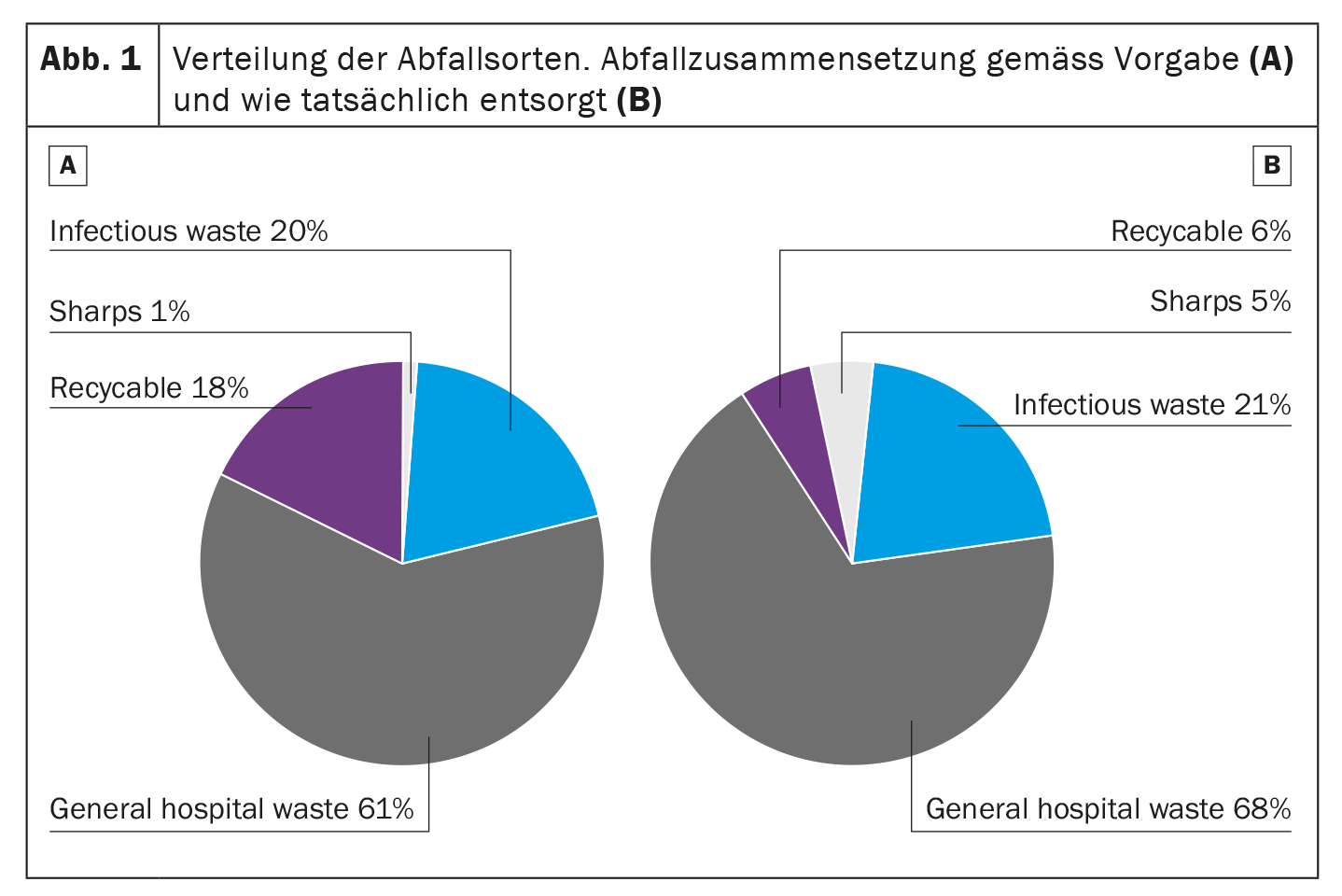
The waste composition is mainly general hospital waste (61%), which also has to be incinerated in Switzerland. 18% of the waste is considered recyclable, e.g. plastic, 20% was infectious waste – mainly suction fluids. Sharp objects accounted for only 1% (Fig. 1A). Thus the theory. “However, if we look at how our waste is actually disposed of, the picture is slightly different,” said the researcher: “Only a third of recyclable waste is actually recycled in our department (6%) – this is mainly glass and some paper.” In addition, sharp objects, e.g. permanently installed disposable tips, are not actually sharp objects in the sense of the regulation. The actual proportion was therefore 5% (Fig. 1B).

The proportion of leftovers, such as unused endoscopy kit components or syringes filled with water/Nacl, was also striking. Rybinski and his colleagues wondered what potential for reduction there would be in the department if the waste were disposed of differently. “For example, if we could recycle plastics such as O2 tubing, packaging and crystalloid containers, we would produce 17% less general waste.”

Include green electricity and telemedicine in the bill

The Basel gastroenterologists’ plan for the future is to introduce the recycling of plastics, collect unused kit components and use them in other examinations and discuss the disposal of endoscopic accessories. Apart from waste, factors such as switching to LEDs or green electricity to reduce carbon dioxide emissions or the use of telemedicine are also important and helpful in the future in order to conserve resources. Further research into the economic and ecological costs of reprocessing, among other things, is necessary for this.

Source:

  1. Rybinski F: Vortrag «Waste audit – Swiss data on waste production and complication in a large endoscopy unit»; Jahreskongress der Schweizerischen Gesellschaft für Gastroenterologie (SGG), Interlaken, 14.09.2023.

GASTROENTEROLOGIE PRAXIS 2023: 1(2): 26

Autoren
  • Jens Dehn
Publikation
  • GASTROENTEROLOGIE PRAXIS
Related Topics
  • CO2 production
  • colonoscopy
  • endoscopy
  • Gastroscopy
  • Green electricity
  • Hospital waste
  • Recycling
  • Telemedicine
  • Waste
Previous Article
  • Integrated care models

Launch of an innovative project with pioneering character

  • General Internal Medicine
  • Practice Management
  • Prevention and health care
  • RX
View Post
Next Article
  • Environmental influences and lung health

High air pollution = small baby

  • Congress Reports
  • General Internal Medicine
  • Gynecology
  • Pediatrics
  • Pneumology
  • Prevention and health care
  • RX
  • Studies
View Post
You May Also Like
View Post
  • 3 min
  • Soft tissue sarcomas of the lower extremity

Diagnostics, subtypes and treatment options

    • RX
    • Education
    • Oncology
View Post
  • 38 min
  • Psychological dependence on AI assistants, smartphones and short videos

Algorithms, avatars and the unburdened mind

    • RX
    • CME continuing education
    • Neurology
    • Pediatrics
    • Prevention and health care
    • Psychiatry and psychotherapy
    • Studies
View Post
  • 8 min
  • Psychooncology

Communication as the key to therapy adherence

    • CME continuing education
    • Practice Management
    • RX
View Post
  • 12 min
  • The Brain and the Motivation to Eat

Why is it so hard to lose weight?

    • RX
    • CME continuing education
    • Endocrinology and Diabetology
    • General Internal Medicine
    • Nutrition
    • Pharmacology and toxicology
    • Prevention and health care
    • Psychiatry and psychotherapy
    • Studies
View Post
  • 5 min
  • Omaveloxolone for Friedreich's Ataxia

Efficacy and Safety Studied Over 6 Years

    • Neurology
    • Congress Reports
    • Endocrinology and Diabetology
    • RX
    • Studies
View Post
  • 6 min
  • Psoriasis: therapy with biologics and TYK-2-i

Progress assessments based on current long-term and real-world data

    • RX
    • Congress Reports
    • Dermatology and venereology
    • Pharmacology and toxicology
    • Rheumatology
    • Studies
View Post
  • 4 min
  • Hypertension: the most important facts for daily practice

Early dual antihypertensive therapy is usually indicated

    • RX
    • Cardiology
    • Congress Reports
    • General Internal Medicine
View Post
  • 4 min
  • Escitalopram for anxiety disorders

Positive effect, but no immediate improvement in symptoms

    • RX
    • Education
    • Neurology
    • Pharmacology and toxicology
    • Psychiatry and psychotherapy
    • Studies
  • IBD matters

    Zum Thema
Top CME content
  • 1
    Why is it so hard to lose weight?
  • 2
    Algorithms, avatars and the unburdened mind
  • 3
    Communication as the key to therapy adherence
  • 4
    Communication as the key to therapy adherence
  • 5
    Solutions to the malnutrition dilemma

Newsletter

Sign up and stay up to date

Subscribe
Medizinonline Medizinonline
  • Contact
  • General terms and conditions
  • Imprint

Input your search keywords and press Enter.