Medizinonline Medizinonline
  • News
    • News
    • Market & Medicine
  • Patients
    • Disease patterns
    • Diagnostics
    • Therapy
  • Partner Content
    • Diabetes
      • Dia-Month Club – Type 2 Diabetes
      • Diabetes in Motion
      • Diabetes Podcasts
    • Gastroenterology
      • IBD matters
    • Oncology
      • Swiss Oncology in motion
    • Orthopedics
      • Osteoporosis in motion
  • Departments
    • Allergology and clinical immunology
    • General Internal Medicine
    • Anesthesiology
    • Angiology
    • Surgery
    • Dermatology and venereology
    • Endocrinology and Diabetology
    • Nutrition
    • Gastroenterology and Hepatology
    • Genetics
    • Geriatrics
    • Gynecology
    • Hematology
    • Infectiology
    • Cardiology
    • Nephrology
    • Neurology
    • Emergency and intensive care medicine
    • Nuclear Medicine
    • Oncology
    • Ophthalmology
    • ORL
    • Orthopedics
    • Pediatrics
    • Pharmacology and toxicology
    • Pharmaceutical medicine
    • Phlebology
    • Physical medicine and rehabilitation
    • Pneumology
    • Prevention and health care
    • Psychiatry and psychotherapy
    • Radiology
    • Forensic Medicine
    • Rheumatology
    • Sports Medicine
    • Traumatology and trauma surgery
    • Tropical and travel medicine
    • Urology
    • Dentistry
  • CME & Congresses
    • CME continuing education
    • Congress Reports
    • Congress calendar
  • Practice
    • Noctimed
    • Practice Management
    • Jobs
    • Interviews
  • Log In
  • Register
  • My account
  • Contact
  • Publications
  • Contact
  • Deutsch
  • English
  • Français
  • Italiano
  • Português
  • Español
Subscribe
Medizinonline Medizinonline
  • News
    • News
    • Market & Medicine
  • Patienten
    • Krankheitsbilder
    • Diagnostik
    • Therapie
  • Partner Content
    • Diabetes
      • Dia-Month Club – Type 2 Diabetes
      • Diabetes in Motion
      • Diabetes Podcasts
    • Gastroenterology
      • IBD matters
    • Oncology
      • Swiss Oncology in motion
    • Orthopedics
      • Osteoporosis in motion
    • Phytotherapie
    • Rheumatology
  • Departments
    • Fachbereiche 1-13
      • Allergology and clinical immunology
      • General Internal Medicine
      • Anesthesiology
      • Angiology
      • Surgery
      • Dermatology and venereology
      • Endocrinology and Diabetology
      • Nutrition
      • Gastroenterology and Hepatology
      • Genetics
      • Geriatrics
      • Gynecology
      • Hematology
    • Fachbereiche 14-26
      • Infectiology
      • Cardiology
      • Nephrology
      • Neurology
      • Emergency and intensive care medicine
      • Nuclear Medicine
      • Oncology
      • Ophthalmology
      • ORL
      • Orthopedics
      • Pediatrics
      • Pharmacology and toxicology
      • Pharmaceutical medicine
    • Fachbereiche 26-38
      • Phlebology
      • Physical medicine and rehabilitation
      • Phytotherapy
      • Pneumology
      • Prevention and health care
      • Psychiatry and psychotherapy
      • Radiology
      • Forensic Medicine
      • Rheumatology
      • Sports Medicine
      • Traumatology and trauma surgery
      • Tropical and travel medicine
      • Urology
      • Dentistry
  • CME & Congresses
    • CME continuing education
    • Congress Reports
    • Congress calendar
  • Practice
    • Noctimed
    • Practice Management
    • Jobs
    • Interviews
Login

Sie haben noch keinen Account? Registrieren

  • News on melanoma therapy at ASCO 2014

How do immunotherapies work in combination and in the adjuvant setting?

    • Congress Reports
    • Dermatology and venereology
    • Oncology
    • RX
  • 3 minute read

In the course of this year’s ASCO congress in Chicago at the beginning of June, new results of the phase Ib study on the combination of PD1 and CTLA4 inhibition were presented. They are extremely promising. In the adjuvant setting, ipilimumab alone met the primary endpoint of the recurrence-free survival.

New data from Study-004, a phase I trial that evaluated the safety, antitumor activity and pharmacokinetics of the combination of PD1 (nivolumab) and CTLA4 (ipilimumab) inhibition, offer hope for patients with advanced melanoma. Presented at this year’s ASCO Congress by Mario Sznol, MD, Yale, “Two other studies are currently underway testing this combination in later phases. Our results certainly warrant such research efforts.”

Agents were given either concurrently or sequentially (n=127). Patients were allowed to have taken up to three systemic therapies prior to participation.

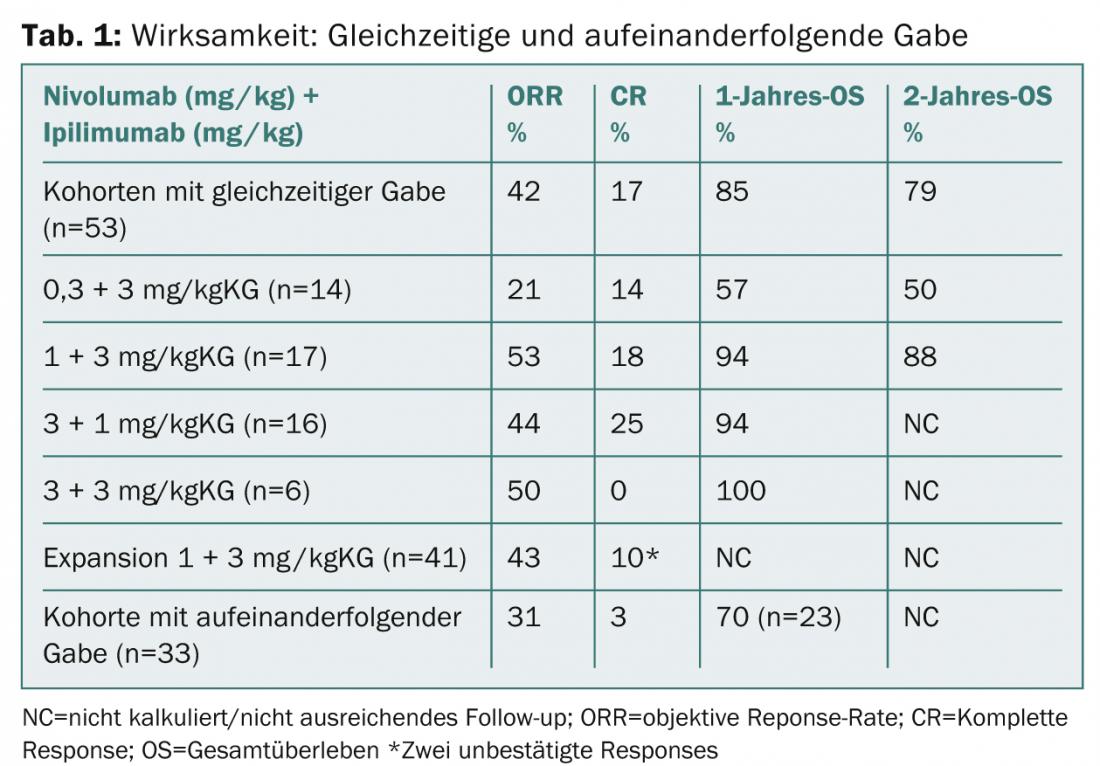
The concurrent group (nivolumab 1 mg/kgKG plus ipilimumab 3 mg/kgKG [n=17]) achieved a 1-year overall survival rate of 94, and a 2-year overall survival rate of 88%. In the extended cohort, 41 patients received the above regimen every three weeks for four doses and then nivolumab alone at 3 mg/kgKG every two weeks until progression. Research will continue at these doses in the ongoing Phase II and III trials (CheckMate-069 and -067).

Response was observed regardless of BRAF mutation status or PD-L1 release.

No new safety issues were found in the extended follow-up. Grade 3-4 therapy-associated adverse events occurred in 62% of patients in the cohorts with concomitant administration. The main results of the study update are presented in Table 1.
Ipilimumab in the adjuvant setting.

A double-blind randomized phase III trial also showed that ipilimumab at a dose of 10 mg/kgKG significantly improved recurrence-free survival (RFS, time to recurrence or death) compared with placebo, even at an earlier melanoma stage. Participants were patients with melanoma (stage III) and high risk of recurrence after complete surgical resection (adjuvant setting). This is now the third phase III trial that has been positive for ipilimumab in melanoma therapy.

“Although in stage III the likelihood of recurrence is very high. there are very few treatment options that help reduce the risk of metastasis after surgery,” said Prof. Alexander Eggermont, MD, Villejuif, who presented the results at ASCO.

The study observed a 25% reduction in the risk of recurrence or mortality (HR=0.75; 95% CI=0.64-0.90; p=0.0013). After three years, 46.5% of ipilimumab patients and 34.8% of the placebo group were relapse-free. The median RFS was 26.1 resp. 17.1 months.

Side effects were broadly comparable to those of ipilimumab in the treatment of advanced melanoma. They were mostly immune-related and well treatable within the management protocols on this agent. A higher incidence of endocrinopathies was observed. 48.8% discontinued ipilimumab therapy due to adverse events (vs. 1.7% on placebo). Five deaths were related to verum.

According to Prof. Eggermont, the results are relevant both because ipilimumab is the first immune checkpoint inhibitor to show improvement in such a treatment setting and because the benefit was observed in all subgroups, including those at highest risk of relapse. It is therefore reasonable to assume that ipilimumab could be used broadly across different lines of therapy and stages of disease in the future. Further studies investigating the compound in the adjuvant setting are currently ongoing. Meanwhile, ipilimumab at a dose of 3 mg/kgKG is approved for the treatment of advanced (non-resectable or metastatic) melanoma in adults who have received prior therapy.

Source: 50
th
Annual Meeting of the American Society of Clinical Oncology (ASCO), May 30-June 3, 2014, Chicago.

InFo ONCOLOGY & HEMATOLOGY 2014; 2(5): 20-21.
CONGRESS SPECIAL 2014; 30-32
Autoren
  • Andreas Grossmann
Publikation
  • InFo ONKOLOGIE & HÄMATOLOGIE
Related Topics
  • ASCO
  • CTLA4 inhibitor
  • Ipilimumab
  • Melanoma
  • Nivolumab
  • PD1
  • Skin cancer
Previous Article
  • Pediatric hematology and oncology

Acute childhood leukemias: an update.

  • Education
  • Hematology
  • Oncology
  • Pediatrics
  • RX
View Post
Next Article
  • Pediatric and geriatric oncology

Treat young and old correctly

  • Geriatrics
  • News
  • Oncology
  • Orthopedics
  • RX
View Post
You May Also Like
View Post
  • 12 min
  • The Brain and the Motivation to Eat

Why is it so hard to lose weight?

    • RX
    • CME continuing education
    • Endocrinology and Diabetology
    • General Internal Medicine
    • Nutrition
    • Pharmacology and toxicology
    • Prevention and health care
    • Psychiatry and psychotherapy
    • Studies
View Post
  • 12 min
  • Global Recommendation, Swissmedic Approval, and SL Limitation

WHO Guidelines on GLP-1 for Obesity

    • RX
    • Cardiology
    • Education
    • Endocrinology and Diabetology
    • General Internal Medicine
    • Nutrition
    • Pharmacology and toxicology
    • Prevention and health care
    • Studies
View Post
  • 7 min
  • Obesity in Children and Adolescents

Gene-Environment Interactions: Polygenic or Monogenic Determinants?

    • RX
    • Education
    • General Internal Medicine
    • Genetics
    • Nutrition
    • Pediatrics
View Post
  • 18 min
  • From Risk Identification to Anti-Inflammatory Intervention

Inflammation as a Treatment Goal in Its Own Right

    • RX
    • Angiology
    • Cardiology
    • CME continuing education
    • Endocrinology and Diabetology
    • General Internal Medicine
    • Nutrition
    • Studies
View Post
  • 7 min
  • H. pylori infection: current study data

Fewer gastric carcinomas and peptic ulcers after eradication

    • RX
    • Gastroenterology and Hepatology
    • General Internal Medicine
    • Infectiology
    • Oncology
    • Studies
View Post
  • 4 min
  • From symptom to diagnosis

Pneumology – tracheal and bronchial calcifications

    • RX
    • Cases
    • Education
    • General Internal Medicine
    • Pneumology
    • Radiology
View Post
  • 3 min
  • Tinea capitis: Current Guidelines and Recommendations

What should be kept in mind when treating adult patients?

    • Dermatology and venereology
    • Education
    • Infectiology
    • Pharmacology and toxicology
    • RX
View Post
  • 7 min
  • Geriatric patients

Micronutrient Intake in Older Adults

    • RX
    • Education
    • General Internal Medicine
    • Geriatrics
    • Nutrition
  • IBD matters

    Zum Thema
Top CME content
  • 1
    Inflammation as a Treatment Goal in Its Own Right
  • 2
    Personalized Treatment Before a Planned Pregnancy
  • 3
    Current State of Knowledge and New Therapeutic Approaches
  • 4
    Why is it so hard to lose weight?
  • 5
    Functional limb preservation between infection control, vascular medicine and resurfacing

Newsletter

Sign up and stay up to date

Subscribe
Medizinonline Medizinonline
  • Contact
  • General terms and conditions
  • Imprint

Input your search keywords and press Enter.