Medizinonline Medizinonline
  • News
    • News
    • Market & Medicine
  • Patients
    • Disease patterns
    • Diagnostics
    • Therapy
  • Partner Content
    • Diabetes
      • Dia-Month Club – Type 2 Diabetes
      • Diabetes in Motion
      • Diabetes Podcasts
    • Gastroenterology
      • IBD matters
    • Oncology
      • Swiss Oncology in motion
    • Orthopedics
      • Osteoporosis in motion
  • Departments
    • Allergology and clinical immunology
    • General Internal Medicine
    • Anesthesiology
    • Angiology
    • Surgery
    • Dermatology and venereology
    • Endocrinology and Diabetology
    • Nutrition
    • Gastroenterology and Hepatology
    • Genetics
    • Geriatrics
    • Gynecology
    • Hematology
    • Infectiology
    • Cardiology
    • Nephrology
    • Neurology
    • Emergency and intensive care medicine
    • Nuclear Medicine
    • Oncology
    • Ophthalmology
    • ORL
    • Orthopedics
    • Pediatrics
    • Pharmacology and toxicology
    • Pharmaceutical medicine
    • Phlebology
    • Physical medicine and rehabilitation
    • Pneumology
    • Prevention and health care
    • Psychiatry and psychotherapy
    • Radiology
    • Forensic Medicine
    • Rheumatology
    • Sports Medicine
    • Traumatology and trauma surgery
    • Tropical and travel medicine
    • Urology
    • Dentistry
  • CME & Congresses
    • CME continuing education
    • Congress Reports
    • Congress calendar
  • Practice
    • Noctimed
    • Practice Management
    • Jobs
    • Interviews
  • Log In
  • Register
  • My account
  • Contact
  • Publications
  • Contact
  • Deutsch
  • English
  • Français
  • Italiano
  • Português
  • Español
Subscribe
Medizinonline Medizinonline
  • News
    • News
    • Market & Medicine
  • Patienten
    • Krankheitsbilder
    • Diagnostik
    • Therapie
  • Partner Content
    • Diabetes
      • Dia-Month Club – Type 2 Diabetes
      • Diabetes in Motion
      • Diabetes Podcasts
    • Gastroenterology
      • IBD matters
    • Oncology
      • Swiss Oncology in motion
    • Orthopedics
      • Osteoporosis in motion
    • Phytotherapie
    • Rheumatology
  • Departments
    • Fachbereiche 1-13
      • Allergology and clinical immunology
      • General Internal Medicine
      • Anesthesiology
      • Angiology
      • Surgery
      • Dermatology and venereology
      • Endocrinology and Diabetology
      • Nutrition
      • Gastroenterology and Hepatology
      • Genetics
      • Geriatrics
      • Gynecology
      • Hematology
    • Fachbereiche 14-26
      • Infectiology
      • Cardiology
      • Nephrology
      • Neurology
      • Emergency and intensive care medicine
      • Nuclear Medicine
      • Oncology
      • Ophthalmology
      • ORL
      • Orthopedics
      • Pediatrics
      • Pharmacology and toxicology
      • Pharmaceutical medicine
    • Fachbereiche 26-38
      • Phlebology
      • Physical medicine and rehabilitation
      • Phytotherapy
      • Pneumology
      • Prevention and health care
      • Psychiatry and psychotherapy
      • Radiology
      • Forensic Medicine
      • Rheumatology
      • Sports Medicine
      • Traumatology and trauma surgery
      • Tropical and travel medicine
      • Urology
      • Dentistry
  • CME & Congresses
    • CME continuing education
    • Congress Reports
    • Congress calendar
  • Practice
    • Noctimed
    • Practice Management
    • Jobs
    • Interviews
Login

Sie haben noch keinen Account? Registrieren

  • Anticoagulation for atrial fibrillation

Large-scale cohort study compares two DOAKs

    • Cardiology
    • Education
    • General Internal Medicine
    • RX
    • Studies
  • 3 minute read

The results of the prospective observational study showed that in patients over 65 years of age with atrial fibrillation, treatment with rivaroxaban was associated with a significantly increased risk of severe ischemic or hemorrhagic events compared with apixaban.

Atrial fibrillation (VHF) is the most common cardiac arrhythmia and increases the risk of stroke fivefold [1,2]. Anticoagulation is an important treatment pillar for the prevention of stroke [3]. In a retrospective analysis in elderly frail patients with VCF, the risk of stroke, embolism, and major bleeding was found to be significantly lower with treatment with direct oral anticoagulants (DOAKs) than with vitamin K antagonists [4,5]. DOAKs such as rivaroxaban and apixaban – both direct factor Xa inhibitors – are among the preferred class of agents for this patient population. Ray et al. investigated whether there is a difference in the risk of serious ischemic or hemorrhagic events depending on which of these two anticoagulants was used in patients over 65 years of age with VCF in a study published in JAMA in 2021 [5].

Comparison in favor of apixaban – even at reduced doses

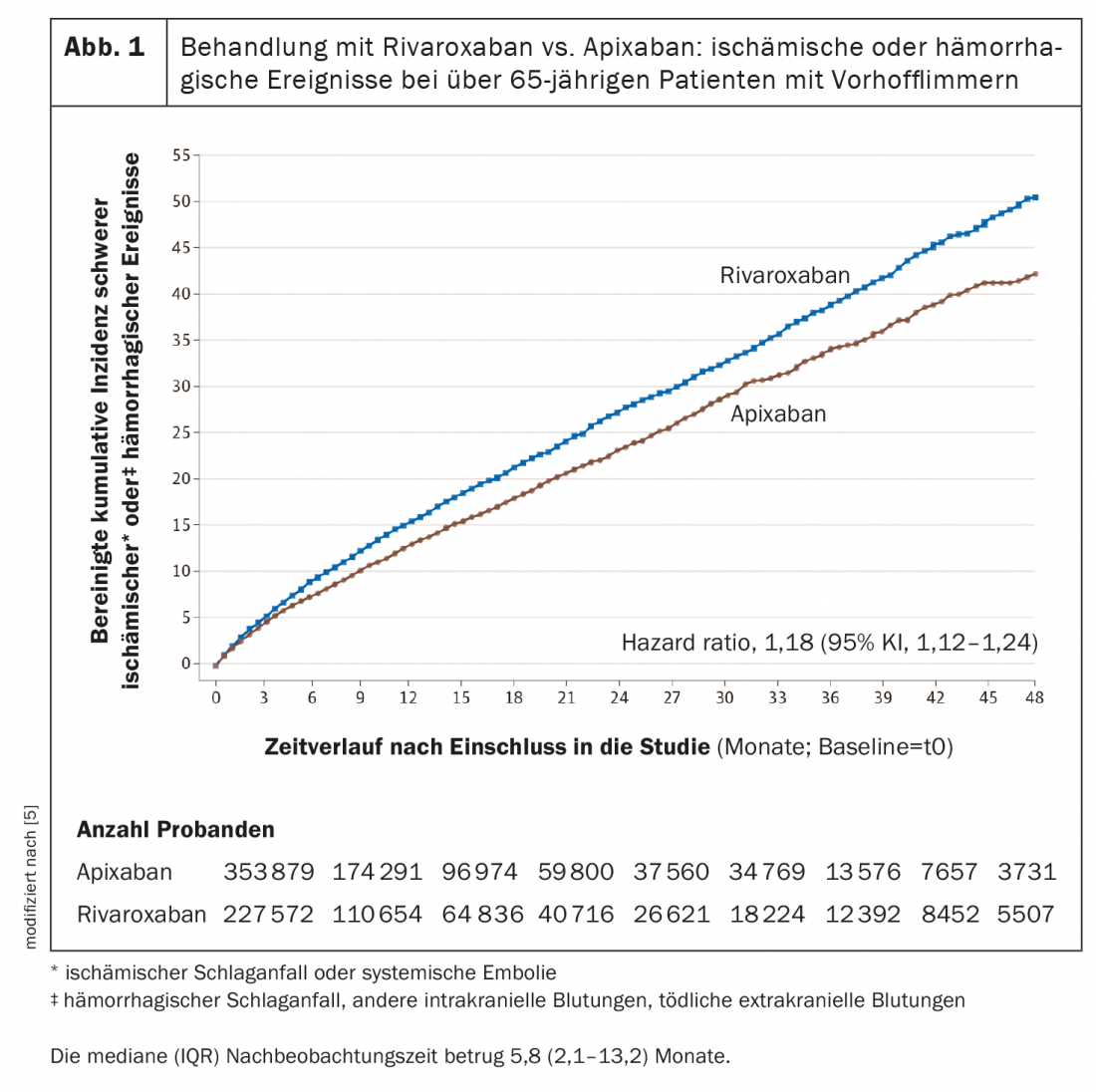
The study included 581 451 patients with AF treated with either rivaroxaban or apixaban [5]. The median follow-up time was 5.8 (2.1-13.2) months. The mean age of study participants was 77.0 years and 50.2% were female. 76.9% of subjects received anticoagulation at standard doses and 23.1% at reduced doses. In the entire study population, 6946 majore ischemic or hemorrhagic events occurred during follow-up. The risk with rivaroxaban proved to be higher compared with apixaban, with adjusted rates of 16.1 vs. 13.4 per 1000 person-years (HR, 1.18; 95% CI 1.12-1.24) (Fig. 1) [5]. Both the risk of major ischemic events (HR 1.12; 95% CI 1.04-1.20) and hemorrhagic events (HR 1.26; 95% CI 1.16-1.36) were increased with treatment with rivaroxaban [5].


DOAK treatment was started at reduced doses in 23% of study participants in each group, for a total of 134,393 patients [5]. Also in this patient population, a difference in favor of apixaban was manifested, respectively, the risk for ischemic and hemorrhagic events was increased under rivaroxaban. Patients receiving DOAKs at reduced doses had a higher mean age compared with those receiving standard doses (82.8 vs 75.2 years). In addition, the prevalence of other risk factors for bleeding or stroke was higher (mean CHA2DS2-VASc score, 5.0 vs. 4.1).

Practice-relevant expansion of the evidence base

Although the efficacy of rivaroxaban and apixaban in VCF has been compared in previous retrospective cohort studies [6–8], the present data produced new insights that are very valuable for clinical practice. With more than half a million new users of rivaroxaban or apixaban, this was a larger cohort than in previous studies. Furthermore, only patients over 65 years of age were included [9,10]. The larger sample size allowed more accurate quantification of the occurrence of rare but clinically important events, such as fatal extracranial hemorrhage. In contrast to other studies, patients receiving reduced-dose oral anticoagulation were also included, a subpopulation of VHF sufferers that is particularly vulnerable because of common patient characteristics [5–7].


Literature:

  1. Singer E, et al: Medicine and Reason 2015; 3-82.
  2. Zimetbaum P: Ann Intern Med 2017; 166(5): ITC33-ITC48. doi:10.7326/AITC201703070
  3. January CT, et al: Circulation 2019; 140(2):e125-e151.
  4. Lip GYH, et al: J Intern Med 2020; https://doi.org/10.1111/JOIM.13140
  5. Ray WA, et al: JAMA. 2021 Dec 21; 326(23): 2395-2240.
  6. Graham DJ, et al: Am J Med 2019; 132(5): 596-604.e11.
  7. Fralick M, et al: Ann Intern Med 2020; 172(7): 463-473.
  8. Lip GYH, et al: Stroke 2018; 49(12): 2933-2944.
  9. Go AS, et al: JAMA 2001; 285 (18): 2370-2375.
  10. Lowenstern A, et al: Ann Intern Med. 2018;169(11): 774-787.


HAUSARZT PRAXIS 2022; 17(5): 32

Autoren
  • Mirjam Peter, M.Sc.
Publikation
  • HAUSARZT PRAXIS
Related Topics
  • Anticoagulation
  • Atrial fibrillation
  • DOAK
  • Stroke
Previous Article
  • Wound care

Antimicrobial wound dressings in the context of “Antibiotic Stewardship”.

  • Dermatology and venereology
  • Education
  • Infectiology
  • RX
  • Studies
View Post
Next Article
  • Lung cancer

Lung cancer in focus: What’s new?

  • Congress Reports
  • Oncology
  • Pneumology
  • RX
  • Studies
View Post
You May Also Like
View Post
  • 5 min
  • Highlights from the AAD Annual Meeting

Atopic Dermatitis: Interesting News on Drug Candidates in Phase III

    • RX
    • Allergology and clinical immunology
    • Congress Reports
    • Dermatology and venereology
    • Studies
View Post
  • 6 min
  • Autoimmune Liver Diseases

Innovative Treatment Approaches for PBC, PSC, and AIH: What’s New?

    • RX
    • Congress Reports
    • Gastroenterology and Hepatology
    • General Internal Medicine
    • Studies
View Post
  • 8 min
  • Myelofibrosis

Mutations and Molecular Diagnostics in Treatment Decisions

    • RX
    • Education
    • Hematology
    • Oncology
    • Studies
View Post
  • 5 min
  • Psoriasis in the Age of Precision Medicine

Systemic Therapy for Patients with Comorbidities: What Is the Best Choice?

    • RX
    • Cardiology
    • Congress Reports
    • Dermatology and venereology
    • Gastroenterology and Hepatology
    • Nutrition
    • Rheumatology
    • Studies
View Post
  • 13 min
  • The AMALFI study and the limits of digital screening for atrial fibrillation

Remote monitoring for atrial fibrillation: lots of detection, little stroke prevention?

    • RX
    • Cardiology
    • Education
    • Studies
View Post
  • 4 min
  • MASH

Pharmacotherapies as “Game Changers”—What Are the Upcoming Challenges?

    • RX
    • Congress Reports
    • Endocrinology and Diabetology
    • Gastroenterology and Hepatology
    • General Internal Medicine
    • Studies
View Post
  • 13 min
  • Obesity Treatment

Oral GLP-1 Therapies: ATTAIN-1 and OASIS-4—The Next Leap Forward

    • RX
    • Education
    • Endocrinology and Diabetology
    • General Internal Medicine
    • Nutrition
    • Prevention and health care
    • Studies
View Post
  • 5 min
  • Older patients with atopic dermatitis

Why the Use of Biologics Is Recommended

    • RX
    • Allergology and clinical immunology
    • Congress Reports
    • Dermatology and venereology
    • Studies
  • IBD matters

    Zum Thema
Top CME content
  • 1
    Update on Anti-Rheumatic Medications
  • 2
    Psychiatry versus Neuro-Oncology: Diagnostic Pitfalls
  • 3
    Focus on preventive care options
  • 4
    Inflammation as a Treatment Goal in Its Own Right
  • 5
    Personalized Treatment Before a Planned Pregnancy

Newsletter

Sign up and stay up to date

Subscribe
Medizinonline Medizinonline
  • Contact
  • General terms and conditions
  • Imprint

Input your search keywords and press Enter.