Medizinonline Medizinonline
  • News
    • News
    • Market & Medicine
  • Patients
    • Disease patterns
    • Diagnostics
    • Therapy
  • Partner Content
    • Diabetes
      • Dia-Month Club – Type 2 Diabetes
      • Diabetes in Motion
      • Diabetes Podcasts
    • Gastroenterology
      • IBD matters
    • Oncology
      • Swiss Oncology in motion
    • Orthopedics
      • Osteoporosis in motion
  • Departments
    • Allergology and clinical immunology
    • General Internal Medicine
    • Anesthesiology
    • Angiology
    • Surgery
    • Dermatology and venereology
    • Endocrinology and Diabetology
    • Nutrition
    • Gastroenterology and Hepatology
    • Genetics
    • Geriatrics
    • Gynecology
    • Hematology
    • Infectiology
    • Cardiology
    • Nephrology
    • Neurology
    • Emergency and intensive care medicine
    • Nuclear Medicine
    • Oncology
    • Ophthalmology
    • ORL
    • Orthopedics
    • Pediatrics
    • Pharmacology and toxicology
    • Pharmaceutical medicine
    • Phlebology
    • Physical medicine and rehabilitation
    • Pneumology
    • Prevention and health care
    • Psychiatry and psychotherapy
    • Radiology
    • Forensic Medicine
    • Rheumatology
    • Sports Medicine
    • Traumatology and trauma surgery
    • Tropical and travel medicine
    • Urology
    • Dentistry
  • CME & Congresses
    • CME continuing education
    • Congress Reports
    • Congress calendar
  • Practice
    • Noctimed
    • Practice Management
    • Jobs
    • Interviews
  • Log In
  • Register
  • My account
  • Contact
  • Publications
  • Contact
  • Deutsch
  • English
  • Français
  • Italiano
  • Português
  • Español
Subscribe
Medizinonline Medizinonline
  • News
    • News
    • Market & Medicine
  • Patienten
    • Krankheitsbilder
    • Diagnostik
    • Therapie
  • Partner Content
    • Diabetes
      • Dia-Month Club – Type 2 Diabetes
      • Diabetes in Motion
      • Diabetes Podcasts
    • Gastroenterology
      • IBD matters
    • Oncology
      • Swiss Oncology in motion
    • Orthopedics
      • Osteoporosis in motion
    • Phytotherapie
    • Rheumatology
  • Departments
    • Fachbereiche 1-13
      • Allergology and clinical immunology
      • General Internal Medicine
      • Anesthesiology
      • Angiology
      • Surgery
      • Dermatology and venereology
      • Endocrinology and Diabetology
      • Nutrition
      • Gastroenterology and Hepatology
      • Genetics
      • Geriatrics
      • Gynecology
      • Hematology
    • Fachbereiche 14-26
      • Infectiology
      • Cardiology
      • Nephrology
      • Neurology
      • Emergency and intensive care medicine
      • Nuclear Medicine
      • Oncology
      • Ophthalmology
      • ORL
      • Orthopedics
      • Pediatrics
      • Pharmacology and toxicology
      • Pharmaceutical medicine
    • Fachbereiche 26-38
      • Phlebology
      • Physical medicine and rehabilitation
      • Phytotherapy
      • Pneumology
      • Prevention and health care
      • Psychiatry and psychotherapy
      • Radiology
      • Forensic Medicine
      • Rheumatology
      • Sports Medicine
      • Traumatology and trauma surgery
      • Tropical and travel medicine
      • Urology
      • Dentistry
  • CME & Congresses
    • CME continuing education
    • Congress Reports
    • Congress calendar
  • Practice
    • Noctimed
    • Practice Management
    • Jobs
    • Interviews
Login

Sie haben noch keinen Account? Registrieren

  • Small Airways Disease

SAD as a precursor of emphysema

    • Education
    • Pneumology
    • RX
  • 3 minute read

Small airways disease (SAD) is a central feature of chronic obstructive pulmonary disease (COPD). More than half of all asthma patients also suffer from it. A team of authors analyzed recent studies on the relationship between SAD and emphysema.

By definition, the small and smallest airways are <2 mm in diameter and arise from the 4th-13th generation of airway branching, with the trachea as the 1st generation extending to the alveolus as the 23rd generation. However, normally they occur only up to the 8th generation. Estimates suggest that about 20% of small airways less than 2 mm in diameter have bronchi with cartilaginous elements in their walls, the remainder being bronchioles or ductus alveolaris.

Relationship between SAD and emphysema

Centrilobular emphysema is strongly associated with chronic cigarette smoking. It attacks the secondary lung lobules, which are irregular, polyhedral units of the lung structure (Fig. 1). Secondary lung lobules contain 3-10 acini, as Dr. Andrew Higham, University of Manchester, and his colleagues write in their review paper [1]. Each acinus includes the respiratory bronchioles, alveolar ducts, and alveolar spaces. The emphysematous destruction, which typically results from smoking, originates from the center of the lobule. The respiratory bronchioles, which are mainly affected by centrilobular emphysema, are located in the center. In contrast, panlobular emphysema attacks all structures, from the distal alveoli to the bronchioles of the airways. Paraseptal emphysema involves the alveoli and ducti alveolaris, while sparing the proximal structures.
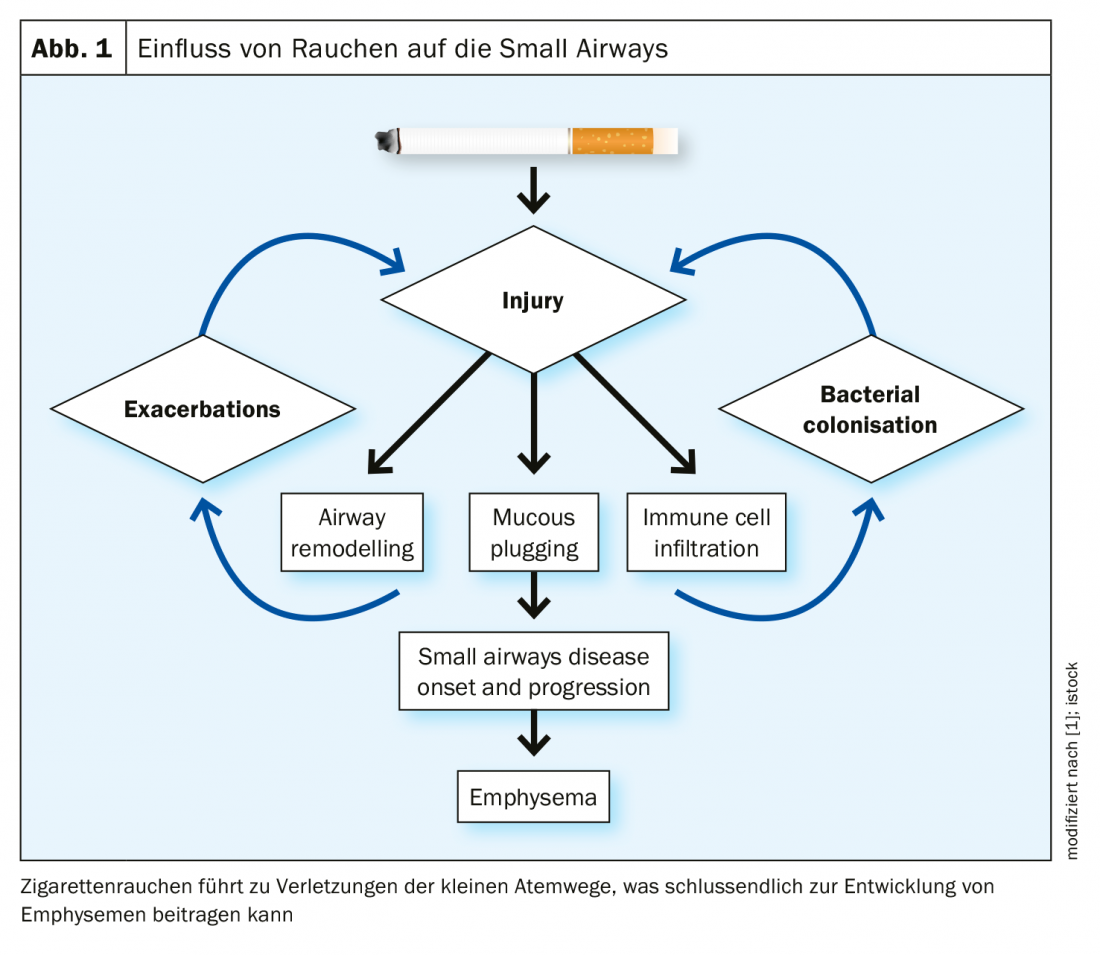


How is small airway remodeling, particularly fibrosis, related to emphysema? On the one hand, there is a thickening of the tissue, but on the other hand, there is a loss of tissue. As Higham et al. a study [2] investigated the expression of 54 tissue repair genes in the small airways and surrounding parenchyma using laser capture microdissections. What was found was differential expression of these genes between the two areas, with expression favoring the parenchymal degradation that surrounds the small airways. The study authors suggest that some small airways are similarly destroyed as the parenchyma, while others have a thickened profile.

Studies support connection

Several recent studies have demonstrated a reduction in the total number of terminal and first order respiratory (transitional) bronchioles in COPD patients compared to controls using microcomputed tomography. 90% of terminal bronchioles were obliterated in stage IV COPD lungs. In GOLD 1 patients, the reduction in terminal and respiratory bronchioles was 29 and 41%, respectively, and in GOLD 2 patients, 40 and 53%, respectively. The remaining small airways had thickened walls and narrowed lumens caused by mucoid obstruction and collagenous debris. The loss and remodeling of terminal and transient bronchioles in lung tissue not affected by emphysema provides further evidence that SAD precedes emphysematous lesions.

SAD, Dr. Higham and his colleagues said, is present in all stages of COPD. The fact that it is also of great importance in the early stages of the disease is now increasingly coming into focus. New research and the resulting findings provide insights into the progression of SAD as well as the importance of exacerbations in promoting inflammatory and remodeling processes associated with small airways disease. SAD appears to be a precursor to the development of emphysema, and therapeutic strategies targeting the small airways in COPD may reduce the rate of emphysema progression. Based on this, the researchers advise that pharmacologic targeting should be applied earlier rather than later in the development of COPD.


Literature:

  1. Higham A, et al: The pathology of small airways disease in COPD: historical aspects and future directions. Respiratory Research 2019; 20: 49
    (https://doi.org/10.1186/s12931-019-1017-y)
  2. Gosselink JV, Hayashi S, Elliott WM, et al: Differential expression of tissue repair genes in the pathogenesis of chronic obstructive pulmonary disease. Am J Respir Crit Care Med 2010; 181(12): 1329-1335.
     

InFo PNEUMOLOGY & ALLERGOLOGY 2019; 1(2): 28.
Autoren
  • Jens Dehn
Publikation
  • InFo PNEUMOLOGIE & ALLERGOLOGIE
Related Topics
  • COPD
  • Emphysema
  • SAD
  • small airways disease
Previous Article
  • Aortic valve replacement

The most frequent arrhythmias after AKE or TAVI

  • Cardiology
  • Education
  • RX
  • Studies
View Post
Next Article
  • Measles vaccination

Dealing with vaccination skepticism

  • Allergology and clinical immunology
  • Education
  • General Internal Medicine
  • Infectiology
  • News
  • Prevention and health care
  • RX
View Post
You May Also Like
View Post
  • 11 min
  • Peristomal skin health

Focus on preventive care options

    • Cases
    • CME continuing education
    • Dermatology and venereology
    • Gastroenterology and Hepatology
    • Infectiology
    • Physical medicine and rehabilitation
    • Prevention and health care
    • RX
    • Surgery
View Post
  • 7 min
  • Disease-modifying therapies for ATTR-CM

TTR stabilizers, gene silencing and gene scissors: where do we stand?

    • Cardiology
    • Congress Reports
    • Genetics
    • RX
    • Studies
View Post
  • 8 min
  • Proteins in wound healing

Do special amino acids lead to success?

    • CME continuing education
    • Dermatology and venereology
    • Endocrinology and Diabetology
    • Nutrition
    • RX
    • Studies
View Post
  • 4 min
  • HER2+ early breast cancer

DESTINY-Breast11 – neoadjuvant T-DXd without anthracyclines

    • Education
    • Gynecology
    • Oncology
    • RX
    • Studies
View Post
  • 3 min
  • Lavender aromatherapy

Take away the fear of the dentist

    • Dentistry
    • Education
    • Pharmaceutical medicine
    • Phytotherapy
    • Psychiatry and psychotherapy
    • RX
    • Studies
View Post
  • 4 min
  • Digital dermatology: innovative project examples

AI and eHealth tools in HS care

    • Dermatology and venereology
    • General Internal Medicine
    • Practice Management
    • Prevention and health care
    • RX
    • Studies
View Post
  • 5 min
  • Mantle cell lymphoma

Recurrence after BTK inhibition – prognostic factors and treatment options

    • Education
    • Hematology
    • Oncology
    • RX
View Post
  • 3 min
  • Dementia risk with type 2 diabetes

SGLT2 inhibitors with advantages vs. DPP4 inhibitors

    • Education
    • Endocrinology and Diabetology
    • Geriatrics
    • Neurology
    • Pharmacology and toxicology
    • Psychiatry and psychotherapy
    • RX
    • Studies
  • IBD matters

    Zum Thema
Top CME content
  • 1
    Communication as the key to therapy adherence
  • 2
    Solutions to the malnutrition dilemma
  • 3
    Solutions to the malnutrition dilemma
  • 4
    Focus on preventive care options
  • 5
    Fertility preservation from gonads to genomes to genoids

Newsletter

Sign up and stay up to date

Subscribe
Medizinonline Medizinonline
  • Contact
  • General terms and conditions
  • Imprint

Input your search keywords and press Enter.