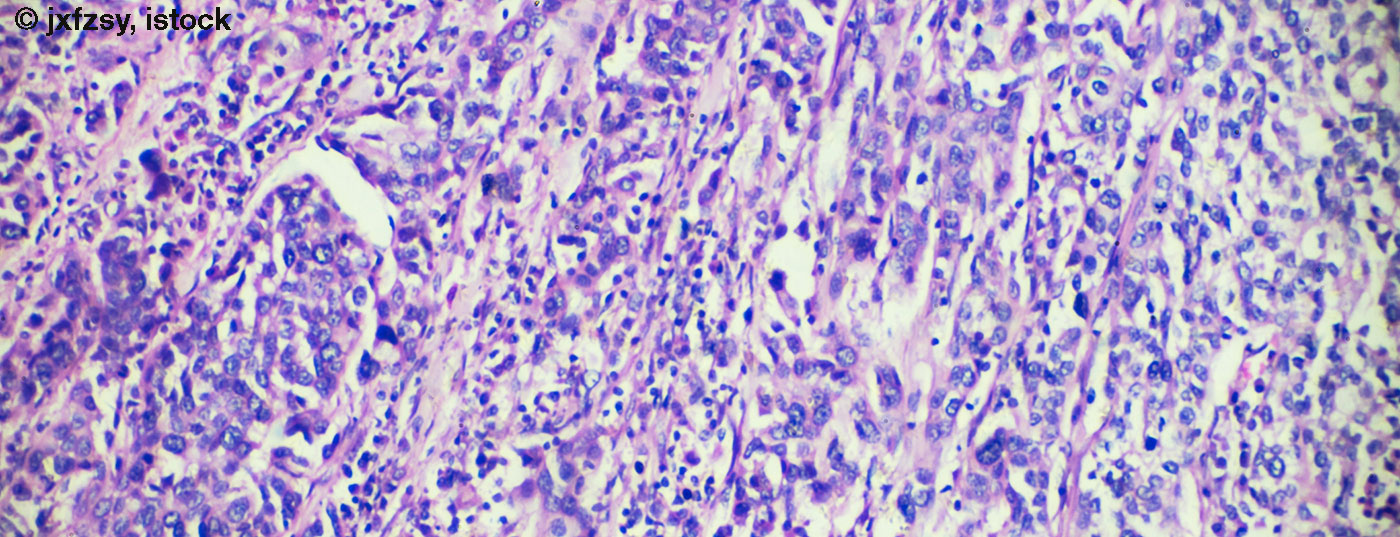
Despite the pandemic, this year’s Swiss Oncology and Hematology Congress (SOHC) was held face-to-face – with more than 1300 participants. Metastatic urothelial carcinoma of the urinary bladder was also a focus. In this entity, a new first-line treatment standard has been established with the recently approved maintenance therapy. And more changes are just around the corner.
Although the prognosis for metastatic bladder cancer is unfavorable, Ursula Vogl, MD, head of the Department of Medical Oncology at the Ente Ospedaliero Cantonale (EOC) in Bellinzona, Italy, predicts that deaths should decline in the coming years. Accordingly, 10,000 fewer bladder cancer deaths are projected in the U.S. by 2040. Immunotherapy is a great source of hope in this regard. This is now considered the standard of care in first-line maintenance therapy with avelumab in stable disease after chemotherapy, regardless of PD-L1 status. However, for the numerous patients who are not suitable for chemotherapy, checkpoint inhibitors exist in the form of pembrolizumab and atezolizumab, which are already approved in Europe for first-line therapy. However, PD-L1 expression is a prerequisite here, and Swissmedic approval is not currently available (Table 1) [1,2].

In the case of recurrent disease, however, atezolizumab, pembrolizumab and nivolumab can also be used in Switzerland without any problems. However, as checkpoint inhibitors advance into earlier lines of treatment, there is a growing need for alternative agents, raising the question of efficacy of sequential treatment with agents in the same class. Research in this area is also in full swing – with tangible results. For example, the antibody-drug conjugate enfortumab vedotin was approved by Swissmedic in November of this year [1]. Other compounds such as sacituzumab govitecan and the FGFR inhibitor Erdafitinib are in the pipeline. In the future, these could help to establish therapeutic standards beyond the second line and also reach those patients who are often denied inclusion in clinical trials – namely those who are particularly old, sick and vulnerable.
First-line therapy at a glance: What’s new?
Platinum-based chemotherapy is still considered the first-line treatment for newly diagnosed metastatic urothelial carcinoma of the urinary bladder. In this case, cisplatin should be preferred, since overall survival is significantly worse with carboplatin-based therapy (Tab. 2) . Unfortunately, more than 40% of patients are unsuitable for a cisplatin-containing chemotherapy regimen due to their creatinine clearance. And carboplatin-based treatment is also out of the question for many sufferers. In this situation, pembrolizumab as well as atezolizumab are approved for monotherapy in nearby countries – in case of PD-L1 expression [2]. Data from the Phase II Keynote-052 and IMvigor 210 trials showed good response rates in this patient population.

For all those whose disease at least stabilizes after four to six cycles of chemotherapy – i.e. who show a response to platinum-based treatment – a new standard of care has been in effect since this year. This, according to the current data, extends overall survival by a median of nearly 7 months (JAVELIN Bladder 100 pivotal trial data: 21.4 months with avelumab vs. 14.3 months with best supportive care, hazard ratio 0.69). This is maintenance therapy with avelumab, which appears to be clearly superior to the previous standard – best supportive care. In the pivotal study, all included patients benefited from the treatment, regardless of which chemotherapy they had received and regardless of their PD-L1 status. Accordingly, this is not a selection criterion for therapy. However, there are still a number of issues to be resolved over the next few years. Thus, it is currently unclear how long maintenance therapy should be given. According to the experts at SOHC, if tolerated, this is currently used until progress is made. Clear standards are missing. There is also uncertainty regarding the optimal number of chemotherapy cycles prior to maintenance therapy. Further data will probably have to be awaited here. Ursula Vogl stressed the importance of avoiding undesirable and often irreversible chemotherapy effects, such as neurotoxicity, as far as possible. This is often achieved by shortening chemotherapy, with two additional cycles often providing little clinical benefit.
With the success of checkpoint inhibitor therapy in the first line of treatment, the question also arises as to whether efficacy could be further enhanced by combination treatment. Unfortunately, both the DANUBE trial, which investigated dual immunotherapy using durvalumab (anti-PD-L1) and tremelimumab (anti-CTLA-4), and two trials of chemotherapy-immunotherapy combinations (IMvigor 130, Keynote-361) showed no benefit in favor of upfront combination treatment.
Look into the future
Combination or not, it is hard to imagine the first two lines of treatment without immunotherapy. Thus, the need for alternative agents that can be used in the event of progression is again increasing. As such, the antibody-drug conjugates enfortumab vedotin and sacituzumab govitecan currently be in the spotlight. While the latter substance has so far only been approved for use in breast carcinoma, enfortumab vedotin may be used for the first time in metastatic urothelial carcinoma after chemotherapy and checkpoint inhibitor therapy. A number of studies are also underway on the FGF inhibitor Erdafitinib. The therapy is aimed at those patients who have an FGFR mutation. However, no approval has yet been granted in Switzerland.
According to Prof. Frank Stenner, deputy head of the Tumor Center at the University Hospital Basel, these and other substances could soon additionally shape the treatment landscape of metastatic bladder cancer. In particular, they may also be an option for those affected who have not been able to benefit from specific therapy due to their general condition and comorbidities. It is important to identify suitable biomarkers and to use them in a standardized manner. Liquid biopsy-derived ctDNA (circulating tumor DNA) is a promising option in this regard [3].
Source: Satellite symposium “Advances in urothelial carcinoma – From evidence to clinical practice” at the Swiss Oncology and Hematology Congress (SOHC), organized and sponsored by Merck AG and Pfizer AG, Nov. 18, 2021, Zurich.
Literature:
- Swissmedic drug information: www.swissmedicinfo.ch (last accessed 11/18/2021).
- EMA Drug Information: www.ema.europa.eu/en/medicines/human (last accessed 11/18/2021).
- Powles T, et al: ctDNA guiding adjuvant immunotherapy in urothelial carcinoma. Nature. 2021; 595(7867): 432-437.
InFo ONCOLOGY & HEMATOLOGY 2021; 9(6): 34-35.