Medizinonline Medizinonline
  • News
    • News
    • Market & Medicine
  • Patients
    • Disease patterns
    • Diagnostics
    • Therapy
  • Partner Content
    • Diabetes
      • Dia-Month Club – Type 2 Diabetes
      • Diabetes in Motion
    • Gastroenterology
      • IBD matters
    • Oncology
      • Swiss Oncology in motion
    • Orthopedics
      • Osteoporosis in motion
  • Departments
    • Allergology and clinical immunology
    • General Internal Medicine
    • Anesthesiology
    • Angiology
    • Surgery
    • Dermatology and venereology
    • Endocrinology and Diabetology
    • Nutrition
    • Gastroenterology and Hepatology
    • Genetics
    • Geriatrics
    • Gynecology
    • Hematology
    • Infectiology
    • Cardiology
    • Nephrology
    • Neurology
    • Emergency and intensive care medicine
    • Nuclear Medicine
    • Oncology
    • Ophthalmology
    • ORL
    • Orthopedics
    • Pediatrics
    • Pharmacology and toxicology
    • Pharmaceutical medicine
    • Phlebology
    • Physical medicine and rehabilitation
    • Pneumology
    • Prevention and health care
    • Psychiatry and psychotherapy
    • Radiology
    • Forensic Medicine
    • Rheumatology
    • Sports Medicine
    • Traumatology and trauma surgery
    • Tropical and travel medicine
    • Urology
    • Dentistry
  • CME & Congresses
    • CME continuing education
    • Congress Reports
    • Congress calendar
  • Practice
    • Noctimed
    • Practice Management
    • Jobs
    • Interviews
  • Log In
  • Register
  • My account
  • Contact
  • Publications
  • Contact
  • Deutsch
  • English
  • Français
  • Italiano
  • Português
  • Español
Subscribe
Medizinonline Medizinonline
  • News
    • News
    • Market & Medicine
  • Patienten
    • Krankheitsbilder
    • Diagnostik
    • Therapie
  • Partner Content
    • Diabetes
      • Dia-Month Club – Type 2 Diabetes
      • Diabetes in Motion
    • Gastroenterology
      • IBD matters
    • Oncology
      • Swiss Oncology in motion
    • Orthopedics
      • Osteoporosis in motion
    • Phytotherapie
    • Rheumatology
  • Departments
    • Fachbereiche 1-13
      • Allergology and clinical immunology
      • General Internal Medicine
      • Anesthesiology
      • Angiology
      • Surgery
      • Dermatology and venereology
      • Endocrinology and Diabetology
      • Nutrition
      • Gastroenterology and Hepatology
      • Genetics
      • Geriatrics
      • Gynecology
      • Hematology
    • Fachbereiche 14-26
      • Infectiology
      • Cardiology
      • Nephrology
      • Neurology
      • Emergency and intensive care medicine
      • Nuclear Medicine
      • Oncology
      • Ophthalmology
      • ORL
      • Orthopedics
      • Pediatrics
      • Pharmacology and toxicology
      • Pharmaceutical medicine
    • Fachbereiche 26-38
      • Phlebology
      • Physical medicine and rehabilitation
      • Phytotherapy
      • Pneumology
      • Prevention and health care
      • Psychiatry and psychotherapy
      • Radiology
      • Forensic Medicine
      • Rheumatology
      • Sports Medicine
      • Traumatology and trauma surgery
      • Tropical and travel medicine
      • Urology
      • Dentistry
  • CME & Congresses
    • CME continuing education
    • Congress Reports
    • Congress calendar
  • Practice
    • Noctimed
    • Practice Management
    • Jobs
    • Interviews
Login

Sie haben noch keinen Account? Registrieren

  • Pain Management

Tumor pain – a therapeutic challenge that affects everyone

    • Education
    • Oncology
    • Pharmacology and toxicology
    • RX
  • 3 minute read

The survival times of malignant patients have increased significantly in recent years due to the improvement of therapy options. However, about one in two patients develops tumor pain in the course of their disease. Effective and interdisciplinary pain treatment is therefore increasingly becoming the focus of therapy management.

The care of oncology patients is complex. For optimal care, many disciplines and professional groups must work closely together. Also in the management of tumor pain. 50-70% of oncology patients develop severe to very severe tumor pain during the course of their disease [1]. Medical knowledge of tumor biology is growing rapidly, and so is the development of new treatment approaches. These lead to significantly better survival rates. Accordingly, more attention needs to be paid to the effective treatment of tumor pain.

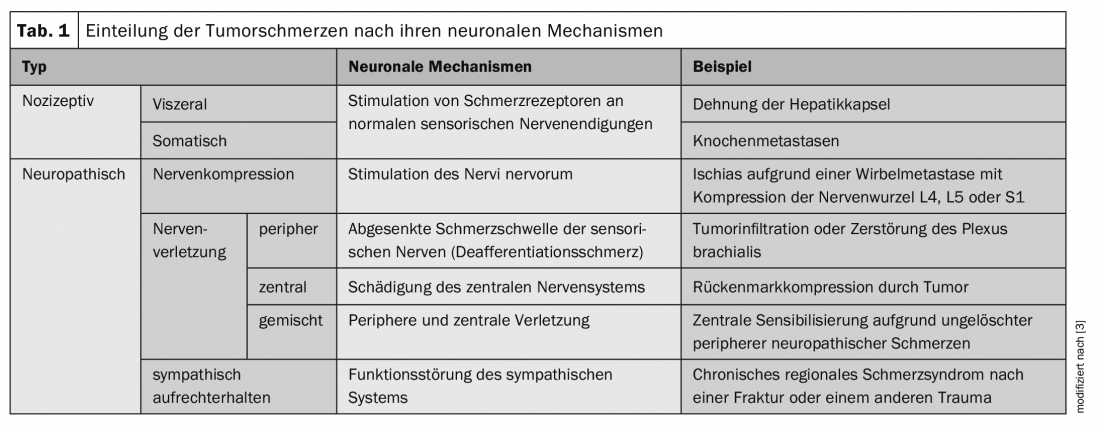
In addition to neuropathic and nociceptive pain, severe pain is often caused by osseous or hepatic metastases [2]. According to the current WHO guidelines, however, they are primarily classified according to their neuronal mechanisms [3] (Table 1) . The patients are also massively impaired in their lifestyle by the tumor pain. However, treatment is often a balancing act, as the possible development of tolerance and dependence at high doses can be accompanied by hyperalgesia. Under high doses of morphine, pain states may occur that are no longer based on the original pain but are iatrogenically induced by the opioids. As a result, tumor pain patients often tend to be underserved. However, current knowledge suggests that tumor pain can be relieved in almost all patients [4].


Targeting medications

Pain management recommendations refer to different levels of pain intensity (mild, moderate, or severe). Therefore, a pain history and pain-related clinical examination should be part of any pain diagnosis. If possible, the assessment of pain intensity should be done by the patient himself. In addition, it must be clarified whether there is a treatable cause of pain. The German S3 guidelines recommend evaluating the possibility of radiotherapy, especially in cases of bone metastases [4].

For tumor pain therapy, a number of drug classes can be used depending on the type of pain [3] (Tab. 2). However, differences between the WHO guideline shown and the German S3 guideline should be noted here. For example, the former mentions ketorolac, which has not been on the market in Germany since 1993 but is available in Switzerland.
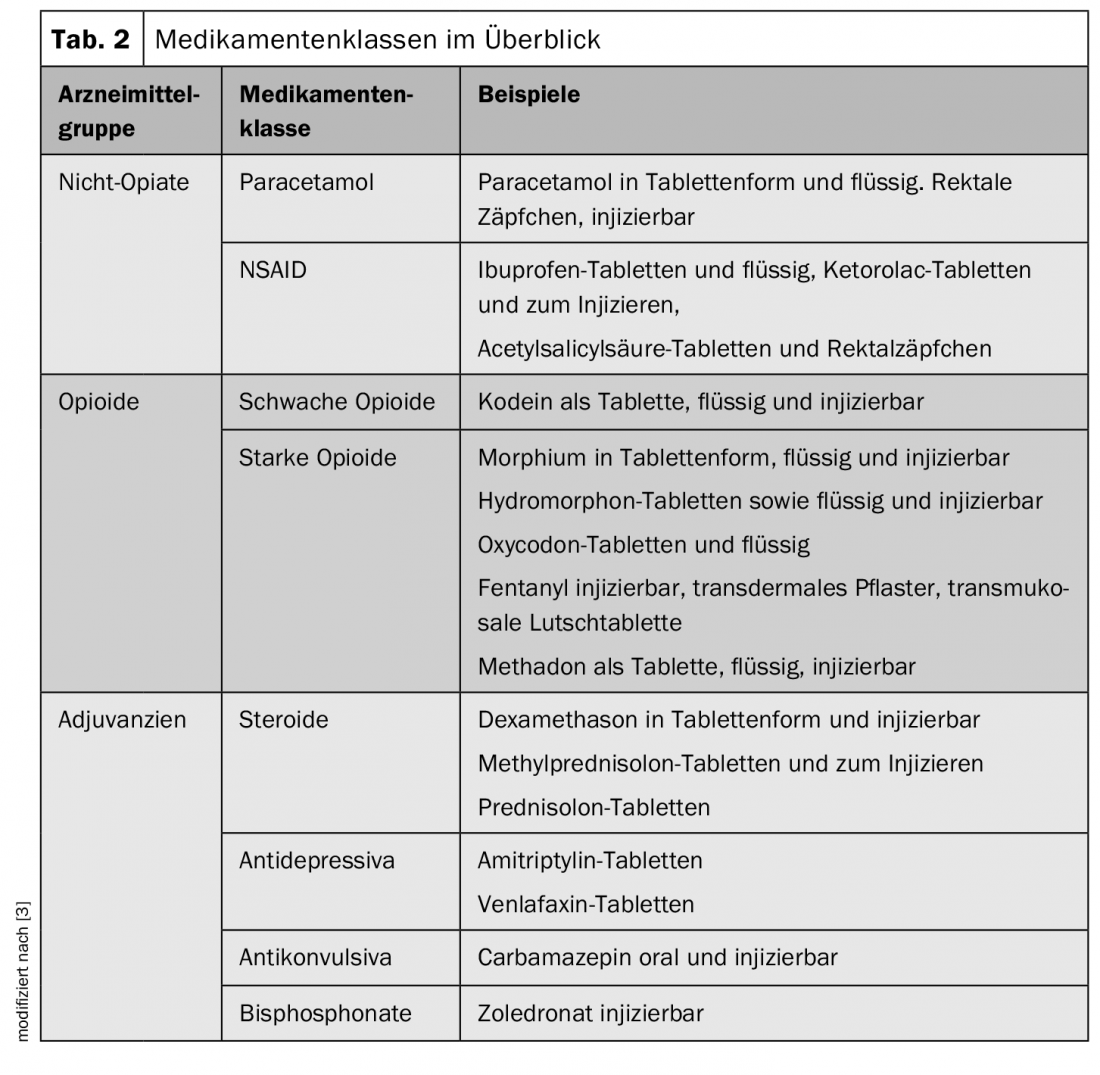


According to the S3 guideline, which is based on the recommendations of the European Association for Palliative Care (EAPC), treatment should be started with non-opioids according to the 3-step regimen. If pain cannot be adequately controlled in this way, or in patients with moderate tumor pain, additional oral weak-acting opioids or low-dose strong-acting opioids should be administered. Strong-acting opioids should be used in patients with moderate to severe tumor pain. Morphine, oxycodone, and hydromorphone can be used as the first choice [4]. However, in principle, according to WHO guidelines, in adults (including the elderly) and adolescents with cancer-related pain, any opioid can be considered to maintain pain relief, depending on clinical judgment and severity of pain, to maintain effective and safe pain control [3]. Regardless of which guideline is followed, the primary call is for continuous and sufficient baseline medication titration schedules and rapid-release opioids as an on-demand medication for pain attacks.

Literature:

  1. Horlemann J: DGS Practice Guidelines Pain Medicine. 2014. www.dgs-praxisleitlinien.de (last accessed 03/14/2020)
  2. Taghizadeh H, Benrath J. (2019): Tumor pain therapy. In: Pocket Guide Pain Management. Springer, Berlin, Heidelberg
  3. World Health Organization: WHO guidelines for the pharmacological and radiotherapeutic management of cancer pain in adults and adolescents. Geneva January 2019. www.who.int/ncds/management/palliative-care/cancer-pain-guidelines/en/ (last accessed 03/14/2020)
  4. Oncology guideline program (German Cancer Society, German Cancer Aid, AWMF): Palliative care for patients with a non-curable cancer, abridged version 2.1, 2020, AWMF register number: 128/001OL, www.leitlinienprogramm-onkologie.de/leitlinien/palliativmedizin (last accessed on: 14.03.2020).


InFo ONCOLOGY & HEMATOLOGY 2020; 8(2): 24-25.

Autoren
  • Leoni Burggraf
Publikation
  • InFo ONKOLOGIE & HÄMATOLOGIE
Related Topics
  • Pain control
  • Pain Management
  • Tumor pain
Previous Article
  • Medicinal products containing cannabis

Miracle cure or marketing hype?

  • Education
  • General Internal Medicine
  • Neurology
  • Oncology
  • ORL
  • Pharmaceutical medicine
  • Pharmacology and toxicology
  • RX
View Post
Next Article
  • Endogenous psychoses

Schizophrenia: As if from another world

  • Education
  • Psychiatry and psychotherapy
  • RX
View Post
You May Also Like
View Post
  • 4 min
  • Multiple sclerosis

Physical and psychosocial fatigue have the greatest impact on HRQoL

    • RX
    • Education
    • Neurology
    • Psychiatry and psychotherapy
    • Studies
View Post
  • 8 min
  • Hyperhidrosis: Keep a Cool Head

An Overview of Important Treatment Options

    • RX
    • Dermatology and venereology
    • Education
    • General Internal Medicine
    • Pharmacology and toxicology
    • Studies
View Post
  • 6 min
  • This article was sponsored by Johnson & Johnson.

Give your patients a chance to live longer without progression with TECVAYLI® + DARZALEX® compared to DPd/DVd1

    • RX
    • Hematology
    • Oncology
    • Partner Content
    • Studies
View Post
  • 6 min
  • Sjögren's Syndrome in Early Childhood

Children often develop lymphomas

    • RX
    • Education
    • Pediatrics
    • Rheumatology
    • Studies
View Post
  • 12 min
  • Multidrug-Resistant Pathogens in Wound Care

An Enemy in the Microbiome?

    • Dermatology and venereology
    • CME continuing education
    • Infectiology
    • Physical medicine and rehabilitation
    • Prevention and health care
    • RX
    • Surgery
View Post
  • 14 min
  • Rare Genodermatoses: From Diagnosis to Treatment

Darier’s Disease, also known as Follicular Keratosis – Update 2026

    • CME continuing education
    • Cases
    • Dermatology and venereology
    • Pharmacology and toxicology
    • RX
    • Studies
View Post
  • 9 min
  • Psychedelic-assisted therapy

Current status of PAT

    • RX
    • CME continuing education
    • General Internal Medicine
    • Pharmacology and toxicology
    • Psychiatry and psychotherapy
    • Studies
View Post
  • 7 min
  • Osgood-Schlatter Disease

Clinical Presentation, Diagnosis, and Treatment

    • RX
    • Cases
    • Education
    • Orthopedics
    • Pediatrics
  • IBD matters

    Zum Thema
Top CME content
  • 1
    Darier’s Disease, also known as Follicular Keratosis – Update 2026
  • 2
    An Enemy in the Microbiome?
  • 3
    Evidence-Based Neuromodulation Based on Clinical Trials and Real-World Data
  • 4
    Current status of PAT
  • 5
    Development, Diagnosis, Epidemiology, and Treatment of a Disease Entity

Newsletter

Sign up and stay up to date

Subscribe
Medizinonline Medizinonline
  • Contact
  • General terms and conditions
  • Imprint

Input your search keywords and press Enter.