Medizinonline Medizinonline
  • News
    • News
    • Market & Medicine
  • Patients
    • Disease patterns
    • Diagnostics
    • Therapy
  • Partner Content
    • Diabetes
      • Dia-Month Club – Type 2 Diabetes
      • Diabetes in Motion
      • Diabetes Podcasts
    • Gastroenterology
      • IBD matters
    • Oncology
      • Swiss Oncology in motion
    • Orthopedics
      • Osteoporosis in motion
  • Departments
    • Allergology and clinical immunology
    • General Internal Medicine
    • Anesthesiology
    • Angiology
    • Surgery
    • Dermatology and venereology
    • Endocrinology and Diabetology
    • Nutrition
    • Gastroenterology and Hepatology
    • Genetics
    • Geriatrics
    • Gynecology
    • Hematology
    • Infectiology
    • Cardiology
    • Nephrology
    • Neurology
    • Emergency and intensive care medicine
    • Nuclear Medicine
    • Oncology
    • Ophthalmology
    • ORL
    • Orthopedics
    • Pediatrics
    • Pharmacology and toxicology
    • Pharmaceutical medicine
    • Phlebology
    • Physical medicine and rehabilitation
    • Pneumology
    • Prevention and health care
    • Psychiatry and psychotherapy
    • Radiology
    • Forensic Medicine
    • Rheumatology
    • Sports Medicine
    • Traumatology and trauma surgery
    • Tropical and travel medicine
    • Urology
    • Dentistry
  • CME & Congresses
    • CME continuing education
    • Congress Reports
    • Congress calendar
  • Practice
    • Noctimed
    • Practice Management
    • Jobs
    • Interviews
  • Log In
  • Register
  • My account
  • Contact
  • Publications
  • Contact
  • Deutsch
  • English
  • Français
  • Italiano
  • Português
  • Español
Subscribe
Medizinonline Medizinonline
  • News
    • News
    • Market & Medicine
  • Patienten
    • Krankheitsbilder
    • Diagnostik
    • Therapie
  • Partner Content
    • Diabetes
      • Dia-Month Club – Type 2 Diabetes
      • Diabetes in Motion
      • Diabetes Podcasts
    • Gastroenterology
      • IBD matters
    • Oncology
      • Swiss Oncology in motion
    • Orthopedics
      • Osteoporosis in motion
    • Phytotherapie
    • Rheumatology
  • Departments
    • Fachbereiche 1-13
      • Allergology and clinical immunology
      • General Internal Medicine
      • Anesthesiology
      • Angiology
      • Surgery
      • Dermatology and venereology
      • Endocrinology and Diabetology
      • Nutrition
      • Gastroenterology and Hepatology
      • Genetics
      • Geriatrics
      • Gynecology
      • Hematology
    • Fachbereiche 14-26
      • Infectiology
      • Cardiology
      • Nephrology
      • Neurology
      • Emergency and intensive care medicine
      • Nuclear Medicine
      • Oncology
      • Ophthalmology
      • ORL
      • Orthopedics
      • Pediatrics
      • Pharmacology and toxicology
      • Pharmaceutical medicine
    • Fachbereiche 26-38
      • Phlebology
      • Physical medicine and rehabilitation
      • Phytotherapy
      • Pneumology
      • Prevention and health care
      • Psychiatry and psychotherapy
      • Radiology
      • Forensic Medicine
      • Rheumatology
      • Sports Medicine
      • Traumatology and trauma surgery
      • Tropical and travel medicine
      • Urology
      • Dentistry
  • CME & Congresses
    • CME continuing education
    • Congress Reports
    • Congress calendar
  • Practice
    • Noctimed
    • Practice Management
    • Jobs
    • Interviews
Login

Sie haben noch keinen Account? Registrieren

  • Good Friday rolls and hummingbirds

Typical appearance patterns of atypical Parkinson’s syndromes

    • Cases
    • Neurology
    • Partner Content
    • RX
  • 2 minute read

In atypical Parkinson’s syndromes, imaging often reveals charakeristic patterns that allow diganostic assignment. These infestation patterns often have catchy names.

Introduction: In the so-called “atypical Parkinson’s syndromes” (also: Parkinson’s plus), other brain systems are affected early on in addition to the dopaminergic neurons of the substantia nigra. While these diseases usually allow clear clinical diagnoses in later stages, the differentiation from idiopathic PD in earlier stages or with atypical course is sometimes difficult. Due to advanced atrophy of circumscribed areas of the CNS, imaging often reveals characteristic patterns that allow accurate diagnostic assignment. The designation of these infestation patterns is very descriptive and memorable.


Case description: Both patients presented here were suspected of having atypical Parkinson’s disease with tremor and gait unsteadiness. Multisystem atrophy (MSA) refers to a sporadic neurodegenerative disorder with symptoms of Parkinson’s disease (MSA-P), cerebellar ataxia (MSA-C), or autonomic deficits (MSA-A). Subclassification depends on the dominant symptomatology.
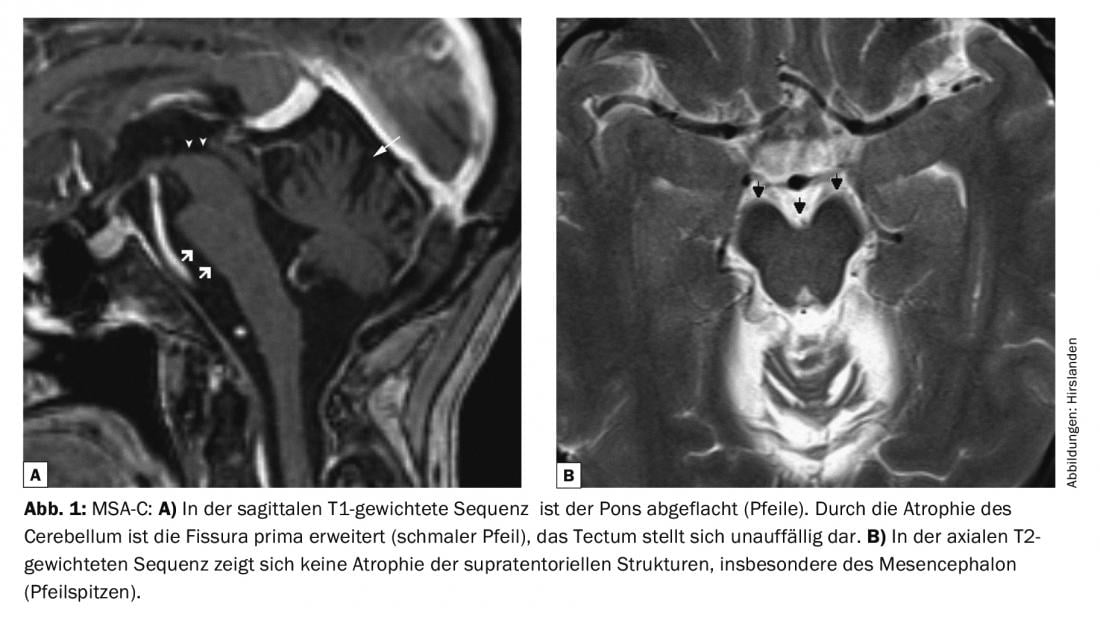


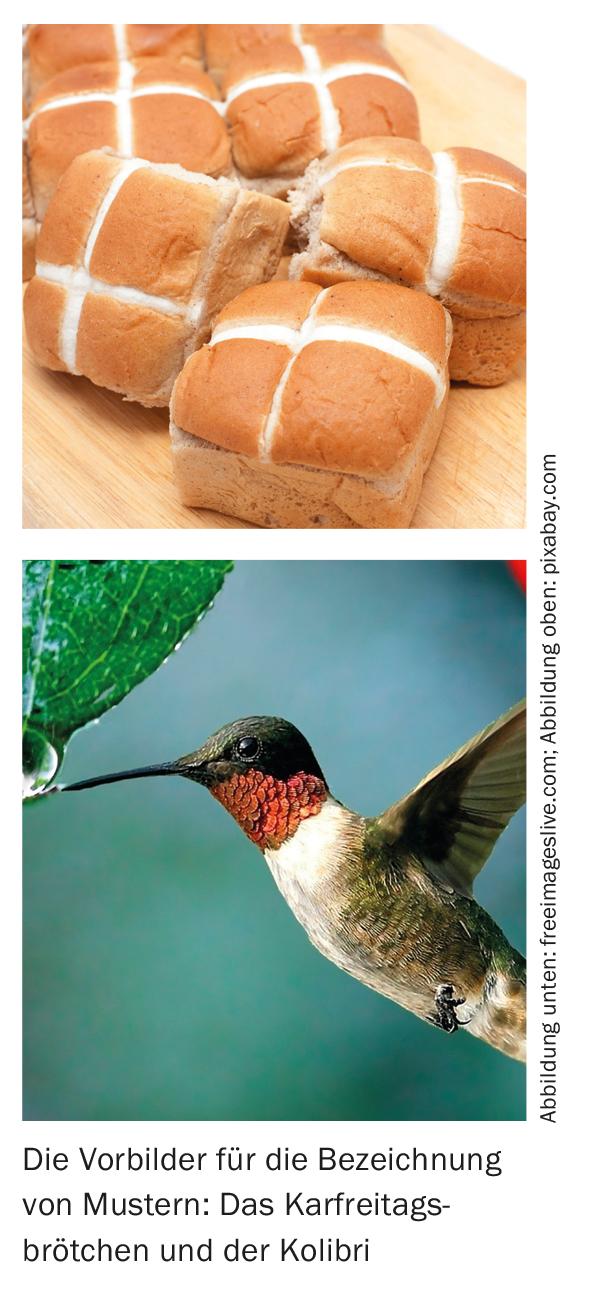
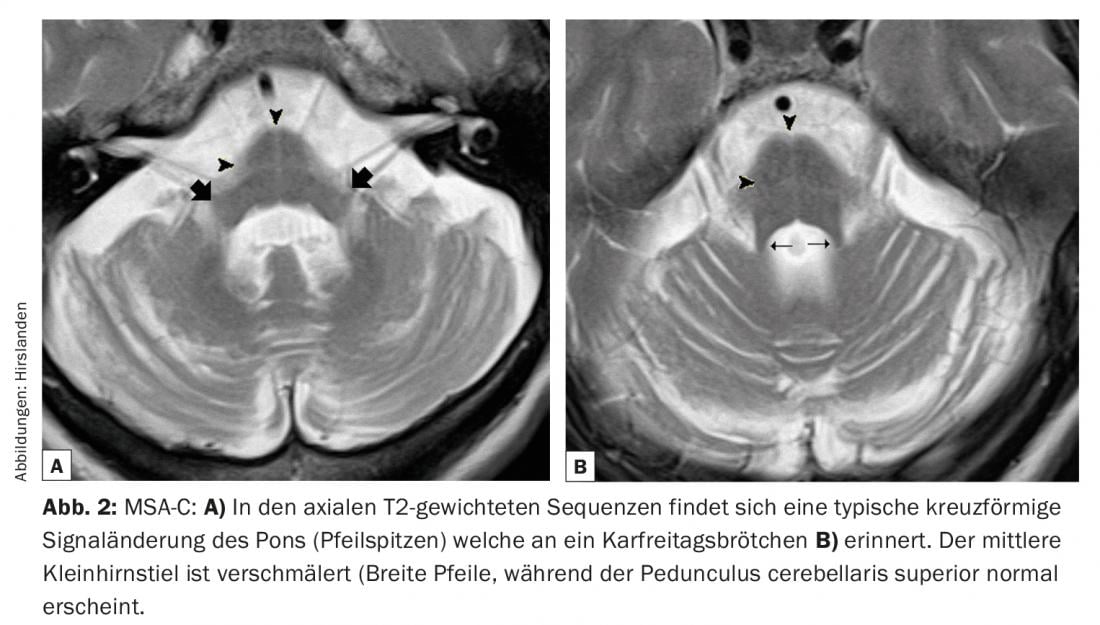
In particular, MSA-C shows a characteristic picture with exclusively infratentorial atrophy of the pons and cerebellum. Sagittal images show marked atrophy of the pons (arrows in Fig. 1b) and of the cerebellum with dilated fissura prima (narrow arrow in Figure 1a). The selective loss of transverse pontine fibers with concomitantly preserved corticocerebellar tracts shows a characteristic cross-shaped pattern in the transverse T2-weighted and flair sequences (Fig. 2). This one is reminiscent of English Good Friday rolls (Fig. 2b), which is why the literature speaks of the so-called “Hot-Cross-Bun Sign”.


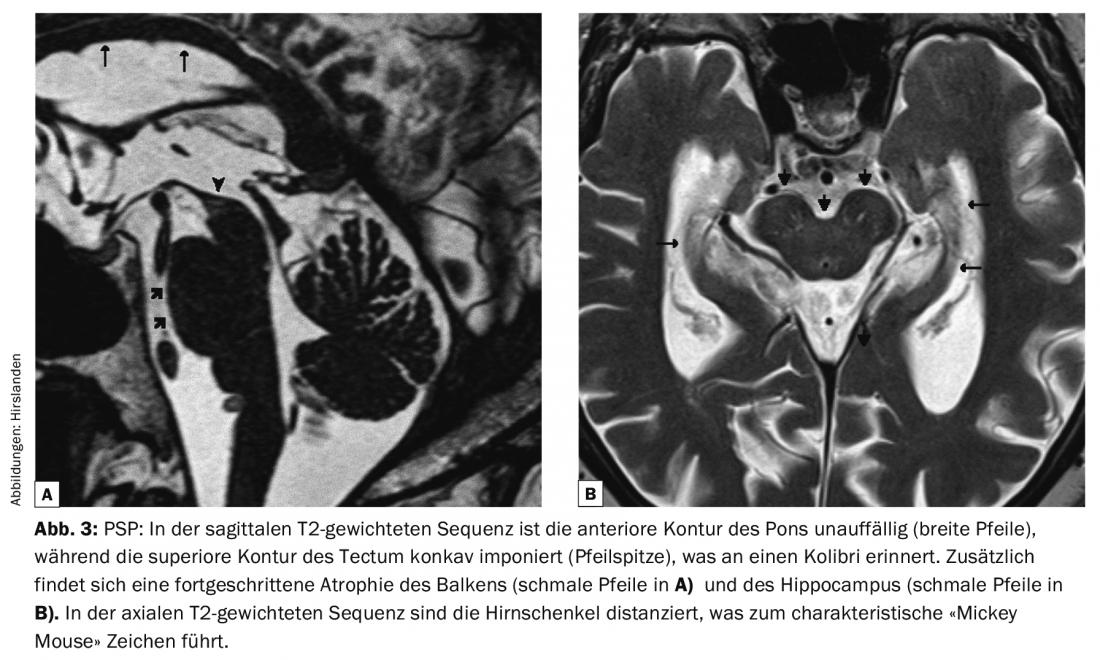
Discussion: Progressive supranuclear gaze palsy (PSP) is a tau pathology with extensive supra- and infratentorial atrophy (Fig. 3). Imaging shows a characteristic atrophy of the midbrain already in early stages. In the midsagittal images, the superior contour of the tectum is concave (arrowhead in Fig. 3a) which reminds the image of a flying hummingbird. In the axial sequences, there is a divergence of the crura cerebri, which themselves are not significantly atrophied, the so-called “Mickey Mouse sign” (Fig. 3).


While the above signs were originally considered pathognomonic for MSA-C and PSP, respectively, it is now believed that significant overlap of symptoms exists. Nevertheless, diagnostic imaging can provide an important clue to the differential diagnosis.


InFo NEUROLOGY & PSYCHIATRY 2017; 15(4): 20-21.

Autoren
  • PD Dr. med. Arne Fischmann
  • Prof. Dr. med. Stephan G. Wetzel
Publikation
  • InFo NEUROLOGIE & PSYCHIATRIE
Related Topics
  • atypical Parkinson's syndromes
  • Cerebellar ataxia
  • Parkinson's
  • Parkinson's Plus
  • Supranuclear gaze paresis
Previous Article
  • Rheumatoid arthritis in the early stages

Countermeasures in the early stages can prevent manifest rheumatoid arthritis

  • Congress Reports
  • General Internal Medicine
  • Rheumatology
  • RX
View Post
Next Article
  • Therapy for gastrointestinal stromal tumors

Surgical and oncological aspects

  • Education
  • Gastroenterology and Hepatology
  • Oncology
  • RX
  • Surgery
View Post
You May Also Like
View Post
  • 6 min
  • Analysis of SNVCS data from the period 2005-2022

TBE vaccination for children and adolescents in Switzerland

    • Education
    • General Internal Medicine
    • Infectiology
    • Neurology
    • Pediatrics
    • Prevention and health care
    • RX
View Post
  • 4 min
  • Tuberculosis

Detecting diabetes in TB patients early and efficiently

    • Education
    • Endocrinology and Diabetology
    • Infectiology
    • Pneumology
    • RX
    • Studies
View Post
  • 4 min
  • Trichophyton indotineae

Terbinafine-resistant dermatophytoses are on the rise in Central Europe

    • Allergology and clinical immunology
    • Congress Reports
    • Dermatology and venereology
    • Infectiology
    • RX
    • Studies
    • Tropical and travel medicine
View Post
  • 11 min
  • Peristomal skin health

Focus on preventive care options

    • Cases
    • CME continuing education
    • Dermatology and venereology
    • Gastroenterology and Hepatology
    • Infectiology
    • Physical medicine and rehabilitation
    • Prevention and health care
    • RX
    • Surgery
View Post
  • 7 min
  • Disease-modifying therapies for ATTR-CM

TTR stabilizers, gene silencing and gene scissors: where do we stand?

    • Cardiology
    • Congress Reports
    • Genetics
    • RX
    • Studies
View Post
  • 8 min
  • Proteins in wound healing

Do special amino acids lead to success?

    • CME continuing education
    • Dermatology and venereology
    • Endocrinology and Diabetology
    • Nutrition
    • RX
    • Studies
View Post
  • 4 min
  • HER2+ early breast cancer

DESTINY-Breast11 – neoadjuvant T-DXd without anthracyclines

    • Education
    • Gynecology
    • Oncology
    • RX
    • Studies
View Post
  • 3 min
  • Lavender aromatherapy

Take away the fear of the dentist

    • Dentistry
    • Education
    • Pharmaceutical medicine
    • Phytotherapy
    • Psychiatry and psychotherapy
    • RX
    • Studies
Landingpage Fachinfo Landingpage Button
  • IBD matters

    Zum Thema
Top CME content
  • 1
    Communication as the key to therapy adherence
  • 2
    Solutions to the malnutrition dilemma
  • 3
    Solutions to the malnutrition dilemma
  • 4
    Focus on preventive care options
  • 5
    Fertility preservation from gonads to genomes to genoids

Newsletter

Sign up and stay up to date

Subscribe
Medizinonline Medizinonline
  • Contact
  • General terms and conditions
  • Imprint

Input your search keywords and press Enter.