Medizinonline Medizinonline
  • News
    • News
    • Market & Medicine
  • Patients
    • Disease patterns
    • Diagnostics
    • Therapy
  • Partner Content
    • Diabetes
      • Dia-Month Club – Type 2 Diabetes
      • Diabetes in Motion
      • Diabetes Podcasts
    • Gastroenterology
      • IBD matters
    • Oncology
      • Swiss Oncology in motion
    • Orthopedics
      • Osteoporosis in motion
  • Departments
    • Allergology and clinical immunology
    • General Internal Medicine
    • Anesthesiology
    • Angiology
    • Surgery
    • Dermatology and venereology
    • Endocrinology and Diabetology
    • Nutrition
    • Gastroenterology and Hepatology
    • Genetics
    • Geriatrics
    • Gynecology
    • Hematology
    • Infectiology
    • Cardiology
    • Nephrology
    • Neurology
    • Emergency and intensive care medicine
    • Nuclear Medicine
    • Oncology
    • Ophthalmology
    • ORL
    • Orthopedics
    • Pediatrics
    • Pharmacology and toxicology
    • Pharmaceutical medicine
    • Phlebology
    • Physical medicine and rehabilitation
    • Pneumology
    • Prevention and health care
    • Psychiatry and psychotherapy
    • Radiology
    • Forensic Medicine
    • Rheumatology
    • Sports Medicine
    • Traumatology and trauma surgery
    • Tropical and travel medicine
    • Urology
    • Dentistry
  • CME & Congresses
    • CME continuing education
    • Congress Reports
    • Congress calendar
  • Practice
    • Noctimed
    • Practice Management
    • Jobs
    • Interviews
  • Log In
  • Register
  • My account
  • Contact
  • Publications
  • Contact
  • Deutsch
  • English
  • Français
  • Italiano
  • Português
  • Español
Subscribe
Medizinonline Medizinonline
  • News
    • News
    • Market & Medicine
  • Patienten
    • Krankheitsbilder
    • Diagnostik
    • Therapie
  • Partner Content
    • Diabetes
      • Dia-Month Club – Type 2 Diabetes
      • Diabetes in Motion
      • Diabetes Podcasts
    • Gastroenterology
      • IBD matters
    • Oncology
      • Swiss Oncology in motion
    • Orthopedics
      • Osteoporosis in motion
    • Phytotherapie
    • Rheumatology
  • Departments
    • Fachbereiche 1-13
      • Allergology and clinical immunology
      • General Internal Medicine
      • Anesthesiology
      • Angiology
      • Surgery
      • Dermatology and venereology
      • Endocrinology and Diabetology
      • Nutrition
      • Gastroenterology and Hepatology
      • Genetics
      • Geriatrics
      • Gynecology
      • Hematology
    • Fachbereiche 14-26
      • Infectiology
      • Cardiology
      • Nephrology
      • Neurology
      • Emergency and intensive care medicine
      • Nuclear Medicine
      • Oncology
      • Ophthalmology
      • ORL
      • Orthopedics
      • Pediatrics
      • Pharmacology and toxicology
      • Pharmaceutical medicine
    • Fachbereiche 26-38
      • Phlebology
      • Physical medicine and rehabilitation
      • Phytotherapy
      • Pneumology
      • Prevention and health care
      • Psychiatry and psychotherapy
      • Radiology
      • Forensic Medicine
      • Rheumatology
      • Sports Medicine
      • Traumatology and trauma surgery
      • Tropical and travel medicine
      • Urology
      • Dentistry
  • CME & Congresses
    • CME continuing education
    • Congress Reports
    • Congress calendar
  • Practice
    • Noctimed
    • Practice Management
    • Jobs
    • Interviews
Login

Sie haben noch keinen Account? Registrieren

  • Epilepsy

Precision medicine in epilepsy management within reach?

    • Education
    • Neurology
    • RX
    • Surgery
  • 3 minute read

Epileptic seizures are the clinical manifestation of excessive hypersynchronous discharges of neurons of the cerebral cortex. Although pharmacologic options have become much more diverse in recent decades, effective treatment management still presents significant challenges. The goal is individually designed precision medicine that optimizes the course of disease.

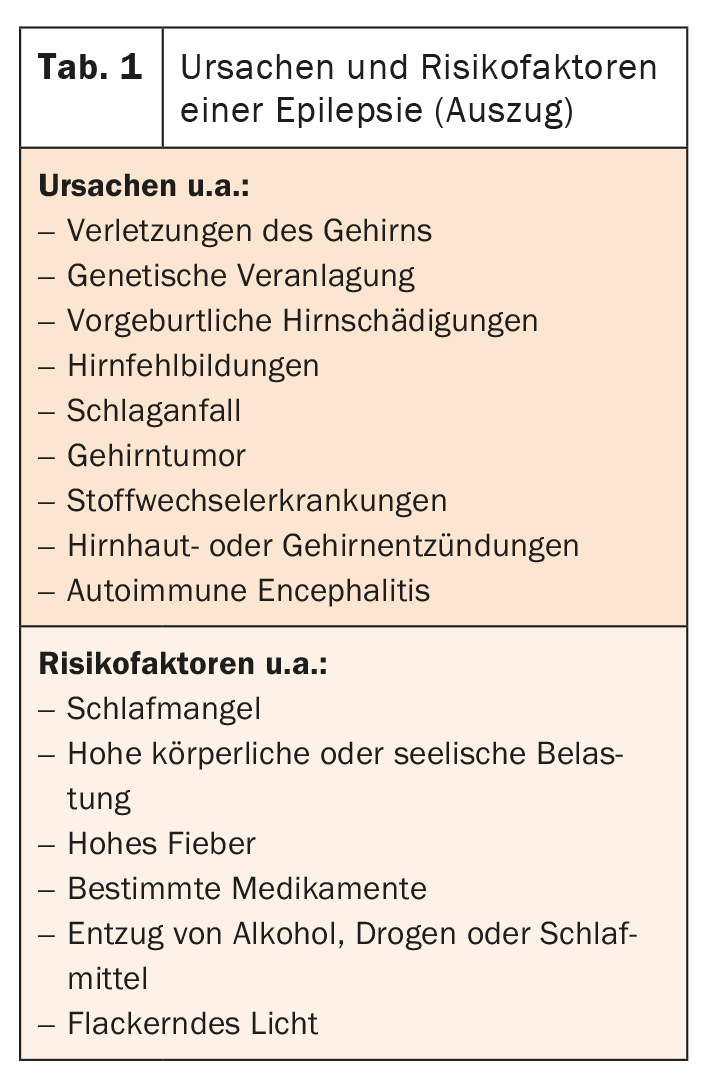
In Switzerland, about 80,000 people live with epilepsy [1]. Up to 5% of the population will experience an epileptic seizure in their lifetime [2]. Epilepsy is defined as a functional disorder of the brain that occurs due to pathological excitation formation in the absence of excitation limitation in the nerve cell assemblies of the CNS [3]. This requires at least two unprovoked epileptic seizures occurring more than 24 hours apart, or one unprovoked epileptic seizure associated with a high probability of further seizures occurring within the next 10 years. The causes and risk factors are complex (Table 1) [2]. In total, there are over 30 different types of epilepsy [1].

Several types of seizures are distinguished:

  • Absence: Brief clouding of consciousness that usually occurs in childhood.
  • Myoclonic seizure: seizure associated with twitching of individual muscle groups
  • Focal seizure: Often altered perception (aura) in the run-up, then seizure limited to one area of the brain with, among other things, paraesthesia, automatic movements, speech disorders, etc.
  • Generalized seizure: seizure in both cerebral hemispheres with unconsciousness and twitching or spasms of the extremities.

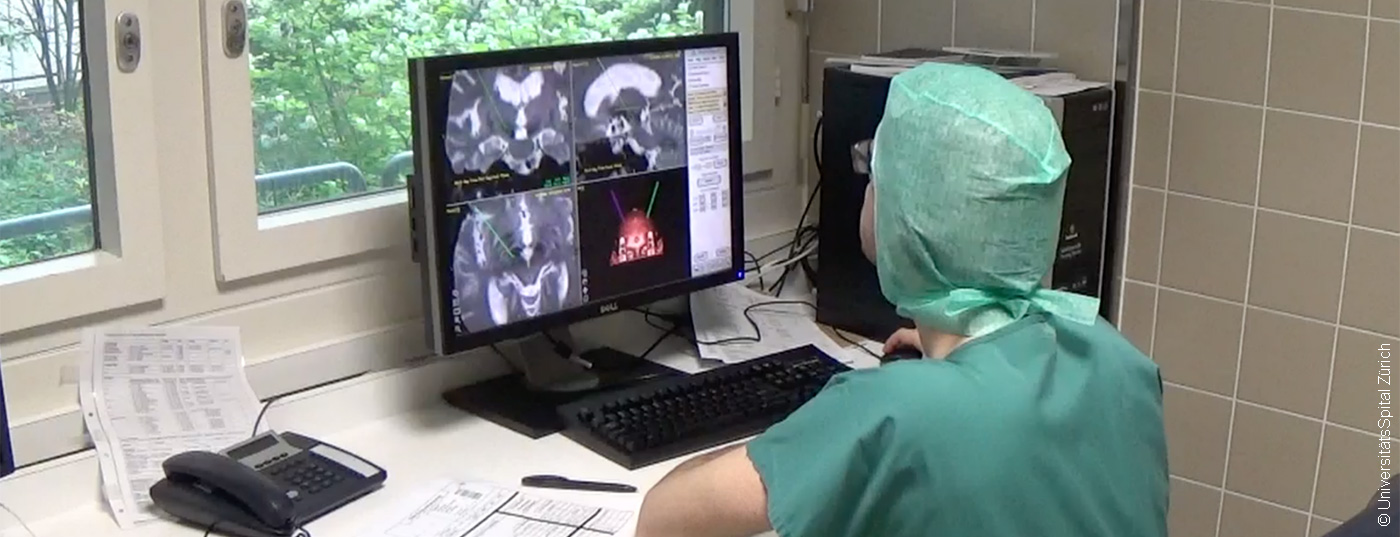
Furthermore, a seizure that initially starts focally may spread further and thus become a “secondary generalized seizure”. Whether a seizure recurs at all, if so, how often and how severe the condition is, varies greatly from individual to individual. The diagnostic procedure is therefore very comprehensive. In addition to a sequential description of the seizures by the patient, changes in the electroencephalogram (EEG) are detected. In addition to a surface EEG, an intracranial EEG may be required. Especially when an accurate diagnosis is a prerequisite for a successful surgical intervention. Multimodal imaging with high-field MRI or molecular imaging is then also used for this purpose [4].


Treatment options tailored to individual needs

Primarily, epilepsy is treated with antiepileptic drugs. In two-thirds of patients, long-term freedom from seizures can be achieved in this way. More than 20 different agents are available, including carbamazepine, gabapentin, lamotrigine, levetiracetam, oxcarbazepine, topiramate, valproic acid, and zonisamide. New developments in recent years for the treatment of focal epilepsies include eslicarbazepine acetate, perampanel, lacosamide, and brivaracetam. Eslicarbazepine acetate belongs to the third-generation antiepileptic drugs. As a further development of carbamazepine and oxcarbazepine, it exhibits more selective use of the enantiomer and significantly improved pharmacokinetics. Thus, a single dose can also be given at more uniform serum levels. Only if the seizures persist despite medication do measures such as surgery, vagus nerve stimulation or deep brain stimulation take effect.

In principle, the choice of medication should be made individually. Therefore, in addition to the seizure situation, age, gender, and compliance should also be considered. Also, combination treatments are needed more often for difficult-to-treat epilepsies than for vascular epilepsies. In the latter, monotherapies with, for example, eslicarbazepine acetate, lamotrigine, or pregabalin are usually effective.


Literature:

  1. www.epi.ch/ueber-epilepsie (last accessed 07.03.2022)
  2. www.usz.ch/krankheit/epilepsie (last accessed 07.03.2022)
  3. https://flexikon.doccheck.com/de/Epilepsie (last accessed 07.03.2022)
  4. Baud MO, Schindler K, Flügel D, Bassetti C: Personalized chronotherapy in epilepsy. Swiss Med Forum. 2020; 20(3940): 532-537.


InFo NEUROLOGY & PSYCHIATRY 2022; 20(2): 32.

Autoren
  • Leoni Burggraf
Publikation
  • InFo NEUROLOGIE & PSYCHIATRIE
Related Topics
  • accrual
  • Brain Stimulation
  • Epilepsy
  • lacosamide
  • vagus nerve stimulation
  • zonisamide
Previous Article
  • Corona protection and skin health

Mask dermatitis – expert tips for prophylaxis and treatment

  • Allergology and clinical immunology
  • Congress Reports
  • Dermatology and venereology
  • Infectiology
  • News
  • RX
  • Studies
View Post
Next Article
  • Pediatric pneumology

Growing up after lung transplantation

  • CME continuing education
  • Education
  • General Internal Medicine
  • Pediatrics
  • Pneumology
  • RX
  • Studies
  • Surgery
View Post
You May Also Like
View Post
  • 4 min
  • Casuistry

Rituximab used effectively against IgG4-RD colitis

    • RX
    • Cases
    • Education
    • Gastroenterology and Hepatology
    • General Internal Medicine
    • Radiology
    • Rheumatology
View Post
  • 5 min
  • Sarcoidosis

New options from JAKi to mTOR

    • RX
    • Congress Reports
    • General Internal Medicine
    • Pneumology
    • Studies
View Post
  • 6 min
  • Head and neck squamous cell carcinoma

Precision immunotherapy and local treatment

    • RX
    • Congress Reports
    • Dermatology and venereology
    • Oncology
    • ORL
    • Studies
View Post
  • 3 min
  • From symptom to diagnosis

Abdominal pain – Prostate cysts

    • RX
    • Cases
    • Education
    • General Internal Medicine
    • Radiology
    • Surgery
    • Urology
View Post
  • 0 min
  • Multimodal Parkinson's Treatment

Positive Effects of a Music-Based Intervention

    • RX
    • Education
    • Geriatrics
    • Neurology
    • Physical medicine and rehabilitation
    • Psychiatry and psychotherapy
View Post
  • 8 min
  • Psychooncology

Communication as the key to therapy adherence

    • RX
    • CME continuing education
    • General Internal Medicine
    • Practice Management
View Post
  • 9 min
  • Cardiology

Minimally invasive – the quiet triumph of modern heart surgery

    • RX
    • Cardiology
    • CME continuing education
    • Studies
    • Surgery
View Post
  • 6 min
  • Schizophrenia in the early-onset stage

Which antipsychotic should be used for treatment-naive patients?

    • RX
    • Education
    • Pharmacology and toxicology
    • Psychiatry and psychotherapy
    • Studies
  • IBD matters

    Zum Thema
Top CME content
  • 1
    Current State of Knowledge and New Therapeutic Approaches
  • 2
    Why is it so hard to lose weight?
  • 3
    Functional limb preservation between infection control, vascular medicine and resurfacing
  • 4
    Algorithms, avatars and the unburdened mind
  • 5
    Communication as the key to therapy adherence

Newsletter

Sign up and stay up to date

Subscribe
Medizinonline Medizinonline
  • Contact
  • General terms and conditions
  • Imprint

Input your search keywords and press Enter.