Medizinonline Medizinonline
  • News
    • News
    • Market & Medicine
  • Patients
    • Disease patterns
    • Diagnostics
    • Therapy
  • Partner Content
    • Dermatology
      • Atopic dermatitis and psoriasis news
    • Diabetes
      • Dia-Month Club – Type 2 Diabetes
      • Diabetes in Motion
      • Diabetes Podcasts
    • Gastroenterology
      • IBD matters
    • Oncology
      • Swiss Oncology in motion
    • Orthopedics
      • Osteoporosis in motion
  • Departments
    • Allergology and clinical immunology
    • General Internal Medicine
    • Anesthesiology
    • Angiology
    • Surgery
    • Dermatology and venereology
    • Endocrinology and Diabetology
    • Nutrition
    • Gastroenterology and Hepatology
    • Genetics
    • Geriatrics
    • Gynecology
    • Hematology
    • Infectiology
    • Cardiology
    • Nephrology
    • Neurology
    • Emergency and intensive care medicine
    • Nuclear Medicine
    • Oncology
    • Ophthalmology
    • ORL
    • Orthopedics
    • Pediatrics
    • Pharmacology and toxicology
    • Pharmaceutical medicine
    • Phlebology
    • Physical medicine and rehabilitation
    • Pneumology
    • Prevention and health care
    • Psychiatry and psychotherapy
    • Radiology
    • Forensic Medicine
    • Rheumatology
    • Sports Medicine
    • Traumatology and trauma surgery
    • Tropical and travel medicine
    • Urology
    • Dentistry
  • CME & Congresses
    • CME continuing education
    • Congress Reports
    • Congress calendar
  • Practice
    • Noctimed
    • Practice Management
    • Jobs
    • Interviews
  • Log In
  • Register
  • My account
  • Contact
  • Publications
  • Contact
  • Deutsch
  • English
  • Français
  • Italiano
  • Português
  • Español
Subscribe
Medizinonline Medizinonline
  • News
    • News
    • Market & Medicine
  • Patienten
    • Krankheitsbilder
    • Diagnostik
    • Therapie
  • Partner Content
    • Dermatology
      • Atopic dermatitis and psoriasis news
    • Diabetes
      • Dia-Month Club – Type 2 Diabetes
      • Diabetes in Motion
      • Diabetes Podcasts
    • Gastroenterology
      • IBD matters
    • Oncology
      • Swiss Oncology in motion
    • Orthopedics
      • Osteoporosis in motion
    • Phytotherapie
    • Rheumatology
  • Departments
    • Fachbereiche 1-13
      • Allergology and clinical immunology
      • General Internal Medicine
      • Anesthesiology
      • Angiology
      • Surgery
      • Dermatology and venereology
      • Endocrinology and Diabetology
      • Nutrition
      • Gastroenterology and Hepatology
      • Genetics
      • Geriatrics
      • Gynecology
      • Hematology
    • Fachbereiche 14-26
      • Infectiology
      • Cardiology
      • Nephrology
      • Neurology
      • Emergency and intensive care medicine
      • Nuclear Medicine
      • Oncology
      • Ophthalmology
      • ORL
      • Orthopedics
      • Pediatrics
      • Pharmacology and toxicology
      • Pharmaceutical medicine
    • Fachbereiche 26-38
      • Phlebology
      • Physical medicine and rehabilitation
      • Phytotherapy
      • Pneumology
      • Prevention and health care
      • Psychiatry and psychotherapy
      • Radiology
      • Forensic Medicine
      • Rheumatology
      • Sports Medicine
      • Traumatology and trauma surgery
      • Tropical and travel medicine
      • Urology
      • Dentistry
  • CME & Congresses
    • CME continuing education
    • Congress Reports
    • Congress calendar
  • Practice
    • Noctimed
    • Practice Management
    • Jobs
    • Interviews
Login

Sie haben noch keinen Account? Registrieren

  • Health Services Research

International prospective registry study on pustular psoriasis

    • Congress Reports
    • Dermatology and venereology
    • Rheumatology
    • RX
    • Studies
  • 3 minute read

There are still many unanswered questions regarding the pathophysiology, course and treatment options of pustular psoriasis. Because it is a rare condition, there is a lack of large cohort data to date. Therefore, based on the “European Rare and Severe Psoriasis Expert Network”, the IRASPEN registry study was launched to gain new insights into different aspects of the disease and its treatment.

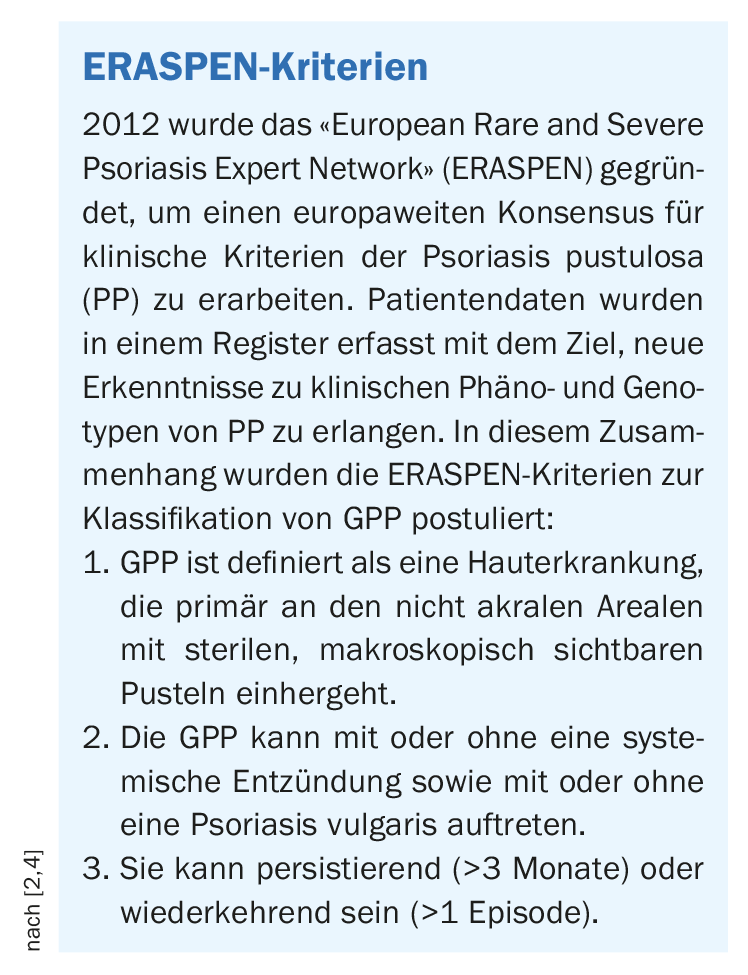
Psoriasis is a chronic, immune-mediated inflammatory disease in which both erythematous and pustular lesions may occur. These differ clinically and histologically, but occur in a clustered, coincident manner [1]. Occasionally, pustular skin manifestations can be observed dermatoscopically in inflammatory plaques of psoriasis vulgaris, as described by Barber and Königsbeck [2]. This led to the assumption that primary pustular skin lesions are part of the psoriasis spectrum, so that they are grouped together under the term psoriasis pustulosa (PP). Pustular forms of psoriasis are rare and pose a challenge in clinical practice [3]. In Generalized Pustular Psoriasis (GPP), in addition to pustular skin manifestations, a life-threatening multisystemic inflammatory reaction may occur. The ERASPEN criteria [2,4] (box) serve as the basis for the diagnostic classification of GPP. Palmoplantar pustulosis (PPP) is characterized by eruptive sterile vesicles and erythematous plaques on the palms and soles. In “Acrodermatitis continua suppurativa Hallopeau”, red, scaly foci with pustules form with a tendency to spread slowly starting from the tips of the fingers and toes.


IRASPEN: International Rare and Severe Psoriasis Expert Network

The aim of the prospective international registry study IRASPEN is primarily to describe the disease course and the different subtypes of pustular psoriasis [2,5]. Furthermore, it is hoped that the acquisition of genetic data and the investigation of molecular pathways will lead to a better understanding of clinical and pathophysiological processes. Another goal is to assess existing treatment options and identify “unmet needs.” The IRASPEN registry is planned to include at least 180 patients worldwide, including 140 with Palmoplantar Psoriasis (PPP), 20 with Generalized Pustular Psoriasis (GPP) and 20 with Acrodermatitis Continua of Hallopeau (ACH), as well as 360 unaffected relatives. The main inclusion criteria are: Age ≥6 months and a confirmed diagnosis of pustular psoriasis (PP) with an active episode within the last 6 months. It may be GPP, PPP or ACH or a mixed phenotype. Eight measurement time points are planned within the 5-year observation period, as well as flexible follow-up appointments for acute relapses. Patient-reported outcomes measurement tools (DLQI, EQ-5D, WPAI-GH, PSS, VAS pain and disease activity) and physician-collected assessments (GPPASI, GPPGA, PPP ASI, NAPSI) will be used. In addition, photodocumentation and lesion counts are performed and genetic material is collected (blood and skin biopsies).


The IRASPEN project is led by Prof. Dr. med. Dr. sc. net. Alexander Navarini, University Hospital Basel, and PD Julia-Tatjana Maul, MD, University Hospital Zurich. Further information is available at this web address: www.iraspen.org

Congress: European Academy of Dermatology and Venereology


Literature:

  1. Global Psoriasis Atlas, www.globalpsoriasisatlas.org/en/resources/pustular-psoriasis-research-progress, (last accessed Jan. 19, 2022).
  2. IRASPEN, www.iraspen.org/iraspen/About-Iraspen/Background-and-project-rationale.html (last accessed Jan. 19, 2022).
  3. Menter A, Van Voorhees AS, Hsu S: Pustular Psoriasis: A Narrative Review of Recent Developments in Pathophysiology and Therapeutic Options. Dermatol Ther (Heidelb) 2021; 11(6): 1917-1929.
  4. Navarini AA, et al: ERASPEN Network: European consensus statement on phenotypes of pustular psoriasis. J Eur Acad Dermatol Venereol 2017; 31(11): 1792-1799.
  5. Maul JT, et al: International Rare and Severe Psoriasis Expert Network (IRASPEN) – A prospective multi-center pustular psoriasis registry with genotype-phenotype correlation, Abstract N°: 1078, EADV Annual Meeting, Sept 29-Oct 2, 2022.
  6. Körber A, et al: Mutations in IL36RN in patients with generalized pustular psoriasis. J Invest Dermatol 2013; 133(11): 2634-2637.
  7. Mössner R, et al: The genetic basis for most patients with pustular skin disease remains elusive. Br J Dermatol 2018; 178(3): 740-748.
  8. Hüffmeier U, et al: Successful therapy with anakinra in a patient with generalized pustular psoriasis carrying IL36RN mutations. Br J Dermatol 2014; 170(1): 202-204.
  9. Mössner R, et al: Palmoplantar Pustular Psoriasis Is Associated with Missense Variants in CARD14, but Not with Loss-of-Function Mutations in IL36RN in European Patients. J Invest Dermatol 2015; 135(10): 2538-2541.
  10. Erlangen University Hospital, www.humangenetik.uk-erlangen.de/forschung/forschungsschwerpunkte/psoriasis/seltenere-psoriasisformen (last accessed 19.01.2022)


DERMATOLOGIE PRAXIS 2022; 32(1): 17

Autoren
  • Mirjam Peter, M.Sc.
Publikation
  • DERMATOLOGIE PRAXIS
Related Topics
  • Psoriasis
  • psoriasis pustulosa
  • Registry Study
Previous Article
  • Psychotherapy

Conflict management with patients from foreign cultures

  • CME continuing education
  • Education
  • Psychiatry and psychotherapy
  • RX
View Post
Next Article
  • Heart failure

Updated ESC guideline: What has remained the same and what is new?

  • Cardiology
  • Education
  • General Internal Medicine
  • RX
View Post
You May Also Like
View Post
  • 6 min
  • Respiratory infections: viral bronchitis or bacterial pneumonia?

Old crucial question in the light of current findings

    • Congress Reports
    • General Internal Medicine
    • Infectiology
    • Pharmaceutical medicine
    • Pharmacology and toxicology
    • Phytotherapy
    • Pneumology
    • RX
View Post
  • 6 min
  • What biomarkers reveal about "biological youth" - and what not (yet)

Epigenetic ageing

    • Education
    • Genetics
    • Geriatrics
    • Prevention and health care
    • RX
    • Studies
View Post
  • 4 min
  • Amyotrophic lateral sclerosis and nutrition

Calorie optimization in ALS through digital intervention

    • Education
    • Neurology
    • Nutrition
    • RX
    • Studies
View Post
  • 14 min
  • "Forgotten axis" between plant substances, gut and systemic health

Microbiome and phytotherapy

    • Education
    • Endocrinology and Diabetology
    • Gastroenterology and Hepatology
    • General Internal Medicine
    • Infectiology
    • Neurology
    • Nutrition
    • Pharmaceutical medicine
    • Phytotherapy
    • RX
    • Studies
View Post
  • 4 min
  • HIV: updated EACS guideline

Individualized approach to sustainable prevention and care

    • Cardiology
    • Education
    • General Internal Medicine
    • Infectiology
    • Prevention and health care
    • RX
    • Studies
View Post
  • 5 min
  • Evidence-based diagnostics and treatment in the medical setting

Anxiety and depression disorders in adolescence

    • Education
    • Pediatrics
    • Pharmacology and toxicology
    • Psychiatry and psychotherapy
    • RX
    • Studies
View Post
  • 25 min
  • Neuroenhancement

Can you swallow intelligence? Relevant substance classes times for healthy people

    • CME continuing education
    • Neurology
    • Pharmacology and toxicology
    • Psychiatry and psychotherapy
    • RX
    • Studies
View Post
  • 9 min
  • Microbiome, inflammaging and affective/cognitive health

Gut-brain axis in old age

    • Education
    • Gastroenterology and Hepatology
    • General Internal Medicine
    • Geriatrics
    • Neurology
    • Nutrition
    • Prevention and health care
    • RX
    • Studies
  • IBD matters

    Zum Thema
Top CME content
  • 1
    Can you swallow intelligence? Relevant substance classes times for healthy people
  • 2
    Clinical care from birth to adulthood
  • 3
    Aligning care with the patient
  • 4
    Control instead of a flood of data: AI makes big data and wearables usable
  • 5
    Causes and prevention at work

Newsletter

Sign up and stay up to date

Subscribe
Medizinonline Medizinonline
  • Contact
  • General terms and conditions
  • Imprint

Input your search keywords and press Enter.