Medizinonline Medizinonline
  • News
    • News
    • Market & Medicine
  • Patients
    • Disease patterns
    • Diagnostics
    • Therapy
  • Partner Content
    • Diabetes
      • Dia-Month Club – Type 2 Diabetes
      • Diabetes in Motion
      • Diabetes Podcasts
    • Gastroenterology
      • IBD matters
    • Oncology
      • Swiss Oncology in motion
    • Orthopedics
      • Osteoporosis in motion
  • Departments
    • Allergology and clinical immunology
    • General Internal Medicine
    • Anesthesiology
    • Angiology
    • Surgery
    • Dermatology and venereology
    • Endocrinology and Diabetology
    • Nutrition
    • Gastroenterology and Hepatology
    • Genetics
    • Geriatrics
    • Gynecology
    • Hematology
    • Infectiology
    • Cardiology
    • Nephrology
    • Neurology
    • Emergency and intensive care medicine
    • Nuclear Medicine
    • Oncology
    • Ophthalmology
    • ORL
    • Orthopedics
    • Pediatrics
    • Pharmacology and toxicology
    • Pharmaceutical medicine
    • Phlebology
    • Physical medicine and rehabilitation
    • Pneumology
    • Prevention and health care
    • Psychiatry and psychotherapy
    • Radiology
    • Forensic Medicine
    • Rheumatology
    • Sports Medicine
    • Traumatology and trauma surgery
    • Tropical and travel medicine
    • Urology
    • Dentistry
  • CME & Congresses
    • CME continuing education
    • Congress Reports
    • Congress calendar
  • Practice
    • Noctimed
    • Practice Management
    • Jobs
    • Interviews
  • Log In
  • Register
  • My account
  • Contact
  • Publications
  • Contact
  • Deutsch
  • English
  • Français
  • Italiano
  • Português
  • Español
Subscribe
Medizinonline Medizinonline
  • News
    • News
    • Market & Medicine
  • Patienten
    • Krankheitsbilder
    • Diagnostik
    • Therapie
  • Partner Content
    • Diabetes
      • Dia-Month Club – Type 2 Diabetes
      • Diabetes in Motion
      • Diabetes Podcasts
    • Gastroenterology
      • IBD matters
    • Oncology
      • Swiss Oncology in motion
    • Orthopedics
      • Osteoporosis in motion
    • Phytotherapie
    • Rheumatology
  • Departments
    • Fachbereiche 1-13
      • Allergology and clinical immunology
      • General Internal Medicine
      • Anesthesiology
      • Angiology
      • Surgery
      • Dermatology and venereology
      • Endocrinology and Diabetology
      • Nutrition
      • Gastroenterology and Hepatology
      • Genetics
      • Geriatrics
      • Gynecology
      • Hematology
    • Fachbereiche 14-26
      • Infectiology
      • Cardiology
      • Nephrology
      • Neurology
      • Emergency and intensive care medicine
      • Nuclear Medicine
      • Oncology
      • Ophthalmology
      • ORL
      • Orthopedics
      • Pediatrics
      • Pharmacology and toxicology
      • Pharmaceutical medicine
    • Fachbereiche 26-38
      • Phlebology
      • Physical medicine and rehabilitation
      • Phytotherapy
      • Pneumology
      • Prevention and health care
      • Psychiatry and psychotherapy
      • Radiology
      • Forensic Medicine
      • Rheumatology
      • Sports Medicine
      • Traumatology and trauma surgery
      • Tropical and travel medicine
      • Urology
      • Dentistry
  • CME & Congresses
    • CME continuing education
    • Congress Reports
    • Congress calendar
  • Practice
    • Noctimed
    • Practice Management
    • Jobs
    • Interviews
Login

Sie haben noch keinen Account? Registrieren

  • Notes from Japan

Does cold prevent neuropathy?

    • Neurology
    • News
    • Oncology
    • RX
    • Studies
  • 2 minute read

Chemotherapy-induced peripheral neuropathy may be associated with sensory impairment. In Japan, it was tested whether the targeted use of cold during the drug infusion would bring about an improvement.

This was remedied by frozen gloves and socks worn on the dominant side of the body during the one-hour drug infusion and for fifteen minutes before/after each infusion. In half the time they replaced them with new ones. After a cumulative paclitaxel dose of 960 mg/m2, we compared tactile sensitivity (as an indicator of CIPN incidence) in the 36 breast cancer patients in the primary endpoint. The reference was the baseline measurement. The side of the body not treated with cold served as the control arm. Secondary measures included thermosensory deficits, subjective symptomatology, and dexterity.
Differences significant

Cold therapy alleviated both subjective and objective signs of CIPN. The main differences are shown in Table 1, and they are statistically and clinically significant. This includes patients who showed corresponding symptoms on both the control and test sides. None of the women discontinued the experiment due to cold intolerance.
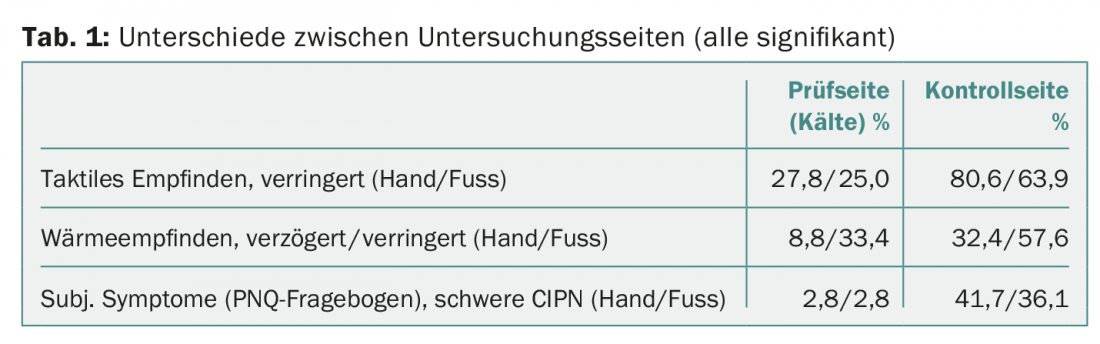


Subjectively perceived marked CIPN was almost completely prevented at the time of a cumulative dose of 960 mg/m2. This was shown by the evaluation of the patient questionnaire. Nevertheless, when the neuropathy signs occurred, they appeared significantly later than on the control side. Finger dexterity was also better in the intervention group, i.e., the sensorimotor test was completed more quickly.

Self-control brings advantages

Of course, the sample of the study is very small. However, the self-control design has the advantage that potentially unknown confounding factors at the interindividual level may exert less influence on the final outcome. In addition, the effects were consistent and pronounced across the different endpoints, supporting the basic conclusion of efficacy of cold therapy. This could be explained by a regionally reduced blood flow or vasoconstriction during infusion and thus a reduced drug exposure.

It cannot be ruled out that the cooling on one side increased the overall body temperature and thus falsified the result of the control side. Although the control values were within the expected range, this can only be refuted by a direct comparison (patients with/without intervention). It is also not entirely clear whether the choice of the dominant half of the body as the intervention side played a role. Bilateral differences in CIPN symptomatology are not known to the authors. The activities of daily living (ADL, subjectively assessed by questionnaire), however, are likely to be more difficult to perform or compensate for due to an impairment of the dominant side. In general, the strongest confounding factors can be assumed for subjective measurement, since the placebo effect also plays a stronger role here.

In a nutshell

  • Cold appears to be effective against symptoms of chemotherapy-induced peripheral neuropathy
  • The small study must now be reproduced

Source: Hanai A, et al: JNCI 2018; 110(2): djx178.


InFo ONCOLOGY & HEMATOLOGY 2018; 6(1): 3.

Autoren
  • Andreas Grossmann
Publikation
  • InFo ONKOLOGIE & HÄMATOLOGIE
Related Topics
  • Chemotherapy-induced peripheral neuropathy
  • CIPN
  • Cold therapy
  • cryotherapy
  • Dexterity
  • Neuropathy
  • Objective symptoms
  • paclitaxel
  • Sensors
  • Subjective symptoms
Previous Article
  • Gloomy red Urticae

Dramatic performance with happy ending

  • Cases
  • Dermatology and venereology
  • Pediatrics
  • RX
View Post
Next Article
  • 57th Medical Congress LUNGE ZÜRICH, Davos

Age-related eye diseases

  • Congress Reports
  • Geriatrics
  • Ophthalmology
  • RX
View Post
You May Also Like
View Post
  • 14 min
  • Seborrheic Dermatitis in Adults and Adolescents

Current State of Knowledge and New Therapeutic Approaches

    • RX
    • CME continuing education
    • Dermatology and venereology
    • Studies
View Post
  • 7 min
  • Plastic surgery and reconstructive microsurgery for DFS

Functional limb preservation between infection control, vascular medicine and resurfacing

    • RX
    • Angiology
    • CME continuing education
    • Dermatology and venereology
    • Endocrinology and Diabetology
    • General Internal Medicine
    • Geriatrics
    • Physical medicine and rehabilitation
    • Surgery
View Post
  • 7 min
  • Orthobiologics for knee osteoarthritis

PRP and hyaluronic acid injections as building blocks in a multimodal concept

    • RX
    • Congress Reports
    • General Internal Medicine
    • Orthopedics
    • Rheumatology
    • Sports Medicine
    • Studies
    • Surgery
View Post
  • 3 min
  • Soft tissue sarcomas of the lower extremity

Diagnostics, subtypes and treatment options

    • RX
    • Education
    • Oncology
View Post
  • 38 min
  • Psychological dependence on AI assistants, smartphones and short videos

Algorithms, avatars and the unburdened mind

    • RX
    • CME continuing education
    • Neurology
    • Pediatrics
    • Prevention and health care
    • Psychiatry and psychotherapy
    • Studies
View Post
  • 12 min
  • The Brain and the Motivation to Eat

Why is it so hard to lose weight?

    • RX
    • CME continuing education
    • Endocrinology and Diabetology
    • General Internal Medicine
    • Nutrition
    • Pharmacology and toxicology
    • Prevention and health care
    • Psychiatry and psychotherapy
    • Studies
View Post
  • 8 min
  • Psychooncology

Communication as the key to therapy adherence

    • CME continuing education
    • Practice Management
    • RX
View Post
  • 5 min
  • Omaveloxolone for Friedreich's Ataxia

Efficacy and Safety Studied Over 6 Years

    • Neurology
    • Congress Reports
    • Endocrinology and Diabetology
    • RX
    • Studies
  • IBD matters

    Zum Thema
Top CME content
  • 1
    Current State of Knowledge and New Therapeutic Approaches
  • 2
    Why is it so hard to lose weight?
  • 3
    Functional limb preservation between infection control, vascular medicine and resurfacing
  • 4
    Algorithms, avatars and the unburdened mind
  • 5
    Communication as the key to therapy adherence

Newsletter

Sign up and stay up to date

Subscribe
Medizinonline Medizinonline
  • Contact
  • General terms and conditions
  • Imprint

Input your search keywords and press Enter.