Medizinonline Medizinonline
  • News
    • News
    • Market & Medicine
  • Patients
    • Disease patterns
    • Diagnostics
    • Therapy
  • Partner Content
    • Dermatology
      • Atopic dermatitis and psoriasis news
    • Diabetes
      • Dia-Month Club – Type 2 Diabetes
      • Diabetes in Motion
      • Diabetes Podcasts
    • Gastroenterology
      • IBD matters
    • Oncology
      • Swiss Oncology in motion
    • Orthopedics
      • Osteoporosis in motion
  • Departments
    • Allergology and clinical immunology
    • General Internal Medicine
    • Anesthesiology
    • Angiology
    • Surgery
    • Dermatology and venereology
    • Endocrinology and Diabetology
    • Nutrition
    • Gastroenterology and Hepatology
    • Genetics
    • Geriatrics
    • Gynecology
    • Hematology
    • Infectiology
    • Cardiology
    • Nephrology
    • Neurology
    • Emergency and intensive care medicine
    • Nuclear Medicine
    • Oncology
    • Ophthalmology
    • ORL
    • Orthopedics
    • Pediatrics
    • Pharmacology and toxicology
    • Pharmaceutical medicine
    • Phlebology
    • Physical medicine and rehabilitation
    • Pneumology
    • Prevention and health care
    • Psychiatry and psychotherapy
    • Radiology
    • Forensic Medicine
    • Rheumatology
    • Sports Medicine
    • Traumatology and trauma surgery
    • Tropical and travel medicine
    • Urology
    • Dentistry
  • CME & Congresses
    • CME continuing education
    • Congress Reports
    • Congress calendar
  • Practice
    • Noctimed
    • Practice Management
    • Jobs
    • Interviews
  • Log In
  • Register
  • My account
  • Contact
  • Publications
  • Contact
  • Deutsch
  • English
  • Français
  • Italiano
  • Português
  • Español
Subscribe
Medizinonline Medizinonline
  • News
    • News
    • Market & Medicine
  • Patienten
    • Krankheitsbilder
    • Diagnostik
    • Therapie
  • Partner Content
    • Dermatology
      • Atopic dermatitis and psoriasis news
    • Diabetes
      • Dia-Month Club – Type 2 Diabetes
      • Diabetes in Motion
      • Diabetes Podcasts
    • Gastroenterology
      • IBD matters
    • Oncology
      • Swiss Oncology in motion
    • Orthopedics
      • Osteoporosis in motion
    • Phytotherapie
    • Rheumatology
  • Departments
    • Fachbereiche 1-13
      • Allergology and clinical immunology
      • General Internal Medicine
      • Anesthesiology
      • Angiology
      • Surgery
      • Dermatology and venereology
      • Endocrinology and Diabetology
      • Nutrition
      • Gastroenterology and Hepatology
      • Genetics
      • Geriatrics
      • Gynecology
      • Hematology
    • Fachbereiche 14-26
      • Infectiology
      • Cardiology
      • Nephrology
      • Neurology
      • Emergency and intensive care medicine
      • Nuclear Medicine
      • Oncology
      • Ophthalmology
      • ORL
      • Orthopedics
      • Pediatrics
      • Pharmacology and toxicology
      • Pharmaceutical medicine
    • Fachbereiche 26-38
      • Phlebology
      • Physical medicine and rehabilitation
      • Phytotherapy
      • Pneumology
      • Prevention and health care
      • Psychiatry and psychotherapy
      • Radiology
      • Forensic Medicine
      • Rheumatology
      • Sports Medicine
      • Traumatology and trauma surgery
      • Tropical and travel medicine
      • Urology
      • Dentistry
  • CME & Congresses
    • CME continuing education
    • Congress Reports
    • Congress calendar
  • Practice
    • Noctimed
    • Practice Management
    • Jobs
    • Interviews
Login

Sie haben noch keinen Account? Registrieren

  • Rare diseases

Current diagnostic criteria for neurofibromatosis type 1 – an update.

    • Dermatology and venereology
    • General Internal Medicine
    • Genetics
    • Neurology
    • Ophthalmology
    • RX
  • 3 minute read

Also known as “von Recklinghausen disease,” neurofibromatosis type 1 is a rare genetic multi-organ disease. A common feature of neurofibromatosis type 1 that can be diagnosed early in its course by modern diagnostic techniques is choroidal abnormalities. This has also been incorporated into the 2021 revised diagnostic criteria of the International Consensus Group on Neurofibromatosis Diagnostic Criteria.

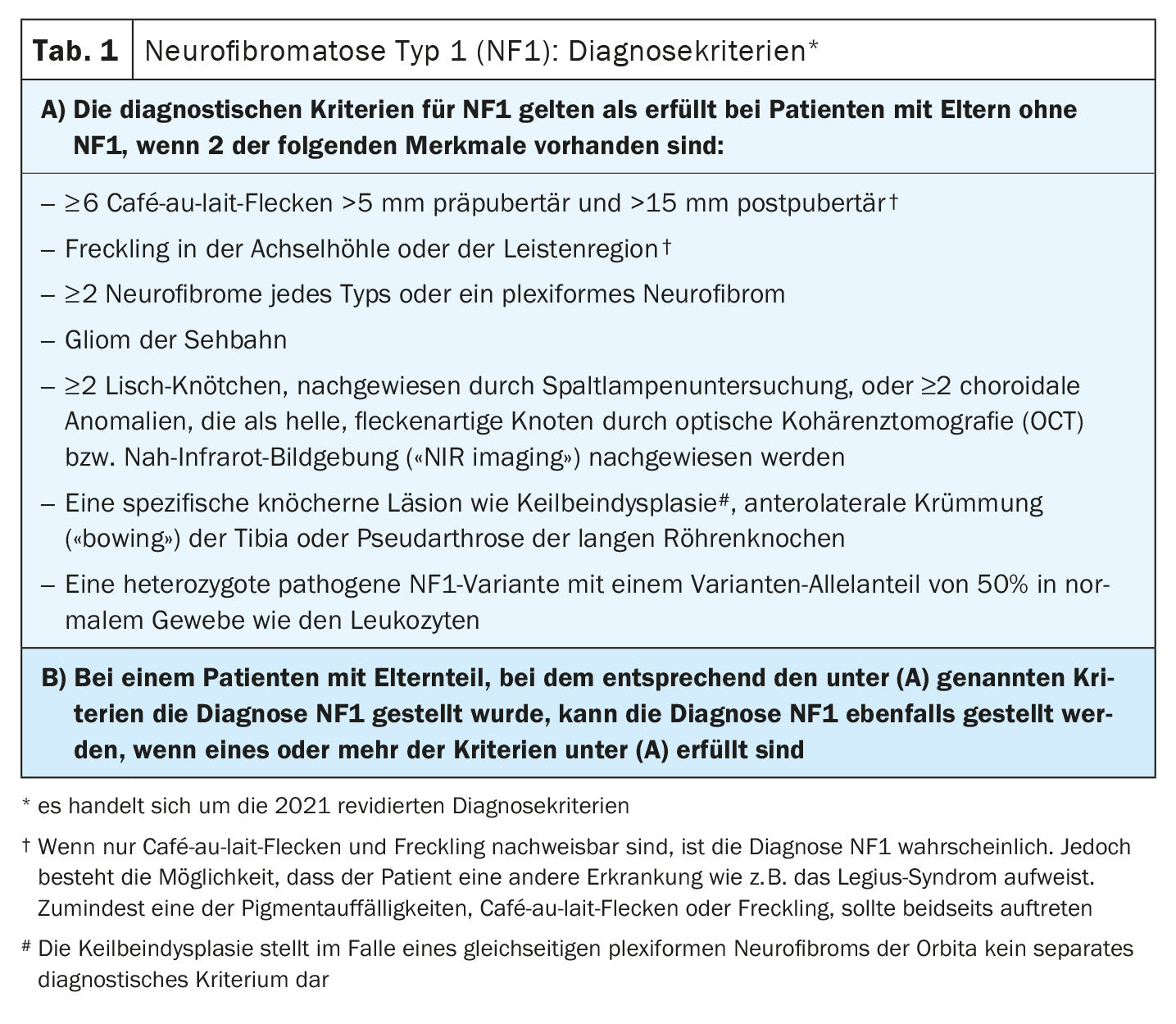
The incidence of neurofibromatosis type 1 (NF1) is reported to be 1:3000, with NF1 occurring approximately 50% familial and 50% sporadic, respectively [1]. NF1 is associated with a significantly increased risk of specific tumors [2,3]. It is named for the dermal neurofibromas that occur in a large proportion of adults with NF1. With complete penetrance and heterogeneous expression, NF1 has a pleiotropic character: impairments of various organ systems include malformations of the skeletal system, cardiovascular abnormalities, and neurocognitive impairment [4]. This requires comprehensive multidisciplinary care of the affected individuals along with accurate differential diagnosis. Almost all patients with NF1 have café-au-lait spots, which are usually present in the first year of life and are the earliest diagnostic feature of the disease [4]. In addition to the appearance of tumors, other changes in the skin as well as bones, blood vessels and eyes are characteristic. Moreover, neuropsychological deficits such as attention deficit disorder, learning difficulties and partial performance disorders may develop. The currently applicable diagnostic criteria for NF1 can be seen in Table 1 [4,5]. Cardiovascular, ocular, neurological, and orthopedic manifestations should be treated by specialists [6]. Cutaneous or subcutaneous neurofibromas can be surgically removed, but plexiform neurofibromas are more difficult to treat [6].
Do not miss choroidal anomalies

Choroidal anomalies are asymptomatic, pale, ovoid nodules localized around axons and composed of hyperplastic Schwann cells and melanocytes [4]. Choroidal abnormalities are very common in NF1 and can be diagnosed early by methods such as optical coherence tomography (OCT) and confocal laser scanning ophthalmoscopy with near-infrared reflectance imaging.

While Lisch nodules of the iris usually do not appear until 5 to 6 years of age, choroidal abnormalities are often visible earlier and occur in 60-79% of NF1 patients under 12 years of age. In particular, in children younger than 7 years of age who have only café-au-lait spots with or without freckling, choroidal abnormalities may contribute to the differential diagnosis [7–10]. Choroidal abnormalities are found in over 95% of cases of adults with NF1, in contrast to extremely rare in healthy controls [8–11]. In healthy individuals, choroidal abnormalities occur at most as single lesions, whereas in NF1 patients they are often present in multiple numbers.

Literature:

  1. “Neurofibromatosis Type 1,” Institute of Clinical Genetics, www.uniklinikum-dresden.de/de/das-klinikum/kliniken-polikliniken-institute/kge/patienten-ambulanz,(last accessed Mar. 31, 2023).
  2. Uusitalo E, et al: Breast cancer in neurofibromatosis type 1: overrepresentation of unfavourable prognostic factors. Br J Cancer 2017; 116: 211-217.
  3. Hirbe AC, Gutmann DH: Neurofibromatosis type 1: a multidisciplinary approach to care. Lancet Neurol 2014; 13: 834-843.
  4. Kehrer-Sawatzki H, Farschtschi S, Mautner VF: Revised diagnostic criteria for neurofibromatosis type 1 (NF1) allow early precise differential diagnosis differentiation from other RASopathies and facilitate diagnosis. Monatsschr Kinderheilkd 2021,
    https://doi.org/10.1007/s00112-021-01323-5.
  5. Legius E, et al: Revised diagnostic criteria for neurofibromatosis type 1 and Legius syndrome: an international consensus recommendation. Genet Med 2021, https://doi.org/10.1038/s41436-021-01170-5
  6. “Neurofibromatosis Type 1,” www.orpha.net,(last accessed Mar. 31 , 2023).
  7. Viola F, et al: Choroidal abnormalities detected by near-infrared reflectance imaging as a new diagnostic criterion for neurofibromatosis 1. Ophthalmology 2012; 119: 369-375.
  8. Goktas S, et al: Frequency of choroidal abnormalities in pediatric patients with neurofibromatosis type 1. J Pediatr Ophthalmol Strabismus 2014; 51: 204-208.
  9. Parrozzani R, et al: In vivo detection of choroidal abnormalities related to NF1: feasibility and comparison with standard NIH diagnostic criteria in pediatric patients. Invest Ophthalmol Vis Sci 2015; 56: 6036-6042.
  10. Vagge A, et al: Choroidal abnormalities in neurofibromatosis type 1 detected by near-infrared reflectance imaging in paediatric population. Acta Ophthalmol 2015; 93:e667-71.
  11. Cassiman C, et al: Choroidal abnormalities in café-au-lait syndromes: a new differential diagnostic tool? Clin Genet 2017; 91: 529-535.

GP PRACTICE 2023; 18(5): 48
InFo NEUROLOGY & PSYCHIATRY 2023; 21(3): 40.

Autoren
  • Mirjam Peter, M.Sc.
Publikation
  • HAUSARZT PRAXIS
  • InFo NEUROLOGIE & PSYCHIATRIE
Related Topics
  • Diagnostic criteria
  • International Consensus Group on Neurofibromatosis Diagnostic Criteria
  • Neurofibromatosis type 1
  • rare diseases
  • von Recklinghausen disease
Previous Article
  • Chronic tinnitus

How subjective stress is alleviated – current guideline provides clarification

  • Education
  • General Internal Medicine
  • ORL
  • RX
  • Studies
View Post
Next Article
  • Acute chest pain

The important difference: women in the Chest Pain Unit!

  • Cardiology
  • CME continuing education
  • General Internal Medicine
  • Gynecology
  • Prevention and health care
  • RX
  • Studies
View Post
You May Also Like
View Post
  • 14 min
  • "Forgotten axis" between plant substances, gut and systemic health

Microbiome and phytotherapy

    • Education
    • Endocrinology and Diabetology
    • Gastroenterology and Hepatology
    • General Internal Medicine
    • Infectiology
    • Neurology
    • Nutrition
    • Pharmaceutical medicine
    • Phytotherapy
    • RX
    • Studies
View Post
  • 4 min
  • HIV: updated EACS guideline

Individualized approach to sustainable prevention and care

    • Cardiology
    • Education
    • General Internal Medicine
    • Infectiology
    • Prevention and health care
    • RX
    • Studies
View Post
  • 5 min
  • Evidence-based diagnostics and treatment in the medical setting

Anxiety and depression disorders in adolescence

    • Education
    • Pediatrics
    • Pharmacology and toxicology
    • Psychiatry and psychotherapy
    • RX
    • Studies
View Post
  • 25 min
  • Neuroenhancement

Can you swallow intelligence? Relevant substance classes times for healthy people

    • CME continuing education
    • Neurology
    • Pharmacology and toxicology
    • Psychiatry and psychotherapy
    • RX
    • Studies
View Post
  • 9 min
  • Microbiome, inflammaging and affective/cognitive health

Gut-brain axis in old age

    • Education
    • Gastroenterology and Hepatology
    • General Internal Medicine
    • Geriatrics
    • Neurology
    • Nutrition
    • Prevention and health care
    • RX
    • Studies
View Post
  • 6 min
  • Vitiligo - the level of suffering should not be underestimated

A lot can be achieved therapeutically nowadays

    • Congress Reports
    • Dermatology and venereology
    • RX
    • Studies
View Post
  • 7 min
  • Vector-borne infections with skin manifestations

Arboviruses and leishmaniasis in Europe

    • Congress Reports
    • Infectiology
    • Prevention and health care
    • RX
    • Studies
    • Tropical and travel medicine
View Post
  • 12 min
  • Patient-centered rounds in medicine

Aligning care with the patient

    • CME continuing education
    • Education
    • General Internal Medicine
    • Prevention and health care
    • RX
    • Studies
  • IBD matters

    Zum Thema
Top CME content
  • 1
    Can you swallow intelligence? Relevant substance classes times for healthy people
  • 2
    Clinical care from birth to adulthood
  • 3
    Aligning care with the patient
  • 4
    Control instead of a flood of data: AI makes big data and wearables usable
  • 5
    Causes and prevention at work

Newsletter

Sign up and stay up to date

Subscribe
Medizinonline Medizinonline
  • Contact
  • General terms and conditions
  • Imprint

Input your search keywords and press Enter.