Medizinonline Medizinonline
  • News
    • News
    • Market & Medicine
  • Patients
    • Disease patterns
    • Diagnostics
    • Therapy
  • Partner Content
    • Diabetes
      • Dia-Month Club – Type 2 Diabetes
      • Diabetes in Motion
      • Diabetes Podcasts
    • Gastroenterology
      • IBD matters
    • Oncology
      • Swiss Oncology in motion
    • Orthopedics
      • Osteoporosis in motion
  • Departments
    • Allergology and clinical immunology
    • General Internal Medicine
    • Anesthesiology
    • Angiology
    • Surgery
    • Dermatology and venereology
    • Endocrinology and Diabetology
    • Nutrition
    • Gastroenterology and Hepatology
    • Genetics
    • Geriatrics
    • Gynecology
    • Hematology
    • Infectiology
    • Cardiology
    • Nephrology
    • Neurology
    • Emergency and intensive care medicine
    • Nuclear Medicine
    • Oncology
    • Ophthalmology
    • ORL
    • Orthopedics
    • Pediatrics
    • Pharmacology and toxicology
    • Pharmaceutical medicine
    • Phlebology
    • Physical medicine and rehabilitation
    • Pneumology
    • Prevention and health care
    • Psychiatry and psychotherapy
    • Radiology
    • Forensic Medicine
    • Rheumatology
    • Sports Medicine
    • Traumatology and trauma surgery
    • Tropical and travel medicine
    • Urology
    • Dentistry
  • CME & Congresses
    • CME continuing education
    • Congress Reports
    • Congress calendar
  • Practice
    • Noctimed
    • Practice Management
    • Jobs
    • Interviews
  • Log In
  • Register
  • My account
  • Contact
  • Publications
  • Contact
  • Deutsch
  • English
  • Français
  • Italiano
  • Português
  • Español
Subscribe
Medizinonline Medizinonline
  • News
    • News
    • Market & Medicine
  • Patienten
    • Krankheitsbilder
    • Diagnostik
    • Therapie
  • Partner Content
    • Diabetes
      • Dia-Month Club – Type 2 Diabetes
      • Diabetes in Motion
      • Diabetes Podcasts
    • Gastroenterology
      • IBD matters
    • Oncology
      • Swiss Oncology in motion
    • Orthopedics
      • Osteoporosis in motion
    • Phytotherapie
    • Rheumatology
  • Departments
    • Fachbereiche 1-13
      • Allergology and clinical immunology
      • General Internal Medicine
      • Anesthesiology
      • Angiology
      • Surgery
      • Dermatology and venereology
      • Endocrinology and Diabetology
      • Nutrition
      • Gastroenterology and Hepatology
      • Genetics
      • Geriatrics
      • Gynecology
      • Hematology
    • Fachbereiche 14-26
      • Infectiology
      • Cardiology
      • Nephrology
      • Neurology
      • Emergency and intensive care medicine
      • Nuclear Medicine
      • Oncology
      • Ophthalmology
      • ORL
      • Orthopedics
      • Pediatrics
      • Pharmacology and toxicology
      • Pharmaceutical medicine
    • Fachbereiche 26-38
      • Phlebology
      • Physical medicine and rehabilitation
      • Phytotherapy
      • Pneumology
      • Prevention and health care
      • Psychiatry and psychotherapy
      • Radiology
      • Forensic Medicine
      • Rheumatology
      • Sports Medicine
      • Traumatology and trauma surgery
      • Tropical and travel medicine
      • Urology
      • Dentistry
  • CME & Congresses
    • CME continuing education
    • Congress Reports
    • Congress calendar
  • Practice
    • Noctimed
    • Practice Management
    • Jobs
    • Interviews
Login

Sie haben noch keinen Account? Registrieren

  • Proton pump inhibitors

No prescription without correct indication

    • Congress Reports
    • Gastroenterology and Hepatology
    • General Internal Medicine
    • Pharmacology and toxicology
    • RX
  • 3 minute read

At the 55th Continuing Medical Education in Davos in January 2016, a workshop focused on the correct use of proton pump inhibitors (PPI). Prof. Dr. med. Christoph Beglinger, Claraspital Basel, explained the effects and side effects of these active substances and pleaded for them not to be prescribed lightly, but only when clearly indicated. While PPIs are generally well tolerated, they can also cause adverse side effects with long-term treatment.

Proton pump inhibitors (PPIs) are among the most commonly prescribed drugs because they are highly effective, well tolerated – and are also cleverly marketed, the speaker noted. One dose of a PPI (e.g., 40 mg pantoprazole) irreversibly inhibits acid production for 12-16 hours until new proton pumps are produced. The efficacy of each preparation in terms of cure rates for gastroesophageal reflux (GERD) or ulcer disease is equivalent, studies show.

The right time to take it: half an hour before a meal

The active ingredients taken are pro-drugs; they are not activated in the stomach until acid is present. Oral bioavailability is good, but the half-life is short. Therefore, the correct time of intake is very important, namely about half an hour before breakfast or breakfast. before the meal: Then the maximum plasma concentration of the PPI falls together with the activation of the proton pumps. “About one-third of all physicians, however, unfortunately do not instruct patients properly,” Prof. Beglinger said.

Most PPIs are metabolized by CYP2C10 and CYP3A4; therefore, factors such as hepatic insufficiency, age, or mutations in CYP2C19 reduce clearance. In general, PPIs are well tolerated, with gastrointestinal side effects such as diarrhea, constipation, and flatulence being the most common. Discontinuation of PPIs may result in a rebound phenomenon with recurrence of symptoms, so PPIs should be phased out slowly.

Indications for PPI

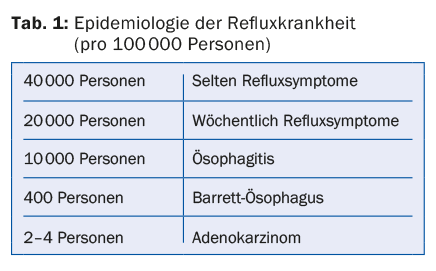
Indications for PPI use include reflux disease, ulcer disease, and ulcer prevention. In reflux, three explicit disease patterns are distinguished: GERD, erosive esophagitis, and Barrett’s esophagus (Table 1) . They can all be mild or severe. “Reflux stenosis, which used to be common, has fortunately almost disappeared today thanks to medications,” Prof. Beglinger mentioned. The most important therapeutic goal in GERD is symptom control. In cases of endoscopically proven esophagitis, one should aim to heal the lesions to prevent complications and document healing endoscopically. If typical GERD symptoms are present and endoscopic findings are unknown, empiric PPI treatment for four weeks is appropriate. If the patient is then symptom-free, PPIs can be prescribed in low doses as an on-demand medication. If there is no improvement after four weeks, endoscopic clarification should be performed.
For eradication of H. pylori, standard therapy consists of administration of a PPI plus two antibiotics. There is no consensus on the duration of eradication treatment (7 or 14 days), but recent data indicate that therapy for at least 14 days with a PPI plus amoxicillin and clarithromycin resp. PPI plus amoxicillin and nitroimidazole significantly increased the eradication rate.

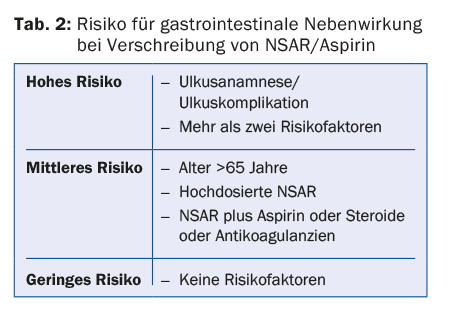
Ulcer prophylaxis with PPI when prescribing NSAIDs and aspirin is established and useful – but only if the patient has an appropriate risk profile (tab. 2). “Patients without a risk profile do not need PPI prophylaxis,” the speaker explained.
Are PPIs prescribed too often?

Various studies show that PPIs are often prescribed without proper indication. For example, patients receive perioperative PPI prophylaxis in the hospital, and later, at discharge, the PPI is still on their medication list. Another problem is false indications such as gastritis or undifferentiated “gastric protection”. The side effects of such an often inappropriate long-term treatment can be significant: Decrease in vitamin B12 levels (data is unclear, however), decreased iron absorption with anemia, or reduced absorption of calcium and vitamin D, which increases the risk of osteoporotic fractures.

Population-based studies also show an association between PPI use and Clostridium difficile infections (risk increase 2.5-2.9). “While causality cannot be inferred from this,” the speaker said. “Still, I recommend caution with long-term PPI prescribing in patients who are at increased risk for C. difficile infection, for example, those on antibiotic therapy, advanced age, or renal insufficiency.” PPIs also increase the risk for community-acquired pneumonia.

Take home messages

  • PPIs are effective and safe medications, but they should be prescribed only for clear indications.
  • PPIs are prescribed too often – even in situations where there is no proven benefit.
  • Long-term therapies must be well justified.
  • Especially in the elderly, the lowest possible doses should be aimed for.
  • It is important to know the potential side effects of PPIs.

Source: 55th Continuing Medical Education Davos, January 7-9, 2016


HAUSARZT PRAXIS 2016; 11(3): 56-57

Autoren
  • Dr. med. Eva Ebnöther
Publikation
  • HAUSARZT PRAXIS
Related Topics
  • Helicobacter pylori
  • PPI
  • Reflux
Previous Article
  • Non-small cell lung cancer

Swiss approval of nivolumab

  • News
  • Oncology
  • Pneumology
  • RX
  • Studies
View Post
Next Article
  • Zika virus

Should certain patients be advised not to travel?

  • General Internal Medicine
  • Gynecology
  • Infectiology
  • News
  • RX
View Post
You May Also Like
View Post
  • 12 min
  • Current evidence, risk classes and new counseling options

Hormonal contraception and cardiovascular risk

    • Cardiology
    • Education
    • Gynecology
    • Neurology
    • Pharmacology and toxicology
    • RX
    • Studies
View Post
  • 4 min
  • Acute otitis media: self-limiting course vs. "red flags"

In which cases are antibiotics necessary?

    • Congress Reports
    • General Internal Medicine
    • Infectiology
    • ORL
    • Pediatrics
    • RX
View Post
  • 6 min
  • Prurigo nodularis: evidence-based treatment

Targeted therapy options on the rise

    • Allergology and clinical immunology
    • Dermatology and venereology
    • Education
    • Pharmacology and toxicology
    • RX
    • Studies
View Post
  • 13 min
  • MACE risk, heart failure incidence and all-cause mortality

Metabolic syndrome as a cardiovascular risk factor

    • Cardiology
    • Education
    • Endocrinology and Diabetology
    • General Internal Medicine
    • RX
    • Studies
View Post
  • 9 min
  • Glaucoma in old age: slowing down progression

IOP lowering is currently the only evidence-based treatment

    • Education
    • General Internal Medicine
    • Ophthalmology
    • Prevention and health care
    • RX
    • Studies
View Post
  • 7 min
  • Vector-borne infections with skin manifestations

Arboviruses and leishmaniasis in Europe

    • Congress Reports
    • Infectiology
    • Prevention and health care
    • RX
    • Studies
    • Tropical and travel medicine
View Post
  • 6 min
  • Multimorbidity and functional capacity in old age

Clarify individual health status and reduce risks

    • Congress Reports
    • General Internal Medicine
    • Geriatrics
    • Neurology
    • Orthopedics
    • Physical medicine and rehabilitation
    • Prevention and health care
    • Rheumatology
    • RX
View Post
  • 6 min
  • Tick season: danger from early summer meningoencephalitis

TBE vaccination recommended for adults and children aged 3 and over

    • Education
    • Infectiology
    • Neurology
    • Prevention and health care
    • RX
    • Studies
  • IBD matters

    Zum Thema
Top CME content
  • 1
    Do special amino acids lead to success?
  • 2
    Current status of PAT
  • 3
    Surgical wound complications
  • 4
    Do special amino acids lead to success?
  • 5
    Functional limb preservation between infection control, vascular medicine and resurfacing

Newsletter

Sign up and stay up to date

Subscribe
Medizinonline Medizinonline
  • Contact
  • General terms and conditions
  • Imprint

Input your search keywords and press Enter.