Medizinonline Medizinonline
  • News
    • News
    • Market & Medicine
  • Patients
    • Disease patterns
    • Diagnostics
    • Therapy
  • Partner Content
    • Diabetes
      • Dia-Month Club – Type 2 Diabetes
      • Diabetes in Motion
      • Diabetes Podcasts
    • Gastroenterology
      • IBD matters
    • Oncology
      • Swiss Oncology in motion
    • Orthopedics
      • Osteoporosis in motion
  • Departments
    • Allergology and clinical immunology
    • General Internal Medicine
    • Anesthesiology
    • Angiology
    • Surgery
    • Dermatology and venereology
    • Endocrinology and Diabetology
    • Nutrition
    • Gastroenterology and Hepatology
    • Genetics
    • Geriatrics
    • Gynecology
    • Hematology
    • Infectiology
    • Cardiology
    • Nephrology
    • Neurology
    • Emergency and intensive care medicine
    • Nuclear Medicine
    • Oncology
    • Ophthalmology
    • ORL
    • Orthopedics
    • Pediatrics
    • Pharmacology and toxicology
    • Pharmaceutical medicine
    • Phlebology
    • Physical medicine and rehabilitation
    • Pneumology
    • Prevention and health care
    • Psychiatry and psychotherapy
    • Radiology
    • Forensic Medicine
    • Rheumatology
    • Sports Medicine
    • Traumatology and trauma surgery
    • Tropical and travel medicine
    • Urology
    • Dentistry
  • CME & Congresses
    • CME continuing education
    • Congress Reports
    • Congress calendar
  • Practice
    • Noctimed
    • Practice Management
    • Jobs
    • Interviews
  • Log In
  • Register
  • My account
  • Contact
  • Publications
  • Contact
  • Deutsch
  • English
  • Français
  • Italiano
  • Português
  • Español
Subscribe
Medizinonline Medizinonline
  • News
    • News
    • Market & Medicine
  • Patienten
    • Krankheitsbilder
    • Diagnostik
    • Therapie
  • Partner Content
    • Diabetes
      • Dia-Month Club – Type 2 Diabetes
      • Diabetes in Motion
      • Diabetes Podcasts
    • Gastroenterology
      • IBD matters
    • Oncology
      • Swiss Oncology in motion
    • Orthopedics
      • Osteoporosis in motion
    • Phytotherapie
    • Rheumatology
  • Departments
    • Fachbereiche 1-13
      • Allergology and clinical immunology
      • General Internal Medicine
      • Anesthesiology
      • Angiology
      • Surgery
      • Dermatology and venereology
      • Endocrinology and Diabetology
      • Nutrition
      • Gastroenterology and Hepatology
      • Genetics
      • Geriatrics
      • Gynecology
      • Hematology
    • Fachbereiche 14-26
      • Infectiology
      • Cardiology
      • Nephrology
      • Neurology
      • Emergency and intensive care medicine
      • Nuclear Medicine
      • Oncology
      • Ophthalmology
      • ORL
      • Orthopedics
      • Pediatrics
      • Pharmacology and toxicology
      • Pharmaceutical medicine
    • Fachbereiche 26-38
      • Phlebology
      • Physical medicine and rehabilitation
      • Phytotherapy
      • Pneumology
      • Prevention and health care
      • Psychiatry and psychotherapy
      • Radiology
      • Forensic Medicine
      • Rheumatology
      • Sports Medicine
      • Traumatology and trauma surgery
      • Tropical and travel medicine
      • Urology
      • Dentistry
  • CME & Congresses
    • CME continuing education
    • Congress Reports
    • Congress calendar
  • Practice
    • Noctimed
    • Practice Management
    • Jobs
    • Interviews
Login

Sie haben noch keinen Account? Registrieren

  • Antibiotic resistance

Strategy against impending antibiotics crisis?

    • Education
    • General Internal Medicine
    • Infectiology
    • News
    • Prevention and health care
    • RX
  • 3 minute read

Resistant germs are a major problem for doctors and patients worldwide. The development of a new substance, which is directed against a different target structure than previous drugs, is a possible solution. An interim assessment is positive, although results from preclinical tests are only available.

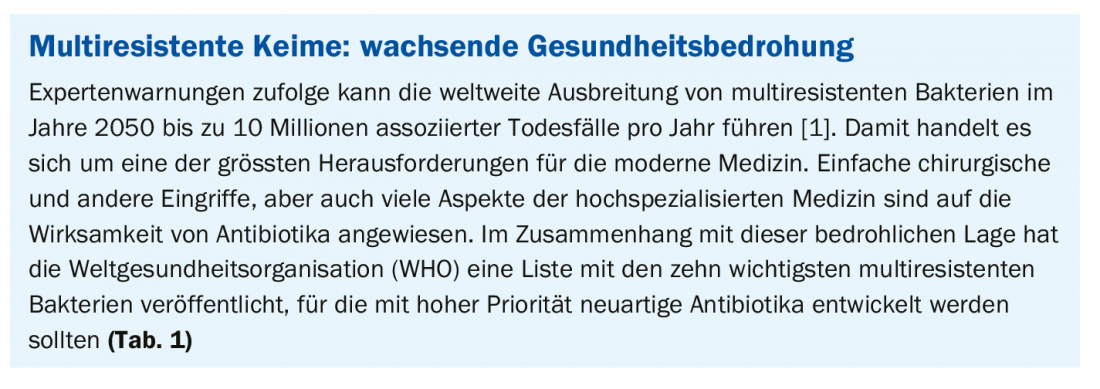
An increase in multidrug-resistant bacteria can cause routine surgical procedures and minor infections to become life-threatening and torpedo advances in modern medicine. Doctors and researchers fear that more and more people will have to deal with resistant germs in the future. The number of annual deaths due to drug-resistant infections is estimated to be as high as 50,000 in Europe and the United States [1].

Newly developed active ingredient in the research stage

Recently, scientists at Martin Luther University Halle-Wittenberg (MLU) have succeeded in developing a substance that is directed against the target pyruvate kinase – an enzyme that occurs in this form only in pathogenic bacteria and plays an important role in metabolism. Since this polypeptide has not been a drug target, bacteria have not yet developed resistance to it. In initial tests in cell cultures, this substance showed comparable efficacy to common antibiotics. In the best case, the new substances only act on the bacterial enzyme and thus the bacteria, so that there are as few side effects as possible. “In addition, this new target structure can be used to break existing antibiotic resistance,” explains Prof. Dr. Andreas Hilgeroth from the Institute of Pharmacy at MLU [2]. In experiments on the larvae of the great wax moth, a model organism, the researchers were able to confirm the effectiveness of the new substances. “These initial results give us confidence that we are on the right track,” says Prof. Hilgeroth. However, many more tests need to be performed before human clinical trials are possible. It may therefore take more than ten years before the substances developed by the German scientists become a marketable drug,


Forward-looking solutions in demand

The more frequently and the longer antibiotics are used, the higher the probability that the genetic material of bacteria will adapt accordingly and that they will become resistant [3]. Excessive use of antibiotics therefore favors the emergence of resistant germs, which applies not only to the field of human medicine. In conventional agriculture, too, animals are often treated en masse with antibiotics. Resistant bacteria from animal fattening can spread to humans. For example, the germ MRSA CC398 primarily colonizes people who come into professional contact with animals from fattening farms [4]. Research efforts to develop new antibiotics have been partially suspended, so that currently almost only variations of already established antibiotics are available. In the case of increasing resistance to the Gram-positive bacteria Staphylococcus aureus and Enterococcus species, such costly variations of already known antibiotics are sometimes a misinvestment, as the eventual benefit is small due to the expected risk of resistance development [5]. Just a few weeks ago, several major pharmaceutical companies announced that they would further scale back their own research into new antibiotics. “However, in order to treat infectious diseases reliably in the long term, we need new active substances to which bacteria have not yet developed resistance,” says Prof. Hilgeroth.


Literature:

  1. AMR: Review on Antimicrobial Resistance, www.amr-review.org
  2. Hilgeroth A: Prof. Dr. Andreas Hilgeroth, Institute of Pharmacy, Head of the Drug Development and Analysis Group, Martin Luther University Halle-Wittenberg, https://pc.pharmazie.uni-halle.de/
  3. Seethaler M, et al: Antibiotics 2019; 8(4): 210.
  4. Robert Koch Institute, www.rki.de
  5. Eades C, et al: Clinical Pharmacist 2017; 9 (9), DOI: 10.1211/CP.2017.20203363.
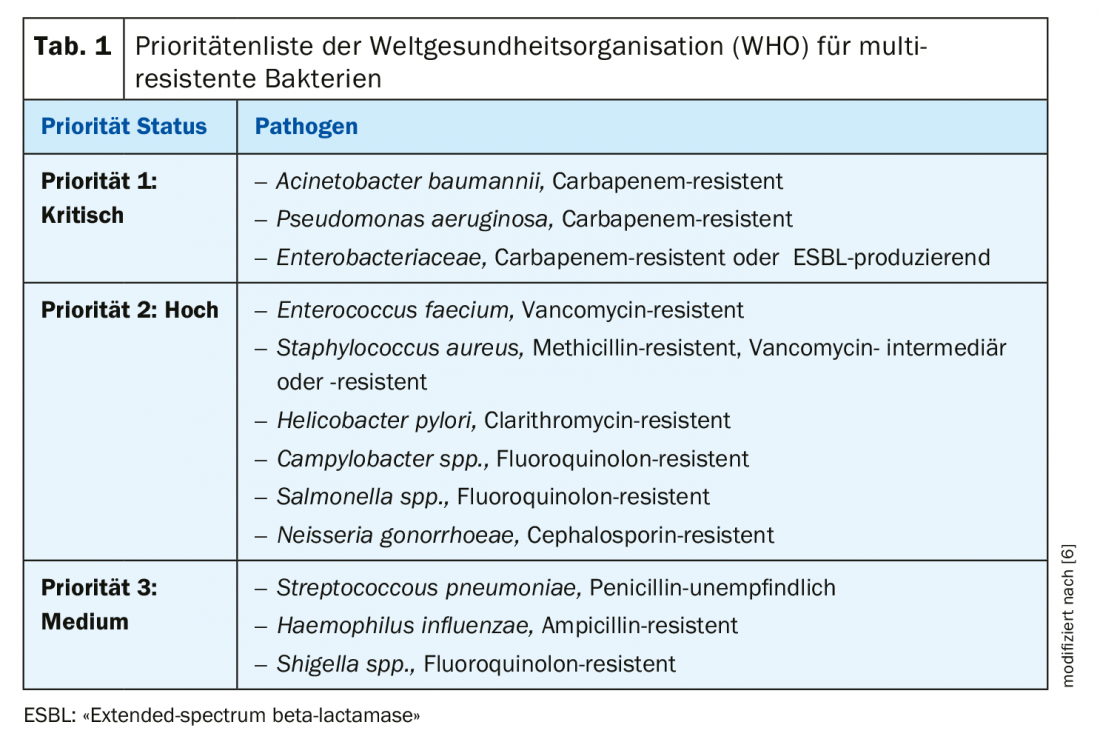
  6. WHO: World Health Organization, www.who.int


HAUSARZT PRAXIS 2019; 14(12): 6
Autoren
  • Mirjam Peter, M.Sc.
Publikation
  • HAUSARZT PRAXIS
Related Topics
  • antibiotic resistance
  • Antibiotics
  • resistance
Previous Article
  • Pleural diseases in thoracic sonography

Etiological differentiation by means of sono

  • Education
  • Pneumology
  • Radiology
  • RX
View Post
Next Article
  • Case Report

Arthritis in a teenage football player

  • Congress Reports
  • Dermatology and venereology
  • General Internal Medicine
  • Pediatrics
  • Rheumatology
  • RX
  • Sports Medicine
View Post
You May Also Like
View Post
  • 8 min
  • Proteins in wound healing

Do special amino acids lead to success?

    • CME continuing education
    • Dermatology and venereology
    • Endocrinology and Diabetology
    • Nutrition
    • RX
    • Studies
View Post
  • 0 min
  • Psychedelic-assisted therapy

Current status of PAT

    • CME continuing education
    • General Internal Medicine
    • Pharmacology and toxicology
    • Psychiatry and psychotherapy
    • RX
    • Studies
View Post
  • 5 min
  • Hepatitis B prophylaxis

Vaccination protection for healthcare staff with patient contact – an update

    • Congress Reports
    • General Internal Medicine
    • Infectiology
    • Prevention and health care
    • RX
View Post
  • 7 min
  • Plastic surgery and reconstructive microsurgery for DFS

Functional limb preservation between infection control, vascular medicine and resurfacing

    • Angiology
    • CME continuing education
    • Endocrinology and Diabetology
    • General Internal Medicine
    • Geriatrics
    • Physical medicine and rehabilitation
    • RX
    • Surgery
View Post
  • 6 min
  • Chronic urticaria: new treatment alternatives in sight

If antihistamines are not sufficient and IgE levels are low

    • Allergology and clinical immunology
    • Congress Reports
    • Dermatology and venereology
    • Pharmacology and toxicology
    • RX
    • Studies
View Post
  • 14 min
  • Adrenogenital syndrome

Clinical care from birth to adulthood

    • CME continuing education
    • Endocrinology and Diabetology
    • Nephrology
    • Pediatrics
    • RX
    • Studies
View Post
  • 4 min
  • Digital dermatology: innovative project examples

AI and eHealth tools in HS care

    • Dermatology and venereology
    • General Internal Medicine
    • Practice Management
    • Prevention and health care
    • RX
    • Studies
View Post
  • 7 min
  • Atopic dermatitis as a door opener for an atopic cascade?

AD trajectories: Summary of current findings

    • Allergology and clinical immunology
    • Congress Reports
    • Dermatology and venereology
    • RX
    • Studies
  • IBD matters

    Zum Thema
Top CME content
  • 1
    Current status of PAT
  • 2
    Do special amino acids lead to success?
  • 3
    Functional limb preservation between infection control, vascular medicine and resurfacing
  • 4
    Minimally invasive – the quiet triumph of modern heart surgery
  • 5
    HPV prevention, screening innovation and sentinel lymph node biopsy

Newsletter

Sign up and stay up to date

Subscribe
Medizinonline Medizinonline
  • Contact
  • General terms and conditions
  • Imprint

Input your search keywords and press Enter.