Medizinonline Medizinonline
  • News
    • News
    • Market & Medicine
  • Patients
    • Disease patterns
    • Diagnostics
    • Therapy
  • Partner Content
    • Diabetes
      • Dia-Month Club – Type 2 Diabetes
      • Diabetes in Motion
      • Diabetes Podcasts
    • Gastroenterology
      • IBD matters
    • Oncology
      • Swiss Oncology in motion
    • Orthopedics
      • Osteoporosis in motion
  • Departments
    • Allergology and clinical immunology
    • General Internal Medicine
    • Anesthesiology
    • Angiology
    • Surgery
    • Dermatology and venereology
    • Endocrinology and Diabetology
    • Nutrition
    • Gastroenterology and Hepatology
    • Genetics
    • Geriatrics
    • Gynecology
    • Hematology
    • Infectiology
    • Cardiology
    • Nephrology
    • Neurology
    • Emergency and intensive care medicine
    • Nuclear Medicine
    • Oncology
    • Ophthalmology
    • ORL
    • Orthopedics
    • Pediatrics
    • Pharmacology and toxicology
    • Pharmaceutical medicine
    • Phlebology
    • Physical medicine and rehabilitation
    • Pneumology
    • Prevention and health care
    • Psychiatry and psychotherapy
    • Radiology
    • Forensic Medicine
    • Rheumatology
    • Sports Medicine
    • Traumatology and trauma surgery
    • Tropical and travel medicine
    • Urology
    • Dentistry
  • CME & Congresses
    • CME continuing education
    • Congress Reports
    • Congress calendar
  • Practice
    • Noctimed
    • Practice Management
    • Jobs
    • Interviews
  • Log In
  • Register
  • My account
  • Contact
  • Publications
  • Contact
  • Deutsch
  • English
  • Français
  • Italiano
  • Português
  • Español
Subscribe
Medizinonline Medizinonline
  • News
    • News
    • Market & Medicine
  • Patienten
    • Krankheitsbilder
    • Diagnostik
    • Therapie
  • Partner Content
    • Diabetes
      • Dia-Month Club – Type 2 Diabetes
      • Diabetes in Motion
      • Diabetes Podcasts
    • Gastroenterology
      • IBD matters
    • Oncology
      • Swiss Oncology in motion
    • Orthopedics
      • Osteoporosis in motion
    • Phytotherapie
    • Rheumatology
  • Departments
    • Fachbereiche 1-13
      • Allergology and clinical immunology
      • General Internal Medicine
      • Anesthesiology
      • Angiology
      • Surgery
      • Dermatology and venereology
      • Endocrinology and Diabetology
      • Nutrition
      • Gastroenterology and Hepatology
      • Genetics
      • Geriatrics
      • Gynecology
      • Hematology
    • Fachbereiche 14-26
      • Infectiology
      • Cardiology
      • Nephrology
      • Neurology
      • Emergency and intensive care medicine
      • Nuclear Medicine
      • Oncology
      • Ophthalmology
      • ORL
      • Orthopedics
      • Pediatrics
      • Pharmacology and toxicology
      • Pharmaceutical medicine
    • Fachbereiche 26-38
      • Phlebology
      • Physical medicine and rehabilitation
      • Phytotherapy
      • Pneumology
      • Prevention and health care
      • Psychiatry and psychotherapy
      • Radiology
      • Forensic Medicine
      • Rheumatology
      • Sports Medicine
      • Traumatology and trauma surgery
      • Tropical and travel medicine
      • Urology
      • Dentistry
  • CME & Congresses
    • CME continuing education
    • Congress Reports
    • Congress calendar
  • Practice
    • Noctimed
    • Practice Management
    • Jobs
    • Interviews
Login

Sie haben noch keinen Account? Registrieren

  • Heart failure

The “Fantastic Four” for optimal HFrEF therapy

    • Cardiology
    • Education
    • General Internal Medicine
    • RX
    • Studies
  • 3 minute read

The conclusion of a recent article in the European Heart Journal is that ARNI and SGLT-2 inhibitors should be combined in HFrEF patients. Treatment is most promising when supplemented with a beta blocker and a mineralocorticoid receptor antagonist. This is indicated by recent subanalyses of large cardiovascular outcome studies.

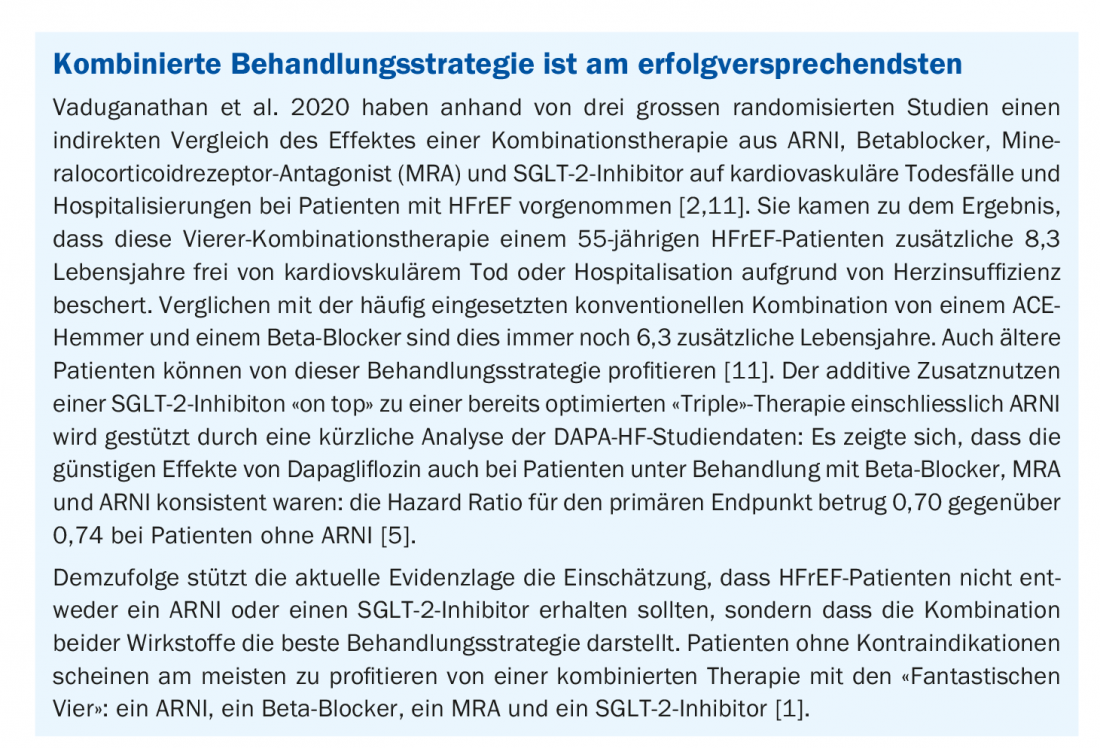
According to current scientific evidence, the four-way combination of ARNI, SGLT-2 inhibitor, beta blocker, and mineralocorticoid receptor antagonist is the best guarantee for maximally reducing deaths and hospitalizations in patients with heart failure and reduced ejection fraction (HFrEF), according to German heart failure expert Prof. Johann Bauersachs, MD, of Hannover Medical School, in a recently published article [1,2].

Additive SGLT-2 inhibitor treatment: proven additional benefit.

According to the European Society of Cardiology (ESC), LVEF<40% is heart failure with reduced ejection fraction (HFrEF). HFrEF requires multimodal treatment with a combination of different medications to achieve symptomatic and prognostic improvement [3,4]. After DAPA-HF, the EMPEROR-Reduced trial also provided evidence that the SGLT-2 inhibitors dapagliflozin and empagliflozin, respectively, significantly reduce cardiovascular mortality and hospitalizations due to heart failure in patients with HFrEF additive to standard therapy [6,7]. Improvements in these outcomes were seen to a similar extent in both diabetic and nondiabetic patients.


Do both patients with vs. without ARNI benefit from empagliflozin?

A subanalysis of the EMPEROR-Reduced trial published this year in the European Heart Journal addressed the question of whether empagliflozin would also prove clinically effective in those HFrEF patients who, in addition to beta-blockers and MRA, had also received ARNI therapy [2,8]. Empagliflozin was shown to significantly reduce cardiovascular deaths and heart failure hospitalizations compared to placebo in both the 727 participants on sacubitril/valsartan therapy (hazard ratio: 0.64; 95% confidence interval: 0.45-0.89; p=0.009) and the 3003 participants not on ARNI therapy (HR: 0.77; 95% CI: 0.66-0.90; p=0.0008). [2,8].

The detailed analyses of two large outcome trials on SGLT-2 inhibitors in HFrEF patients [8,9] support data from previous publications [6,7] as well as the results of the metaanalysis of the DAPA-HF and the EMPEROR-Reduced study, which show that patients treated with ARNI benefit at least as much from add-on treatment with an SGLT-2 inhibitor as patients without ARNI therapy [10].


Literature:

  1. Bauersachs J: Heart failure drug treatment: the fantastic four. European Heart Journal 2021: 42(6): 681-683.
  2. Overbeck P: Optimal heart failure therapy with the “Fantastic Four,” Jan. 20, 2021, www.kardiologie.org/herzinsuffizienz/optimale-herzinsuffizienz-therapie-mit-den–fantastischen-vier-/18782468, (last accessed Apr. 28, 2021).
  3. Ponikowski P, et al: 2016 ESC Guidelines for the diagnosis and treatment of acute and chronic heart failure: The Task Force for the diagnosis and treatment of acute and chronic heart failure of the European Society of Cardiology (ESC). Eur J Heart Fail 2016; 18: 891-975.
  4. Berliner D, Hänselmann A , Bauersachs J: The treatment of heart failure with reduced ejection fraction. Dtsch Arztebl Int 2020; 117: 376-386.
  5. Docherty KF, et al: Effects of dapagliflozin in DAPA-HF according to background heart failure therapy. Eur Heart J 2020; 41: 2379-2392.
  6. McMurray JJV, et al: DAPA-HF Trial Committees and Investigators. Dapagliflozin in patients with heart failure and reduced ejection fraction. N Engl J Med 2019; 381: 1995-2008.
  7. Packer M, et al: EMPEROR Reduced Trial Investigators. Cardiovascular and renal outcomes with empagliflozin in heart failure. N Engl J Med 2020; 383: 1413-1424.
  8. Packer M, et al: for the EMPEROR-Reduced Trial Committees and Investigators. Influence of neprilysin inhibition on the efficacy and safety of empagliflozin in patients with chronic heart failure and a reduced ejection fraction: the EMPEROR-Reduced Trial. Eur Heart J 2021; 42: 671-680.
  9. Solomon SD, et al: Effect of dapagliflozin in patients with HFrEF treated with sacubitril/valsartan: the DAPA-HF trial. JACC Heart Fail 2020; 8: 811-818.
  10. Zannad F, et al: SGLT2 inhibitors in patients with heart failure with reduced ejection fraction: a meta-analysis of the EMPEROR-Reduced and DAPA-HF trials. Lancet 2020; 396: 819-829.
  11. Vaduganathan M, et al: Estimating lifetime benefits of comprehensive disease-modifying pharmacological therapies in patients with heart failure with reduced ejection fraction: a comparative analysis of three randomised controlled trials. Lancet 2020; 396: 121-128.


HAUSARZT PRAXIS 2021; 16(6): 25

Autoren
  • Mirjam Peter, M.Sc.
Publikation
  • HAUSARZT PRAXIS
Related Topics
  • Heart failure
Previous Article
  • Primary headache

Problem case migraine: pharmacotherapy put to the test

  • Education
  • General Internal Medicine
  • Neurology
  • RX
View Post
Next Article
  • Skin cancer diagnostics

New study on AI-assisted detection of basal cell carcinoma.

  • Congress Reports
  • Dermatology and venereology
  • Oncology
  • Prevention and health care
  • RX
  • Studies
View Post
You May Also Like
View Post
  • 7 min
  • Plastic surgery and reconstructive microsurgery for DFS

Functional limb preservation between infection control, vascular medicine and resurfacing

    • RX
    • Angiology
    • CME continuing education
    • Dermatology and venereology
    • Endocrinology and Diabetology
    • General Internal Medicine
    • Geriatrics
    • Physical medicine and rehabilitation
    • Surgery
View Post
  • 14 min
  • Seborrheic Dermatitis in Adults and Adolescents

Current State of Knowledge and New Therapeutic Approaches

    • RX
    • CME continuing education
    • Dermatology and venereology
    • Studies
View Post
  • 7 min
  • Orthobiologics for knee osteoarthritis

PRP and hyaluronic acid injections as building blocks in a multimodal concept

    • RX
    • Congress Reports
    • General Internal Medicine
    • Orthopedics
    • Rheumatology
    • Sports Medicine
    • Studies
    • Surgery
View Post
  • 3 min
  • Soft tissue sarcomas of the lower extremity

Diagnostics, subtypes and treatment options

    • RX
    • Education
    • Oncology
View Post
  • 38 min
  • Psychological dependence on AI assistants, smartphones and short videos

Algorithms, avatars and the unburdened mind

    • RX
    • CME continuing education
    • Neurology
    • Pediatrics
    • Prevention and health care
    • Psychiatry and psychotherapy
    • Studies
View Post
  • 12 min
  • The Brain and the Motivation to Eat

Why is it so hard to lose weight?

    • RX
    • CME continuing education
    • Endocrinology and Diabetology
    • General Internal Medicine
    • Nutrition
    • Pharmacology and toxicology
    • Prevention and health care
    • Psychiatry and psychotherapy
    • Studies
View Post
  • 8 min
  • Psychooncology

Communication as the key to therapy adherence

    • CME continuing education
    • Practice Management
    • RX
View Post
  • 5 min
  • Omaveloxolone for Friedreich's Ataxia

Efficacy and Safety Studied Over 6 Years

    • Neurology
    • Congress Reports
    • Endocrinology and Diabetology
    • RX
    • Studies
  • IBD matters

    Zum Thema
Top CME content
  • 1
    Current State of Knowledge and New Therapeutic Approaches
  • 2
    Why is it so hard to lose weight?
  • 3
    Functional limb preservation between infection control, vascular medicine and resurfacing
  • 4
    Algorithms, avatars and the unburdened mind
  • 5
    Communication as the key to therapy adherence

Newsletter

Sign up and stay up to date

Subscribe
Medizinonline Medizinonline
  • Contact
  • General terms and conditions
  • Imprint

Input your search keywords and press Enter.