Medizinonline Medizinonline
  • News
    • News
    • Market & Medicine
  • Patients
    • Disease patterns
    • Diagnostics
    • Therapy
  • Partner Content
    • Diabetes
      • Dia-Month Club – Type 2 Diabetes
      • Diabetes in Motion
    • Gastroenterology
      • IBD matters
    • Oncology
      • Swiss Oncology in motion
    • Orthopedics
      • Osteoporosis in motion
  • Departments
    • Allergology and clinical immunology
    • General Internal Medicine
    • Anesthesiology
    • Angiology
    • Surgery
    • Dermatology and venereology
    • Endocrinology and Diabetology
    • Nutrition
    • Gastroenterology and Hepatology
    • Genetics
    • Geriatrics
    • Gynecology
    • Hematology
    • Infectiology
    • Cardiology
    • Nephrology
    • Neurology
    • Emergency and intensive care medicine
    • Nuclear Medicine
    • Oncology
    • Ophthalmology
    • ORL
    • Orthopedics
    • Pediatrics
    • Pharmacology and toxicology
    • Pharmaceutical medicine
    • Phlebology
    • Physical medicine and rehabilitation
    • Pneumology
    • Prevention and health care
    • Psychiatry and psychotherapy
    • Radiology
    • Forensic Medicine
    • Rheumatology
    • Sports Medicine
    • Traumatology and trauma surgery
    • Tropical and travel medicine
    • Urology
    • Dentistry
  • CME & Congresses
    • CME continuing education
    • Congress Reports
    • Congress calendar
  • Practice
    • Noctimed
    • Practice Management
    • Jobs
    • Interviews
  • Log In
  • Register
  • My account
  • Contact
  • Publications
  • Contact
  • Deutsch
  • English
  • Français
  • Italiano
  • Português
  • Español
Subscribe
Medizinonline Medizinonline
  • News
    • News
    • Market & Medicine
  • Patienten
    • Krankheitsbilder
    • Diagnostik
    • Therapie
  • Partner Content
    • Diabetes
      • Dia-Month Club – Type 2 Diabetes
      • Diabetes in Motion
    • Gastroenterology
      • IBD matters
    • Oncology
      • Swiss Oncology in motion
    • Orthopedics
      • Osteoporosis in motion
    • Phytotherapie
    • Rheumatology
  • Departments
    • Fachbereiche 1-13
      • Allergology and clinical immunology
      • General Internal Medicine
      • Anesthesiology
      • Angiology
      • Surgery
      • Dermatology and venereology
      • Endocrinology and Diabetology
      • Nutrition
      • Gastroenterology and Hepatology
      • Genetics
      • Geriatrics
      • Gynecology
      • Hematology
    • Fachbereiche 14-26
      • Infectiology
      • Cardiology
      • Nephrology
      • Neurology
      • Emergency and intensive care medicine
      • Nuclear Medicine
      • Oncology
      • Ophthalmology
      • ORL
      • Orthopedics
      • Pediatrics
      • Pharmacology and toxicology
      • Pharmaceutical medicine
    • Fachbereiche 26-38
      • Phlebology
      • Physical medicine and rehabilitation
      • Phytotherapy
      • Pneumology
      • Prevention and health care
      • Psychiatry and psychotherapy
      • Radiology
      • Forensic Medicine
      • Rheumatology
      • Sports Medicine
      • Traumatology and trauma surgery
      • Tropical and travel medicine
      • Urology
      • Dentistry
  • CME & Congresses
    • CME continuing education
    • Congress Reports
    • Congress calendar
  • Practice
    • Noctimed
    • Practice Management
    • Jobs
    • Interviews
Login

Sie haben noch keinen Account? Registrieren

  • Microorganisms in food

What do you need to know about salmonella, molds, aflatoxins and Co.

    • Congress Reports
    • General Internal Medicine
    • Infectiology
    • Prevention and health care
    • RX
  • 3 minute read

The number of cases of salmonella infections in Switzerland has been reduced over the last few years, but not for the more dangerous campylobacter. What is the current situation regarding risky microorganisms in food?

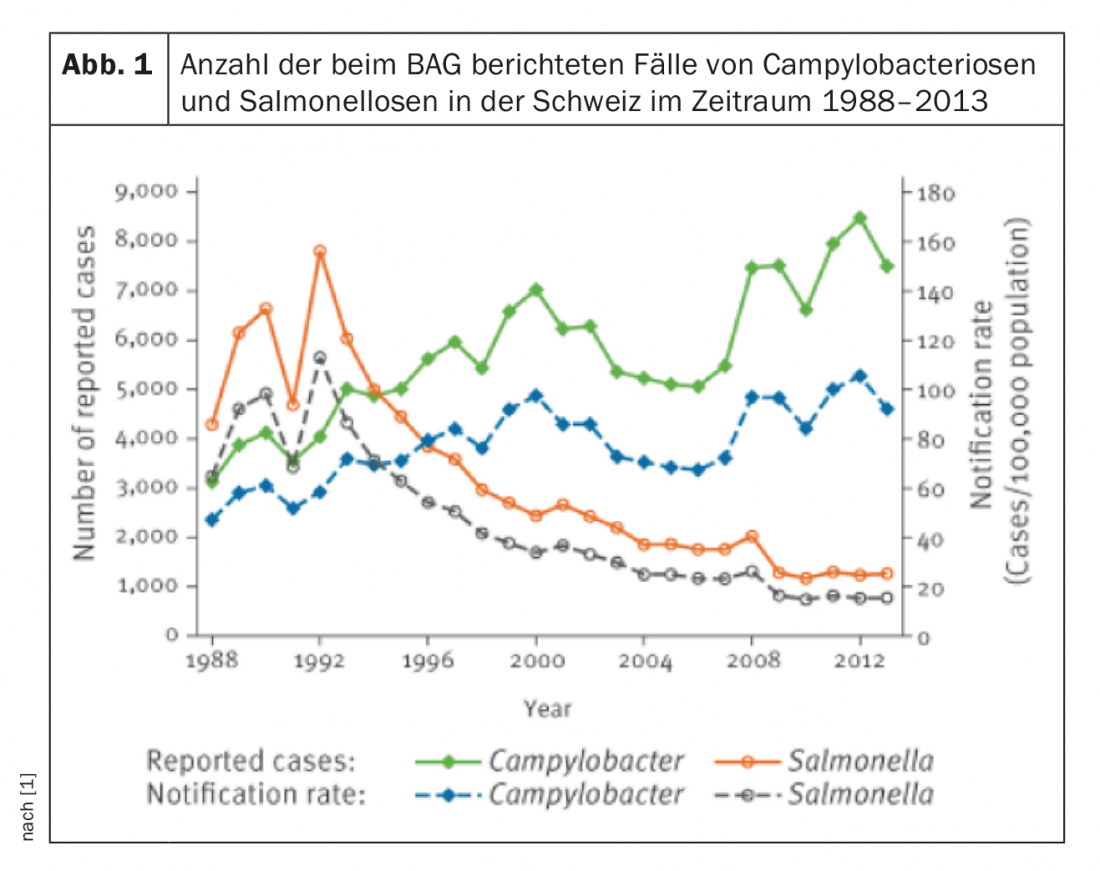
(mp) The following three hazard risks are associated with the consumption of food contaminated by microorganisms: Intoxications (e.g. by Clostridium), infections (e.g. by Listeria, Campylobacter) and (toxi-) infections (e.g. by Salmonella, Shigella). Salmonella (in poultry, eggs, unpasteurized milk, meat products) and Campylobacter (especially in poultry) are the most common foodborne pathogens in Switzerland. Compared to Salmonella, the infectious dose of Campylobacter is very low and incidence rates have increased in recent years (Fig. 1) [1]. In this context, the Federal Food Safety and Veterinary Office (FSVO) has issued safety instructions for the preparation of raw meat (e.g. fondue chinoise) [2]. PD Dr. rer. nat. Markus Schuppler, a researcher at the Institute of Food, Nutrition and Health at ETH Zurich, pointed out that a reduced “awareness” of risks resulting from contaminated food could be observed in the Swiss population.


Immunocompromised persons in particular are at risk

Listeriosis (a zoonosis) is relatively harmless to persons with intact immune systems, but can be fatal to persons with weakened immune systems. There is also an increased risk of Listeria infection during pregnancy. Listeria is widely distributed in the environment (animals, soil, plants, water) and can be killed by heating (>65°C) [3]. Pathogenic is mainly the consumption of contaminated food of animal origin (e.g. raw milk, soft cheese, smoked fish, raw meat).

But mycotoxins, which are found in plant products, also pose risks. If in doubt, spoiled food (e.g. moldy bread or vegetables) should be disposed of; this is safer than just removing the mold-infested portions. Aflatoxin is a mycotoxin (Aspergillus) found primarily on high-fat, plant-based products (e.g., nuts, corn, oilseeds), but exotic spices can also be affected (e.g., curry, chili, peppers). Aflatoxin B1 is very dangerous, barely visible to the naked eye, and has significant hepatotoxic and carcinogenic hazard potential with repeated consumption. As precautions, in addition to cool and dry storage, the expiration date should be observed.

Hygiene measures as prophylaxis

Enterohemorrhagic Escherichia coli (EHEC) are human pathogenic strains of the intestinal bacterium Escherichia coli. With regard to the transmission path, Dr. Schuppler cited the example of an EHEC epidemic in which the germs got onto spinach via an irrigation system of a cattle farm, the consumption of which subsequently led to infections. Hygiene measures are also extremely important with regard to EHEC germs in order to prevent their spread. Particularly in the case of children, care should be taken to clean hands after contact with animals or the ground. Heating can kill pathogens; appropriate foods should be cooked thoroughly [4]. In addition, perishable food should be stored refrigerated. Also in the case of EHEC, immunocompromised persons, small children and elderly people are at risk for severe symptoms (hemorrhagic colitis, hemolytic uremic syndrome).

Source: VZI Symposium, January 31, 2019, Zurich

Literature:

  1. Schmutz C, et al: Inverse trends of Campylobacter and Salmonella in Swiss surveillance data, 1988-2013. Surveillance and outbreak report. Euro Surveill. 2016; 21(6): 30130. DOI: https://doi.org/10.2807/1560-7917.ES.2016.21.6.30130.
  2. Federal Food Safety and Veterinary Office (FSVO). www.blv.admin.ch, last accessed 02 Feb. 2019.
  3. European Food Safety Authority. www.efsa.europa.eu, last accessed 02 Feb. 2019.  
  4. Robert Koch Institute: EHEC disease. RKI guidebook. www.rki.de/DE/Content/Infekt/EpidBull/Merkblaetter/Ratgeber_EHEC.html, last accessed 02 Feb. 2019.


GP PRACTICE 2019; 14(2): 35

Autoren
  • Mirjam Peter, M.Sc.
Publikation
  • HAUSARZT PRAXIS
Related Topics
  • aspergillus
  • campylobacter
  • hygiene
  • listeriosis
  • salmonella
  • shigella
Previous Article
  • Sleep disorders in children and adolescents

Psychoeducation is central

  • Education
  • Neurology
  • Pediatrics
  • Psychiatry and psychotherapy
  • RX
View Post
Next Article
  • Laser-assisted drug delivery

New indications for ablative laser treatment

  • Congress Reports
  • Dermatology and venereology
  • RX
View Post
You May Also Like
View Post
  • 4 min
  • Preclinical Study on a Special Ginkgo biloba Extract

What role do proanthocyanidins play?

    • RX
    • Education
    • General Internal Medicine
    • Geriatrics
    • Neurology
    • Pharmaceutical medicine
    • Pharmacology and toxicology
    • Phytotherapy
    • Studies
View Post
  • 6 min
  • Myasthenia gravis: immunomodulatory therapies for long-term treatment

Expanded Possibilities Thanks to Innovative Classes of Active Ingredients

    • RX
    • Congress Reports
    • General Internal Medicine
    • Neurology
    • Ophthalmology
    • Studies
View Post
  • 10 min
  • Interstitial Lung Diseases

Update on Idiopathic Pulmonary Fibrosis

    • RX
    • CME continuing education
    • Pneumology
    • Studies
View Post
  • 7 min
  • Plastic surgery and reconstructive microsurgery for DFS

Functional limb preservation between infection control, vascular medicine and resurfacing

    • RX
    • Angiology
    • CME continuing education
    • Dermatology and venereology
    • Endocrinology and Diabetology
    • General Internal Medicine
    • Geriatrics
    • Physical medicine and rehabilitation
    • Surgery
View Post
  • 7 min
  • Ischemic stroke: Are smaller or larger brain arteries affected?

Recent study findings on intravenous lysis therapy with fibrinolytic agents

    • RX
    • Congress Reports
    • Emergency and intensive care medicine
    • General Internal Medicine
    • Neurology
    • Pharmacology and toxicology
    • Studies
    • Surgery
View Post
  • 7 min
  • Interview

“On par with the gold standards for trauma”

    • RX
    • Education
    • Interviews
    • Neurology
    • Physical medicine and rehabilitation
    • Psychiatry and psychotherapy
    • Studies
View Post
  • 5 min
  • Psychology: Emotional Freedom Techniques (EFT)

Emotional Healing Through Tapping

    • RX
    • Education
    • General Internal Medicine
    • Neurology
    • Physical medicine and rehabilitation
    • Psychiatry and psychotherapy
    • Studies
View Post
  • 5 min
  • Systemic Lupus (SLE): What Does the Diagnosis and Treatment Toolbox Have to Offer?

Treat-to-Target – Consensus Recommendations for GC Tapering and the Use of DMARDs

    • RX
    • Congress Reports
    • General Internal Medicine
    • Nephrology
    • Rheumatology
    • Studies
  • IBD matters

    Zum Thema
Top CME content
  • 1
    Functional limb preservation between infection control, vascular medicine and resurfacing
  • 2
    Update on Idiopathic Pulmonary Fibrosis
  • 3
    Update on Idiopathic Pulmonary Fibrosis
  • 4
    Current status of PAT
  • 5
    Darier’s Disease, also known as Follicular Keratosis – Update 2026

Newsletter

Sign up and stay up to date

Subscribe
Medizinonline Medizinonline
  • Contact
  • General terms and conditions
  • Imprint

Input your search keywords and press Enter.