Medizinonline Medizinonline
  • News
    • News
    • Market & Medicine
  • Patients
    • Disease patterns
    • Diagnostics
    • Therapy
  • Partner Content
    • Diabetes
      • Dia-Month Club – Type 2 Diabetes
      • Diabetes in Motion
      • Diabetes Podcasts
    • Gastroenterology
      • IBD matters
    • Oncology
      • Swiss Oncology in motion
    • Orthopedics
      • Osteoporosis in motion
  • Departments
    • Allergology and clinical immunology
    • General Internal Medicine
    • Anesthesiology
    • Angiology
    • Surgery
    • Dermatology and venereology
    • Endocrinology and Diabetology
    • Nutrition
    • Gastroenterology and Hepatology
    • Genetics
    • Geriatrics
    • Gynecology
    • Hematology
    • Infectiology
    • Cardiology
    • Nephrology
    • Neurology
    • Emergency and intensive care medicine
    • Nuclear Medicine
    • Oncology
    • Ophthalmology
    • ORL
    • Orthopedics
    • Pediatrics
    • Pharmacology and toxicology
    • Pharmaceutical medicine
    • Phlebology
    • Physical medicine and rehabilitation
    • Pneumology
    • Prevention and health care
    • Psychiatry and psychotherapy
    • Radiology
    • Forensic Medicine
    • Rheumatology
    • Sports Medicine
    • Traumatology and trauma surgery
    • Tropical and travel medicine
    • Urology
    • Dentistry
  • CME & Congresses
    • CME continuing education
    • Congress Reports
    • Congress calendar
  • Practice
    • Noctimed
    • Practice Management
    • Jobs
    • Interviews
  • Log In
  • Register
  • My account
  • Contact
  • Publications
  • Contact
  • Deutsch
  • English
  • Français
  • Italiano
  • Português
  • Español
Subscribe
Medizinonline Medizinonline
  • News
    • News
    • Market & Medicine
  • Patienten
    • Krankheitsbilder
    • Diagnostik
    • Therapie
  • Partner Content
    • Diabetes
      • Dia-Month Club – Type 2 Diabetes
      • Diabetes in Motion
      • Diabetes Podcasts
    • Gastroenterology
      • IBD matters
    • Oncology
      • Swiss Oncology in motion
    • Orthopedics
      • Osteoporosis in motion
    • Phytotherapie
    • Rheumatology
  • Departments
    • Fachbereiche 1-13
      • Allergology and clinical immunology
      • General Internal Medicine
      • Anesthesiology
      • Angiology
      • Surgery
      • Dermatology and venereology
      • Endocrinology and Diabetology
      • Nutrition
      • Gastroenterology and Hepatology
      • Genetics
      • Geriatrics
      • Gynecology
      • Hematology
    • Fachbereiche 14-26
      • Infectiology
      • Cardiology
      • Nephrology
      • Neurology
      • Emergency and intensive care medicine
      • Nuclear Medicine
      • Oncology
      • Ophthalmology
      • ORL
      • Orthopedics
      • Pediatrics
      • Pharmacology and toxicology
      • Pharmaceutical medicine
    • Fachbereiche 26-38
      • Phlebology
      • Physical medicine and rehabilitation
      • Phytotherapy
      • Pneumology
      • Prevention and health care
      • Psychiatry and psychotherapy
      • Radiology
      • Forensic Medicine
      • Rheumatology
      • Sports Medicine
      • Traumatology and trauma surgery
      • Tropical and travel medicine
      • Urology
      • Dentistry
  • CME & Congresses
    • CME continuing education
    • Congress Reports
    • Congress calendar
  • Practice
    • Noctimed
    • Practice Management
    • Jobs
    • Interviews
Login

Sie haben noch keinen Account? Registrieren

  • 12th National Laser Congress

An overview of tattoo removal and skin tightening procedures

    • Congress Reports
    • Dermatology and venereology
    • RX
    • Surgery
  • 4 minute read

The twelfth national laser congress of the Swiss Society for Medical Laser Applications (SGML) in Zurich focused on the possibilities of de-tattooing. If you want to actually remove a permanent tattoo and not just cover it up with camouflage, a scar is inevitable. Various surgical, physical or chemical procedures are used. Skin tightening, another topic of the congress, does not always have to be done surgically. In less advanced cases, thermage, Ultherapy, or fractional laser are sometimes options.

(ag) What to do if you want to remove a tattoo? This was the question discussed by Prof. Claus Udo Fritzemeier, Düsseldorf, MD: “In principle, a permanent tattoo stores the colors in the dermis (corium), i.e. in the stratum papillare and stratum reticulare. Thus, a de-tattooing always leaves scars.”

Besides the jewelry tattoos, there are also the dirt tattoos, for example, from the repeated use of a syringe for drug use, accidents or explosions. Iatrogenic tattoos are used, for example, to mark a tumor prior to radiation, but they can also be cosmetic, such as permanently recording eyebrows, lips, or nipples after surgical reconstruction.

The techniques of de-tattooing available are physical, surgical, chemical, cosmetic or a combination of different methods (Table 1).
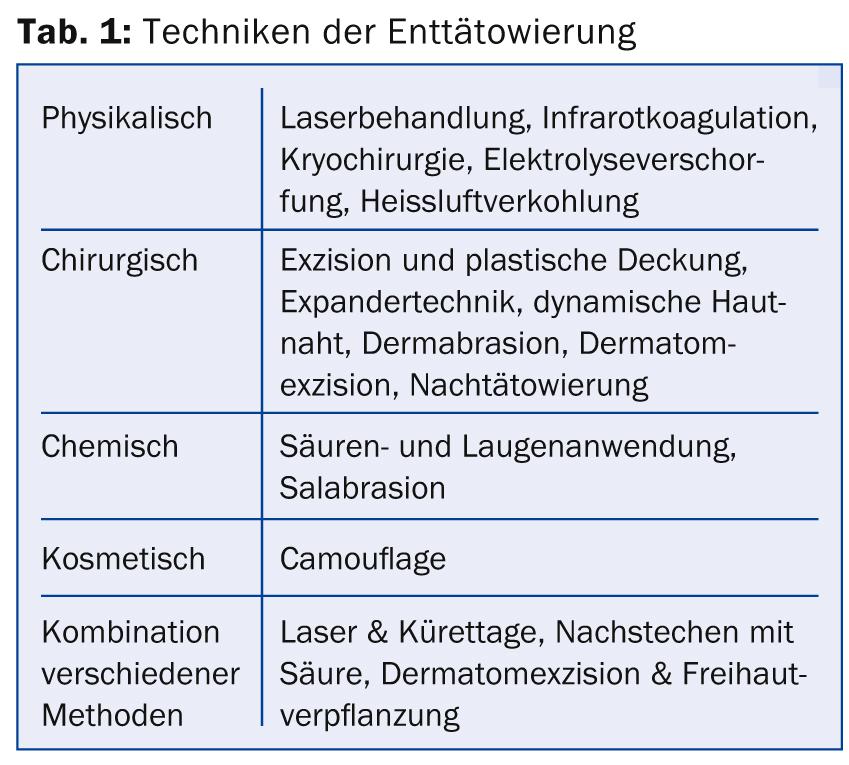


For laser treatment, there are the “q-switched” ruby laser, the “q-switched” Nd:YAG, the “q-switched” frequency-doubled Nd:YAG, and the “q-switched” alexandrite. Chemical removal by means of acid and alkali application is usually carried out with the standard solution of nitric acid and acetone in the ratio 2:1. “Regarding the financial cost, laser treatment is by far the most expensive, followed by excision and chemical application. Less expensive are dermabrasion, cryosurgery and night tattooing. And the cheapest, of course, is camouflage, although this technique can be very effective if applied correctly,” says Prof. Fritzemeier.

Skin tightening procedure

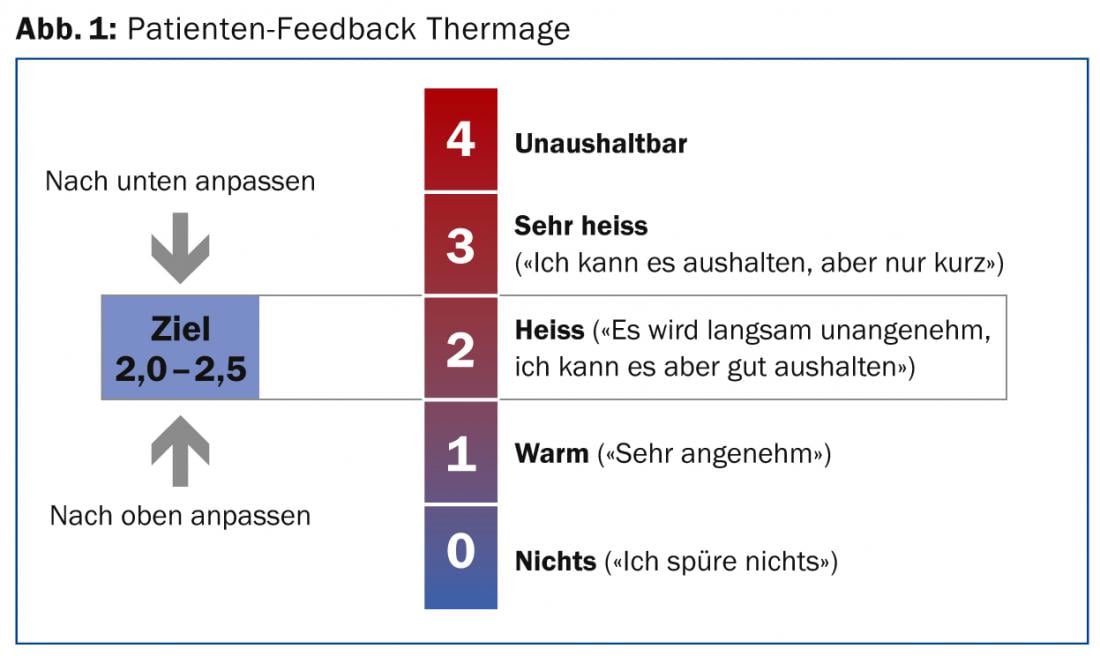
Thermage: Monika Hess Schmid, MD, Zurich, spoke on the subject of Thermage. In this process, collagen is contracted (“shrunk”) using high-frequency radio waves. After two to six months, the body’s own collagen forms anew, resulting in a tightening effect. In principle, the thermo effect targets the deeper layers of the skin, the upper layers are cooled at the same time. “There are three depths of heat: superficial (1.1 mm per 0.25 cm2) is used mainly on the eyes for smoothing and tightening, medium (2.4 mm per 3 cm2) applied on the face and submental for smoothing, tightening and contouring and the deep (4.3 mm per 16 or 3 cm2) applied on the body and partly on the face for deep contouring and shaping. In any case, the patient should provide feedback on how the heat feels so that proper energy adjustment can be made. The goal would be to achieve a feeling that is on the borderline of unpleasantness but still easy to bear,” says Dr. Hess Schmid (Fig. 1).


Since the introduction of the current therapy standard in Thermage in 2004, surface irregularities hardly ever occur during treatment. It can be described as gentle, causes little pain, requires no downtime, and usually leaves at most mild edema or erythema. Sensitive localizations on the face sometimes include the supra-orbital nerve, the intra-orbital nerve, the mental nerve, and the great auricular nerve. Dr. Hess Schmid considers the ideal patient to be someone with adequate expectations, mild to moderate skin elasticity or wrinkles, no excessive sun damage, and 35-60 years of age. A contraindication is the use of a pacemaker.

Of course, Thermage cannot replace an invasive surgical method, but as a gentle method and in combination with Botox, filler and laser, it is ideal.

Ultherapy: After Ultherapy was introduced just over four years ago, it quickly established itself within non-invasive aesthetic and medical applications. It uses micro-focused ultrasound energy to precisely access and heat deep tissue layers (about 50 °C causes collagen contraction/”shrinking”). 95% of the total energy is concentrated at about 1 mm3. It penetrates much deeper than laser and radio frequency. The distances between the coagulation points can be set precisely, thus facilitating healing (neo-collagenesis). According to Dr. med. Michael Gütling, Winterthur, a decisive advantage of this therapy is that it does not require downtime, i.e. absence from work and public life. “In addition, focused ultrasound is the only procedure that also initiates a tightening process in the superficial musculoaponeurotic system (SMAS), in the same connective tissue layer where surgical facelift procedures work. This is in contrast to laser/thermage procedures.” The only side effect is pain, which can certainly be a problem. Small hematomas or temporary irritation of the superficial nerves are rare; usually the faint redness or swelling heals after four to six  hours and no specific follow-up treatment is needed. In addition, the technique allows, as the only one ever, simultaneous imaging of the treated areas by collimated ultrasound.

Fractional lasers: In so-called “fractional resurfacing”, a maximum of 30% of the skin surface is removed. The “bullet holes” are approximately 120-500 µm in diameter and are surrounded by non-lasered intact skin, resulting in rapid repair. “So the advantages of this therapy are the fast wound healing, the low complication rate, the short downtime, the low pain and the quickly visible results,” summarized Bettina Rümmelein, MD, president of SGML, Kilchberg. However, make-up and over-greasing should be avoided during the first two days. Irritating cosmetics should also be avoided as long as the redness persists. Furthermore, sun exposure should be avoided for at least one month after treatment (only go outside with good sun protection).

Source: 12th National Laser Congress, January 16, 2014, Zurich

DERMATOLOGIE PRAXIS 2014; 24(3): 36-37
Autoren
  • Andreas Grossmann
Publikation
  • DERMATOLOGIE PRAXIS
Related Topics
  • Botox
  • Filler
  • Laser
  • Neo-Collagenesis
  • Reconstruction
  • Skin tightening
  • Tattoo
  • Tattoo
  • Tattoo removal
Previous Article
  • Warts

Treatment must not be suspended too early

  • Dermatology and venereology
  • Infectiology
  • Interviews
  • RX
View Post
Next Article
  • Pain conditions in the lower extremities

Leg pain – a neglected syndrome

  • News
  • Orthopedics
  • Physical medicine and rehabilitation
  • Prevention and health care
  • RX
  • Sports Medicine
  • Surgery
View Post
You May Also Like
View Post
  • 6 min
  • Prurigo nodularis: evidence-based treatment

Targeted therapy options on the rise

    • Allergology and clinical immunology
    • Dermatology and venereology
    • Education
    • Pharmacology and toxicology
    • RX
    • Studies
View Post
  • 13 min
  • MACE risk, heart failure incidence and all-cause mortality

Metabolic syndrome as a cardiovascular risk factor

    • Cardiology
    • Education
    • Endocrinology and Diabetology
    • General Internal Medicine
    • RX
    • Studies
View Post
  • 9 min
  • Glaucoma in old age: slowing down progression

IOP lowering is currently the only evidence-based treatment

    • Education
    • General Internal Medicine
    • Ophthalmology
    • Prevention and health care
    • RX
    • Studies
View Post
  • 7 min
  • Vector-borne infections with skin manifestations

Arboviruses and leishmaniasis in Europe

    • Congress Reports
    • Infectiology
    • Prevention and health care
    • RX
    • Studies
    • Tropical and travel medicine
View Post
  • 6 min
  • Multimorbidity and functional capacity in old age

Clarify individual health status and reduce risks

    • Congress Reports
    • General Internal Medicine
    • Geriatrics
    • Neurology
    • Orthopedics
    • Physical medicine and rehabilitation
    • Prevention and health care
    • Rheumatology
    • RX
View Post
  • 6 min
  • Tick season: danger from early summer meningoencephalitis

TBE vaccination recommended for adults and children aged 3 and over

    • Education
    • Infectiology
    • Neurology
    • Prevention and health care
    • RX
    • Studies
View Post
  • 13 min
  • New WHO guideline, updated stimulation protocols, focus on PGT-A

Fertility and reproductive medicine 2026

    • Education
    • Gynecology
    • RX
    • Studies
View Post
  • 12 min
  • Wound treatment

Surgical wound complications

    • CME continuing education
    • Dermatology and venereology
    • Endocrinology and Diabetology
    • Geriatrics
    • Physical medicine and rehabilitation
    • RX
    • Surgery
  • IBD matters

    Zum Thema
Top CME content
  • 1
    Do special amino acids lead to success?
  • 2
    Current status of PAT
  • 3
    Surgical wound complications
  • 4
    Do special amino acids lead to success?
  • 5
    Functional limb preservation between infection control, vascular medicine and resurfacing

Newsletter

Sign up and stay up to date

Subscribe
Medizinonline Medizinonline
  • Contact
  • General terms and conditions
  • Imprint

Input your search keywords and press Enter.