Medizinonline Medizinonline
  • News
    • News
    • Market & Medicine
  • Patients
    • Disease patterns
    • Diagnostics
    • Therapy
  • Partner Content
    • Diabetes
      • Dia-Month Club – Type 2 Diabetes
      • Diabetes in Motion
      • Diabetes Podcasts
    • Gastroenterology
      • IBD matters
    • Oncology
      • Swiss Oncology in motion
    • Orthopedics
      • Osteoporosis in motion
  • Departments
    • Allergology and clinical immunology
    • General Internal Medicine
    • Anesthesiology
    • Angiology
    • Surgery
    • Dermatology and venereology
    • Endocrinology and Diabetology
    • Nutrition
    • Gastroenterology and Hepatology
    • Genetics
    • Geriatrics
    • Gynecology
    • Hematology
    • Infectiology
    • Cardiology
    • Nephrology
    • Neurology
    • Emergency and intensive care medicine
    • Nuclear Medicine
    • Oncology
    • Ophthalmology
    • ORL
    • Orthopedics
    • Pediatrics
    • Pharmacology and toxicology
    • Pharmaceutical medicine
    • Phlebology
    • Physical medicine and rehabilitation
    • Pneumology
    • Prevention and health care
    • Psychiatry and psychotherapy
    • Radiology
    • Forensic Medicine
    • Rheumatology
    • Sports Medicine
    • Traumatology and trauma surgery
    • Tropical and travel medicine
    • Urology
    • Dentistry
  • CME & Congresses
    • CME continuing education
    • Congress Reports
    • Congress calendar
  • Practice
    • Noctimed
    • Practice Management
    • Jobs
    • Interviews
  • Log In
  • Register
  • My account
  • Contact
  • Publications
  • Contact
  • Deutsch
  • English
  • Français
  • Italiano
  • Português
  • Español
Subscribe
Medizinonline Medizinonline
  • News
    • News
    • Market & Medicine
  • Patienten
    • Krankheitsbilder
    • Diagnostik
    • Therapie
  • Partner Content
    • Diabetes
      • Dia-Month Club – Type 2 Diabetes
      • Diabetes in Motion
      • Diabetes Podcasts
    • Gastroenterology
      • IBD matters
    • Oncology
      • Swiss Oncology in motion
    • Orthopedics
      • Osteoporosis in motion
    • Phytotherapie
    • Rheumatology
  • Departments
    • Fachbereiche 1-13
      • Allergology and clinical immunology
      • General Internal Medicine
      • Anesthesiology
      • Angiology
      • Surgery
      • Dermatology and venereology
      • Endocrinology and Diabetology
      • Nutrition
      • Gastroenterology and Hepatology
      • Genetics
      • Geriatrics
      • Gynecology
      • Hematology
    • Fachbereiche 14-26
      • Infectiology
      • Cardiology
      • Nephrology
      • Neurology
      • Emergency and intensive care medicine
      • Nuclear Medicine
      • Oncology
      • Ophthalmology
      • ORL
      • Orthopedics
      • Pediatrics
      • Pharmacology and toxicology
      • Pharmaceutical medicine
    • Fachbereiche 26-38
      • Phlebology
      • Physical medicine and rehabilitation
      • Phytotherapy
      • Pneumology
      • Prevention and health care
      • Psychiatry and psychotherapy
      • Radiology
      • Forensic Medicine
      • Rheumatology
      • Sports Medicine
      • Traumatology and trauma surgery
      • Tropical and travel medicine
      • Urology
      • Dentistry
  • CME & Congresses
    • CME continuing education
    • Congress Reports
    • Congress calendar
  • Practice
    • Noctimed
    • Practice Management
    • Jobs
    • Interviews
Login

Sie haben noch keinen Account? Registrieren

  • Effects of physical activity

Biological adaptations and training theory

    • General Internal Medicine
    • News
    • Orthopedics
    • Prevention and health care
    • RX
    • Sports Medicine
  • 3 minute read

The manifold positive effects of physical activity on health but also on pathological processes are the result of subtle adaptation processes in the various organs and organ systems. How does it work?

Let’s take the skin as an example. This complete organ reacts to UV stimuli in a known way: If the stimulus is too weak or too short, nothing visible happens; if it is too strong and/or too long, burns occur; and if it is matched in time and intensity, the tan – whether good or not – that is sought occurs. And to complete the similarity with athletic training, because that is what this article is about: If the stimulus does not act at repeated intervals, adaptation is lost.

Ability to adapt

The “sun” of the organs and organ systems hidden under the skin is called the condition factors or the main physical stresses in sports science terminology. Today’s methods of training stimulation include the following areas: endurance (aerobic and anaerobic), strength, agility, speed and coordination. As is often the case in nature, there are smooth transitions and inevitable overlaps between these separate elements. However, this differentiation is of great importance in both practical and theoretical terms. Once again, we point out that the targeted training of these factors is based on the recognition that organic systems respond in different ways to different types of stimulation. The adaptation response occurs in exact correspondence to the type of stimulation applied, so qualitatively the training stimuli are not interchangeable. Thus, for each element of motor function, there is only one specific, well-defined form of training that can be used to achieve the desired increase in performance.

These extremely interesting observations are based on the fact that the human organism possesses a characteristic that is crucial for the survival of the species: the aforementioned ability to adapt. In addition to the quantitative and qualitative factors that elicit these adaptation responses, it is also important to consider the specific conditions that the stress stimulus must meet. This is particularly important when one considers the different ways in which the various tissues that make up the human organism react.

Adjustment effects

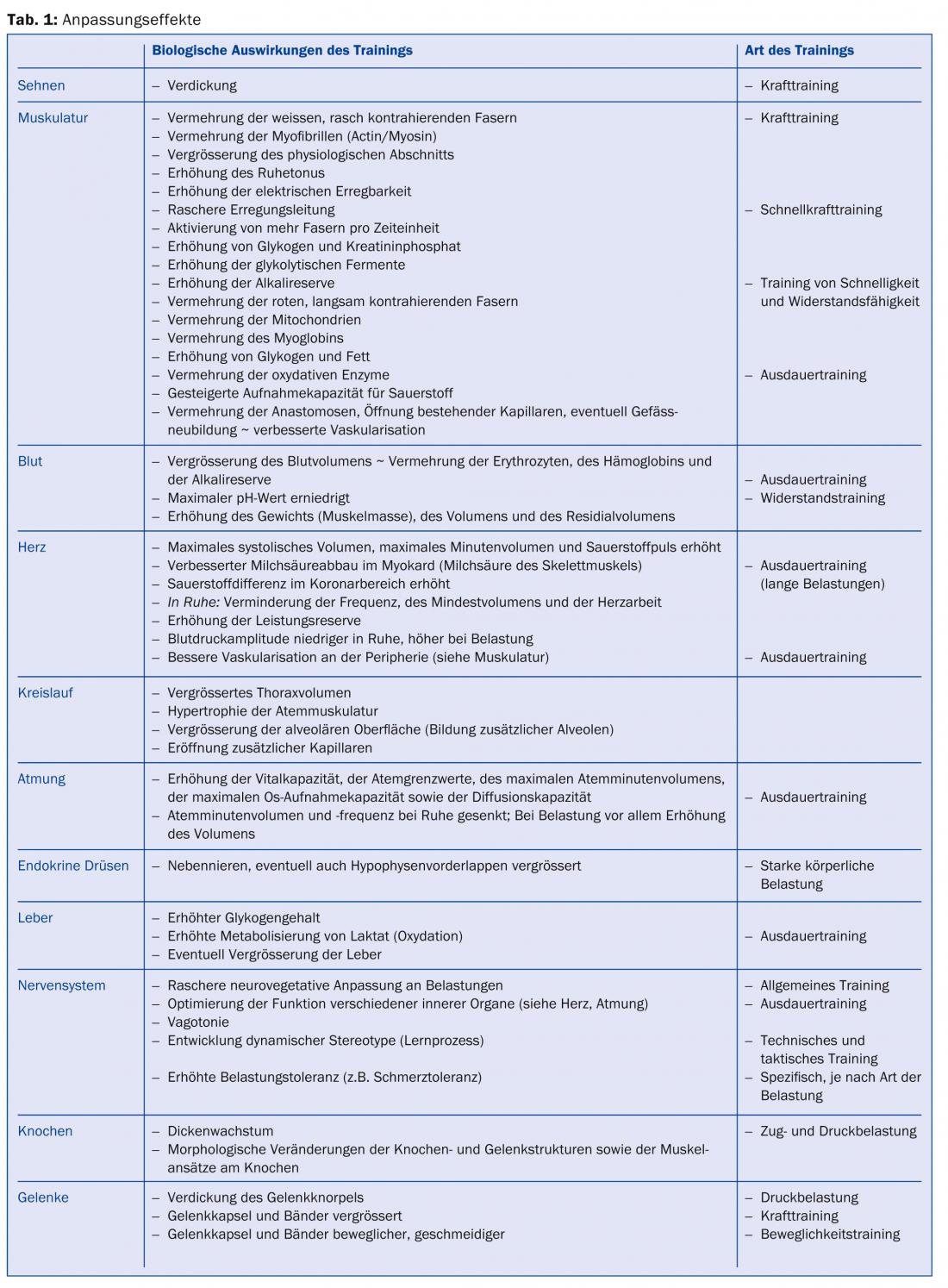
Table 1 provides a non-exhaustive overview of the physical adaptation effects that have been observed to date in the wake of targeted training. It also shows that, in addition to visible and measurable adaptive responses, other functions that are important for athletic performance and health can be improved through targeted training. A generally trained organism copes more easily with stress and can adapt more effectively to increased physical demands, ensuring increased performance and better athletic results. With the same load, the organism recovers more quickly and the load-related fatigue symptoms are lower.
                                         

Set load incentives

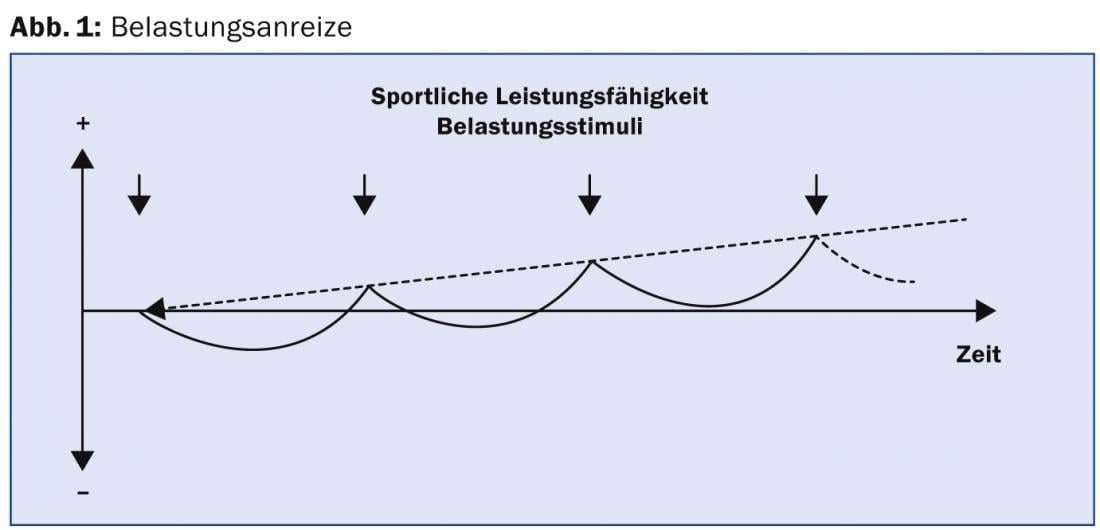
Thus, to increase physical performance, precise load stimuli are required that induce the desired adaptation processes in the stressed systems. These stimuli are characterized by their intensity (strength of the stimulus), density (temporal relationship between stimulus exposure and recovery phase), duration, amplitude (duration and number of stimuli per training session), and training frequency (number of training sessions per day or per week). Not only the quantitative aspect is crucial for the training effect, but also the qualitative aspect of the training performance. The same attention should be paid to the recovery phases, as there is a temporary decrease in physical performance following exercise, which is caused, among other things, by a depletion of energy reserves. In the course of the recovery phase, however, there is a renewed increase in performance that exceeds the original performance level as a result of overcompensation (Fig. 1) . Optimal timing of the training stimuli achieves the goal of increasing performance.
Thus, physical activity practiced regularly and according to conscious principles leads to significant functional improvement of various organic systems. Conversely, it is now proven that the lack of such activity due to modern lifestyle can cause a whole range of unfavorable symptoms. The widespread lack of movement is a kind of time bomb that must be defused at all costs!

HAUSARZT PRAXIS 2014; 9(3): 8-9
Autoren
  • Dr. med. Peter Jenoure
Publikation
  • HAUSARZT PRAXIS
Related Topics
  • aerobic
  • anaerobic
  • Biological adaptation
  • Condition
  • Coordination
  • Mobility
  • Organism
  • Performance improvement
  • power
  • Skin
  • Speed
  • Sports
  • UV
Previous Article
  • Hypogonadism

How can long-lasting testosterone substitution be achieved?

  • Endocrinology and Diabetology
  • News
  • Pediatrics
  • RX
View Post
Next Article
  • Infectiology

When are the antiviral drugs used?

  • Allergology and clinical immunology
  • Infectiology
  • Interviews
  • RX
View Post
You May Also Like
View Post
  • 11 min
  • New evidence on descensus, urinary incontinence and the future of reconstruction

Urogynecology and pelvic floor surgery 2026

    • Education
    • General Internal Medicine
    • Gynecology
    • Physical medicine and rehabilitation
    • RX
    • Studies
    • Surgery
    • Urology
View Post
  • 8 min
  • Proteins in wound healing

Do special amino acids lead to success?

    • CME continuing education
    • Dermatology and venereology
    • Endocrinology and Diabetology
    • Nutrition
    • RX
    • Studies
View Post
  • 5 min
  • Case study

Autosomal recessive polycystic kidney disease: atypical phenotype

    • Cases
    • Education
    • Gastroenterology and Hepatology
    • Genetics
    • Nephrology
    • RX
View Post
  • 12 min
  • Current evidence, risk classes and new counseling options

Hormonal contraception and cardiovascular risk

    • Cardiology
    • Education
    • Gynecology
    • Neurology
    • Pharmacology and toxicology
    • RX
    • Studies
View Post
  • 4 min
  • Acute otitis media: self-limiting course vs. "red flags"

In which cases are antibiotics necessary?

    • Congress Reports
    • General Internal Medicine
    • Infectiology
    • ORL
    • Pediatrics
    • RX
View Post
  • 6 min
  • Prurigo nodularis: evidence-based treatment

Targeted therapy options on the rise

    • Allergology and clinical immunology
    • Dermatology and venereology
    • Education
    • Pharmacology and toxicology
    • RX
    • Studies
View Post
  • 13 min
  • MACE risk, heart failure incidence and all-cause mortality

Metabolic syndrome as a cardiovascular risk factor

    • Cardiology
    • Education
    • Endocrinology and Diabetology
    • General Internal Medicine
    • RX
    • Studies
View Post
  • 9 min
  • Glaucoma in old age: slowing down progression

IOP lowering is currently the only evidence-based treatment

    • Education
    • General Internal Medicine
    • Ophthalmology
    • Prevention and health care
    • RX
    • Studies
  • IBD matters

    Zum Thema
Top CME content
  • 1
    Do special amino acids lead to success?
  • 2
    Current status of PAT
  • 3
    Surgical wound complications
  • 4
    Do special amino acids lead to success?
  • 5
    Functional limb preservation between infection control, vascular medicine and resurfacing

Newsletter

Sign up and stay up to date

Subscribe
Medizinonline Medizinonline
  • Contact
  • General terms and conditions
  • Imprint

Input your search keywords and press Enter.