Medizinonline Medizinonline
  • News
    • News
    • Market & Medicine
  • Patients
    • Disease patterns
    • Diagnostics
    • Therapy
  • Partner Content
    • Diabetes
      • Dia-Month Club – Type 2 Diabetes
      • Diabetes in Motion
      • Diabetes Podcasts
    • Gastroenterology
      • IBD matters
    • Oncology
      • Swiss Oncology in motion
    • Orthopedics
      • Osteoporosis in motion
  • Departments
    • Allergology and clinical immunology
    • General Internal Medicine
    • Anesthesiology
    • Angiology
    • Surgery
    • Dermatology and venereology
    • Endocrinology and Diabetology
    • Nutrition
    • Gastroenterology and Hepatology
    • Genetics
    • Geriatrics
    • Gynecology
    • Hematology
    • Infectiology
    • Cardiology
    • Nephrology
    • Neurology
    • Emergency and intensive care medicine
    • Nuclear Medicine
    • Oncology
    • Ophthalmology
    • ORL
    • Orthopedics
    • Pediatrics
    • Pharmacology and toxicology
    • Pharmaceutical medicine
    • Phlebology
    • Physical medicine and rehabilitation
    • Pneumology
    • Prevention and health care
    • Psychiatry and psychotherapy
    • Radiology
    • Forensic Medicine
    • Rheumatology
    • Sports Medicine
    • Traumatology and trauma surgery
    • Tropical and travel medicine
    • Urology
    • Dentistry
  • CME & Congresses
    • CME continuing education
    • Congress Reports
    • Congress calendar
  • Practice
    • Noctimed
    • Practice Management
    • Jobs
    • Interviews
  • Log In
  • Register
  • My account
  • Contact
  • Publications
  • Contact
  • Deutsch
  • English
  • Français
  • Italiano
  • Português
  • Español
Subscribe
Medizinonline Medizinonline
  • News
    • News
    • Market & Medicine
  • Patienten
    • Krankheitsbilder
    • Diagnostik
    • Therapie
  • Partner Content
    • Diabetes
      • Dia-Month Club – Type 2 Diabetes
      • Diabetes in Motion
      • Diabetes Podcasts
    • Gastroenterology
      • IBD matters
    • Oncology
      • Swiss Oncology in motion
    • Orthopedics
      • Osteoporosis in motion
    • Phytotherapie
    • Rheumatology
  • Departments
    • Fachbereiche 1-13
      • Allergology and clinical immunology
      • General Internal Medicine
      • Anesthesiology
      • Angiology
      • Surgery
      • Dermatology and venereology
      • Endocrinology and Diabetology
      • Nutrition
      • Gastroenterology and Hepatology
      • Genetics
      • Geriatrics
      • Gynecology
      • Hematology
    • Fachbereiche 14-26
      • Infectiology
      • Cardiology
      • Nephrology
      • Neurology
      • Emergency and intensive care medicine
      • Nuclear Medicine
      • Oncology
      • Ophthalmology
      • ORL
      • Orthopedics
      • Pediatrics
      • Pharmacology and toxicology
      • Pharmaceutical medicine
    • Fachbereiche 26-38
      • Phlebology
      • Physical medicine and rehabilitation
      • Phytotherapy
      • Pneumology
      • Prevention and health care
      • Psychiatry and psychotherapy
      • Radiology
      • Forensic Medicine
      • Rheumatology
      • Sports Medicine
      • Traumatology and trauma surgery
      • Tropical and travel medicine
      • Urology
      • Dentistry
  • CME & Congresses
    • CME continuing education
    • Congress Reports
    • Congress calendar
  • Practice
    • Noctimed
    • Practice Management
    • Jobs
    • Interviews
Login

Sie haben noch keinen Account? Registrieren

  • Journal Club

CED-associated intestinal microbes identified

    • Education
    • Gastroenterology and Hepatology
    • General Internal Medicine
    • RX
  • 3 minute read

Millions of people worldwide suffer from inflammatory bowel disease (IBD) and the prevalence is increasing. To find out more about the role of the microbiome, researchers at Massachusetts General Hospital analyzed data from the gut microbiota of IBD patients and healthy controls. They found that certain strains of gut bacteria are associated with IBD. The results were published in the journal Cell Host & Microbe.

Crohn’s disease (Crohn’s disease) and ulcerative colitis (ulcerative colitis), the two subtypes of IBD, are different on a clinical and molecular level, but both share compelling evidence of a microbiome-based etiology [1,2]. “Inflammation puts tremendous selective pressure on gut bacteria, so we hypothesized that the gut microbiome may contain unique bacterial strains that are associated with inflammatory disease processes in terms of abundance and genetic adaptation,” explained first author Dr. Adarsh Kumbhari, a Research Fellow in Medicine at Massachusetts General Hospital [3]. “To test this hypothesis, we are using evolutionary approaches that can detect bacterial strains in the context of IBD, i.e. Crohn’s disease and ulcerative colitis.” Specifically, this involves the fecal metagenome, which enables large-scale analyses to map bacterial strains that underlie inflammatory processes [1]. Dr. Kumbhari explained that the identification of these bacterial strains can help to uncover which molecular strategies bacteria use to survive during inflammatory processes and to find out more about new microbiome-host interactions that are relevant to disease risk [3].

Multi-stage analysis of stool samples

Based on data sets from 11 studies conducted between 2009 and 2021, the research team extracted stool sample data from 822 IBD patients and 1257 healthy controls, focusing on the genotypes of the bacterial strains [1,3]. They found that hundreds of bacterial strains were more prevalent in stool samples from IBD patients than in healthy controls and that these strains showed long-term evolutionary relationships with the disease. Genomic analysis of these strains revealed key differences in disease-related metabolic pathways, including oxidative stress, biosynthesis of essential nutrients, motility and the bacterial cell wall [1].

In a next step, they analyzed the stool samples of individual IBD patients over time and found that the IBD-associated bacterial strains predominated during periods of high inflammation compared to healthy controls, implying that genetic innovations had given them a survival advantage in the context of IBD [3]. Genetic differences between IBD-associated and health-associated bacterial strains were mapped in relation to known aspects of inflammation – including oxidative stress, nutrient synthesis and immune system invasion.

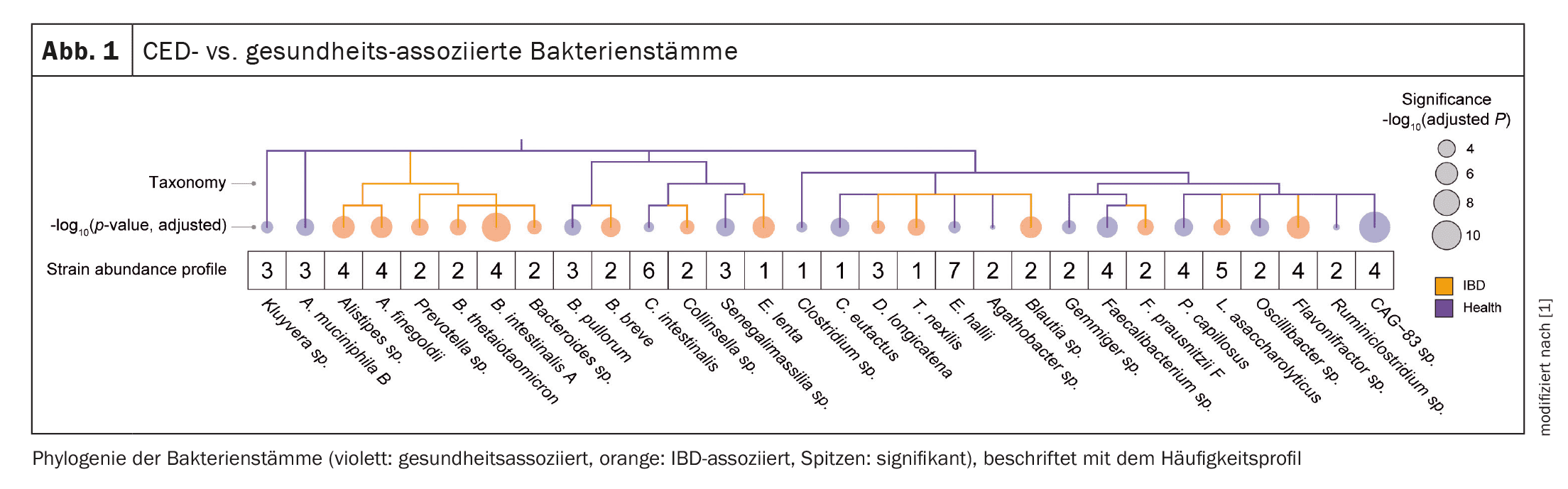
Figure 1 shows an overview of some CED- vs. health-associated bacterial strains that the researchers identified based on prior cluster analysis across different stool samples.
Correlation with fecal calprotectin

Disease-associated strains were also found in healthy individuals, but did not reflect the dominant strain. These could provide colonization resistance, with IBD-associated strains of commensals occupying inflammatory niches to prevent opportunistic colonization by other bacterial invaders [1]. “We also found that the loss of health-associated bacterial strains predicted higher fecal concentrations of calprotectin – a marker of inflammation,” said Dr. Christopher S. Smillie, a senior researcher at the Center for Computational and Integrative Biology at Massachusetts General [3]. “Our findings may have diagnostic utility and the potential to contribute to the development of targeted interventions for IBD and other immune-mediated diseases,” the expert explained [1].

Literature:

  1. Kumbhari A, et al.: Discovery of disease-adapted bacterial lineages in inflammatory bowel diseases. Cell Host & Microbe 2024; Volume 32: 1147–1162.
  2. Schirmer M, et al.: Microbial genes and pathways in inflammatory bowel disease. Nat Rev Microbiol 2019; 17: 497–511.
  3. «Research Identifies Gut Bacterial Strains Linked To Inflammatory Bowel Disease», Massachusetts General Hospital, 24.06.2024.

HAUSARZT PRAXIS 2024; 19(11): 30

Autoren
  • Mirjam Peter, M.Sc.
Publikation
  • HAUSARZT PRAXIS
Related Topics
  • Bacterial strains
  • Crohn's disease
  • Ulcerative colitis
Previous Article
  • Psycho-cardiology

The complex interaction of cardiovascular diseases and mental disorders

  • Cardiology
  • Education
  • Psychiatry and psychotherapy
  • RX
  • Studies
View Post
Next Article
  • Updated guidelines for hypertension

Elevated blood pressure as a new category

  • RX
  • Cardiology
  • Congress Reports
  • General Internal Medicine
  • Studies
View Post
You May Also Like
View Post
  • 6 min
  • Secondary prevention after ACS: individually optimized lipid management

Trend towards early combination therapy and new strategies for lowering Lp(a)

    • RX
    • Cardiology
    • Congress Reports
    • General Internal Medicine
    • Studies
View Post
  • 27 min
  • Pediatric Brain Tumors

Psychiatry versus Neuro-Oncology: Diagnostic Pitfalls

    • RX
    • CME continuing education
    • Neurology
    • Oncology
    • Pediatrics
    • Psychiatry and psychotherapy
    • Studies
View Post
  • 13 min
  • What the latest studies on the entire EF spectrum mean for clinical practice

Heart Failure – The 2026 Evidence Update

    • RX
    • Cardiology
    • Education
    • Endocrinology and Diabetology
    • Studies
View Post
  • 5 min
  • Acute ischemic stroke

Alteplase and Tenecteplase Are on the Same Level

    • RX
    • Education
    • Emergency and intensive care medicine
    • Neurology
    • Pharmacology and toxicology
    • Studies
View Post
  • 5 min
  • CKD in People with Type 2 Diabetes: Evidence-Based, Optimized Treatment

SGLT-2 inhibitors and GLP-1 receptor agonists: significant improvement in renal outcomes

    • RX
    • Education
    • Endocrinology and Diabetology
    • General Internal Medicine
    • Nephrology
    • Studies
View Post
  • 2 min
  • Wearables: screening via smartwatch?

New study on atrial fibrillation in high-risk patients

    • RX
    • Cardiology
    • Practice Management
    • Prevention and health care
    • Studies
View Post
  • 11 min
  • Peristomal skin health

Focus on preventive care options

    • RX
    • Cases
    • CME continuing education
    • Dermatology and venereology
    • Gastroenterology and Hepatology
    • Infectiology
    • Physical medicine and rehabilitation
    • Prevention and health care
    • Surgery
View Post
  • 13 min
  • Planning a Family, Pregnancy, and Breastfeeding

Update on Anti-Rheumatic Medications

    • RX
    • CME continuing education
    • General Internal Medicine
    • Gynecology
    • Pharmacology and toxicology
    • Rheumatology
    • Studies
Landingpage Fachinfo Landingpage Button
  • IBD matters

    Zum Thema
Top CME content
  • 1
    Update on Anti-Rheumatic Medications
  • 2
    Psychiatry versus Neuro-Oncology: Diagnostic Pitfalls
  • 3
    Focus on preventive care options
  • 4
    Inflammation as a Treatment Goal in Its Own Right
  • 5
    Personalized Treatment Before a Planned Pregnancy

Newsletter

Sign up and stay up to date

Subscribe
Medizinonline Medizinonline
  • Contact
  • General terms and conditions
  • Imprint

Input your search keywords and press Enter.